

Presented by
SUMIT SINGH
Semester III (MBA – M52)
MONIRBA, University of Allahabad
 Print Media
 Broadcast Media
 DigitalAdvertising
 Outdoor Advertising
 Speciality Media
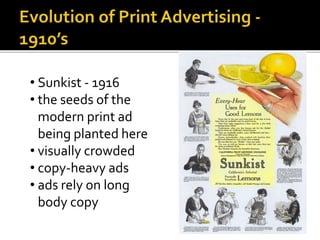
• Sunkist - 1916
• the seeds of the
modern print ad
being planted here
• visually crowded
• copy-heavy ads
• ads rely on long
body copy
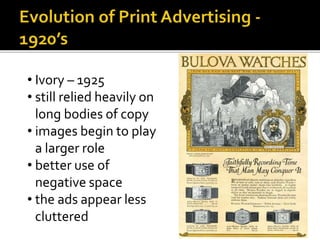
• Ivory – 1925
• still relied heavily on
long bodies of copy
• images begin to play
a larger role
• better use of
negative space
• the ads appear less
cluttered
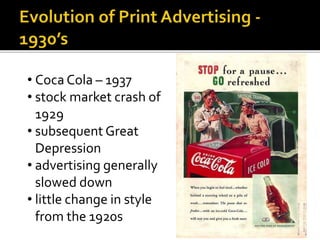
• Coca Cola – 1937
• stock market crash of
1929
• subsequent Great
Depression
• advertising generally
slowed down
• little change in style
from the 1920s
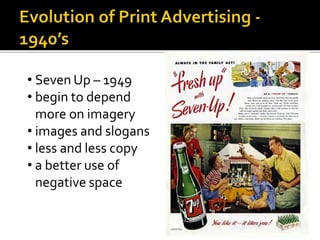
• Seven Up – 1949
• begin to depend
more on imagery
• images and slogans
• less and less copy
• a better use of
negative space
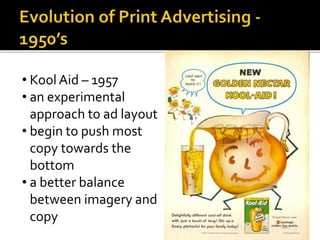
• Kool Aid – 1957
• an experimental
approach to ad layout
• begin to push most
copy towards the
bottom
• a better balance
between imagery and
copy
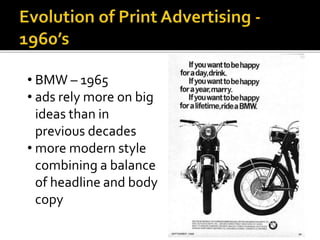
• BMW – 1965
• ads rely more on big
ideas than in
previous decades
• more modern style
combining a balance
of headline and body
copy
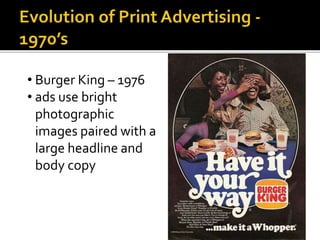
• Burger King – 1976
• ads use bright
photographic
images paired with a
large headline and
body copy
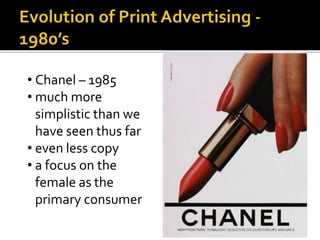
• Chanel – 1985
• much more
simplistic than we
have seen thus far
• even less copy
• a focus on the
female as the
primary consumer
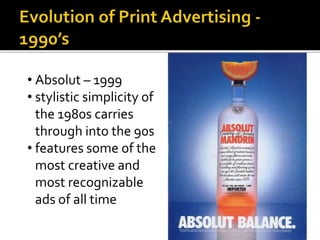
• Absolut – 1999
• stylistic simplicity of
the 1980s carries
through into the 90s
• features some of the
most creative and
most recognizable
ads of all time
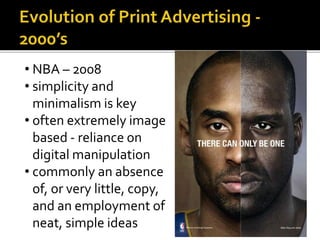
• NBA – 2008
• simplicity and
minimalism is key
• often extremely image
based - reliance on
digital manipulation
• commonly an absence
of, or very little, copy,
and an employment of
neat, simple ideas
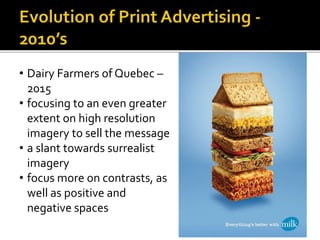
• Dairy Farmers of Quebec –
2015
• focusing to an even greater
extent on high resolution
imagery to sell the message
• a slant towards surrealist
imagery
• focus more on contrasts, as
well as positive and
negative spaces
 Print media advertising is a form of
advertising that uses physically printed
media, such as magazines and newspapers,
to reach consumers, business customers and
prospects.
 They are among the oldest and most
effective types of advertising.
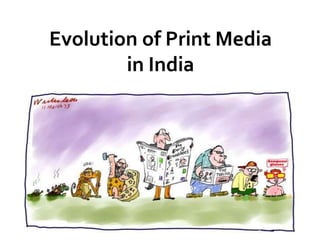
Evolution of Print Media
in India
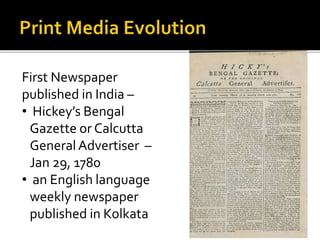
First Newspaper
published in India –
• Hickey’s Bengal
Gazette or Calcutta
GeneralAdvertiser –
Jan 29, 1780
• an English language
weekly newspaper
published in Kolkata
 consisted of two sheets only
 specialised in the exposure of the stories
regarding the private lives of the servants of
the East India Company
 could not survive more than two years due to
sharp confrontation with Governor General
Warren Hastings and Chief Justice Elijah
Impey.
 Indian Gazette as a rival to Bengal Gazette,
published in the same year (1780) by Peter
Read, a salt agent (backing by Hastings)
 Other publications followed were - Madras
Courier weekly (1785), Bombay Herald weekly
(1789) merged into Bombay Gazette in 1791,
Hurukaru weekly (1793), Calcutta Chronicle
(1818), and so on
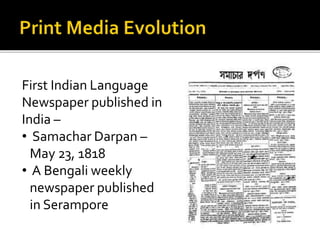
First Indian Language
Newspaper published in
India –
• Samachar Darpan –
May 23, 1818
• A Bengali weekly
newspaper published
in Serampore
• By 1836, the circulation crossed 400 mark
• Successful as a newspaper
• Failed to achieve primary objective of
spreading Christianity
• Discontinued in 1841
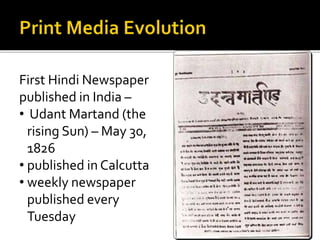
First Hindi Newspaper
published in India –
• Udant Martand (the
rising Sun) – May 30,
1826
• published in Calcutta
• weekly newspaper
published every
Tuesday
 Published by Pt. Jugal Kishore Shukla
 The first issue printed 500 copies
 Closed on December 4, 1827 due to financial
difficulties
 “Hindi Journalism Day” or “Hindi Patrakarita
Diwas” is celebrated on 30 May each year, as
it marked the "beginning
to journalism in Hindi language"
 More than 70,000 newspapers
 Over 140 million copies are sold
 Currently published over 1000 Hindi dailies with
total circulation of 80 million copies
 About 250 dailies are of English language with
over 40 million copies
 The circulation of India’s print publications grew
at the compound annual growth rate or CAGR of
4.87% between the end of 2006 and the end of
2016, the Audit Bureau of Circulation (ABC)
Growth at a glance
 1950:
 Total Daily Newspapers 214
 1993:
 Total Daily Newspapers 3,805
 Total Number of newspapers published in the country
35,595
 2015:
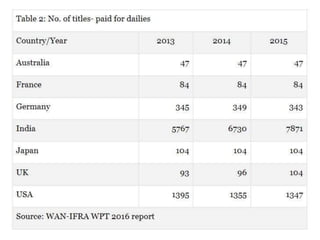
 Total Daily Newspapers 7,871
 Total Number of newspapers published in the country
70,000+
 The prominent Hindi newspapers - Dainik
Jagran, Dainik Bhaskar, Amar Ujala, Navbharat
Times, Hindustan Dainik, Rajasthan Patrika, and Nai
Dunia.
 The prominent English newspapers are TheTimes of
India,The HindustanTimes, andThe Hindu.
 The main regional newspapers – Lokmat (Marathi),
Gujarat Samachar (Gujarati), Malayala Manorama
(Malayalam), DailyThanthi (Tamil), Eenadu (Telugu),
Vijaya Karnataka (Kannada) and Anandabazar
Patrika (Bengali).
 The prominent Hindi magazines - Pratiyogita
Darpan, IndiaToday, Saras Salil, Samanya Gyan
Darpan, Grihshobha, and JagranJosh Plus.
 The prominent English magazines - IndiaToday
Pratiyogita Darpan, General KnowledgeToday,The
Sportstar, Competition Success Review, and Outlook.
 The main regional magazines –
Vanitha (Malayalam), Mathrubhumi Arogya
Masika (Malayalam), ManoramaThozhilveedhi
(Malayalam), Kumudam (Tamil), and
Karmasangsthaan (Bengali).
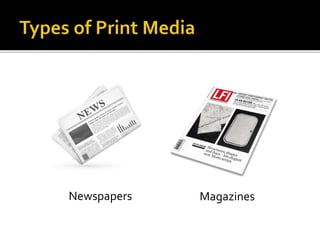
Newspapers Magazines
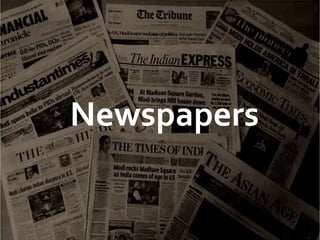
Newspapers
 Preferred media for local advertising of
retailers
 Also a media for business advertising,
corporate advertising, financial advertising,
legal notice and social advertising
Local market circulation and readership make
newspapers an attractive medium.
 Newspapers are ideal for a “key market” media
strategy.
 Newspapers are attractive to national
advertisers, and national and local retailers.
 Newspapers offer “merchandising”
opportunities.
 Local, Regional, or National
 Daily, Evening, orWeekly
 Display Ads
 Local (Mostly Retail)
 National or General
 Classified Ads
 Small items arranged by topics
 Rates based on size, duration
 Public Notices
 Legal Notices – Public reports
 Notices by People, Organizations
 Political Ads
 Printed Inserts
 Prepared separately by advertisers
 Circulation and readership
 Newspaper ad rate
 Placing the ad in the newspapers
 Having a very short life
 Limited coverage
 Advertisement may go unnoticed
 Suffers from literacy barrier
 Lack of art work
 Lack of drama & emotion
 Demonstration of product features not effective
 Overtaken byTV in speed
 Average time devoted to news paper reading is
very low
 It is flexible & timely
 High choice of market
 Repetitive value
 Prompt response
 Message received at home in a relaxed
atmosphere
 Trusted
 Regular attention
 Detailed coverage
 Written words has more credibility
 Reader loyalty
Magazines & Journals
Magazines are excellent at targeting precisely
defined audiences.
 Magazines are a “class” medium instead of a
“mass” medium.
 The clustering of ads has a negative influence
on message impact.
 Magazines are ideal for “profile matching”
media strategies.
 Published weekly (IndiaToday), fortnightly
(Champak), bi-weekly, monthly, tri-monthly
(Grihshobha,Vanitha) or even annually
 Generally read at leisure and with attention
 Effective shelf life general magazines
specialized magazines special issues
 Local, Regional, or National
 Weekly, Monthly, or Quarterly
 Consumer or Business
 Meant for a special group of readers
 Have got a long shelf life
 Better presentation and display
 Good number of subscribers
 Having a high cost
 Lack of flexibility
 Limited circulation
 Limited coverage
Print Advertising Media

Print Advertising Media

  • 1.
    Presented by SUMIT SINGH SemesterIII (MBA – M52) MONIRBA, University of Allahabad
  • 2.
     Print Media Broadcast Media  DigitalAdvertising  Outdoor Advertising  Speciality Media
  • 3.
    • Sunkist -1916 • the seeds of the modern print ad being planted here • visually crowded • copy-heavy ads • ads rely on long body copy
  • 4.
    • Ivory –1925 • still relied heavily on long bodies of copy • images begin to play a larger role • better use of negative space • the ads appear less cluttered
  • 5.
    • Coca Cola– 1937 • stock market crash of 1929 • subsequent Great Depression • advertising generally slowed down • little change in style from the 1920s
  • 6.
    • Seven Up– 1949 • begin to depend more on imagery • images and slogans • less and less copy • a better use of negative space
  • 7.
    • Kool Aid– 1957 • an experimental approach to ad layout • begin to push most copy towards the bottom • a better balance between imagery and copy
  • 8.
    • BMW –1965 • ads rely more on big ideas than in previous decades • more modern style combining a balance of headline and body copy
  • 9.
    • Burger King– 1976 • ads use bright photographic images paired with a large headline and body copy
  • 10.
    • Chanel –1985 • much more simplistic than we have seen thus far • even less copy • a focus on the female as the primary consumer
  • 11.
    • Absolut –1999 • stylistic simplicity of the 1980s carries through into the 90s • features some of the most creative and most recognizable ads of all time
  • 12.
    • NBA –2008 • simplicity and minimalism is key • often extremely image based - reliance on digital manipulation • commonly an absence of, or very little, copy, and an employment of neat, simple ideas
  • 13.
    • Dairy Farmersof Quebec – 2015 • focusing to an even greater extent on high resolution imagery to sell the message • a slant towards surrealist imagery • focus more on contrasts, as well as positive and negative spaces
  • 14.
     Print mediaadvertising is a form of advertising that uses physically printed media, such as magazines and newspapers, to reach consumers, business customers and prospects.  They are among the oldest and most effective types of advertising.
  • 15.
    Evolution of PrintMedia in India
  • 16.
    First Newspaper published inIndia – • Hickey’s Bengal Gazette or Calcutta GeneralAdvertiser – Jan 29, 1780 • an English language weekly newspaper published in Kolkata
  • 17.
     consisted oftwo sheets only  specialised in the exposure of the stories regarding the private lives of the servants of the East India Company  could not survive more than two years due to sharp confrontation with Governor General Warren Hastings and Chief Justice Elijah Impey.
  • 18.
     Indian Gazetteas a rival to Bengal Gazette, published in the same year (1780) by Peter Read, a salt agent (backing by Hastings)  Other publications followed were - Madras Courier weekly (1785), Bombay Herald weekly (1789) merged into Bombay Gazette in 1791, Hurukaru weekly (1793), Calcutta Chronicle (1818), and so on
  • 19.
    First Indian Language Newspaperpublished in India – • Samachar Darpan – May 23, 1818 • A Bengali weekly newspaper published in Serampore
  • 20.
    • By 1836,the circulation crossed 400 mark • Successful as a newspaper • Failed to achieve primary objective of spreading Christianity • Discontinued in 1841
  • 21.
    First Hindi Newspaper publishedin India – • Udant Martand (the rising Sun) – May 30, 1826 • published in Calcutta • weekly newspaper published every Tuesday
  • 22.
     Published byPt. Jugal Kishore Shukla  The first issue printed 500 copies  Closed on December 4, 1827 due to financial difficulties  “Hindi Journalism Day” or “Hindi Patrakarita Diwas” is celebrated on 30 May each year, as it marked the "beginning to journalism in Hindi language"
  • 23.
     More than70,000 newspapers  Over 140 million copies are sold  Currently published over 1000 Hindi dailies with total circulation of 80 million copies  About 250 dailies are of English language with over 40 million copies  The circulation of India’s print publications grew at the compound annual growth rate or CAGR of 4.87% between the end of 2006 and the end of 2016, the Audit Bureau of Circulation (ABC)
  • 24.
    Growth at aglance  1950:  Total Daily Newspapers 214  1993:  Total Daily Newspapers 3,805  Total Number of newspapers published in the country 35,595  2015:  Total Daily Newspapers 7,871  Total Number of newspapers published in the country 70,000+
  • 26.
     The prominentHindi newspapers - Dainik Jagran, Dainik Bhaskar, Amar Ujala, Navbharat Times, Hindustan Dainik, Rajasthan Patrika, and Nai Dunia.  The prominent English newspapers are TheTimes of India,The HindustanTimes, andThe Hindu.  The main regional newspapers – Lokmat (Marathi), Gujarat Samachar (Gujarati), Malayala Manorama (Malayalam), DailyThanthi (Tamil), Eenadu (Telugu), Vijaya Karnataka (Kannada) and Anandabazar Patrika (Bengali).
  • 27.
     The prominentHindi magazines - Pratiyogita Darpan, IndiaToday, Saras Salil, Samanya Gyan Darpan, Grihshobha, and JagranJosh Plus.  The prominent English magazines - IndiaToday Pratiyogita Darpan, General KnowledgeToday,The Sportstar, Competition Success Review, and Outlook.  The main regional magazines – Vanitha (Malayalam), Mathrubhumi Arogya Masika (Malayalam), ManoramaThozhilveedhi (Malayalam), Kumudam (Tamil), and Karmasangsthaan (Bengali).
  • 28.
  • 29.
  • 30.
     Preferred mediafor local advertising of retailers  Also a media for business advertising, corporate advertising, financial advertising, legal notice and social advertising
  • 31.
    Local market circulationand readership make newspapers an attractive medium.  Newspapers are ideal for a “key market” media strategy.  Newspapers are attractive to national advertisers, and national and local retailers.  Newspapers offer “merchandising” opportunities.
  • 32.
     Local, Regional,or National  Daily, Evening, orWeekly
  • 33.
     Display Ads Local (Mostly Retail)  National or General  Classified Ads  Small items arranged by topics  Rates based on size, duration  Public Notices  Legal Notices – Public reports  Notices by People, Organizations  Political Ads  Printed Inserts  Prepared separately by advertisers
  • 34.
     Circulation andreadership  Newspaper ad rate  Placing the ad in the newspapers
  • 35.
     Having avery short life  Limited coverage  Advertisement may go unnoticed  Suffers from literacy barrier  Lack of art work  Lack of drama & emotion  Demonstration of product features not effective  Overtaken byTV in speed  Average time devoted to news paper reading is very low
  • 36.
     It isflexible & timely  High choice of market  Repetitive value  Prompt response  Message received at home in a relaxed atmosphere  Trusted  Regular attention  Detailed coverage  Written words has more credibility  Reader loyalty
  • 37.
  • 38.
    Magazines are excellentat targeting precisely defined audiences.  Magazines are a “class” medium instead of a “mass” medium.  The clustering of ads has a negative influence on message impact.  Magazines are ideal for “profile matching” media strategies.
  • 39.
     Published weekly(IndiaToday), fortnightly (Champak), bi-weekly, monthly, tri-monthly (Grihshobha,Vanitha) or even annually  Generally read at leisure and with attention  Effective shelf life general magazines specialized magazines special issues
  • 40.
     Local, Regional,or National  Weekly, Monthly, or Quarterly  Consumer or Business
  • 41.
     Meant fora special group of readers  Have got a long shelf life  Better presentation and display  Good number of subscribers
  • 42.
     Having ahigh cost  Lack of flexibility  Limited circulation  Limited coverage