MANAGEMENT
RICHARD L. DAFT
Managing Diversity
CHAPTER 12
chapter12
Copyright ©2010 by South-Western, a division of Cengage
Learning. All rights reserved.
3
Learning Outcomes
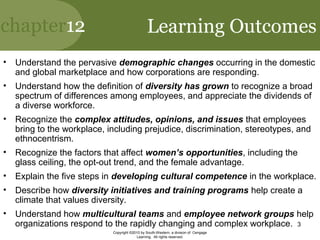
• Understand the pervasive demographic changes occurring in the domestic
and global marketplace and how corporations are responding.
• Understand how the definition of diversity has grown to recognize a broad
spectrum of differences among employees, and appreciate the dividends of
a diverse workforce.
• Recognize the complex attitudes, opinions, and issues that employees
bring to the workplace, including prejudice, discrimination, stereotypes, and
ethnocentrism.
• Recognize the factors that affect women’s opportunities, including the
glass ceiling, the opt-out trend, and the female advantage.
• Explain the five steps in developing cultural competence in the workplace.
• Describe how diversity initiatives and training programs help create a
climate that values diversity.
• Understand how multicultural teams and employee network groups help
organizations respond to the rapidly changing and complex workplace.
chapter12
Copyright ©2010 by South-Western, a division of Cengage
Learning. All rights reserved.
4
Do You Know Your Biases?
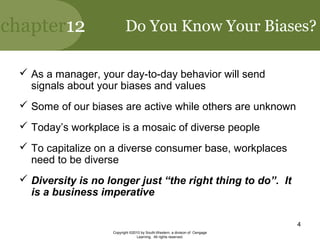
 As a manager, your day-to-day behavior will send
signals about your biases and values
 Some of our biases are active while others are unknown
 Today’s workplace is a mosaic of diverse people
 To capitalize on a diverse consumer base, workplaces
need to be diverse
 Diversity is no longer just “the right thing to do”. It
is a business imperative
chapter12
Copyright ©2010 by South-Western, a division of Cengage
Learning. All rights reserved.
5
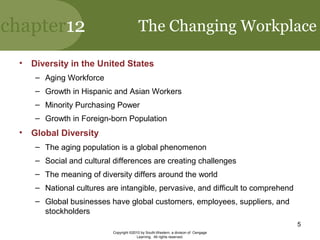
The Changing Workplace
• Diversity in the United States
– Aging Workforce
– Growth in Hispanic and Asian Workers
– Minority Purchasing Power
– Growth in Foreign-born Population
• Global Diversity
– The aging population is a global phenomenon
– Social and cultural differences are creating challenges
– The meaning of diversity differs around the world
– National cultures are intangible, pervasive, and difficult to comprehend
– Global businesses have global customers, employees, suppliers, and
stockholders
chapter12
Copyright ©2010 by South-Western, a division of Cengage
Learning. All rights reserved.
6
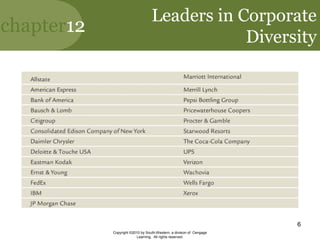
Leaders in Corporate
Diversity
chapter12
Copyright ©2010 by South-Western, a division of Cengage
Learning. All rights reserved.
7
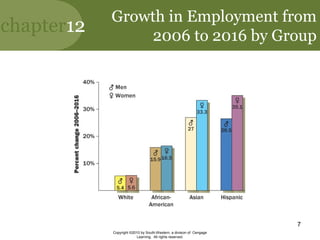
Growth in Employment from
2006 to 2016 by Group
chapter12
Copyright ©2010 by South-Western, a division of Cengage
Learning. All rights reserved.
8
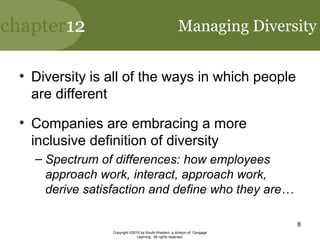
Managing Diversity
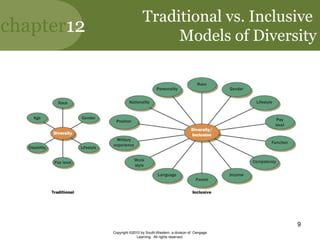
• Diversity is all of the ways in which people
are different
• Companies are embracing a more
inclusive definition of diversity
– Spectrum of differences: how employees
approach work, interact, approach work,
derive satisfaction and define who they are…
chapter12
Copyright ©2010 by South-Western, a division of Cengage
Learning. All rights reserved.
9
Traditional vs. Inclusive
Models of Diversity
chapter12
Copyright ©2010 by South-Western, a division of Cengage
Learning. All rights reserved.
10
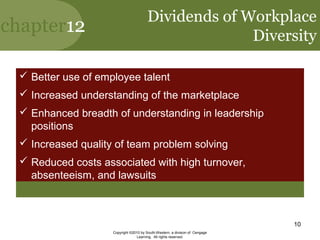
Dividends of Workplace
Diversity
 Better use of employee talent
 Increased understanding of the marketplace
 Enhanced breadth of understanding in leadership
positions
 Increased quality of team problem solving
 Reduced costs associated with high turnover,
absenteeism, and lawsuits
chapter12
Copyright ©2010 by South-Western, a division of Cengage
Learning. All rights reserved.
11
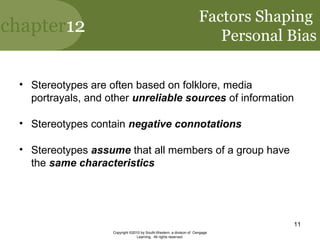
Factors Shaping
Personal Bias
• Stereotypes are often based on folklore, media
portrayals, and other unreliable sources of information
• Stereotypes contain negative connotations
• Stereotypes assume that all members of a group have
the same characteristics
chapter12
Copyright ©2010 by South-Western, a division of Cengage
Learning. All rights reserved.
12
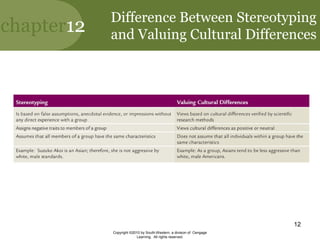
Difference Between Stereotyping
and Valuing Cultural Differences
chapter12
Copyright ©2010 by South-Western, a division of Cengage
Learning. All rights reserved.
13
Federal and State Laws
Regarding Diversity
• Title VII of the Civil Rights Act of 1964
• The Equal Pay Act of 1963
• The American with Disabilities Act
• The Age Discrimination in Employment Act
chapter12
Copyright ©2010 by South-Western, a division of Cengage
Learning. All rights reserved.
14
Ethnocentrism
• The belief that one’s own group or subculture is
inherently superior
• Barrier to embracing diversity
• Ethnocentric views produce a monoculture
– A culture that accepts one way of doing things and
one set of values and beliefs
• The goal of cultural diversity is pluralism
– Organization accommodates several subcultures
chapter12
Copyright ©2010 by South-Western, a division of Cengage
Learning. All rights reserved.
15
Factors Affecting Women’s
Careers
• Glass Ceiling. An invisible barrier that separates
women from top management positions.
• Opt-Out Trend. Many women are deciding to get off the
fast track to top management before hitting the glass
ceiling.
• The Female Advantage. The idea that women are
better managers because of their more collaborative,
less hierarchical relationship-oriented approach.
chapter12
Copyright ©2010 by South-Western, a division of Cengage
Learning. All rights reserved.
16
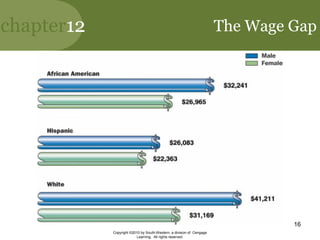
The Wage Gap
chapter12
Copyright ©2010 by South-Western, a division of Cengage
Learning. All rights reserved.
17
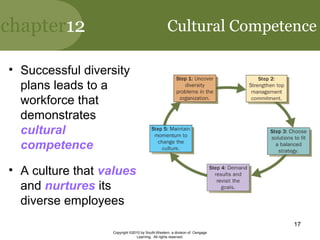
Cultural Competence
• Successful diversity
plans leads to a
workforce that
demonstrates
cultural
competence
• A culture that values
and nurtures its
diverse employees
chapter12
Copyright ©2010 by South-Western, a division of Cengage
Learning. All rights reserved.
18
Diversity Initiatives and
Programs
 Changing Structures and Policies
 Expanding Recruitment Efforts
 Establishing Mentor Relationships
 Accommodating Special Needs
 Providing Diversity Skills Training
chapter12
Copyright ©2010 by South-Western, a division of Cengage
Learning. All rights reserved.
19
Increasing Awareness of
Sexual Harassment
• Sexual harassment creates an
unhealthy and unproductive
work environment
• Sexual Harassment is illegal,
violation of Civil Rights Act
• 150% increase in sexual
harassment filings in US
• Companies are creating
awareness programs
chapter12
Copyright ©2010 by South-Western, a division of Cengage
Learning. All rights reserved.
20
New Diversity Initiatives
• Multicultural Teams
– Teams of diverse national, racial, ethnic, and cultural
backgrounds
– Greater potential for enhanced creativity and innovation
– Strategic in global marketplace
– More difficult to manage
• Employee Network Groups
– Based on social identity: gender, race
– Organized by employees
– Focus on concerns of employee group
– Reduce social isolation through networking, training and
professional development

9e daft chapter_12_managing_diversity

  • 1.
  • 2.
  • 3.
    chapter12 Copyright ©2010 bySouth-Western, a division of Cengage Learning. All rights reserved. 3 Learning Outcomes • Understand the pervasive demographic changes occurring in the domestic and global marketplace and how corporations are responding. • Understand how the definition of diversity has grown to recognize a broad spectrum of differences among employees, and appreciate the dividends of a diverse workforce. • Recognize the complex attitudes, opinions, and issues that employees bring to the workplace, including prejudice, discrimination, stereotypes, and ethnocentrism. • Recognize the factors that affect women’s opportunities, including the glass ceiling, the opt-out trend, and the female advantage. • Explain the five steps in developing cultural competence in the workplace. • Describe how diversity initiatives and training programs help create a climate that values diversity. • Understand how multicultural teams and employee network groups help organizations respond to the rapidly changing and complex workplace.
  • 4.
    chapter12 Copyright ©2010 bySouth-Western, a division of Cengage Learning. All rights reserved. 4 Do You Know Your Biases?  As a manager, your day-to-day behavior will send signals about your biases and values  Some of our biases are active while others are unknown  Today’s workplace is a mosaic of diverse people  To capitalize on a diverse consumer base, workplaces need to be diverse  Diversity is no longer just “the right thing to do”. It is a business imperative
  • 5.
    chapter12 Copyright ©2010 bySouth-Western, a division of Cengage Learning. All rights reserved. 5 The Changing Workplace • Diversity in the United States – Aging Workforce – Growth in Hispanic and Asian Workers – Minority Purchasing Power – Growth in Foreign-born Population • Global Diversity – The aging population is a global phenomenon – Social and cultural differences are creating challenges – The meaning of diversity differs around the world – National cultures are intangible, pervasive, and difficult to comprehend – Global businesses have global customers, employees, suppliers, and stockholders
  • 6.
    chapter12 Copyright ©2010 bySouth-Western, a division of Cengage Learning. All rights reserved. 6 Leaders in Corporate Diversity
  • 7.
    chapter12 Copyright ©2010 bySouth-Western, a division of Cengage Learning. All rights reserved. 7 Growth in Employment from 2006 to 2016 by Group
  • 8.
    chapter12 Copyright ©2010 bySouth-Western, a division of Cengage Learning. All rights reserved. 8 Managing Diversity • Diversity is all of the ways in which people are different • Companies are embracing a more inclusive definition of diversity – Spectrum of differences: how employees approach work, interact, approach work, derive satisfaction and define who they are…
  • 9.
    chapter12 Copyright ©2010 bySouth-Western, a division of Cengage Learning. All rights reserved. 9 Traditional vs. Inclusive Models of Diversity
  • 10.
    chapter12 Copyright ©2010 bySouth-Western, a division of Cengage Learning. All rights reserved. 10 Dividends of Workplace Diversity  Better use of employee talent  Increased understanding of the marketplace  Enhanced breadth of understanding in leadership positions  Increased quality of team problem solving  Reduced costs associated with high turnover, absenteeism, and lawsuits
  • 11.
    chapter12 Copyright ©2010 bySouth-Western, a division of Cengage Learning. All rights reserved. 11 Factors Shaping Personal Bias • Stereotypes are often based on folklore, media portrayals, and other unreliable sources of information • Stereotypes contain negative connotations • Stereotypes assume that all members of a group have the same characteristics
  • 12.
    chapter12 Copyright ©2010 bySouth-Western, a division of Cengage Learning. All rights reserved. 12 Difference Between Stereotyping and Valuing Cultural Differences
  • 13.
    chapter12 Copyright ©2010 bySouth-Western, a division of Cengage Learning. All rights reserved. 13 Federal and State Laws Regarding Diversity • Title VII of the Civil Rights Act of 1964 • The Equal Pay Act of 1963 • The American with Disabilities Act • The Age Discrimination in Employment Act
  • 14.
    chapter12 Copyright ©2010 bySouth-Western, a division of Cengage Learning. All rights reserved. 14 Ethnocentrism • The belief that one’s own group or subculture is inherently superior • Barrier to embracing diversity • Ethnocentric views produce a monoculture – A culture that accepts one way of doing things and one set of values and beliefs • The goal of cultural diversity is pluralism – Organization accommodates several subcultures
  • 15.
    chapter12 Copyright ©2010 bySouth-Western, a division of Cengage Learning. All rights reserved. 15 Factors Affecting Women’s Careers • Glass Ceiling. An invisible barrier that separates women from top management positions. • Opt-Out Trend. Many women are deciding to get off the fast track to top management before hitting the glass ceiling. • The Female Advantage. The idea that women are better managers because of their more collaborative, less hierarchical relationship-oriented approach.
  • 16.
    chapter12 Copyright ©2010 bySouth-Western, a division of Cengage Learning. All rights reserved. 16 The Wage Gap
  • 17.
    chapter12 Copyright ©2010 bySouth-Western, a division of Cengage Learning. All rights reserved. 17 Cultural Competence • Successful diversity plans leads to a workforce that demonstrates cultural competence • A culture that values and nurtures its diverse employees
  • 18.
    chapter12 Copyright ©2010 bySouth-Western, a division of Cengage Learning. All rights reserved. 18 Diversity Initiatives and Programs  Changing Structures and Policies  Expanding Recruitment Efforts  Establishing Mentor Relationships  Accommodating Special Needs  Providing Diversity Skills Training
  • 19.
    chapter12 Copyright ©2010 bySouth-Western, a division of Cengage Learning. All rights reserved. 19 Increasing Awareness of Sexual Harassment • Sexual harassment creates an unhealthy and unproductive work environment • Sexual Harassment is illegal, violation of Civil Rights Act • 150% increase in sexual harassment filings in US • Companies are creating awareness programs
  • 20.
    chapter12 Copyright ©2010 bySouth-Western, a division of Cengage Learning. All rights reserved. 20 New Diversity Initiatives • Multicultural Teams – Teams of diverse national, racial, ethnic, and cultural backgrounds – Greater potential for enhanced creativity and innovation – Strategic in global marketplace – More difficult to manage • Employee Network Groups – Based on social identity: gender, race – Organized by employees – Focus on concerns of employee group – Reduce social isolation through networking, training and professional development