ELEMENT &
PRINCIPLES
OF DESIGN
M O D U L E 2
ELEMENTS OF ART
• These are the building blocks of the
Principles of Design.
• These include:
• Line
• Shape
• Form
• Color
• Value
• Texture
• Space
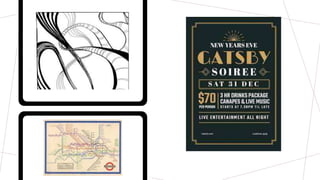
LINE
• The path of a moving point.
• A mark on a surface with
length and direction, created
by a tool (pencil, pen, brush.)
• Lines have the power to
define form, divide space,
create the illusion of depth,
suggest movement or energy
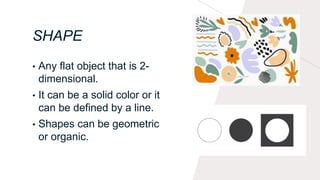
SHAPE
• Any flat object that is 2-
dimensional.
• It can be a solid color or it
can be defined by a line.
• Shapes can be geometric
or organic.
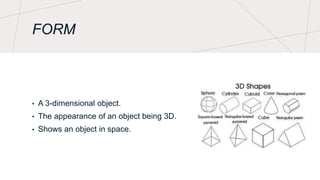
FORM
• A 3-dimensional object.
• The appearance of an object being 3D.
• Shows an object in space.
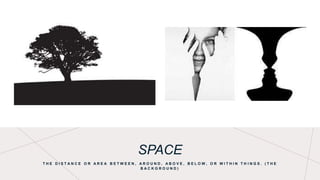
SPACE
T H E D I S T A N C E O R A R E A B E T W E E N , A R O U N D , A B O V E , B E L O W , O R W I T H I N T H I N G S . ( T H E
B A C K G R O U N D )
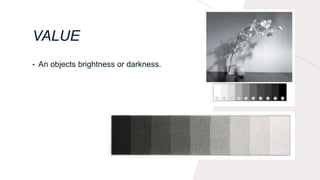
VALUE
• An objects brightness or darkness.
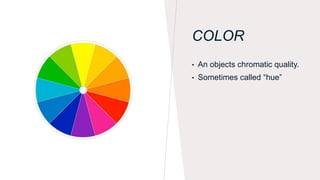
COLOR
• An objects chromatic quality.
• Sometimes called “hue”
TEXTURE
T H E TA C T I L E Q U A L I T Y O F A N O B J E C T, O F T H E A P P E A R A N C E O F.
PRINCIPLES
OF DESIGN
W H AT W E U S E T O O R G A N I Z E T H E
E L E M E N T S O F A R T.
T H E T O O L S T O M A K E A R T.
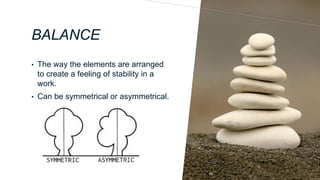
BALANCE
• The way the elements are arranged
to create a feeling of stability in a
work.
• Can be symmetrical or asymmetrical.
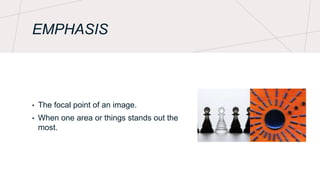
EMPHASIS
• The focal point of an image.
• When one area or things stands out the
most.
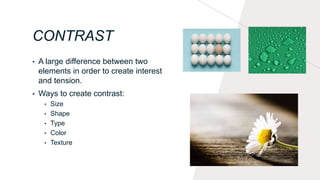
CONTRAST
• A large difference between two
elements in order to create interest
and tension.
• Ways to create contrast:
• Size
• Shape
• Type
• Color
• Texture
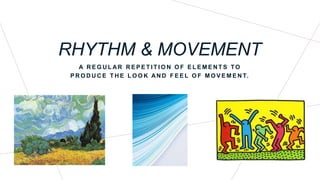
RHYTHM & MOVEMENT
A R E G U L AR R E P E T I T I O N O F E L E M E N T S TO
P R O D U C E T H E L O O K AN D F E E L O F M O V E M E N T.
PATTERN
AND
REPETITION
R E P E T I T I O N O F A
D E S I G N M O T I F.
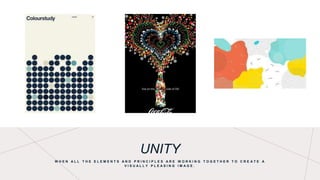
UNITY
W H E N A L L T H E E L E M E N T S A N D P R I N C I P L E S A R E W O R K I N G T O G E T H E R T O C R E A T E A
V I S U A L L Y P L E A S I N G I M A G E .
VARIETY
T H E U S E O F D I F F E R E N T E L E M E N T S
TO I N C R E AS E V I S U AL I N T E R E S T.
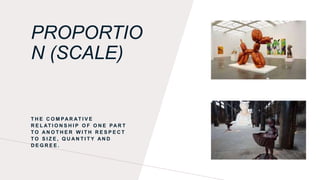
PROPORTIO
N (SCALE)
T H E C O M PA R AT I V E
R E L AT I O N S H I P O F O N E PA R T
T O A N O T H E R W I T H R E S P E C T
T O S I Z E , Q U A N T I T Y A N D
D E G R E E .
Principles & Elements of Design

Principles & Elements of Design

  • 1.
  • 2.
    ELEMENTS OF ART •These are the building blocks of the Principles of Design. • These include: • Line • Shape • Form • Color • Value • Texture • Space
  • 3.
    LINE • The pathof a moving point. • A mark on a surface with length and direction, created by a tool (pencil, pen, brush.) • Lines have the power to define form, divide space, create the illusion of depth, suggest movement or energy
  • 5.
    SHAPE • Any flatobject that is 2- dimensional. • It can be a solid color or it can be defined by a line. • Shapes can be geometric or organic.
  • 6.
    FORM • A 3-dimensionalobject. • The appearance of an object being 3D. • Shows an object in space.
  • 7.
    SPACE T H ED I S T A N C E O R A R E A B E T W E E N , A R O U N D , A B O V E , B E L O W , O R W I T H I N T H I N G S . ( T H E B A C K G R O U N D )
  • 8.
    VALUE • An objectsbrightness or darkness.
  • 9.
    COLOR • An objectschromatic quality. • Sometimes called “hue”
  • 10.
    TEXTURE T H ETA C T I L E Q U A L I T Y O F A N O B J E C T, O F T H E A P P E A R A N C E O F.
  • 11.
    PRINCIPLES OF DESIGN W HAT W E U S E T O O R G A N I Z E T H E E L E M E N T S O F A R T. T H E T O O L S T O M A K E A R T.
  • 12.
    BALANCE • The waythe elements are arranged to create a feeling of stability in a work. • Can be symmetrical or asymmetrical.
  • 13.
    EMPHASIS • The focalpoint of an image. • When one area or things stands out the most.
  • 14.
    CONTRAST • A largedifference between two elements in order to create interest and tension. • Ways to create contrast: • Size • Shape • Type • Color • Texture
  • 15.
    RHYTHM & MOVEMENT AR E G U L AR R E P E T I T I O N O F E L E M E N T S TO P R O D U C E T H E L O O K AN D F E E L O F M O V E M E N T.
  • 16.
    PATTERN AND REPETITION R E PE T I T I O N O F A D E S I G N M O T I F.
  • 17.
    UNITY W H EN A L L T H E E L E M E N T S A N D P R I N C I P L E S A R E W O R K I N G T O G E T H E R T O C R E A T E A V I S U A L L Y P L E A S I N G I M A G E .
  • 18.
    VARIETY T H EU S E O F D I F F E R E N T E L E M E N T S TO I N C R E AS E V I S U AL I N T E R E S T.
  • 19.
    PROPORTIO N (SCALE) T HE C O M PA R AT I V E R E L AT I O N S H I P O F O N E PA R T T O A N O T H E R W I T H R E S P E C T T O S I Z E , Q U A N T I T Y A N D D E G R E E .