ELEMENTS OF ART:
SHAPE
Module 3
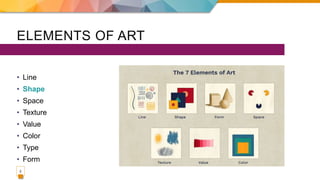
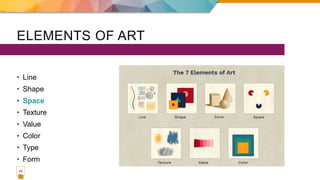
ELEMENTS OF ART
• Line
• Shape
• Space
• Texture
• Value
• Color
• Type
• Form
2
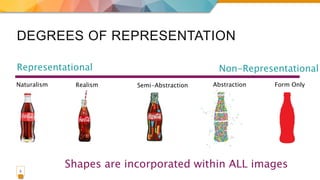
DEGREES OF REPRESENTATION
3
Representational Non-Representational
Naturalism Realism Semi-Abstraction Abstraction Form Only
Shapes are incorporated within ALL images
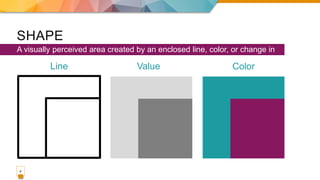
SHAPE
A visually perceived area created by an enclosed line, color, or change in
value.
4
Line Value Color
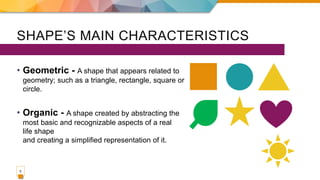
SHAPE’S MAIN CHARACTERISTICS
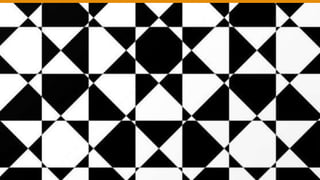
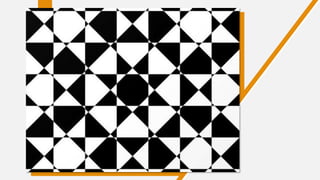
• Geometric - A shape that appears related to
geometry; such as a triangle, rectangle, square or
circle.
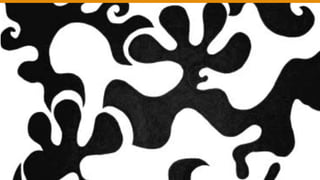
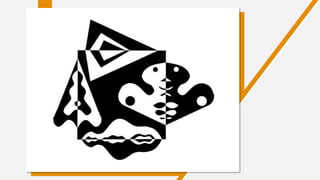
• Organic - A shape created by abstracting the
most basic and recognizable aspects of a real
life shape
and creating a simplified representation of it.
5
6
7
8
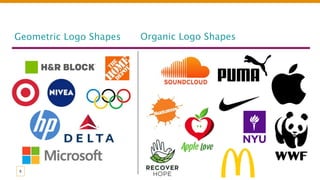
Geometric Logo Shapes Organic Logo Shapes
ELEMENTS OF ART:
SPACE
Module 3
ELEMENTS OF ART
• Line
• Shape
• Space
• Texture
• Value
• Color
• Type
• Form
10
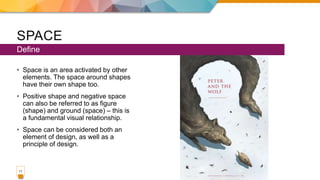
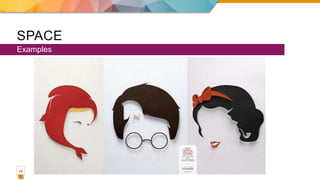
SPACE
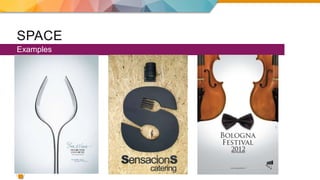
• Space is an area activated by other
elements. The space around shapes
have their own shape too.
• Positive shape and negative space
can also be referred to as figure
(shape) and ground (space) – this is
a fundamental visual relationship.
• Space can be considered both an
element of design, as well as a
principle of design.
Define
11
SPACE
Examples
12
SPACE
Examples
13
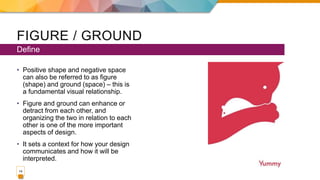
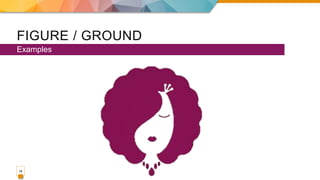
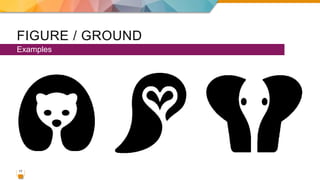
FIGURE / GROUND
• Positive shape and negative space
can also be referred to as figure
(shape) and ground (space) – this is
a fundamental visual relationship.
• Figure and ground can enhance or
detract from each other, and
organizing the two in relation to each
other is one of the more important
aspects of design.
• It sets a context for how your design
communicates and how it will be
interpreted.
Define
14
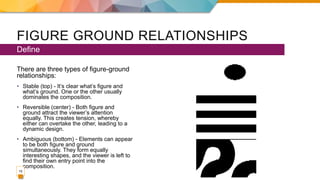
FIGURE GROUND RELATIONSHIPS
There are three types of figure-ground
relationships:
• Stable (top) - It’s clear what’s figure and
what’s ground. One or the other usually
dominates the composition.
• Reversible (center) - Both figure and
ground attract the viewer’s attention
equally. This creates tension, whereby
either can overtake the other, leading to a
dynamic design.
• Ambiguous (bottom) - Elements can appear
to be both figure and ground
simultaneously. They form equally
interesting shapes, and the viewer is left to
find their own entry point into the
composition.
Define
15
FIGURE / GROUND
Examples
16
FIGURE / GROUND
Examples
17
PRINCIPLE OF DESIGN:
BALANCE
Advertising & Graphic Design
Rowan-Cabarrus Community
College
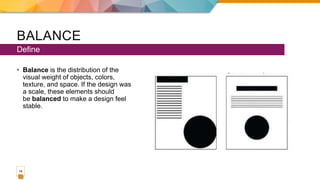
BALANCE
• Balance is the distribution of the
visual weight of objects, colors,
texture, and space. If the design was
a scale, these elements should
be balanced to make a design feel
stable.
Define
19
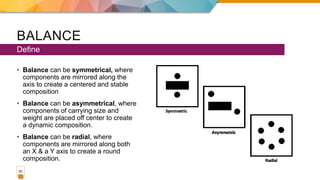
BALANCE
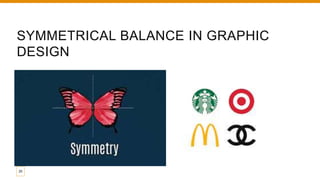
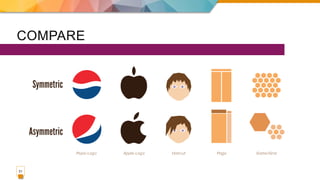
• Balance can be symmetrical, where
components are mirrored along the
axis to create a centered and stable
composition
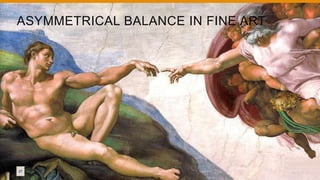
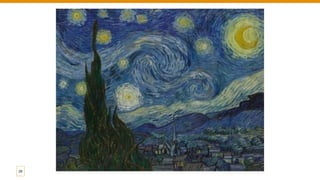
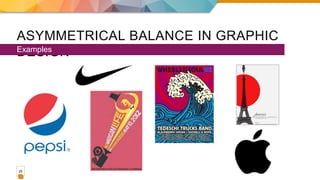
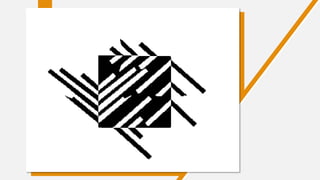
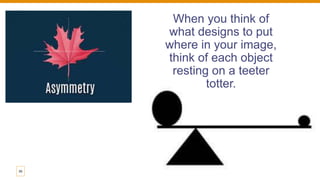
• Balance can be asymmetrical, where
components of carrying size and
weight are placed off center to create
a dynamic composition.
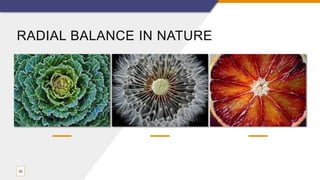
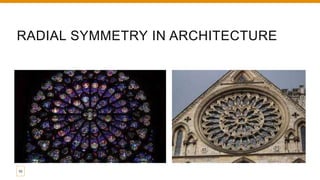
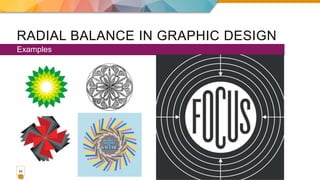
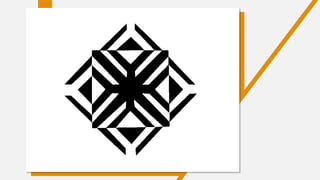
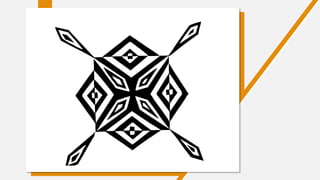
• Balance can be radial, where
components are mirrored along both
an X & a Y axis to create a round
composition.
Define
20
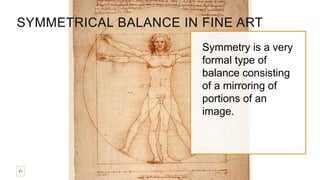
Symmetry is a very
formal type of
balance consisting
of a mirroring of
portions of an
image.
21
SYMMETRICAL BALANCE IN FINE ART
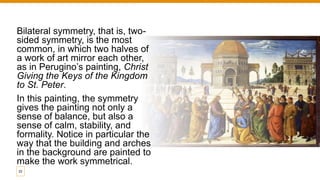
Bilateral symmetry, that is, two-
sided symmetry, is the most
common, in which two halves of
a work of art mirror each other,
as in Perugino’s painting, Christ
Giving the Keys of the Kingdom
to St. Peter.
In this painting, the symmetry
gives the painting not only a
sense of balance, but also a
sense of calm, stability, and
formality. Notice in particular the
way that the building and arches
in the background are painted to
make the work symmetrical.
22
23
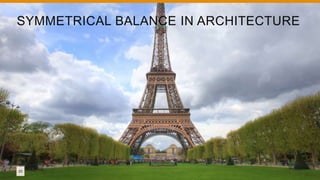
SYMMETRICAL BALANCE IN ARCHITECTURE
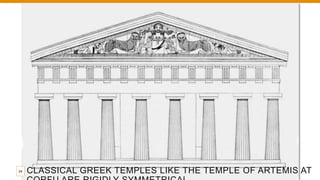
24 CLASSICAL GREEK TEMPLES LIKE THE TEMPLE OF ARTEMIS AT
SYMMETRICAL BALANCE IN GRAPHIC
DESIGN
25
26
27
ASYMMETRICAL BALANCE IN FINE ART
28
ASYMMETRICAL BALANCE IN GRAPHIC
DESIGN
Examples
29
When you think of
what designs to put
where in your image,
think of each object
resting on a teeter
totter.
30
COMPARE
31
RADIAL BALANCE IN NATURE
32
RADIAL SYMMETRY IN ARCHITECTURE
33
RADIAL BALANCE IN GRAPHIC DESIGN
Examples
34
REVI
Assignment Four
Shape & Balance
Shape & Balance
Shape & Balance
Shape & Balance
Shape & Balance
Shape & Balance
Shape & Balance

Shape & Balance

  • 1.
  • 2.
    ELEMENTS OF ART •Line • Shape • Space • Texture • Value • Color • Type • Form 2
  • 3.
    DEGREES OF REPRESENTATION 3 RepresentationalNon-Representational Naturalism Realism Semi-Abstraction Abstraction Form Only Shapes are incorporated within ALL images
  • 4.
    SHAPE A visually perceivedarea created by an enclosed line, color, or change in value. 4 Line Value Color
  • 5.
    SHAPE’S MAIN CHARACTERISTICS •Geometric - A shape that appears related to geometry; such as a triangle, rectangle, square or circle. • Organic - A shape created by abstracting the most basic and recognizable aspects of a real life shape and creating a simplified representation of it. 5
  • 6.
  • 7.
  • 8.
    8 Geometric Logo ShapesOrganic Logo Shapes
  • 9.
  • 10.
    ELEMENTS OF ART •Line • Shape • Space • Texture • Value • Color • Type • Form 10
  • 11.
    SPACE • Space isan area activated by other elements. The space around shapes have their own shape too. • Positive shape and negative space can also be referred to as figure (shape) and ground (space) – this is a fundamental visual relationship. • Space can be considered both an element of design, as well as a principle of design. Define 11
  • 12.
  • 13.
  • 14.
    FIGURE / GROUND •Positive shape and negative space can also be referred to as figure (shape) and ground (space) – this is a fundamental visual relationship. • Figure and ground can enhance or detract from each other, and organizing the two in relation to each other is one of the more important aspects of design. • It sets a context for how your design communicates and how it will be interpreted. Define 14
  • 15.
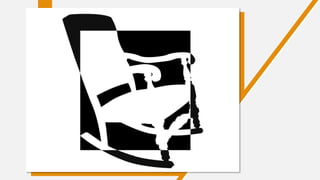
    FIGURE GROUND RELATIONSHIPS Thereare three types of figure-ground relationships: • Stable (top) - It’s clear what’s figure and what’s ground. One or the other usually dominates the composition. • Reversible (center) - Both figure and ground attract the viewer’s attention equally. This creates tension, whereby either can overtake the other, leading to a dynamic design. • Ambiguous (bottom) - Elements can appear to be both figure and ground simultaneously. They form equally interesting shapes, and the viewer is left to find their own entry point into the composition. Define 15
  • 16.
  • 17.
  • 18.
    PRINCIPLE OF DESIGN: BALANCE Advertising& Graphic Design Rowan-Cabarrus Community College
  • 19.
    BALANCE • Balance isthe distribution of the visual weight of objects, colors, texture, and space. If the design was a scale, these elements should be balanced to make a design feel stable. Define 19
  • 20.
    BALANCE • Balance canbe symmetrical, where components are mirrored along the axis to create a centered and stable composition • Balance can be asymmetrical, where components of carrying size and weight are placed off center to create a dynamic composition. • Balance can be radial, where components are mirrored along both an X & a Y axis to create a round composition. Define 20
  • 21.
    Symmetry is avery formal type of balance consisting of a mirroring of portions of an image. 21 SYMMETRICAL BALANCE IN FINE ART
  • 22.
    Bilateral symmetry, thatis, two- sided symmetry, is the most common, in which two halves of a work of art mirror each other, as in Perugino’s painting, Christ Giving the Keys of the Kingdom to St. Peter. In this painting, the symmetry gives the painting not only a sense of balance, but also a sense of calm, stability, and formality. Notice in particular the way that the building and arches in the background are painted to make the work symmetrical. 22
  • 23.
  • 24.
    24 CLASSICAL GREEKTEMPLES LIKE THE TEMPLE OF ARTEMIS AT
  • 25.
    SYMMETRICAL BALANCE INGRAPHIC DESIGN 25
  • 26.
  • 27.
  • 28.
  • 29.
    ASYMMETRICAL BALANCE INGRAPHIC DESIGN Examples 29
  • 30.
    When you thinkof what designs to put where in your image, think of each object resting on a teeter totter. 30
  • 31.
  • 32.
  • 33.
    RADIAL SYMMETRY INARCHITECTURE 33
  • 34.
    RADIAL BALANCE INGRAPHIC DESIGN Examples 34
  • 35.