Using Tourism to
Make Better Places to Live In
Harold Goodwin
Emeritus Professor, MMU, Institute of Place Management
Director Responsible Tourism Partnership
Sustainable Development:
a long history?
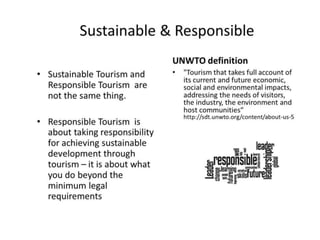
• 1972 World Commission on Environment & Development
• 1980 World Conservation Strategy
• 1987 Brundtland Report & Our Common Future
• 1992 Rio Environment & Development –
UN Commission on Sustainable Development
• 2000 Millennium Development Goals
• 2002 World Summit on Sustainable Development
• 2012 Rio+20
• Sustainable Development Goals
Very little to show for it………
UN IY of Sustainable Tourism for
Development
1. Make optimal use of
environmental
resources
2. Respect the socio-
cultural authenticity of
host communities
3. Provide socio-
economic benefits to
all stakeholders
• Continuous process
requires
• Informed participation
of all stakeholders &
• strong political
leadership
• High level of tourist
satisfaction
2004 Technical Definition
Why Responsibility?
• to respond, to act,
• responsibility implies and requires action.
• critical to creating change is acknowledging
and owning up to problems, and taking
responsibility for making changes.
• Responsibility is free – you can take as much
of it as you can handle
Child protection
Orphanages
Animal Welfare
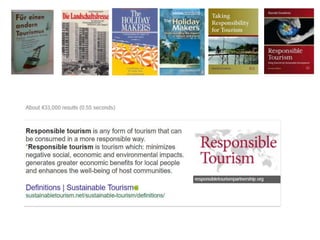
What is Responsible Tourism?
• Identifying issues which matter and address
them through tourism
• a triple bottom line approach to Tourism
Management
• a way of travelling – it offers a better
experience
• a movement
• diverse: particular to cultures, places and
organisations
• characterised by transparency
• requires the acceptance of responsibility and
the willingness to take action
Responsible Travel takes a variety of forms, it is
characterised by travel and tourism which
1. minimises negative environmental, social and
cultural impacts;
2. generates greater economic benefits for local
people and enhances the wellbeing of host
communities, by improving working conditions
and access to the industry;
3. involves local people in decisions that affect their
lives and life chances.
Cape Town Declaration 2002
4. makes positive contributions to the conservation of
natural and cultural heritage and to the maintenance
of the world’s diversity;
5. provides more enjoyable experiences for tourists
through more meaningful connections with local
people, and a greater understanding of local cultural
and environmental issues;
6. provides access for physically challenged and socially
disadvantaged people; and
7. is culturally sensitive and engenders respect between
tourists and hosts.
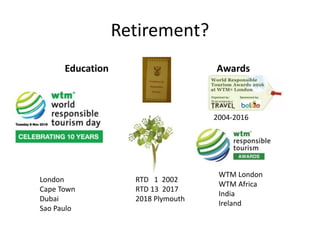
Retirement?
Education Awards
WTM London
WTM Africa
India
Ireland
London
Cape Town
Dubai
Sao Paulo
RTD 1 2002
RTD 13 2017
2018 Plymouth
2004-2016
Tourism: an opportunity?
• Tourists can bring additional spending power to a
community – jobs and economic development.
• Tourism can provide resources for environmental
conservation
• Tourism can provide social benefits keeping young
people in rural communities and valuing cultural
heritage
• But the value has to be captured and the impacts
have to be controlled – tourism has to be
managed.
Sir Colin Marshall
British Airways 1994
Tourism and the travel industry “is essentially
the renting out for short-term lets, of other
people’s environments, whether that is a
coastline, a city, a mountain range or a
rainforest. These ‘products’ must be kept
fresh and unsullied not just for the next day,
but for every tomorrow”
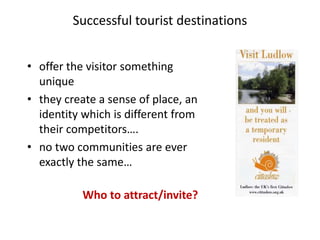
Successful tourist destinations
• offer the visitor something
unique
• they create a sense of place, an
identity which is different from
their competitors….
• no two communities are ever
exactly the same…
Who to attract/invite?
Experiential Tourism
• The experience
economy
• Seeking memorable
experiences
• Driving increased
tourism
• Viral marketing
• Engagement in culture,
community and the
environment
• Shared product of host
and guest
• Quality, depth,
create memories
You can taste the difference?
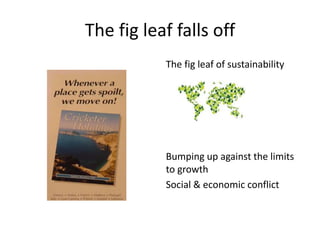
The fig leaf falls off
The fig leaf of sustainability
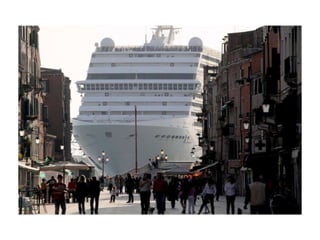
Bumping up against the limits
to growth
Social & economic conflict
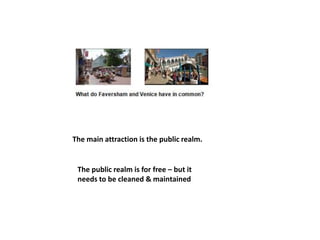
The main attraction is the public realm.
The public realm is for free – but it
needs to be cleaned & maintained
The tragedy of the commons
• Public realm goods are
– Non-rival (light & view)
– Non excludable
But nowhere has infinite
capacity?
Tourist behaviours affect
capacity.
• “Therein is the tragedy.
Each man is locked into a
system that compels him
to increase his herd
without limit - in a world
that is limited. Ruin is the
destination toward which
all men rush, each
pursuing his own best
interest in a society that
believes in the freedom of
the commons.”
• Hardin 1968
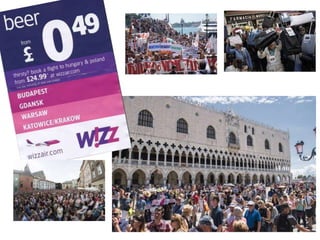
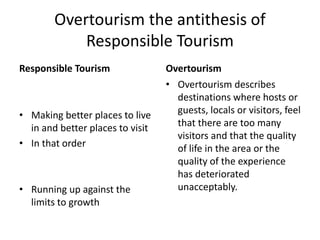
Overtourism the antithesis of
Responsible Tourism
Responsible Tourism
• Making better places to live
in and better places to visit
• In that order
• Running up against the
limits to growth
Overtourism
• Overtourism describes
destinations where hosts or
guests, locals or visitors, feel
that there are too many
visitors and that the quality
of life in the area or the
quality of the experience
has deteriorated
unacceptably.
The realisation of benefits depends on
• the creation of employment at all skill levels and
where there is existing capacity –
wage/progression/additional income
• the additional facilities, restaurants, festivals,
markets, attractions and retail …. ;
• the extent of linkages to existing local economy -
maximise linkages and minimise leakages
• It is not just about the money: sense of pride
generated by “being known”
• the extent of local/non-local ownership of tourist
enterprises – small scale and low risk.
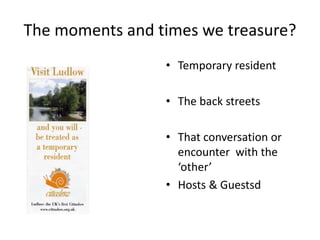
The moments and times we treasure?
• Temporary resident
• The back streets
• That conversation or
encounter with the
‘other’
• Hosts & Guestsd
Tourism is not a natural phenomenon
• Tourism is what we –
the producers and the
consumers – make it
• It is a social construct
• We can make it better
• Access = Egress
• The metrics matter
– International arrivals
– Length of stay
– Spend and retained yield
– Key question is does a
destination use tourism
or is it used by it?
Language
Tourism
– Tourist must stay at least 24
hours
– Accommodation is at the core
of it
• Business
• Leisure
• Sport
• Festival
• MICE
Visitor Economy
Visiting Friends & Relatives
Commuters
Hinterland – market town
Day trippers - railway junction
at the end of the M2
Adjacent towns
Birders
Specialist shopping
Where do we fit?
Competitors or markets?
• Ashford
• Canterbury
• Ramsgate
• Rochester
• Margate
• Lenham
• Broadstairs
• Sandwich
• Deal
• Dover
• Tenterden
• Sittingbourne
• Sheppey
• Ludlow
What is our identity?
• Visit Kent
• Market Town & Port of Kings
• Our market is people who live
in our hinterland - repeats
• & domestic and international
visitors to Kent.
Who does Faversham belong to?
• Tourism and non-tourism
businesses
• Diverse Residents
• Where do you take visitors?
• Existence value
• Incomers
• Second home owners
• Faversham Society
• Market Traders
• Attractions
• Restaurants, cafes pubs
• Accommodation
• Retail
• Boat owners
• Visit Kent
• And many more …
harold@haroldgoodwin.info 29
www.wtmresponsibletourism.com/
www.wtmlondon.com/en/events/
http://haroldgoodwin.info/links/
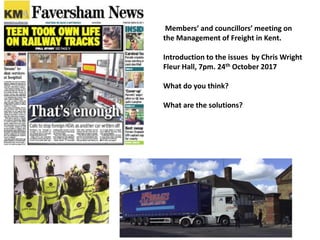
Members’ and councillors’ meeting on
the Management of Freight in Kent.
Introduction to the issues by Chris Wright
Fleur Hall, 7pm. 24th October 2017
What do you think?
What are the solutions?

Faversham oct2017

  • 1.
    Using Tourism to MakeBetter Places to Live In Harold Goodwin Emeritus Professor, MMU, Institute of Place Management Director Responsible Tourism Partnership
  • 2.
    Sustainable Development: a longhistory? • 1972 World Commission on Environment & Development • 1980 World Conservation Strategy • 1987 Brundtland Report & Our Common Future • 1992 Rio Environment & Development – UN Commission on Sustainable Development • 2000 Millennium Development Goals • 2002 World Summit on Sustainable Development • 2012 Rio+20 • Sustainable Development Goals Very little to show for it………
  • 3.
    UN IY ofSustainable Tourism for Development 1. Make optimal use of environmental resources 2. Respect the socio- cultural authenticity of host communities 3. Provide socio- economic benefits to all stakeholders • Continuous process requires • Informed participation of all stakeholders & • strong political leadership • High level of tourist satisfaction 2004 Technical Definition
  • 5.
    Why Responsibility? • torespond, to act, • responsibility implies and requires action. • critical to creating change is acknowledging and owning up to problems, and taking responsibility for making changes. • Responsibility is free – you can take as much of it as you can handle Child protection Orphanages Animal Welfare
  • 6.
    What is ResponsibleTourism? • Identifying issues which matter and address them through tourism • a triple bottom line approach to Tourism Management • a way of travelling – it offers a better experience • a movement • diverse: particular to cultures, places and organisations • characterised by transparency • requires the acceptance of responsibility and the willingness to take action
  • 7.
    Responsible Travel takesa variety of forms, it is characterised by travel and tourism which 1. minimises negative environmental, social and cultural impacts; 2. generates greater economic benefits for local people and enhances the wellbeing of host communities, by improving working conditions and access to the industry; 3. involves local people in decisions that affect their lives and life chances. Cape Town Declaration 2002
  • 8.
    4. makes positivecontributions to the conservation of natural and cultural heritage and to the maintenance of the world’s diversity; 5. provides more enjoyable experiences for tourists through more meaningful connections with local people, and a greater understanding of local cultural and environmental issues; 6. provides access for physically challenged and socially disadvantaged people; and 7. is culturally sensitive and engenders respect between tourists and hosts.
  • 10.
    Retirement? Education Awards WTM London WTMAfrica India Ireland London Cape Town Dubai Sao Paulo RTD 1 2002 RTD 13 2017 2018 Plymouth 2004-2016
  • 11.
    Tourism: an opportunity? •Tourists can bring additional spending power to a community – jobs and economic development. • Tourism can provide resources for environmental conservation • Tourism can provide social benefits keeping young people in rural communities and valuing cultural heritage • But the value has to be captured and the impacts have to be controlled – tourism has to be managed.
  • 12.
    Sir Colin Marshall BritishAirways 1994 Tourism and the travel industry “is essentially the renting out for short-term lets, of other people’s environments, whether that is a coastline, a city, a mountain range or a rainforest. These ‘products’ must be kept fresh and unsullied not just for the next day, but for every tomorrow”
  • 13.
    Successful tourist destinations •offer the visitor something unique • they create a sense of place, an identity which is different from their competitors…. • no two communities are ever exactly the same… Who to attract/invite?
  • 14.
    Experiential Tourism • Theexperience economy • Seeking memorable experiences • Driving increased tourism • Viral marketing • Engagement in culture, community and the environment • Shared product of host and guest • Quality, depth, create memories You can taste the difference?
  • 16.
    The fig leaffalls off The fig leaf of sustainability Bumping up against the limits to growth Social & economic conflict
  • 18.
    The main attractionis the public realm. The public realm is for free – but it needs to be cleaned & maintained
  • 19.
    The tragedy ofthe commons • Public realm goods are – Non-rival (light & view) – Non excludable But nowhere has infinite capacity? Tourist behaviours affect capacity. • “Therein is the tragedy. Each man is locked into a system that compels him to increase his herd without limit - in a world that is limited. Ruin is the destination toward which all men rush, each pursuing his own best interest in a society that believes in the freedom of the commons.” • Hardin 1968
  • 21.
    Overtourism the antithesisof Responsible Tourism Responsible Tourism • Making better places to live in and better places to visit • In that order • Running up against the limits to growth Overtourism • Overtourism describes destinations where hosts or guests, locals or visitors, feel that there are too many visitors and that the quality of life in the area or the quality of the experience has deteriorated unacceptably.
  • 22.
    The realisation ofbenefits depends on • the creation of employment at all skill levels and where there is existing capacity – wage/progression/additional income • the additional facilities, restaurants, festivals, markets, attractions and retail …. ; • the extent of linkages to existing local economy - maximise linkages and minimise leakages • It is not just about the money: sense of pride generated by “being known” • the extent of local/non-local ownership of tourist enterprises – small scale and low risk.
  • 23.
    The moments andtimes we treasure? • Temporary resident • The back streets • That conversation or encounter with the ‘other’ • Hosts & Guestsd
  • 24.
    Tourism is nota natural phenomenon • Tourism is what we – the producers and the consumers – make it • It is a social construct • We can make it better • Access = Egress • The metrics matter – International arrivals – Length of stay – Spend and retained yield – Key question is does a destination use tourism or is it used by it?
  • 25.
    Language Tourism – Tourist muststay at least 24 hours – Accommodation is at the core of it • Business • Leisure • Sport • Festival • MICE Visitor Economy Visiting Friends & Relatives Commuters Hinterland – market town Day trippers - railway junction at the end of the M2 Adjacent towns Birders Specialist shopping
  • 26.
    Where do wefit? Competitors or markets? • Ashford • Canterbury • Ramsgate • Rochester • Margate • Lenham • Broadstairs • Sandwich • Deal • Dover • Tenterden • Sittingbourne • Sheppey • Ludlow What is our identity? • Visit Kent • Market Town & Port of Kings • Our market is people who live in our hinterland - repeats • & domestic and international visitors to Kent.
  • 27.
    Who does Favershambelong to? • Tourism and non-tourism businesses • Diverse Residents • Where do you take visitors? • Existence value • Incomers • Second home owners • Faversham Society • Market Traders • Attractions • Restaurants, cafes pubs • Accommodation • Retail • Boat owners • Visit Kent • And many more …
  • 29.
  • 30.
    Members’ and councillors’meeting on the Management of Freight in Kent. Introduction to the issues by Chris Wright Fleur Hall, 7pm. 24th October 2017 What do you think? What are the solutions?