INTRODUCTION
• Ethics is the rational reflection on what is right, what is wrong,
what is just, what is unjust, what is good & what is bad in terms of
human behaviour.
• Some ethical principles are:
o Truthfulness
o Honesty
o Loyalty
o Respect
o Fairness
o Integrity
ORIGIN OF ETHICS
• The word Ethics is derived from Latin word ‘Ethicus’ & the
Greek word ‘Ethikos’
• Ethics are an arrangement of decent principles & a branch of
attitude which defines what is good for individuals & society
• There are many well known figures in the history of ethics,
Greek philosophers Plato & Aristotle, modern influences
include such people as Immanuel Kant, Jeremy Bentham, John
Stuart Mill, D.W.Ross, C.L.Stevenson, Alasdair MacIntyre &
John Rawls
MEANING OF ETHICS
Ethics refers to the evaluation of
moral values, principles & standards of human conduct &
its application in daily life to determine acceptable human
behaviour.
EVOLUTION OF ETHICS
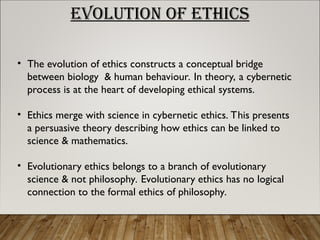
• The evolution of ethics constructs a conceptual bridge
between biology & human behaviour. In theory, a cybernetic
process is at the heart of developing ethical systems.
• Ethics merge with science in cybernetic ethics. This presents
a persuasive theory describing how ethics can be linked to
science & mathematics.
• Evolutionary ethics belongs to a branch of evolutionary
science & not philosophy. Evolutionary ethics has no logical
connection to the formal ethics of philosophy.
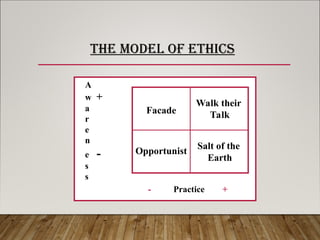
THE MODEL OF ETHICS
A
w +
a
r
e
n
e -
s
s
- Practice +
Facade
Walk their
Talk
Opportunist
Salt of the
Earth
(1) facade
• A façade is an exterior side of a building.
• The word comes from the French language.
(2) Walk their Talk
• Walk their Talk considers the consumer’s ethical
intention and the ethically minded consumers rarely
purchase ethical products.
(3) OPPORTUNIST
• Opportunists are people who see a chance to gain
some advantage from a situation, often at the expense
of ethics or morals.
(4) Salt of the Earth
• Salt of the earth is the most worthy of people; a very
good or worthy person.
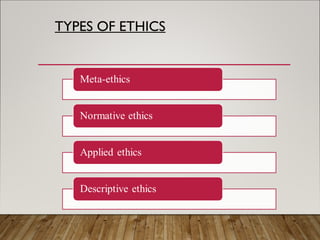
TYPES OF ETHICS
(1) META-ETHICS
• Meta-ethics is the branch of ethics that seeks
to understand the nature of ethical properties,
statements, attitudes and judgments.
• A meta-ethical question is abstract and relates
to a wide range of more specific practical
questions.
(2) NORMATIVE ETHICS
• Normative ethics is the study of ethical action.
• Normative ethics is distinct from meta-ethics and descriptive
ethics. (3) Applied Ethics
• Applied ethics is the most practical of the three divisions of the
philosophy of ethics.
• Applied ethics is the actual application of ethical theory for the
purpose of choosing an ethical action in a given issue.
(4) Descriptive ethics
• Descriptive ethics is the study of people’s beliefs
about morality.
CODE OF ETHICS
CODE OF ETHICS REFERS TO A WRITTEN SET OF
GUIDELINES ISSUED BY AN ORGANIZATION TO ITS
WORKER AND MANAGEMENT TO HELP THEM
CONDUCT THEIR ACTIONS IN ACCORDANCE WITH
ITS PRIMARYVALUES AND ETHICAL STANDARDS.
CONDITION FOR MAKING CODES
EFFECTIVE
There are six conditions for effective code of ethics
• There should be a valid motivation for introduction of ethics
• Broad acceptance within the company
• Continuous feedback is important.
• Verification and control. New guidelines should be drawn up if the rules
prove inadequate in any way
• Integration in a broad company philosophy
• Sanctions and control.
DIFFICULTIES IN IMPLEMENTING CODE OF
ETHICS
• The main difficulty with code of ethics is that they do
not establish priority between norms and beliefs.
There are three main areas that can create an obstacle
to put codes into practice i.e.
o Culture
o Design
o Enforcement
NATIONAL DIFFERENCE IN
ETHICS
• National difference in ethics means difference between two states or two
places of one country.
• In that,
Culture
Attitudes
Religious belief
Education
Nature of government
Competitive environment
Work environment
INTERNATIONAL DIFFERENCE IN
ETHICS
• International difference in ethics means difference between two
different countries value, beliefs and culture.
• Work environment of any country is also affect business while they
are in multi national companies.
• Such as Reliance,Walmart,Amazon,Apple,Tata etc.
• Many companies formed well-designed codes of conduct to help
their employees.
• Two of the most prominent issues that managers in MNCs
operating in foreign countries face are Bribery and corruption
and Worker compensation.
Principle of Ethics, Introduction Origin

Principle of Ethics, Introduction Origin

  • 2.
    INTRODUCTION • Ethics isthe rational reflection on what is right, what is wrong, what is just, what is unjust, what is good & what is bad in terms of human behaviour. • Some ethical principles are: o Truthfulness o Honesty o Loyalty o Respect o Fairness o Integrity
  • 3.
    ORIGIN OF ETHICS •The word Ethics is derived from Latin word ‘Ethicus’ & the Greek word ‘Ethikos’ • Ethics are an arrangement of decent principles & a branch of attitude which defines what is good for individuals & society • There are many well known figures in the history of ethics, Greek philosophers Plato & Aristotle, modern influences include such people as Immanuel Kant, Jeremy Bentham, John Stuart Mill, D.W.Ross, C.L.Stevenson, Alasdair MacIntyre & John Rawls
  • 4.
    MEANING OF ETHICS Ethicsrefers to the evaluation of moral values, principles & standards of human conduct & its application in daily life to determine acceptable human behaviour.
  • 5.
    EVOLUTION OF ETHICS •The evolution of ethics constructs a conceptual bridge between biology & human behaviour. In theory, a cybernetic process is at the heart of developing ethical systems. • Ethics merge with science in cybernetic ethics. This presents a persuasive theory describing how ethics can be linked to science & mathematics. • Evolutionary ethics belongs to a branch of evolutionary science & not philosophy. Evolutionary ethics has no logical connection to the formal ethics of philosophy.
  • 6.
    THE MODEL OFETHICS A w + a r e n e - s s - Practice + Facade Walk their Talk Opportunist Salt of the Earth
  • 7.
    (1) facade • Afaçade is an exterior side of a building. • The word comes from the French language. (2) Walk their Talk • Walk their Talk considers the consumer’s ethical intention and the ethically minded consumers rarely purchase ethical products.
  • 8.
    (3) OPPORTUNIST • Opportunistsare people who see a chance to gain some advantage from a situation, often at the expense of ethics or morals. (4) Salt of the Earth • Salt of the earth is the most worthy of people; a very good or worthy person.
  • 9.
  • 10.
    (1) META-ETHICS • Meta-ethicsis the branch of ethics that seeks to understand the nature of ethical properties, statements, attitudes and judgments. • A meta-ethical question is abstract and relates to a wide range of more specific practical questions.
  • 11.
    (2) NORMATIVE ETHICS •Normative ethics is the study of ethical action. • Normative ethics is distinct from meta-ethics and descriptive ethics. (3) Applied Ethics • Applied ethics is the most practical of the three divisions of the philosophy of ethics. • Applied ethics is the actual application of ethical theory for the purpose of choosing an ethical action in a given issue.
  • 12.
    (4) Descriptive ethics •Descriptive ethics is the study of people’s beliefs about morality.
  • 13.
    CODE OF ETHICS CODEOF ETHICS REFERS TO A WRITTEN SET OF GUIDELINES ISSUED BY AN ORGANIZATION TO ITS WORKER AND MANAGEMENT TO HELP THEM CONDUCT THEIR ACTIONS IN ACCORDANCE WITH ITS PRIMARYVALUES AND ETHICAL STANDARDS.
  • 14.
    CONDITION FOR MAKINGCODES EFFECTIVE There are six conditions for effective code of ethics • There should be a valid motivation for introduction of ethics • Broad acceptance within the company • Continuous feedback is important. • Verification and control. New guidelines should be drawn up if the rules prove inadequate in any way • Integration in a broad company philosophy • Sanctions and control.
  • 15.
    DIFFICULTIES IN IMPLEMENTINGCODE OF ETHICS • The main difficulty with code of ethics is that they do not establish priority between norms and beliefs. There are three main areas that can create an obstacle to put codes into practice i.e. o Culture o Design o Enforcement
  • 16.
    NATIONAL DIFFERENCE IN ETHICS •National difference in ethics means difference between two states or two places of one country. • In that, Culture Attitudes Religious belief Education Nature of government Competitive environment Work environment
  • 17.
    INTERNATIONAL DIFFERENCE IN ETHICS •International difference in ethics means difference between two different countries value, beliefs and culture. • Work environment of any country is also affect business while they are in multi national companies. • Such as Reliance,Walmart,Amazon,Apple,Tata etc. • Many companies formed well-designed codes of conduct to help their employees. • Two of the most prominent issues that managers in MNCs operating in foreign countries face are Bribery and corruption and Worker compensation.

Editor's Notes

  • #2 Definition of Ethics Ethics is the systematic examination of moral principles regarding human behavior, focusing on concepts such as right and wrong, justice and injustice, and goodness and badness. Rational Reflection "Rational reflection" emphasizes that ethics involves thoughtful and reasoned analysis, rather than relying solely on personal feelings or societal norms. Moral Concepts Ethics clarifies essential moral concepts, evaluating actions to determine what is considered right or wrong and the reasoning behind these judgments. Implications on Human Behavior By analyzing human behavior, ethics influences the establishment of codes of conduct, laws, and moral frameworks, shaping how individuals and societies make moral decisions. Conclusion ​Ethics serves as a critical lens for assessing and guiding human conduct, aligning actions with informed moral reasoning and established standards. 1. Truthfulness ​Truthfulness refers to the commitment to provide accurate information and to communicate sincerely, which fosters trust in relationships.​ 2. Honesty Honesty involves being straightforward and sincere, emphasizing the absence of deceit and manipulation, and is essential for building strong relationships based on trust. 3. Loyalty Loyalty entails steadfast support for friends, family, or organizations, fostering long-term relationships built on commitment and mutual support. 4. Respect Respect means acknowledging the inherent worth of others, treating them with dignity, and valuing diverse perspectives, promoting effective communication and collaboration. 5. Fairness Fairness embodies the principle of justice in treatment, ensuring equal consideration without bias, which is vital for maintaining trust and cooperation among individuals. 6. Integrity Integrity signifies consistency between one’s values and actions, promoting moral courage and reliability, thereby cultivating trustworthiness in personal and professional contexts.
  • #3 Meaning “arising from habit”
  • #6 Each of these models offers a different perspective on how ethics can be practiced or portrayed within organizations and by individuals, with varying implications for integrity and public trust.
  • #7 The facade model of ethics refers to the practice where companies or individuals present an ethical front while failing to adhere to ethical principles in practice. This can involve branding oneself as an ethical entity to gain customer loyalty or attract talent, often disingenuously. Such facades can mislead stakeholders about the true nature of an organization's actions, which may be marked by ethical inconsistencies or lapses. The opportunists model characterizes individuals whose behavior is guided primarily by self-interest, often at the expense of ethical considerations. Opportunists tend to exploit situations for personal gain without adhering to consistent moral principles, which can lead to a lack of integrity. Philosopher Robert Solomon suggests that opportunists lack coherence between their personal beliefs and the social world they inhabit, making their actions self-serving rather than principled. This model highlights the dangers of a character-driven approach where ethical behavior is compromised for selfish objectives.
  • #8 The "walking the talk" model emphasizes the alignment of words and actions in ethical leadership. It means that leaders and organizations must demonstrate their values through consistent actions that reflect ethical principles rather than merely making statements about them. This model fosters an ethical environment, encouraging employees to observe and emulate ethical behavior, thus promoting a culture where ethics are integrated into everyday practices. Leaders play a crucial role as role models and set the tone for an organization’s ethical climate by their behaviors. The salt of the earth model represents individuals or organizations that embody genuine ethical behavior, integrity, and a commitment to doing what is right, often seen as ordinary but deeply principled. This model values humility, authenticity, and the consistent application of ethical standards in personal and professional contexts. Such individuals inspire trust and respect, creating an ethical atmosphere that encourages others to act similarly. While this concept may not have specific passages in the provided documents, it relates to the virtues expected of leaders and employees committed to doing the right thing without seeking recognition or gain from their ethical behavior.