PRIME AND
COMPOSITE
NUMBERS
Example: 7 is prime because the only
numbers that will divide into it evenly are
1 and 7.
Definition
•Prime Number – a number that has
only two factors, itself and 1.
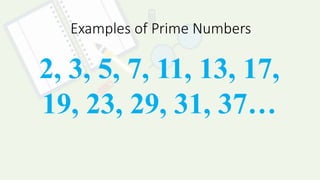
Examples of Prime Numbers
2, 3, 5, 7, 11, 13, 17,
19, 23, 29, 31, 37…
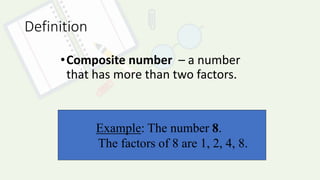
Example: The number 8.
The factors of 8 are 1, 2, 4, 8.
Definition
•Composite number – a number
that has more than two factors.
Examples of Composite Numbers
4, 6, 8, 9, 10, 12, 14,
15, 16, 18, 20, 21, …
One is special because . . .
One is not prime.
(because it does
not have exactly
two different
factors).
One is not
Composite.
(because it does
not have more
than 2 factors).
Let us try to identify if the given
number is a PRIME or COMPOSITE.
Write P or C.
Let us try to identify if the given number is a
PRIME or COMPOSITE. Write P or C.
47
Let us try to identify if the given number is a
PRIME or COMPOSITE. Write P or C.
27
Let us try to identify if the given number is a
PRIME or COMPOSITE. Write P or C.
63
Let us try to identify if the given number is a
PRIME or COMPOSITE. Write P or C.
57
Let us try to identify if the given number is a
PRIME or COMPOSITE. Write P or C.
91
Definition
•Prime Factorization – A way to write a
composite number as the product of its
prime factors.
2 x 2 x 3 = 12
How to do a Prime Factorization?
48
Step 1 – Write down any
composite number.
- - Factor Tree Method - -
Step 2 – Start dividing by
the prime #s (start with 2).
If the composite number is divisible
by 2, write it down and find the next factor.
If not, check if the factor is evenly
divisible by 3, 5, 7, 9, etc.
2 x 24
How to do a Prime Factorization?
48
Step 3 – Check the factors.
If they are prime, you are done.
If they are not, proceed to Step 4.
- - Factor Tree Method - -
Step 4 – Continue dividing.
If one of the factors is
divisible by 2, write it down
and find the next factor.
If not, check if the factor is evenly
divisible by 3, 5, 7, 9, etc.
2 x 24
2 x 2 x 12
How to do a Prime Factorization?
48
Step 5 – Check the factors.
If they are prime, proceed to Step 6.
If they are not, repeat Step 4.
- - Factor Tree Method - -
2 x 24
2 x 12
2 x 6
How to do a Prime Factorization?
48
Step 5 – Check the factors.
If they are prime, proceed to Step 6.
If they are not, repeat Step 4.
- - Factor Tree Method - -
Step 6 – Write the all
the Prime Factors.
2 x 24
2 x 12
2 x 6
2 x 3
48 = 2 x 2 x 2 x 2 x 3
Find the Prime Factorization
27
3 x 9
27 = 3 x 3 x 3
3 x 3
Prime Factorization
Find the Prime Factorization
12
2 x 6
12 = 2 x 2 x 3
2 x 3
Prime Factorization
Find the Prime Factorization
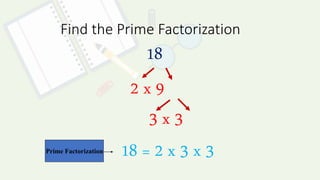
18
2 x 9
18 = 2 x 3 x 3
3 x 3
Prime Factorization
Find the Prime Factorization
18
2 x 9
18 = 2 x 3 x 3
3 x 3
Prime Factorization
You Have Options
The following screens illustrate another method that you can use to
find the Prime Factorization of a Composite Number.
Try it! You may
like it better.
How to do a Prime Factorization?
18
Step 1 – Write down any
composite number.
- - Ladder Method or Continuous Division - -
Step 2 – Start dividing by the
prime #s (start with 2).
If the composite number is divisible by 2,
write it on the left of the L and write the
other factor below the original composite #.
If not, check if the number is evenly divisible
by 3, 5, etc.
2
9
How to do a Prime Factorization?
18
Step 3 – Check the factors.
If they are prime, proceed to Step 6.
If not, continue the process.
- - Ladder Method or Continuous Division - -
Step 4 – Continue dividing the # on the next
rung of the ladder by the prime #s (start with 2).
2
9
3
3
Step 5 – Repeat this process until the # on
the next rung of the ladder is prime.
How to do a Prime Factorization?
18
Step 3 – Check the factors.
If they are prime, proceed to Step 6.
If not, continue the process.
- - Ladder Method or Continuous Division - -
Step 4 – Continue dividing the # on the next
rung of the ladder by the prime #s (start with 2).
2
9
3
3
Step 5 – Repeat this process until the # on
the next rung of the ladder is 1.
3
1
How to do a Prime Factorization?
18
- - Ladder Method or Continuous Division - -
2
9
3
3
3
1
Step 6 – Write the
Prime Factors.
18 = 2x 3x 3
Prime
Factorization
56
- - Ladder Method or Continuous Division - -
2
7
Prime
Factors
56 = 2x 2x 2 x 7
28
2
14
2
Find the Prime Factorization
7
1
Summary
•One (1) is not a prime or composite number.
•Two (2) is the only even prime number.
•Not all odd numbers are prime.
(examples: 9, 15, 21, 27, 33, 35, …)
•All composite numbers can be written as
product of prime numbers.
The End

PRIME AND COMPOSTITE NUMBERS

  • 1.
  • 2.
    Example: 7 isprime because the only numbers that will divide into it evenly are 1 and 7. Definition •Prime Number – a number that has only two factors, itself and 1.
  • 3.
    Examples of PrimeNumbers 2, 3, 5, 7, 11, 13, 17, 19, 23, 29, 31, 37…
  • 4.
    Example: The number8. The factors of 8 are 1, 2, 4, 8. Definition •Composite number – a number that has more than two factors.
  • 5.
    Examples of CompositeNumbers 4, 6, 8, 9, 10, 12, 14, 15, 16, 18, 20, 21, …
  • 6.
    One is specialbecause . . . One is not prime. (because it does not have exactly two different factors). One is not Composite. (because it does not have more than 2 factors).
  • 7.
    Let us tryto identify if the given number is a PRIME or COMPOSITE. Write P or C.
  • 8.
    Let us tryto identify if the given number is a PRIME or COMPOSITE. Write P or C. 47
  • 9.
    Let us tryto identify if the given number is a PRIME or COMPOSITE. Write P or C. 27
  • 10.
    Let us tryto identify if the given number is a PRIME or COMPOSITE. Write P or C. 63
  • 11.
    Let us tryto identify if the given number is a PRIME or COMPOSITE. Write P or C. 57
  • 12.
    Let us tryto identify if the given number is a PRIME or COMPOSITE. Write P or C. 91
  • 13.
    Definition •Prime Factorization –A way to write a composite number as the product of its prime factors. 2 x 2 x 3 = 12
  • 14.
    How to doa Prime Factorization? 48 Step 1 – Write down any composite number. - - Factor Tree Method - - Step 2 – Start dividing by the prime #s (start with 2). If the composite number is divisible by 2, write it down and find the next factor. If not, check if the factor is evenly divisible by 3, 5, 7, 9, etc. 2 x 24
  • 15.
    How to doa Prime Factorization? 48 Step 3 – Check the factors. If they are prime, you are done. If they are not, proceed to Step 4. - - Factor Tree Method - - Step 4 – Continue dividing. If one of the factors is divisible by 2, write it down and find the next factor. If not, check if the factor is evenly divisible by 3, 5, 7, 9, etc. 2 x 24 2 x 2 x 12
  • 16.
    How to doa Prime Factorization? 48 Step 5 – Check the factors. If they are prime, proceed to Step 6. If they are not, repeat Step 4. - - Factor Tree Method - - 2 x 24 2 x 12 2 x 6
  • 17.
    How to doa Prime Factorization? 48 Step 5 – Check the factors. If they are prime, proceed to Step 6. If they are not, repeat Step 4. - - Factor Tree Method - - Step 6 – Write the all the Prime Factors. 2 x 24 2 x 12 2 x 6 2 x 3 48 = 2 x 2 x 2 x 2 x 3
  • 18.
    Find the PrimeFactorization 27 3 x 9 27 = 3 x 3 x 3 3 x 3 Prime Factorization
  • 19.
    Find the PrimeFactorization 12 2 x 6 12 = 2 x 2 x 3 2 x 3 Prime Factorization
  • 20.
    Find the PrimeFactorization 18 2 x 9 18 = 2 x 3 x 3 3 x 3 Prime Factorization
  • 21.
    Find the PrimeFactorization 18 2 x 9 18 = 2 x 3 x 3 3 x 3 Prime Factorization
  • 22.
    You Have Options Thefollowing screens illustrate another method that you can use to find the Prime Factorization of a Composite Number. Try it! You may like it better.
  • 23.
    How to doa Prime Factorization? 18 Step 1 – Write down any composite number. - - Ladder Method or Continuous Division - - Step 2 – Start dividing by the prime #s (start with 2). If the composite number is divisible by 2, write it on the left of the L and write the other factor below the original composite #. If not, check if the number is evenly divisible by 3, 5, etc. 2 9
  • 24.
    How to doa Prime Factorization? 18 Step 3 – Check the factors. If they are prime, proceed to Step 6. If not, continue the process. - - Ladder Method or Continuous Division - - Step 4 – Continue dividing the # on the next rung of the ladder by the prime #s (start with 2). 2 9 3 3 Step 5 – Repeat this process until the # on the next rung of the ladder is prime.
  • 25.
    How to doa Prime Factorization? 18 Step 3 – Check the factors. If they are prime, proceed to Step 6. If not, continue the process. - - Ladder Method or Continuous Division - - Step 4 – Continue dividing the # on the next rung of the ladder by the prime #s (start with 2). 2 9 3 3 Step 5 – Repeat this process until the # on the next rung of the ladder is 1. 3 1
  • 26.
    How to doa Prime Factorization? 18 - - Ladder Method or Continuous Division - - 2 9 3 3 3 1 Step 6 – Write the Prime Factors. 18 = 2x 3x 3 Prime Factorization
  • 27.
    56 - - LadderMethod or Continuous Division - - 2 7 Prime Factors 56 = 2x 2x 2 x 7 28 2 14 2 Find the Prime Factorization 7 1
  • 28.
    Summary •One (1) isnot a prime or composite number. •Two (2) is the only even prime number. •Not all odd numbers are prime. (examples: 9, 15, 21, 27, 33, 35, …) •All composite numbers can be written as product of prime numbers.
  • 29.