Richard E. Frye, M.D., Ph.D.
Chief, Section on Neurodevelopmental Disorders
Director of Autism Program
Barrow Neurological Institute at Phoenix Children's Hospital
Professor of Child Health
University of Arizona College of Medicine
Secondary Mitochondrial Dysfunction
in Neurodevelopmental Disorders:
Origins, Significance and Treatment
Every attempted has been made to make this
presentation as accurate as possible. The information is
provided without any expressed or implied warranty.
This presentation should not be substituted for medical
advice. Treatments in this lecture are considered off-
label and are not FDA-approved.
Disclaimer
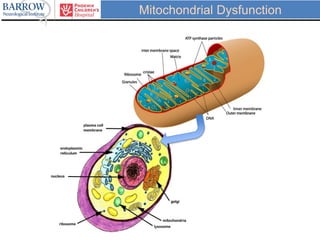
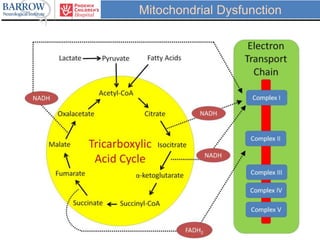
Mitochondrial Dysfunction
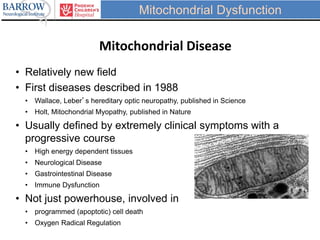
• Relatively new field
• First diseases described in 1988
• Wallace, Leber’s hereditary optic neuropathy, published in Science
• Holt, Mitochondrial Myopathy, published in Nature
• Usually defined by extremely clinical symptoms with a
progressive course
• High energy dependent tissues
• Neurological Disease
• Gastrointestinal Disease
• Immune Dysfunction
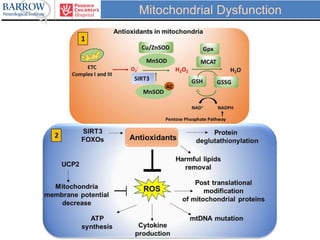
• Not just powerhouse, involved in
• programmed (apoptotic) cell death
• Oxygen Radical Regulation
Mitochondrial Disease
Mitochondrial Dysfunction
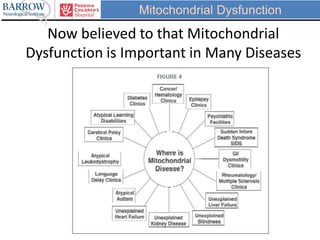
Now believed to that Mitochondrial
Dysfunction is Important in Many Diseases
Mitochondrial Dysfunction
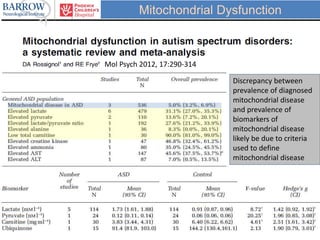
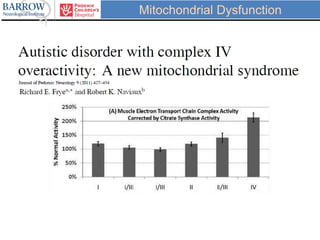
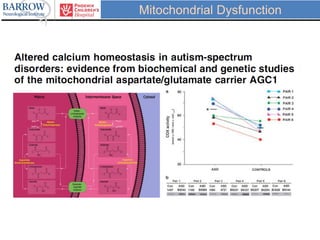
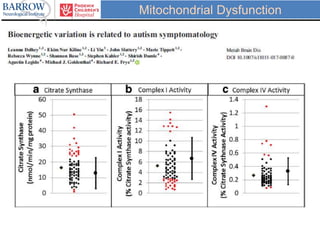
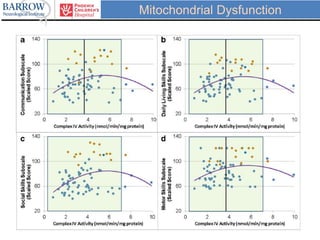
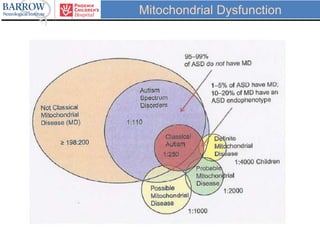
Mitochondrial Dysfunction in Autism
Mol Psych 2012, 17:290-314
Discrepancy between
prevalence of diagnosed
mitochondrial disease
and prevalence of
biomarkers of
mitochondrial disease
likely be due to criteria
used to define
mitochondrial disease
Mitochondrial Dysfunction
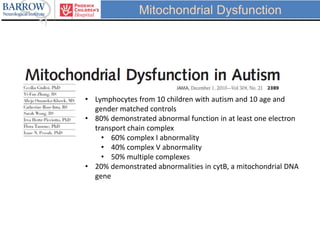
• Lymphocytes from 10 children with autism and 10 age and
gender matched controls
• 80% demonstrated abnormal function in at least one electron
transport chain complex
• 60% complex I abnormality
• 40% complex V abnormality
• 50% multiple complexes
• 20% demonstrated abnormalities in cytB, a mitochondrial DNA
gene
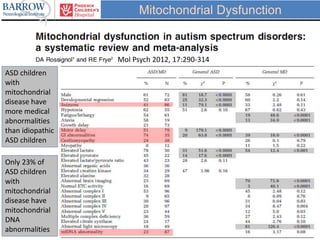
Mitochondrial Dysfunction
Mol Psych 2012, 17:290-314
ASD children
with
mitochondrial
disease have
more medical
abnormalities
than idiopathic
ASD children
Only 23% of
ASD children
with
mitochondrial
disease have
mitochondrial
DNA
abnormalities
Mitochondrial Dysfunction
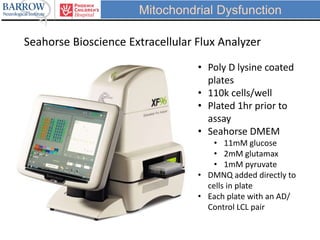
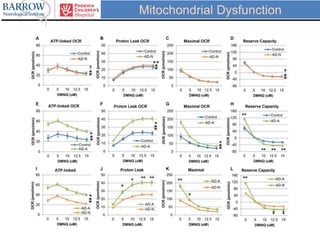
Seahorse Bioscience Extracellular Flux Analyzer
• Poly D lysine coated
plates
• 110k cells/well
• Plated 1hr prior to
assay
• Seahorse DMEM
• 11mM glucose
• 2mM glutamax
• 1mM pyruvate
• DMNQ added directly to
cells in plate
• Each plate with an AD/
Control LCL pair
Mitochondrial Dysfunction
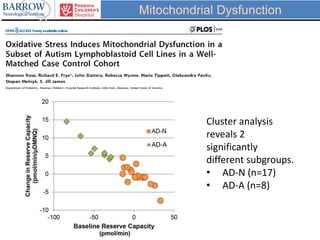
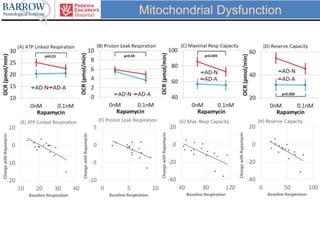
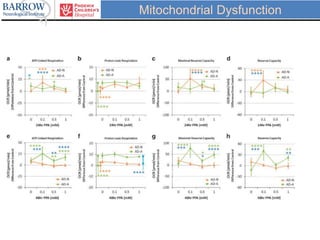
Cluster analysis
reveals 2
significantly
different subgroups.
• AD-N (n=17)
• AD-A (n=8)
Mitochondrial Dysfunction
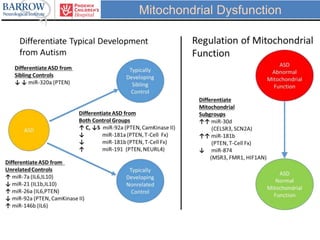
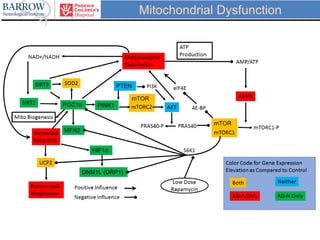
Mitochondrial Dysfunction in Autism
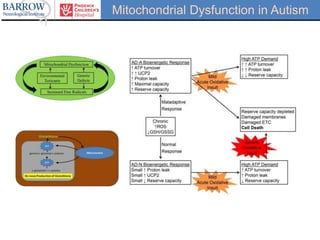
Mechanisms of Molecular Dysregulation
Mitochondrial Dysfunction
Mitochondrial Dysfunction in Autism
Effects of the Environment
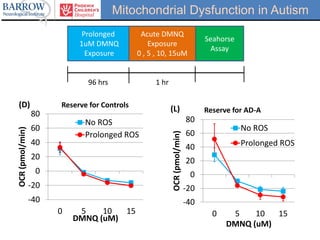
Mitochondrial Dysfunction in Autism
-40
-20
0
20
40
60
80
0 5 10 15
OCR(pmol/min)
DMNQ (uM)
Reserve for Controls
No ROS
Prolonged ROS
(D)
-40
-20
0
20
40
60
80
0 5 10 15
OCR(pmol/min)
DMNQ (uM)
Reserve for AD-A
No ROS
Prolonged ROS
(L)
96 hrs 1 hr
Prolonged
1uM DMNQ
Exposure
Acute DMNQ
Exposure
0 , 5 , 10, 15uM
Seahorse
Assay
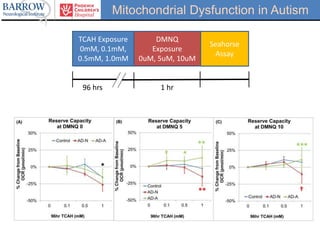
Mitochondrial Dysfunction in Autism
1 hr
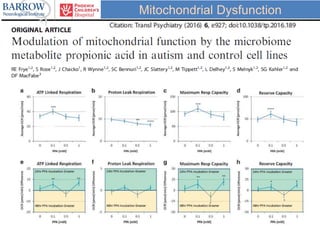
TCAH Exposure
0mM, 0.1mM,
0.5mM, 1.0mM
DMNQ
Exposure
0uM, 5uM, 10uM
Seahorse
Assay
96 hrs
Mitochondrial Dysfunction
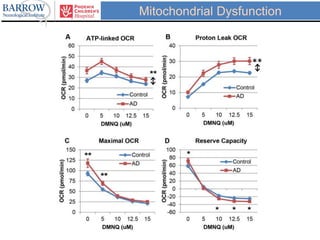
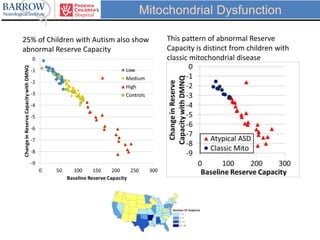
25% of Children with Autism also show
abnormal Reserve Capacity
This pattern of abnormal Reserve
Capacity is distinct from children with
classic mitochondrial disease
Mitochondrial Dysfunction
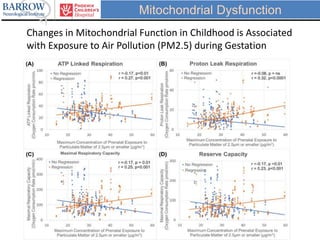
Changes in Mitochondrial Function in Childhood is Associated
with Exposure to Air Pollution (PM2.5) during Gestation
Mitochondrial Dysfunction
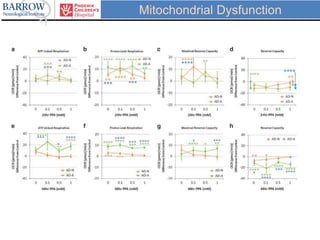
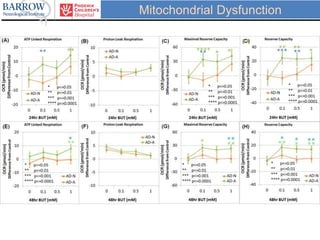
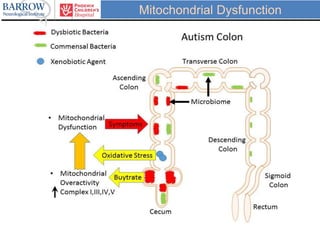
Mitochondrial Dysfunction in Autism
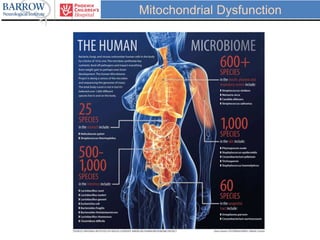
Effects of the Gut Microbiome
Mitochondrial Dysfunction
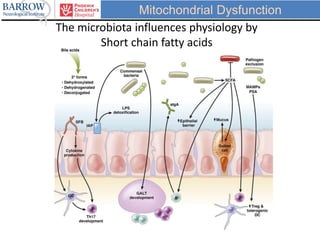
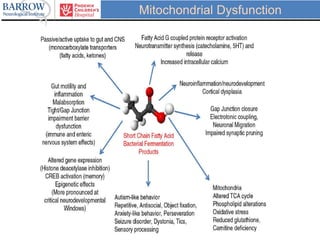
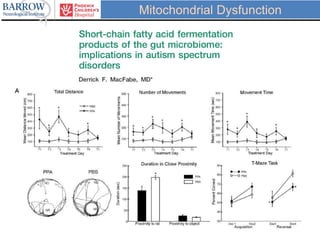
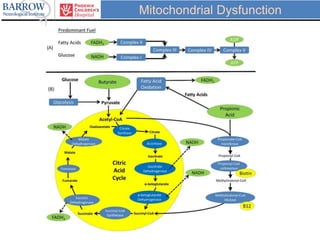
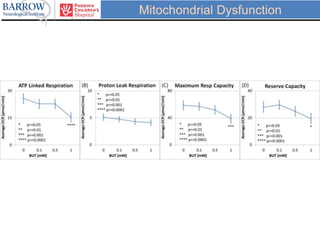
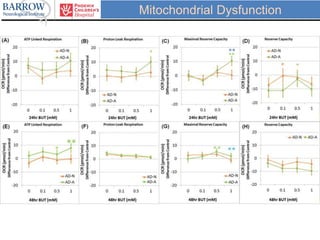
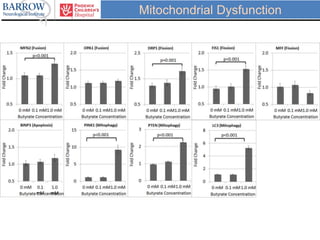
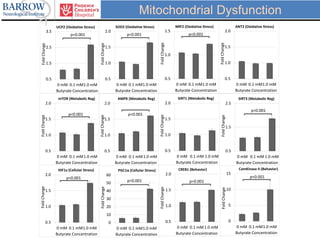
The microbiota influences physiology by
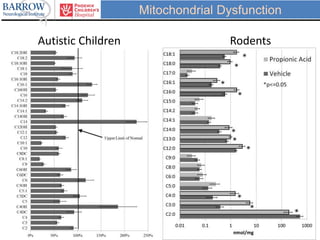
Short chain fatty acids
Mitochondrial Dysfunction
Autistic Children Rodents
Mitochondrial Dysfunction
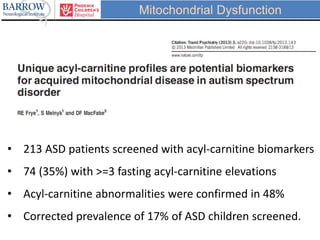
• 213 ASD patients screened with acyl-carnitine biomarkers
• 74 (35%) with >=3 fasting acyl-carnitine elevations
• Acyl-carnitine abnormalities were confirmed in 48%
• Corrected prevalence of 17% of ASD children screened.
Mitochondrial Dysfunction
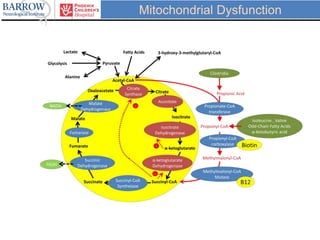
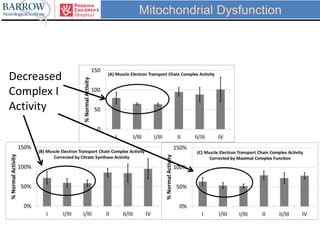
Decreased
Complex I
Activity
Mitochondrial Dysfunction
0.5
1.5
2.5
3.5
0 mM 0.1 mM1.0 mM
FoldChange
Butyrate Concentration
UCP2 (Oxidative Stress)
p<0.001
0.5
1.0
1.5
2.0
0 mM 0.1 mM1.0 mM
FoldChange
Butyrate Concentration
mTOR (Metabolic Reg)
p<0.001
0.5
1.0
1.5
2.0
0 mM 0.1 mM1.0 mM
FoldChange
Butyrate Concentration
HIF1a (Cellular Stress)
p<0.001
0
10
20
30
40
50
60
0 mM 0.1 mM1.0 mM
FoldChange
Butyrate Concentration
PGC1α (Cellular Stress)
p<0.001
0.5
1.0
1.5
2.0
0 mM 0.1 mM1.0 mM
FoldChange
Butyrate Concentration
CREB1 (Behavior)
p<0.001
0
5
10
15
0 mM 0.1 mM1.0 mM
FoldChange
Butyrate Concentration
CamKinase II (Behavior)
p<0.001
0.5
1.0
1.5
2.0
0 mM 0.1 mM1.0 mM
FoldChange
Butyrate Concentration
SOD2 (Oxidative Stress)
p<0.001
0.5
1.0
1.5
0 mM 0.1 mM1.0 mM
FoldChange
Butyrate Concentration
NRF2 (Oxidative Stress)
p<0.001
0.5
1.0
1.5
2.0
0 mM 0.1 mM1.0 mM
FoldChange
Butyrate Concentration
ANT2 (Oxidative Stress)
0.5
1.0
1.5
2.0
0 mM 0.1 mM1.0 mM
FoldChange
Butyrate Concentration
AMPK (Metabolic Reg)
p<0.001
0.5
1.0
1.5
2.0
0 mM 0.1 mM 1.0 mM
FoldChange Butyrate Concentration
SIRT1 (Metabolic Reg)
0.5
1.5
2.5
0 mM 0.1 mM 1.0 mM
FoldChange
Butyrate Concentration
SIRT3 (Metabolic Reg)
p<0.001
Mitochondrial Dysfunction
Examples of Genetic Disorder
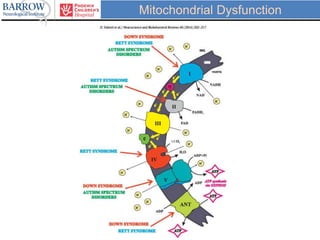
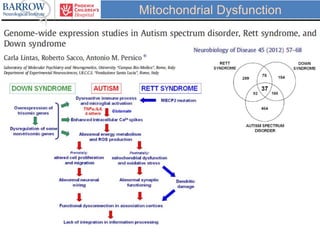
Mitochondrial Dysfunction
Examples of Genetic Disorder
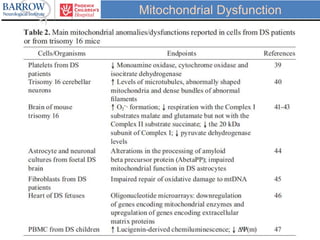
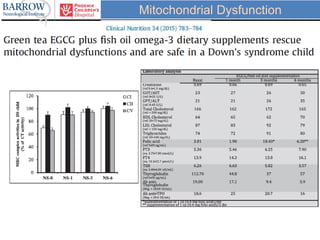
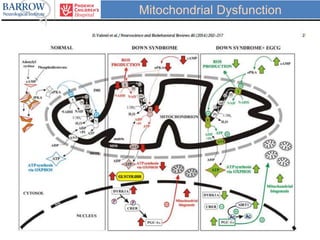
Down Syndrome
Mitochondrial Dysfunction
Examples of Genetic Disorder
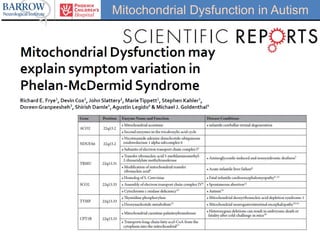
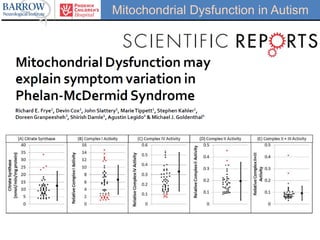
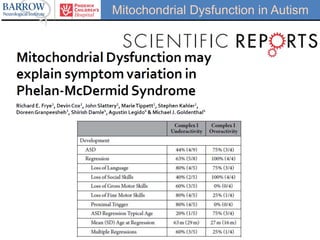
Phelan-McDermid Syndrome
Mitochondrial Dysfunction in Autism
Mitochondrial Dysfunction
Examples of Genetic Disorder
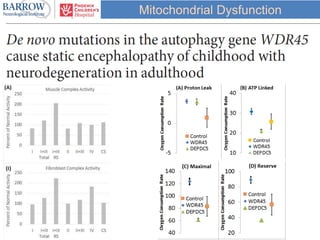
WDR45
Mitochondrial Dysfunction
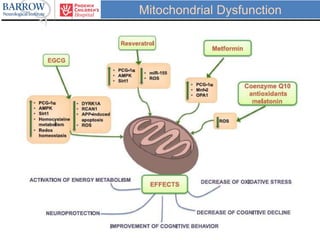
Potential Treatments
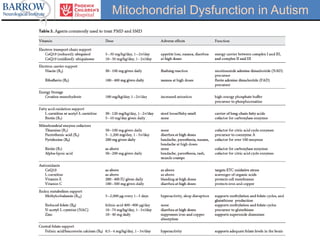
Mitochondrial Dysfunction in Autism
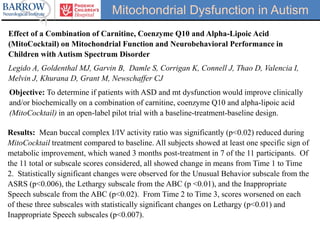
Effect of a Combination of Carnitine, Coenzyme Q10 and Alpha-Lipoic Acid
(MitoCocktail) on Mitochondrial Function and Neurobehavioral Performance in
Children with Autism Spectrum Disorder
Legido A, Goldenthal MJ, Garvin B, Damle S, Corrigan K, Connell J, Thao D, Valencia I,
Melvin J, Khurana D, Grant M, Newschaffer CJ
Objective: To determine if patients with ASD and mt dysfunction would improve clinically
and/or biochemically on a combination of carnitine, coenzyme Q10 and alpha-lipoic acid
(MitoCocktail) in an open-label pilot trial with a baseline-treatment-baseline design.
Results: Mean buccal complex I/IV activity ratio was significantly (p<0.02) reduced during
MitoCocktail treatment compared to baseline. All subjects showed at least one specific sign of
metabolic improvement, which waned 3 months post-treatment in 7 of the 11 participants. Of
the 11 total or subscale scores considered, all showed change in means from Time 1 to Time
2. Statistically significant changes were observed for the Unusual Behavior subscale from the
ASRS (p<0.006), the Lethargy subscale from the ABC (p <0.01), and the Inappropriate
Speech subscale from the ABC (p<0.02). From Time 2 to Time 3, scores worsened on each
of these three subscales with statistically significant changes on Lethargy (p<0.01) and
Inappropriate Speech subscales (p<0.007).
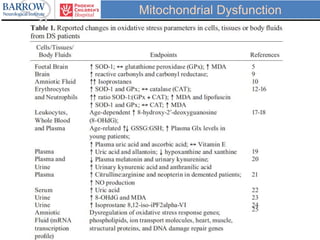
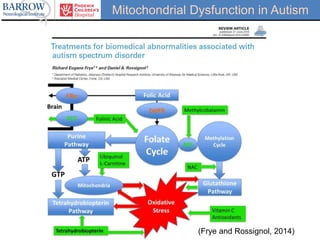
Mitochondrial Dysfunction in Autism
Mitochondrial Dysfunction
(Frye and Rossignol, 2014)
Mitochondrial Dysfunction in Autism
Questions

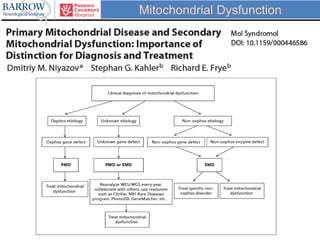
Primary Mitochondrial Disease and Secondary Mitochondrial Dysfunction