Help Is On The Way
Resources For Those Affected
By Mitochondrial Disease
Mary Castro Summers
Marcel’s Way Family Fund and
Franciscan Children’s, Brighton, MA
Mary Castro Summers
Mary is the parent of 3 adult sons, and her young was born with
complex health needs. For the past 30 years, she has relied on research skills
honed as a paralegal with her personal and then professional work
experience with the New England Regional Genetics Group, the FIRST Project
at the University of Massachusetts Medical School, Family TIES of
Massachusetts, and now Franciscan Children’s in Brighton, Mass.
As a member of the committee that reviews applications for Marcel’s
Way Family Fund at MitoAction for the past 5 years, Mary has learned of the
impact of Mitochondrial Disease and has assisted many families in finding
local community resources to address their needs.
Mary is passionate about community resource information-sharing
and making connections among families supporting children and adults who
have special health care needs. She was personally supported by others and
enjoys paying back those acts of kindness. Her motto in this work is, “you may
be caring for your loved one by yourself, but you should never feel alone.”
How Might Mitochondrial Disease
Affect You or Your Loved One?
• Poor growth
• Loss of muscle
coordination
• Muscle weakness
• Seizures
• Autism
• Problems with vision
and/or hearing
• Developmental delay
• Learning disabilities
• Heart, liver, and/or kidney
disease
• Gastrointestinal disorders
• Diabetes
• Increased risk of infection
• Thyroid and/or adrenal
abnormalities
• Autonomic dysfunction
• Dementia
Genetic and Rare Disease Information
Center: 888-205-2311
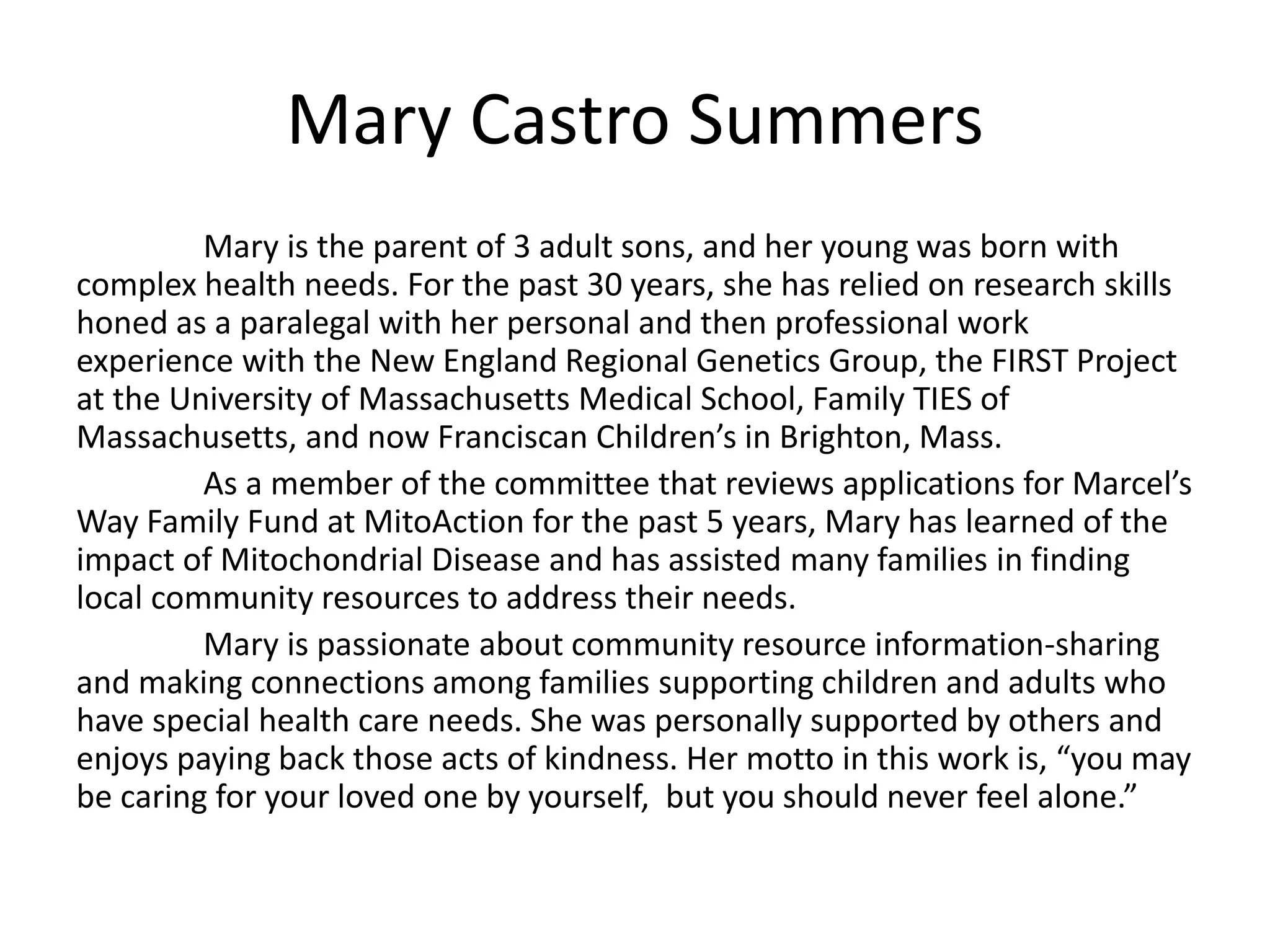
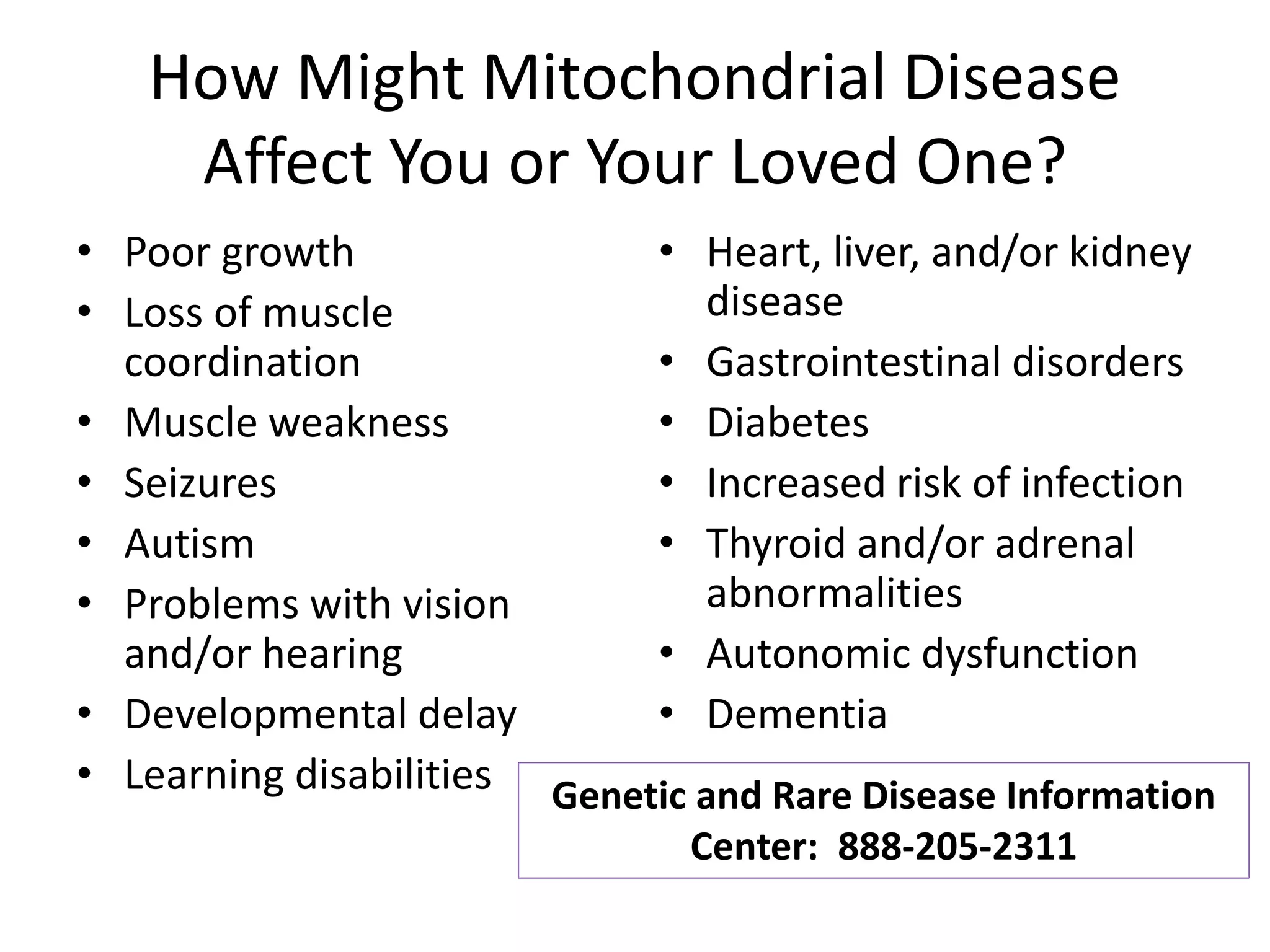
What Types of Help Matter?
• Health care needs
• Emotional support
• Basic needs
• Community services
Health Care Needs
– Health insurance
– Medical services
– Pharmaceuticals
– In-home services
– Durable medical equipment
– Outpatient therapies
– Alternatives to prescription medications
– Home accessibility equipment/devices
Emotional Support
For an affected child or adult
For the caring family and friends
– Consider your options:
• Peer support: I know you like myself…
• Talk therapy: find the words to express yourself
• Introspection: meditation, yoga, exercise
• Tap your creative self: visual arts, music, writing, gardening
• Find peace in nature: breathe in the blessings
– Find meaning in your life, bring joy to others.
Basic Needs
– Financial Assistance: How can I make ends meet?
– Food: Feed my body, nurture my soul
– Housing: Everybody needs a roof over their heads
– Transportation: Getting around town
Community Services
– Education
– Job training and supports
– Socialization
– Recreation
– Charities for funding supports
Questions?
Please turn to your state’s Parent to
Parent Program or Family Voices
chapter to find communities of
support:
www.p2pusa.org
www.familyvoices.org
Thank you for your time!

Help is on the Way

  • 1.
    Help Is OnThe Way Resources For Those Affected By Mitochondrial Disease Mary Castro Summers Marcel’s Way Family Fund and Franciscan Children’s, Brighton, MA
  • 2.
    Mary Castro Summers Maryis the parent of 3 adult sons, and her young was born with complex health needs. For the past 30 years, she has relied on research skills honed as a paralegal with her personal and then professional work experience with the New England Regional Genetics Group, the FIRST Project at the University of Massachusetts Medical School, Family TIES of Massachusetts, and now Franciscan Children’s in Brighton, Mass. As a member of the committee that reviews applications for Marcel’s Way Family Fund at MitoAction for the past 5 years, Mary has learned of the impact of Mitochondrial Disease and has assisted many families in finding local community resources to address their needs. Mary is passionate about community resource information-sharing and making connections among families supporting children and adults who have special health care needs. She was personally supported by others and enjoys paying back those acts of kindness. Her motto in this work is, “you may be caring for your loved one by yourself, but you should never feel alone.”
  • 3.
    How Might MitochondrialDisease Affect You or Your Loved One? • Poor growth • Loss of muscle coordination • Muscle weakness • Seizures • Autism • Problems with vision and/or hearing • Developmental delay • Learning disabilities • Heart, liver, and/or kidney disease • Gastrointestinal disorders • Diabetes • Increased risk of infection • Thyroid and/or adrenal abnormalities • Autonomic dysfunction • Dementia Genetic and Rare Disease Information Center: 888-205-2311
  • 4.
    What Types ofHelp Matter? • Health care needs • Emotional support • Basic needs • Community services
  • 5.
    Health Care Needs –Health insurance – Medical services – Pharmaceuticals – In-home services – Durable medical equipment – Outpatient therapies – Alternatives to prescription medications – Home accessibility equipment/devices
  • 6.
    Emotional Support For anaffected child or adult For the caring family and friends – Consider your options: • Peer support: I know you like myself… • Talk therapy: find the words to express yourself • Introspection: meditation, yoga, exercise • Tap your creative self: visual arts, music, writing, gardening • Find peace in nature: breathe in the blessings – Find meaning in your life, bring joy to others.
  • 7.
    Basic Needs – FinancialAssistance: How can I make ends meet? – Food: Feed my body, nurture my soul – Housing: Everybody needs a roof over their heads – Transportation: Getting around town
  • 8.
    Community Services – Education –Job training and supports – Socialization – Recreation – Charities for funding supports
  • 9.
    Questions? Please turn toyour state’s Parent to Parent Program or Family Voices chapter to find communities of support: www.p2pusa.org www.familyvoices.org Thank you for your time!

Editor's Notes

  • #3 People with mitochondrial genetic disorders can present at any age with almost any affected body system. While some conditions may only affect a single organ, many involve multiple organ systems including the brain, muscles, heart, liver, nerves, eyes, ears and/or kidneys. Symptom severity can also vary widely.
  • #4 As you know, mitochondrial genetic disorders can present at any age with almost any affected body system. Some conditions may only affect a single organ, many involve multiple organ systems including the brain, muscles, heart, liver, nerves, eyes, ears and/or kidneys. Symptom severity can also vary widely.
  • #6 INS: Medicaid, Medicare, Health Exchanges, employer-sponsored health insurance MEDICAL: Doctor visits, hospital stays, outpatient therapies, imaging services, lab services, medications IN-HOME SERVICES: visiting and block nursing, infusion, short-term therapies DME: wheelchair, walker, crutches, lifts and elevators, bath equipment, AFOs and braces PHARMACEUTICALS: prescriptions, OTC medications, compounded cocktails, medical supplies ALTERNATIVES: homeopathic and natural remedies, acupuncture, meditation, yoga, mindfulness OUTPATIENT THERAPIES: OT, PT, Speech/feeding therapies; psychological supports, counseling HOME ACCESSIBILITY: ramp, stair life, elevator, lighting and sound devices, kitchen appliances/counters, bathroom accommodations-roll-in shower
  • #7 Whether you are an affected individual or a caregiver, make your emotional health a priority. When we address the emotional needs of an individual, they have more energy to address their daily needs and enjoy life. -Find others who know your personal situation; this reduces the need to explain yourself over and over and over. Though everyone’s situation is unique, we can learn from each other’s experiences, feelings, resources, and outlooks. Contact your statewide parent-to-parent network (find them through Parent to Parent USA (p2pusa.org) or the Center for Independent Living (ILCs have federal and state funding and offer practical advice, counsel, and assistance related to community living, government and community resources, and job training, support services, and opportunities. -Think about your spiritual and philosophical needs, as you consider the everyday challenges you face – and how they affect your life, overall.
  • #8 Financial: FEDERAL - Social Security: SSI and SSDI STATE - Emergency Assistance for Dependent Children Remember that people with a disability can work and receive Social Security benefits; visit the local office to learn about these benefits. Food: NATIONAL: SNAP/Food stamps, WIC, surplus food programs STATE/LOCAL: Food pantries, charities Housing: the most difficult resource to identify, due to issues of economic stability and available resources NATIONAL AND STATE: government housing, Section 8 vouchers, affordable housing, and cooperative living Transportation: essential yet difficult to maintain on your own (costs of car, gasoline, maintenance, insurance) STATE: Medical Transportation/reimbursement for Medicaid recipients in many states (known as PT-1 in Mass.); Regional transit authorities, government-supported vans and carpooling. Few states have CICRF, offering some financial support for accessible vehicle purchases. LOCAL: Charities may offer financial support to purchase or maintain a vehicle for medical needs, online (GOFUNDME) and local fundraising for accessible vehicles Housing: FEDERAL AND STATE: Section 8 housing, affordable housing units; handicap accessible housing OTHER: Multi-generational homes, Co-habitation
  • #9 EDUCATION: Special education services, PTIs – local district, collaborative schools, specialized schools and school services; IHCP JOB TRAINING AND SUPPORTS: Transition to Adulthood services include attention to a student’s vocational interests and skills, opportunities to develop those skills with an eye toward gainful employment (full- or part-time), and supports to ensure success in the workplace. Supports may come from school programs, Independent Living Centers, and even Developmental Disability funds. It is also important to identify natural supports in the workplace. What better to ensure success in the job than to ensure that peers in the workplace are introduced to the opportunity to support a new employee? SOCIALIZATION: Humans are social creatures; it is crucial to find meaningful opportunities to be engaged with family, friends, and community. RECREATION: There really is something for everyone. Is your interest art, music, sports, the great outdoors? Adaptive equipment and creative thinkers can make almost every activity available to anyone who wants to have fun. Look into your state’s Department of Conservation and Recreation programs, too – for opportunities to enjoy the great outdoors. Very Special Arts and FOOT AND MOUTH PAINTING; music programs; adaptive and supportive cycling (double-riders, platform bikes as examples) and boating, supported swim programs, Special Olympics and Challenger sports programs. CHARITIES: Our communities are filled with caring friends and strangers who extend their hearts and support to individuals who have special needs. There are many WISH programs, national organizations with local chapters or offices (like Knights of Columbus, Jaycees, Kiwanis, Lions Club, The Masons, to name a few) that receive and fund requests to make dreams come true…or ensure that a needed medical treatment or useful piece of equipment is made available. Check with your local Parent to Parent groups or Family Voices to ask for help – TRULY A SIGN OF STRENGTH.