Primary care and AKI test results:
Guidance and support
Richard Fluck
Chair Think Kidneys
15th March 2016
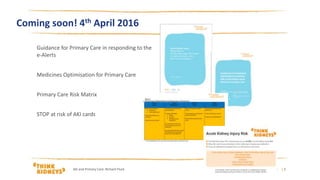
Guidance for Primary Care in responding to the
e-Alerts
Medicines Optimisation for Primary Care
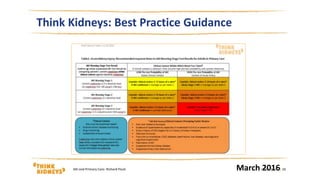
Primary Care Risk Matrix
STOP at risk of AKI cards
15/03/2016
Coming soon! 4th April 2016
AKi and Primary Care: Richard Fluck | 2
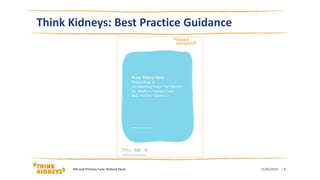
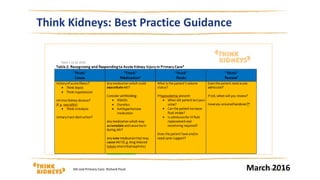
Think Kidneys: Best Practice Guidance
15/03/2016AKi and Primary Care: Richard Fluck | 3
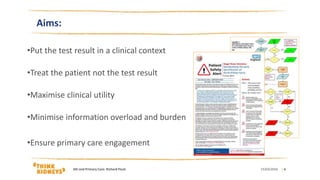
Aims:
•Put the test result in a clinical context
•Treat the patient not the test result
•Maximise clinical utility
•Minimise information overload and burden
•Ensure primary care engagement
15/03/2016AKi and Primary Care: Richard Fluck | 4
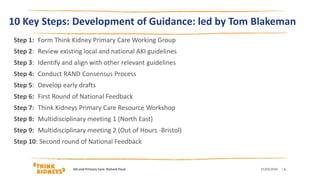
10 Key Steps: Development of Guidance: led by Tom Blakeman
Step 1: Form Think Kidney Primary Care Working Group
Step 2: Review existing local and national AKI guidelines
Step 3: Identify and align with other relevant guidelines
Step 4: Conduct RAND Consensus Process
Step 5: Develop early drafts
Step 6: First Round of National Feedback
Step 7: Think Kidneys Primary Care Resource Workshop
Step 8: Multidisciplinary meeting 1 (North East)
Step 9: Multidisciplinary meeting 2 (Out of Hours -Bristol)
Step 10: Second round of National Feedback
15/03/2016AKi and Primary Care: Richard Fluck | 5
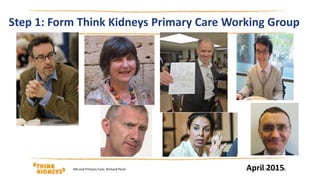
Step 1: Form Think Kidneys Primary Care Working Group
April 201515/03/2016AKi and Primary Care: Richard Fluck | 6
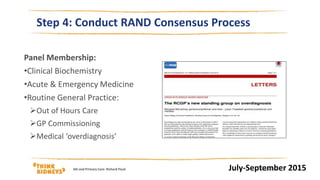
Step 4: Conduct RAND Consensus Process
Panel Membership:
•Clinical Biochemistry
•Acute & Emergency Medicine
•Routine General Practice:
Out of Hours Care
GP Commissioning
Medical ‘overdiagnosis’
July-September 201515/03/2016AKi and Primary Care: Richard Fluck | 7
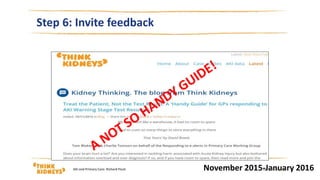
Step 6: Invite feedback
November 2015-January 201615/03/2016AKi and Primary Care: Richard Fluck | 8
Think Kidneys: Best Practice Guidance
March 201615/03/2016AKi and Primary Care: Richard Fluck | 9
Think Kidneys: Best Practice Guidance
March 201615/03/2016AKi and Primary Care: Richard Fluck | 10
Think Kidneys: Best Practice Guidance
March 201615/03/2016AKi and Primary Care: Richard Fluck | 11
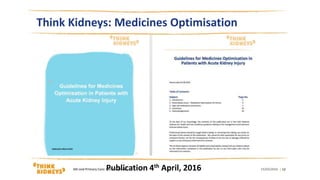
Think Kidneys: Medicines Optimisation
Publication 4th April, 2016 15/03/2016AKi and Primary Care: Richard Fluck | 12
Drugs and the relationship with kidneys
Avoid the term ‘nephrotoxic’
Effects of renal physiology, volume, electrolytes
Does the side effect profile change?
Any actions direct on the kidneys?
15/03/2016AKi and Primary Care: Richard Fluck | 13
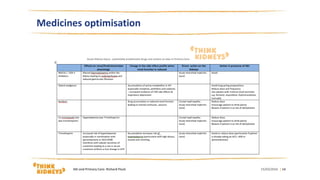
Medicines optimisation
15/03/2016AKi and Primary Care: Richard Fluck | 14
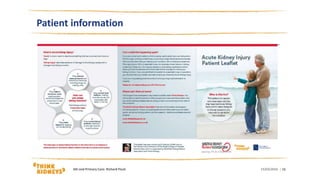
Patient information
15/03/2016AKi and Primary Care: Richard Fluck | 15
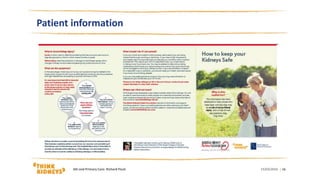
Patient information
15/03/2016AKi and Primary Care: Richard Fluck | 16
15/03/2016AKi and Primary Care: Richard Fluck | 17
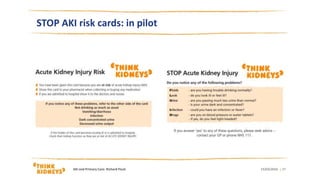
STOP AKI risk cards: in pilot
15/03/2016AKi and Primary Care: Richard Fluck | 18
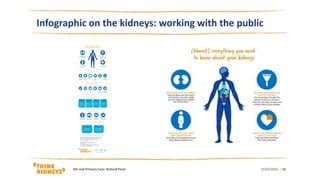
Infographic on the kidneys: working with the public
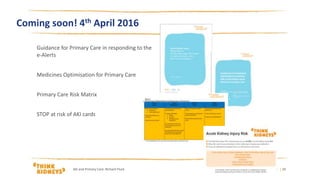
Guidance for Primary Care in responding to the
e-Alerts
Medicines Optimisation for Primary Care
Primary Care Risk Matrix
STOP at risk of AKI cards
15/03/2016
Coming soon! 4th April 2016
AKi and Primary Care: Richard Fluck | 19
How to find out more
Karen Thomas
Think Kidneys Programme Manager
UK Renal Registry
Karen.Thomas@renalregistry.nhs.uk
Teresa Wallace
Think Kidneys Programme Coordinator
UK Renal Registry
Teresajane.Wallace@renalregistry.nhs.uk
15/03/2016AKi and Primary Care: Richard Fluck | 20
Contact Think Kidneys
Richard Fluck
National Clinical Director for Renal
NHS England
Richard.fluck@nhs.net
Joan Russell
Head of Patient Safety
NHS England
Joan.russell@nhs.net
Ron Cullen
Director
UK Renal Registry
Ron.cullen@renalregistry.nhs.uk
www.linkedin.com/company/think-kidneys
www.twitter.com/ThinkKidneys
www.facebook.com/thinkkidneys
www.youtube.com/user/thinkkidneys
www.slideshare.net/ThinkKidneys
www.thinkkidneys.nhs.uk

Primary Care and AKI Test Results

  • 1.
    Primary care andAKI test results: Guidance and support Richard Fluck Chair Think Kidneys 15th March 2016
  • 2.
    Guidance for PrimaryCare in responding to the e-Alerts Medicines Optimisation for Primary Care Primary Care Risk Matrix STOP at risk of AKI cards 15/03/2016 Coming soon! 4th April 2016 AKi and Primary Care: Richard Fluck | 2
  • 3.
    Think Kidneys: BestPractice Guidance 15/03/2016AKi and Primary Care: Richard Fluck | 3
  • 4.
    Aims: •Put the testresult in a clinical context •Treat the patient not the test result •Maximise clinical utility •Minimise information overload and burden •Ensure primary care engagement 15/03/2016AKi and Primary Care: Richard Fluck | 4
  • 5.
    10 Key Steps:Development of Guidance: led by Tom Blakeman Step 1: Form Think Kidney Primary Care Working Group Step 2: Review existing local and national AKI guidelines Step 3: Identify and align with other relevant guidelines Step 4: Conduct RAND Consensus Process Step 5: Develop early drafts Step 6: First Round of National Feedback Step 7: Think Kidneys Primary Care Resource Workshop Step 8: Multidisciplinary meeting 1 (North East) Step 9: Multidisciplinary meeting 2 (Out of Hours -Bristol) Step 10: Second round of National Feedback 15/03/2016AKi and Primary Care: Richard Fluck | 5
  • 6.
    Step 1: FormThink Kidneys Primary Care Working Group April 201515/03/2016AKi and Primary Care: Richard Fluck | 6
  • 7.
    Step 4: ConductRAND Consensus Process Panel Membership: •Clinical Biochemistry •Acute & Emergency Medicine •Routine General Practice: Out of Hours Care GP Commissioning Medical ‘overdiagnosis’ July-September 201515/03/2016AKi and Primary Care: Richard Fluck | 7
  • 8.
    Step 6: Invitefeedback November 2015-January 201615/03/2016AKi and Primary Care: Richard Fluck | 8
  • 9.
    Think Kidneys: BestPractice Guidance March 201615/03/2016AKi and Primary Care: Richard Fluck | 9
  • 10.
    Think Kidneys: BestPractice Guidance March 201615/03/2016AKi and Primary Care: Richard Fluck | 10
  • 11.
    Think Kidneys: BestPractice Guidance March 201615/03/2016AKi and Primary Care: Richard Fluck | 11
  • 12.
    Think Kidneys: MedicinesOptimisation Publication 4th April, 2016 15/03/2016AKi and Primary Care: Richard Fluck | 12
  • 13.
    Drugs and therelationship with kidneys Avoid the term ‘nephrotoxic’ Effects of renal physiology, volume, electrolytes Does the side effect profile change? Any actions direct on the kidneys? 15/03/2016AKi and Primary Care: Richard Fluck | 13
  • 14.
    Medicines optimisation 15/03/2016AKi andPrimary Care: Richard Fluck | 14
  • 15.
    Patient information 15/03/2016AKi andPrimary Care: Richard Fluck | 15
  • 16.
    Patient information 15/03/2016AKi andPrimary Care: Richard Fluck | 16
  • 17.
    15/03/2016AKi and PrimaryCare: Richard Fluck | 17 STOP AKI risk cards: in pilot
  • 18.
    15/03/2016AKi and PrimaryCare: Richard Fluck | 18 Infographic on the kidneys: working with the public
  • 19.
    Guidance for PrimaryCare in responding to the e-Alerts Medicines Optimisation for Primary Care Primary Care Risk Matrix STOP at risk of AKI cards 15/03/2016 Coming soon! 4th April 2016 AKi and Primary Care: Richard Fluck | 19
  • 20.
    How to findout more Karen Thomas Think Kidneys Programme Manager UK Renal Registry Karen.Thomas@renalregistry.nhs.uk Teresa Wallace Think Kidneys Programme Coordinator UK Renal Registry Teresajane.Wallace@renalregistry.nhs.uk 15/03/2016AKi and Primary Care: Richard Fluck | 20 Contact Think Kidneys Richard Fluck National Clinical Director for Renal NHS England Richard.fluck@nhs.net Joan Russell Head of Patient Safety NHS England Joan.russell@nhs.net Ron Cullen Director UK Renal Registry Ron.cullen@renalregistry.nhs.uk www.linkedin.com/company/think-kidneys www.twitter.com/ThinkKidneys www.facebook.com/thinkkidneys www.youtube.com/user/thinkkidneys www.slideshare.net/ThinkKidneys www.thinkkidneys.nhs.uk

Editor's Notes

  • #8 A 10-person panel was identified with representation from clinical biochemistry, acute and emergency medicine and routine general practice. Individuals with an expressed interest and expertise in AKI through membership of the Think Kidneys Programme were invited as well as general practitioners who represented typical practice in relation to out of hours care, GP commissioning and those who represented a medical ‘over-diagnosis’ perspective. The panel was co-chaired by one researcher (SC), who is expert in the RAND Appropriateness Method, and a nephrologist (CT) who is expert in AKI.