Home Dialysis
Improvement project
Why?
• Home dialysis
• Includes PD and HD
• Includes self and assisted care models
• Benefits
• Personal
• Medical
• Quality of life
• System
• Resources
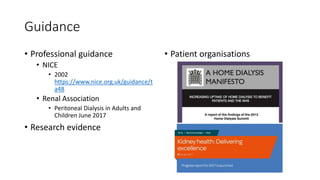
Guidance
• Professional guidance
• NICE
• 2002
https://www.nice.org.uk/guidance/t
a48
• Renal Association
• Peritoneal Dialysis in Adults and
Children June 2017
• Research evidence
• Patient organisations
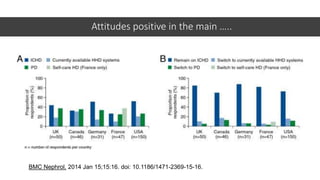
Attitudes positive in the main …..
BMC Nephrol. 2014 Jan 15;15:16. doi: 10.1186/1471-2369-15-16.
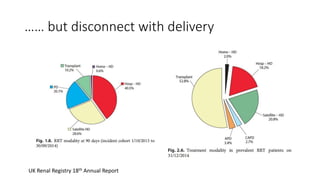
…… but disconnect with delivery
UK Renal Registry 18th Annual Report
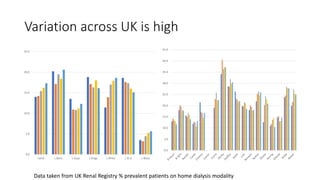
Variation across UK is high
0.0
5.0
10.0
15.0
20.0
25.0
Carsh L Barts L Guys L Kings L Rfree L St.G L West
Data taken from UK Renal Registry % prevalent patients on home dialysis modality
0.0
5.0
10.0
15.0
20.0
25.0
30.0
35.0
40.0
45.0
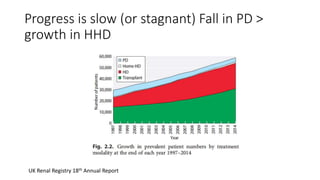
Progress is slow (or stagnant) Fall in PD >
growth in HHD
UK Renal Registry 18th Annual Report
Why?
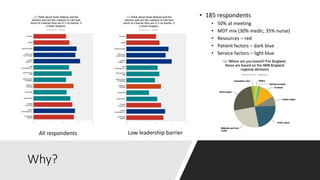
• 185 respondents
• 50% at meeting
• MDT mix (30% medic, 35% nurse)
• Resources – red
• Patient factors – dark blue
• Service factors – light blue
All respondents Low leadership barrier
Responses
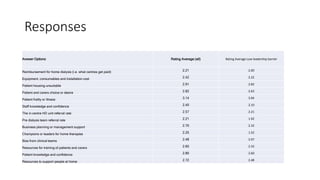
Answer Options Rating Average (all) Rating Average Low leadership barrier
Reimbursement for home dialysis (i.e. what centres get paid) 2.21 2.00
Equipment, consumables and installation cost 2.42 2.22
Patient housing unsuitable 2.91 2.82
Patient and carers choice or desire 2.82 2.63
Patient frailty or illness 3.14 3.04
Staff knowledge and confidence 2.40 2.10
The in centre HD unit referral rate 2.57 2.21
Pre dialysis team referral rate 2.21 1.92
Business planning or management support 2.70 2.32
Champions or leaders for home therapies 2.25 1.52
Bias from clinical teams 2.48 2.07
Resources for training of patients and carers 2.60 2.33
Patient knowledge and confidence 2.80 2.60
Resources to support people at home 2.72 2.48
Why?
• Financial concerns were not the main barriers.
• Strong leadership and a positive organisational culture were the main
contributors towards successful home dialysis programmes.
• Change management skills to deliver sustainable, systematic and
evidenced change are needed.
• Patient factors – frailty, choice – were important determinants, but
less so in some leadership systems.
Manchester Home Dialysis Forum 2016 Workshops
To increase the
proportion of patients on
home dialysis therapies
in England
Clear Vision & Purpose
Leadership
i) Organisational ii) Medical iii) Nursing iv) Patient Leadership
Organisational Culture
Values, behaviours & mindset
Expertise [Knowledge& skills]
Patients
Determining ‘suitable’ home dialysis patients
Develop patient exclusion criteria, dependent on local expertise
Home dialysis training
Effectiveness & experience of training pathway
Patient awareness, recruitment & retention
Patient Education & Informed Choice; Patient & carer experience;
Peer support; Carer support
Organisational Infrastructure
Financial support
Training facilities
Commissioning dialysis consumables and machines
Home modifications
Access to respite care
Multidisciplinary team supported by community team
DRIVER DIAGRAM: Home Dialysis
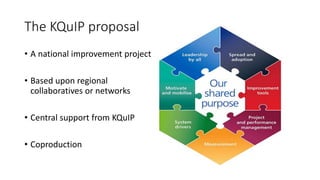
The KQuIP proposal
• A national improvement project
• Based upon regional
collaboratives or networks
• Central support from KQuIP
• Coproduction
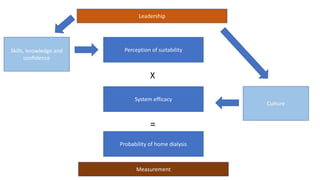
Perception of suitability
X
System efficacy
=
Probability of home dialysis
Leadership
Skills, knowledge and
confidence
Culture
Measurement
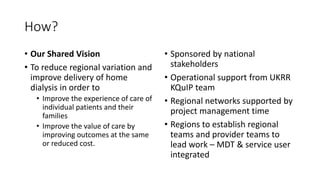
How?
• Our Shared Vision
• To reduce regional variation and
improve delivery of home
dialysis in order to
• Improve the experience of care of
individual patients and their
families
• Improve the value of care by
improving outcomes at the same
or reduced cost.
• Sponsored by national
stakeholders
• Operational support from UKRR
KQuIP team
• Regional networks supported by
project management time
• Regions to establish regional
teams and provider teams to
lead work – MDT & service user
integrated
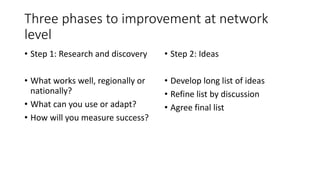
Three phases to improvement at network
level
• Step 1: Research and discovery
• What works well, regionally or
nationally?
• What can you use or adapt?
• How will you measure success?
• Step 2: Ideas
• Develop long list of ideas
• Refine list by discussion
• Agree final list
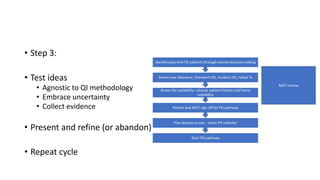
• Step 3:
• Test ideas
• Agnostic to QI methodology
• Embrace uncertainty
• Collect evidence
• Present and refine (or abandon)
• Repeat cycle
Start PD pathway
Plan dialysis access - insert PD catheter
Patient and MDT sign off for PD pathway
Assess for suitability– clinical, patient factors and home
suitability
Screen low clearance, Prevalent HD, Incident HD, Failed Tx
Identify potential PD patients through shared decision making
MDT review
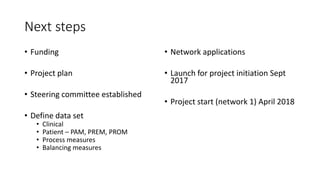
Next steps
• Funding
• Project plan
• Steering committee established
• Define data set
• Clinical
• Patient – PAM, PREM, PROM
• Process measures
• Balancing measures
• Network applications
• Launch for project initiation Sept
2017
• Project start (network 1) April 2018
Home Dialysis RA 2017

Home Dialysis RA 2017

  • 1.
  • 2.
    Why? • Home dialysis •Includes PD and HD • Includes self and assisted care models • Benefits • Personal • Medical • Quality of life • System • Resources
  • 3.
    Guidance • Professional guidance •NICE • 2002 https://www.nice.org.uk/guidance/t a48 • Renal Association • Peritoneal Dialysis in Adults and Children June 2017 • Research evidence • Patient organisations
  • 4.
    Attitudes positive inthe main ….. BMC Nephrol. 2014 Jan 15;15:16. doi: 10.1186/1471-2369-15-16.
  • 5.
    …… but disconnectwith delivery UK Renal Registry 18th Annual Report
  • 6.
    Variation across UKis high 0.0 5.0 10.0 15.0 20.0 25.0 Carsh L Barts L Guys L Kings L Rfree L St.G L West Data taken from UK Renal Registry % prevalent patients on home dialysis modality 0.0 5.0 10.0 15.0 20.0 25.0 30.0 35.0 40.0 45.0
  • 7.
    Progress is slow(or stagnant) Fall in PD > growth in HHD UK Renal Registry 18th Annual Report
  • 8.
    Why? • 185 respondents •50% at meeting • MDT mix (30% medic, 35% nurse) • Resources – red • Patient factors – dark blue • Service factors – light blue All respondents Low leadership barrier
  • 9.
    Responses Answer Options RatingAverage (all) Rating Average Low leadership barrier Reimbursement for home dialysis (i.e. what centres get paid) 2.21 2.00 Equipment, consumables and installation cost 2.42 2.22 Patient housing unsuitable 2.91 2.82 Patient and carers choice or desire 2.82 2.63 Patient frailty or illness 3.14 3.04 Staff knowledge and confidence 2.40 2.10 The in centre HD unit referral rate 2.57 2.21 Pre dialysis team referral rate 2.21 1.92 Business planning or management support 2.70 2.32 Champions or leaders for home therapies 2.25 1.52 Bias from clinical teams 2.48 2.07 Resources for training of patients and carers 2.60 2.33 Patient knowledge and confidence 2.80 2.60 Resources to support people at home 2.72 2.48
  • 10.
    Why? • Financial concernswere not the main barriers. • Strong leadership and a positive organisational culture were the main contributors towards successful home dialysis programmes. • Change management skills to deliver sustainable, systematic and evidenced change are needed. • Patient factors – frailty, choice – were important determinants, but less so in some leadership systems. Manchester Home Dialysis Forum 2016 Workshops
  • 11.
    To increase the proportionof patients on home dialysis therapies in England Clear Vision & Purpose Leadership i) Organisational ii) Medical iii) Nursing iv) Patient Leadership Organisational Culture Values, behaviours & mindset Expertise [Knowledge& skills] Patients Determining ‘suitable’ home dialysis patients Develop patient exclusion criteria, dependent on local expertise Home dialysis training Effectiveness & experience of training pathway Patient awareness, recruitment & retention Patient Education & Informed Choice; Patient & carer experience; Peer support; Carer support Organisational Infrastructure Financial support Training facilities Commissioning dialysis consumables and machines Home modifications Access to respite care Multidisciplinary team supported by community team DRIVER DIAGRAM: Home Dialysis
  • 12.
    The KQuIP proposal •A national improvement project • Based upon regional collaboratives or networks • Central support from KQuIP • Coproduction
  • 13.
    Perception of suitability X Systemefficacy = Probability of home dialysis Leadership Skills, knowledge and confidence Culture Measurement
  • 14.
    How? • Our SharedVision • To reduce regional variation and improve delivery of home dialysis in order to • Improve the experience of care of individual patients and their families • Improve the value of care by improving outcomes at the same or reduced cost. • Sponsored by national stakeholders • Operational support from UKRR KQuIP team • Regional networks supported by project management time • Regions to establish regional teams and provider teams to lead work – MDT & service user integrated
  • 15.
    Three phases toimprovement at network level • Step 1: Research and discovery • What works well, regionally or nationally? • What can you use or adapt? • How will you measure success? • Step 2: Ideas • Develop long list of ideas • Refine list by discussion • Agree final list
  • 16.
    • Step 3: •Test ideas • Agnostic to QI methodology • Embrace uncertainty • Collect evidence • Present and refine (or abandon) • Repeat cycle Start PD pathway Plan dialysis access - insert PD catheter Patient and MDT sign off for PD pathway Assess for suitability– clinical, patient factors and home suitability Screen low clearance, Prevalent HD, Incident HD, Failed Tx Identify potential PD patients through shared decision making MDT review
  • 17.
    Next steps • Funding •Project plan • Steering committee established • Define data set • Clinical • Patient – PAM, PREM, PROM • Process measures • Balancing measures • Network applications • Launch for project initiation Sept 2017 • Project start (network 1) April 2018