Cite It Right!Okanagan College LibraryFall 2010
Objectives To understand why we cite To understand how we cite To understand the basics of APA
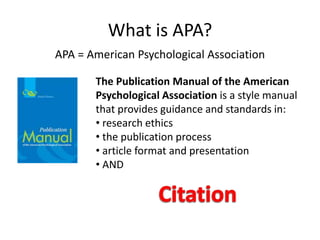
What is APA?APA = American Psychological AssociationThe Publication Manual of the American Psychological Association is a style manual that provides guidance and standards in: research ethics
 the publication process
 article format and presentation
 ANDCitation
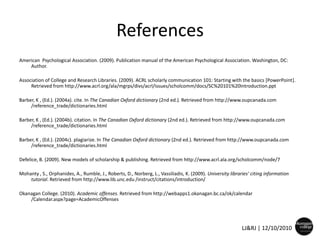
What is citation?Cite1. to support an argument. 2. quote (a passage, book, or author). (Barber, 2004a)Citation1. the act of citing something from a book or other source. 2. a passage cited. (Barber, 2004b)
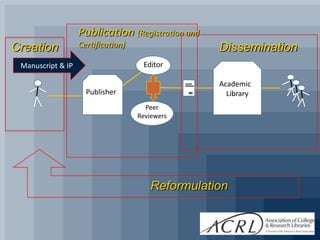
Why do we cite?“Scholarly communication is the entire set of activities that ensure that research and new knowledge can be made known” (DeFelice, 2009)
Publication (Registration and Certification)CreationDisseminationManuscript & IPAcademicLibraryPublisherEditorPeer ReviewersReformulation
Why do we cite?Citations demonstrate how you developed your argument and ideas from the ideas of othersCitations give credit where credit is dueCitations give the reader of your work a path to the sources you used, so they can investigate those sources if interested(Mohanty et al., 2009)
Why do we cite?If you don’t acknowledge other people’s work, words or ideas you commit plagiarismPlagiarize:1. take and use (the thoughts, writings, inventions, etc. of another person) as one's own. 2. pass off the thoughts etc. of (another person) as one's own.(Barber, 2004c)
Why do we cite?Okanagan College Academic Offenses regulations and policies“Penalties for plagiarism serve both to educate students about standards of scholarship and to deter deception and poor scholarly practices. Penalties will reflect the seriousness of the offence; including whether the offence was intentional or unintentional and whether it was a first or a repeat offence” (Okanagan College, 2010, Penalties section, para. 1 ).
What do we cite? Direct quotes
 Paraphrases
 Words or terminology specific to or unique to the author’s research, theories, or ideas
 Use of an author's argument or line of thinking
 Historical, statistical, or scientific facts
 Graphs, drawings, etc.
 Articles or studies you refer to in your work(Mohanty et al., 2009)
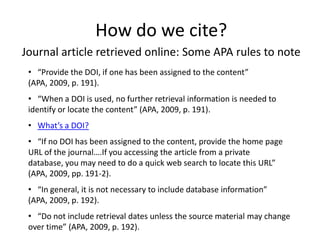
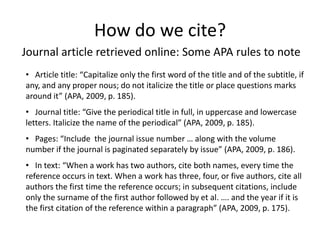
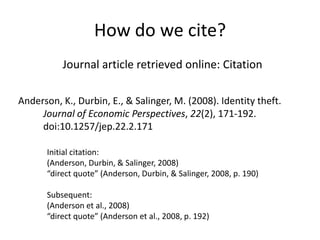
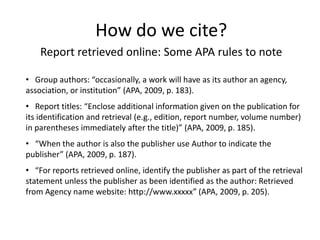
How do we cite?What is it?Journal article
Book
ReportWhat format?Print
ElectronicBuilding blocks?Author(s)
Publication date
Title
Publication information
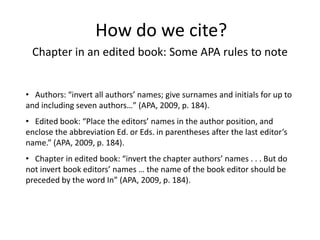
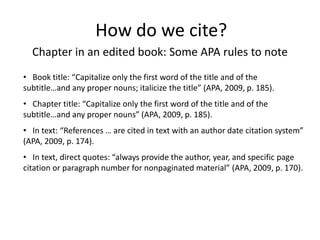
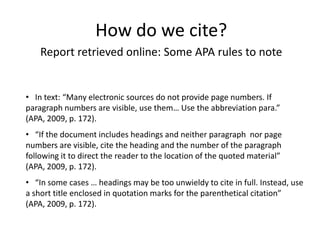
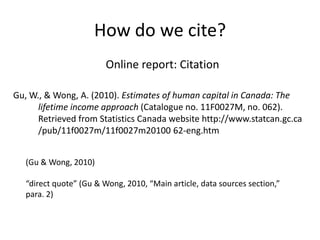
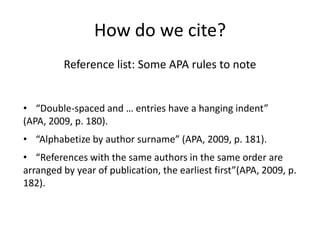
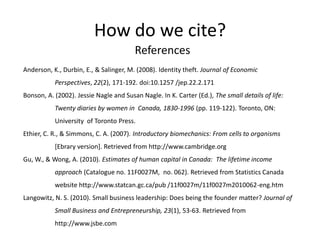
Format-specific details (i.e. page numbers, doi)How do we cite?In text citations:  citations given in the body of the article/essay/paper/assignment.Reference list citations: “provides the information necessary to identify and retrieve each source” (APA, 2009, p. 180).
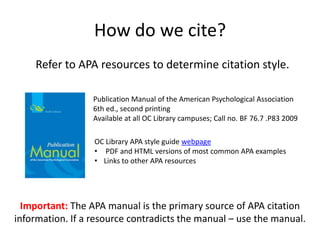
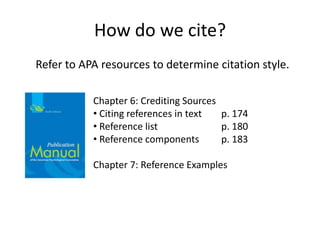
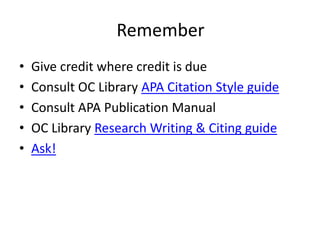
How do we cite?Refer to APA resources to determine citation style.Publication Manual of the American Psychological Association6th ed., second printingAvailable at all OC Library campuses; Call no. BF 76.7 .P83 2009 OC Library APA style guide webpage PDF and HTML versions of most common APA examples

Cite It Right!

  • 1.
    Cite It Right!OkanaganCollege LibraryFall 2010
  • 2.
    Objectives To understandwhy we cite To understand how we cite To understand the basics of APA
  • 3.
    What is APA?APA= American Psychological AssociationThe Publication Manual of the American Psychological Association is a style manual that provides guidance and standards in: research ethics
  • 4.
  • 5.
    article formatand presentation
  • 6.
  • 7.
    What is citation?Cite1. tosupport an argument. 2. quote (a passage, book, or author). (Barber, 2004a)Citation1. the act of citing something from a book or other source. 2. a passage cited. (Barber, 2004b)
  • 8.
    Why do wecite?“Scholarly communication is the entire set of activities that ensure that research and new knowledge can be made known” (DeFelice, 2009)
  • 9.
    Publication (Registration andCertification)CreationDisseminationManuscript & IPAcademicLibraryPublisherEditorPeer ReviewersReformulation
  • 10.
    Why do wecite?Citations demonstrate how you developed your argument and ideas from the ideas of othersCitations give credit where credit is dueCitations give the reader of your work a path to the sources you used, so they can investigate those sources if interested(Mohanty et al., 2009)
  • 11.
    Why do wecite?If you don’t acknowledge other people’s work, words or ideas you commit plagiarismPlagiarize:1. take and use (the thoughts, writings, inventions, etc. of another person) as one's own. 2. pass off the thoughts etc. of (another person) as one's own.(Barber, 2004c)
  • 12.
    Why do wecite?Okanagan College Academic Offenses regulations and policies“Penalties for plagiarism serve both to educate students about standards of scholarship and to deter deception and poor scholarly practices. Penalties will reflect the seriousness of the offence; including whether the offence was intentional or unintentional and whether it was a first or a repeat offence” (Okanagan College, 2010, Penalties section, para. 1 ).
  • 13.
    What do wecite? Direct quotes
  • 14.
  • 15.
    Words orterminology specific to or unique to the author’s research, theories, or ideas
  • 16.
    Use ofan author's argument or line of thinking
  • 17.
    Historical, statistical,or scientific facts
  • 18.
  • 19.
    Articles orstudies you refer to in your work(Mohanty et al., 2009)
  • 20.
    How do wecite?What is it?Journal article
  • 21.
  • 22.
  • 23.
  • 24.
  • 25.
  • 26.
  • 27.
    Format-specific details (i.e.page numbers, doi)How do we cite?In text citations: citations given in the body of the article/essay/paper/assignment.Reference list citations: “provides the information necessary to identify and retrieve each source” (APA, 2009, p. 180).
  • 28.
    How do wecite?Refer to APA resources to determine citation style.Publication Manual of the American Psychological Association6th ed., second printingAvailable at all OC Library campuses; Call no. BF 76.7 .P83 2009 OC Library APA style guide webpage PDF and HTML versions of most common APA examples

Editor's Notes

  • #7 Traditional system of scholarly communication….Standing on the shoulders of giants….
  • #11 A good rule of thumb is to ask yourself if a knowledgeable reader would be familiar with the information in question. If he or she would have to look it up to confirm it, you should usually document it. If you're not sure, cite it to play it safe.APA advises: “Cite the work of those individuals whose ideas, theories, or research have directly influenced your work. They may provide key background information, support of dispute your thesis, or offer critical definitions and data. Citation of an article implies that you have personally read the cited work. In addition….provide documentation for all facts and figures that are not common knowledge” (p. 169).
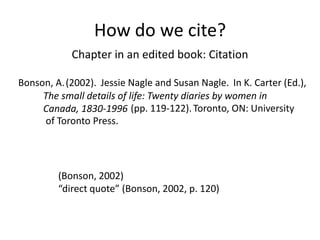
  • #12 Chapter in edited bookE-bookPrint journal articleElectronic journal article, databasePrint reportElectronic (pdf) reportElectronic (html) report
  • #18 Call out, show on ppt
  • #21 Elements on board, ask to put in proper order