BY ADANWALI HASSAN AHMED
MWN, BSC- MEDICAL DOCTOR(MD),
HEALTH OFFICER(HO), MSC-
GYN/OBEST.
ANTENATAL CARE
ANTENATAL CARE
Definition
Antenatal care refers to the care that is
given to an expected mother from time
of conception is confirmed until the
beginning of labor.
It is a preventative cost effective service
GOALS
1-Ensure mother health.
2- Ensure delivery of a healthy infant.
3-Anticipate problem.
4- Diagnose problem early.
Objectives:
1-Early detection and if possible, prevention of
complications of pregnancy.
2-Educate women on danger and emergency
signs & symptoms.
3-Prepare the woman and her family for
childbirth.
4- Give education & counseling on
family planning.
Cont---
1.To detect problems that might affect the woman's
pregnancy and require additional care - routinely,
screen for Anemia, Hypertension, HIV, Syphilis and
Diabetes Mellitus.
 Recognize other problems that may complicate
pregnancy: Malnutrition and Tuberculosis, Vaginal
bleeding, Vaginal discharge, Fetal distress and
Abnormal fetal position after 36 weeks
1.Danger and emergency signs: Fever, vaginal
bleeding, headache and blurring of vision, severe
abdominal pain, convulsion, severe difficulty of
breathing
2. Birth and emergency plan
Schedule of antenatal care:
Medical check up:
Every four weeks up to 28 weeks
gestation
Every 2 weeks until 36 weeks of
gestation
Every week until delivery
An average 7-11 antenatal
visits/pregnancy.
More frequent visits may be required if
complications arise.
On first antenatal visit
1-First : Confirm pregnancy by
pregnancy test or US.
2-History
3-Physical examination
4-investigation
History
 Personal history
 Menstrual history
 Obstetrical history
 Family history
 Medical and surgical history
 History of present pregnancy.
IMMEDIATE ASSESSMENT
for emergency signs.
Vaginal bleeding
Severe abdominal or pelvic pain
Severe headache with visual disturbance
Persistent vomiting
Unconscious/Convulsion
Severe difficulty in breathing
High grade Fever
Looks very ill
Weight measurement
 Maternal height and weight measurements
to determine body mass index(BMI).
 Maternal weight should be
measured at each antenatal
Visit.
Check for pallor or anemia.
1-Look for palmar pallor.
2-Look for conjunctival
pallor
3-Count respiratory rate in
one minute.
Blood pressure measurement
Measure BP in sitting position.
If diastolic BP is 90 mm Hg or higher
repeat measurement after 6 hour
rest.
If diastolic BP is still 90 mm Hg or
higher ask the woman if she has:
• Severe headache
• Blurred vision
• Epigastric pain
Check urine for protein.
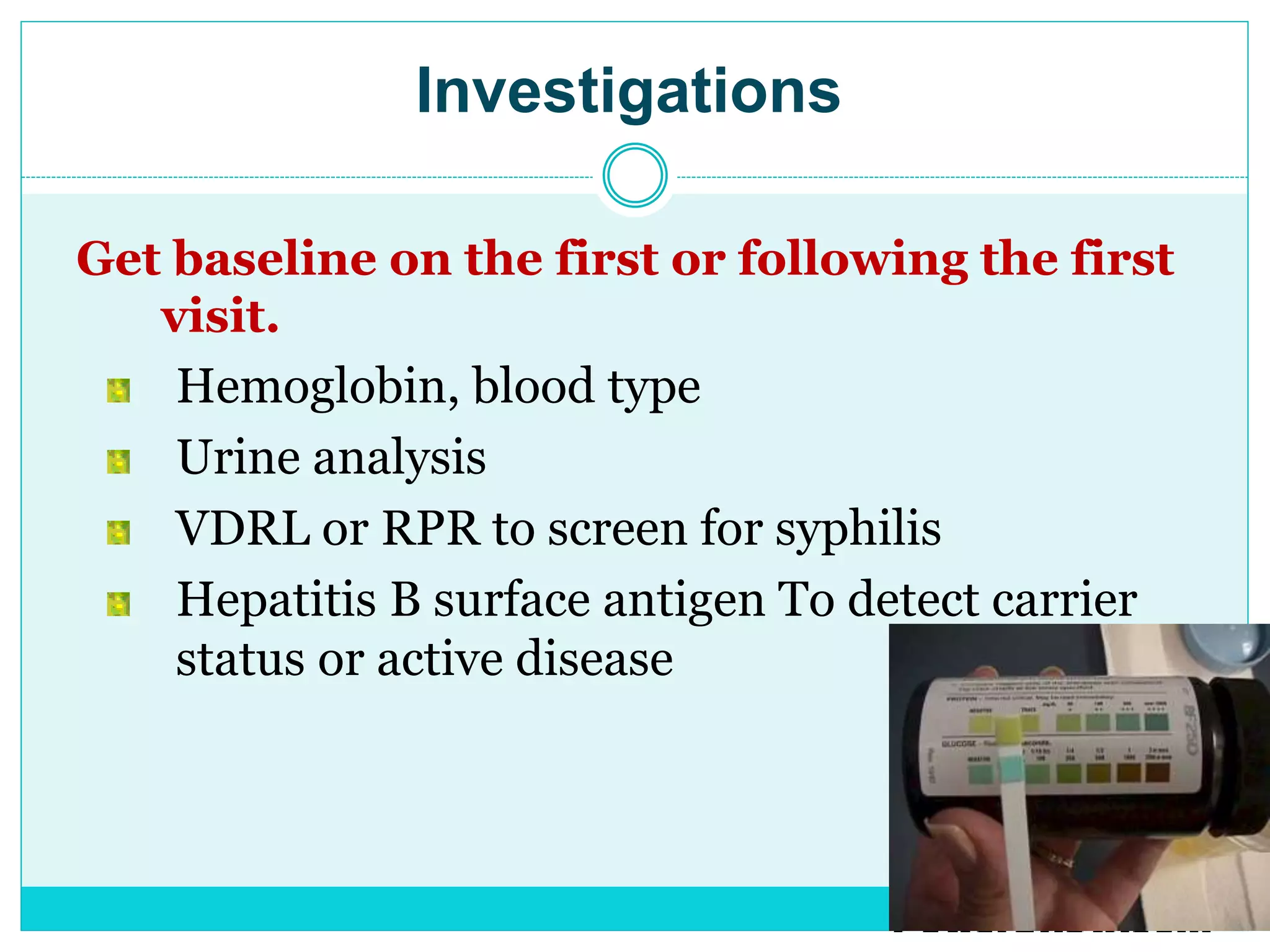
Get baseline on the first or following the first
visit.
Hemoglobin, blood type
Urine analysis
VDRL or RPR to screen for syphilis
Hepatitis B surface antigen To detect carrier
status or active disease
Investigations
At each visit
 1-Questions about fetal movement
 2-Ask for danger signs during this pregnancy
 3-Ask patient if she has any other concerns
Symphysis Fundal hieght
• LMP plus 280
days
• Add 7 days,
subtract 3 months
• MacDonald's Rule
(cm = weeks)
At third trimester
Do
Leopold’s exam
Provide advice on
1.Diet and weight gain
2.Medication
3.Avoid Radiation exposure
4.Self-care during pregnancy
5.Minor complaints.
6.Family planning Breastfeeding
7.Birth place preparation and anticipation of
complication& Emergency situations.
Supplementation
 1-Folic acid 0.4 mg tab daily
 2- iron (ferrous sulphate or gluconate )300 mg/daily
 3- Ca 1200mg /daily.
• -Those with a normal balanced diet
• probably don’t need extra vitamins
Weight gain in pregnancy:
 There is a slight loss of pounds during early
pregnancy if the patient experiences much nausea
and vomiting.
 Weight gain of 2 to 4 lbs(0,5-1 kg) by the end of the
first trimester.
 Gain of 1 lb(0.5)/ per wk is expected during the
second and third trimesters.
 Monitoring of weight gain should be done in
conjunction with close monitoring of BP.
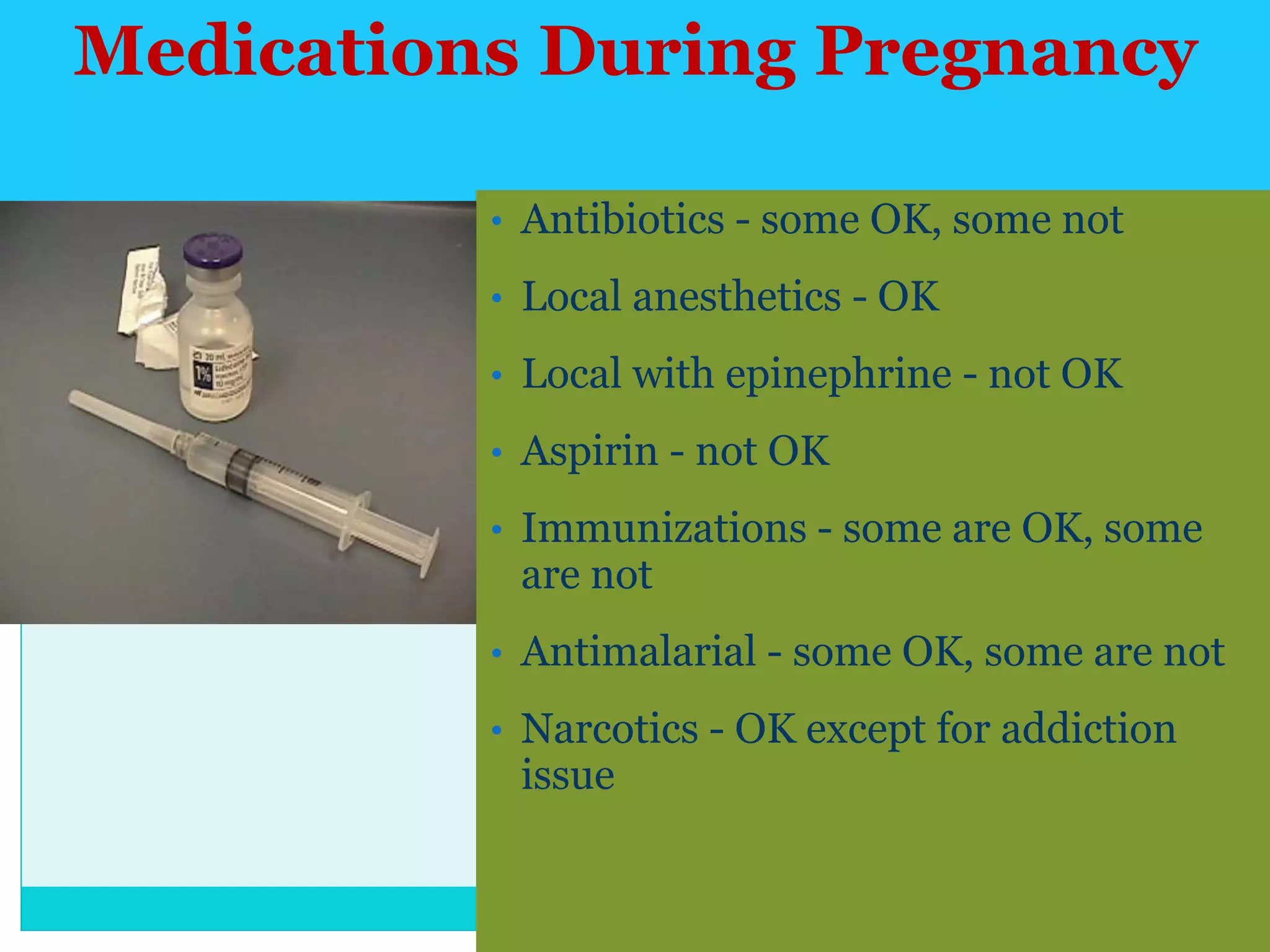
Medications During Pregnancy
• Antibiotics - some OK, some not
• Local anesthetics - OK
• Local with epinephrine - not OK
• Aspirin - not OK
• Immunizations - some are OK, some
are not
• Antimalarial - some OK, some are not
• Narcotics - OK except for addiction
issue
Which vaccines should I not get if I am
pregnant?
 Human papillomavirus (HPV) vaccine.
 Measles, mumps, and rubella (MMR) vaccine.
 Live influenza vaccine (nasal flu vaccine)
 Varicella (chicken pox) vaccine.
 Certain travel vaccines: yellow fever, typhoid fever,
and Japanese encephalitis.
Postnatal Care
Introduction:
 The postnatal period is the period when most
maternal deaths occur compared to the
antepartum and intrapartum periods.
DEFINITION:
 PNC is the care provided to the woman
and her baby during the six weeks period,
following delivery in order to promote
healthy behavior and early identification
and management of complications.
24
 It should include assessment, health promotion and
care provision.
 WHO recommends a postpartum visit within 1-3 days,
if possible through home visits by community health
workers.
 The main life threatening complications of the
postnatal period include
 Hemorrhage
 Anemia
 Genital trauma
 Hypertension
 sepsis, UTI and
 Mastitis. 25
POST NATAL CARE
CONTEXTS:
1. OBJECTIVES
2. THE FIRST 24 HRS AFTER CHILD BIRTH
3. INFORMATION OF THE NEW BABY
4. DURING THE FIRST FEW WKS
5. CONCERN ON FOR BREAST FEEDING
6. CONCERN FOR THE NEW BORN BABY
7. AT EVERY POST NATAL CONTACT
8. BY 6-8 WKS
9. CHALLENGES IN PNC SERVICES
26
1. Objectives
 PNC Plan- Include relevant care
according to the present condition and
that during previous pregnancy, labor
and child birth.
 Adequate rest, privacy, food and plenty
of oral drinks
 Observation of any abnormalities in both
mother and baby by examining both in
the first 1 hr , 24 hrs and continuously.
 Advise on baby, self and future
pregnancies
27
2. In the first 24 hrs
 Measure BP every 6 hrs.
 Check if have passed urine within the first 6 hrs &
observe the Lochia (for clots, offensive smell
etc)
 Encourage moving around & gently (Ambulant)
 Offer you an opportunity to talk about the birth.
 Cleaning of the perinuem using non antiseptic
lotions or soap, but saline water
 Perineal exercises
 After pains in the first 2-3 days caused by mild
contractions of the uterus can be relieved by
500mg of paracetamol.
28
Cont..
 Observe changes in the uterus.
 Daily palpation of the uterine fundus.
 Lochia should change gradually from bloody to
watery until it clears completely.
 Be informed of the problems e.g, fever, breast
engorgement, PV bleeding, smelly discharge,
sores on the nipples, inverted nipples, baby
blues , episiotomy site and how to clean it.
 If mother had a C/S, advise her on the care of the
wound , eating habits, bowel and bladder care.
 She has to remain in the hospital until her
condition and the baby stabilizes, or as per Drs
advise.
29
Cont..
 The first breast milk (colostrum) & is importance
to be explained (rich in fats and proteins and
protects the baby from infection- contains
antibodies).
 Best position and holding the baby on the
breast should be explained.
 The baby should be put on each breast
interchangebly.
 Observe flattened nipples and use your fingers
to roll the nipples continously.
 Breast feeding exclusively is important for the
first 6 months unless contraindicated.
3. Information on the baby
 Baby should pass thick, sticky, greenish stool
(meconium) in the first 24 hrs
 Should able to breast feed.
 Inj Vit K is administered.
 Normal baby’s skin is (yellow colour) in the first 24
hrs(physiological jaundice).
 Mothers are advised to put their children with such
conditions under the sunrays in the morning for
some days to enable the body manufacture Vit D,
if it persists (Pathological Jaundice )this therefore
needs attention of the Dr.
 The baby should be examined throughly in the first
72 hrs for any abnormalities. 31
4. During the first few wks
The following problems may occur and the mother should
be advised accordingly;
 Urine retention
 Infection presented by fever – pueperal pyrexia
 Constipation
 Incontinence of urine
 Baby blues(Post natal depression or post partum
psychosis).
 Haemorroids
 Faecal incontinance
 Anaemia
 PV bleeding
 Musculoskeletal problems
32
5. Concern on breastfeeding
 Inverted nipples
 Painfull, tender breasts
 Cracked or painful nipples
 Mastitis (Red, tender and painful breasts)
 Sleepy baby
 Not enough milk
 Difficulties in positioning the baby for
breastfeeding.
33
6. Concern for the newly born baby
 Pale stool
 Jaundice in breastfeeding babies
 Persistent and painful nappy rash
 Thrush (fungal infection in the mouth)
 Failure to pass meconium in the first 24 hrs
34
7. At every Post natal contact;
- Advise on exercise, nutrition, family planning,
hygiene, perineal muscle exercises, vulval
swabbing (using for saline water.)
o Breast feeding exclusively
o Immunization
o Treatment of any infections
o Prevention of HIV and other STDs.
o Family planning options
35
Cont---;
 Examine the breast for the nipples and
masses.
 Teach the mother self breast examination.
 Examine the size of the uterus, by 10 days it
should have reduced but involution is not
complete until 6 weeks following child birth.
 Take BP, Temperature
 Assess for any abnormal PV discharge
 Self care.
36
8. By 6-8 WKS
 The reproductive organs have returned to
the non pregnant state.
 Lactation is fully established
 Other physiology changes have been
reversed
 Baby has created relationship with the
parents
 The mother has fully recovered from the
stress of pregnancy and assumes fully
responsibility to care for the infant. 37
9. Challenges in PNC Services
 Distance form health units for continuity of care
 Lack of male involvement
 Poor economic status of the family
 HIV/AIDS and other diseases in the mother
 Too short periods of conception between
pregnancies
 Preterm babies and babies born with congenital
abnormalities which may need intensive care.
 Young mothers
 Deliveries done under surgical measures that
require hospital confinement.
 Other illnesses aggravated by pregnancy, eg
hypertension, diabetes, Sickle cell anaemia etc..
38
Delivery Care
 Normal birth is defined as Spontaneous in
onset, low risk at start of labour and
remaining so throughout labour and
delivery.
 The infant is born spontaneously in the
vertex position between 37-42 completed
weeks of pregnancies.
 After birth, mother and baby (child) are in
good condition.
Cont---
 Describes as the process by which the fetus,
placenta with its membrane is expelled
through birth canal.
 It is not always possible to anticipate which
pregnancies end up with complications.
 Therefore, it is essential to extend delivery
services to all pregnant women in order to
provide timely help for complications of labour
and delivery.
 Delivering women should be observed at least
for 24 hours after delivery as most of the deaths
post partum occur at this time.
Aims of delivery care are to achieve
 A healthy mother and child with the least
possible level of intervention .
 Early detection and management of
complications.
 Timely referral of obstetric emergencies
(if any) to a level where it can be
managed appropriately.
Cont---
 More than three-quarters of all maternal
deaths in developing countries take place
during or soon after childbirth.
 Based on these aims, the single most
critical intervention for safe motherhood is
to ensure that a skilled attendant is
present in every birth, and transportation is
available in case of an emergency referral.
Who is a skilled attendant?
 In 1999, the WHO/UNFPA/UNICEF/World
Bank statement recognized skilled attendants
as health professionals such as midwives,
doctors, or nurses with midwifery skills
who have been educated and trained to
proficiency in the skills necessary to manage
normal pregnancies,
 Childbirth and the immediate postnatal
period, and the identification, management,
and referral of complications in women and
newborns.
Cont--
 Skilled care during childbirth is important
because millions of women and newborns
develop hard-to predict complications during
or immediately after delivery.
 Skilled attendants can also recognize these
complications, and either treat them or refer
women to health centers or hospitals
immediately if more advanced care is needed.
 Skilled attendance depends on a partnership
of skilled attendants, an enabling environment,
and access to emergency obstetric care
services.
Cont---
 This means Skilled attendance can only be
provided when health professionals operate
within a functioning health system, or
‘enabling environment’, where drugs,
equipment, supplies, and transport are all
available.
 In 1996, skilled birth attendants were present
at only 53 % of births in the developing world.
 In the developed world, skilled birth
attendance is almost universal.
Cont---
 The best person to care for women during
delivery is a health professional with
midwifery skills who lives in or near to the
community he or she serves.
 However, most midwives work in hospitals
and urban areas.
 In parts of Asia and Africa, there is only
one midwife for every 15,000 births.
Cont--
 Adequate equipment, drugs and supplies
are also essential to enable skilled
attendants to provide good quality care.
 In addition, skilled attendants need to be
supported by appropriate supervision.
 When delivery is taking place at home or in
a local health facility, an emergency
transport system must be available to take
women to facilities that can be provide more
advanced care.
Cont---
 In developing countries women commonly
seek the help of traditional birth
attendants.
 These attendants may have some
training. However, without emergency
backup support (including referral),
training TBAs does not decrease a
woman’s risk of dying during childbirth.
Cont--
 As countries try to ensure that a qualified
health professional is present at the birth of
every child, they face a number of significant
problems.
 Which are:-
• Existing health workers often lack the skills
they need to save the lives of women who
suffer emergency complications
• Curricula used to teach midwifery skills are
often out of date and do not reflect new
techniques and research.
Cont---
• In many places, especially in Africa and
Asia, women give birth with the help of a
relative, or alone Reproductive Health .
•Refresher training in family planning and
maternal health care are often inadequate.
• Many midwives and physicians have no
training in traditional belief systems,
communication and community organizing.
Recommended ways to increase
skilled birth attendance
 Increase the number of professionals with
midwifery skills in underserved regions.
 ‰
Train, authorize and equip midwives, nurses and
community physicians to provide all feasible
obstetric services needed within communities,
especially emergency interventions and to
prescribe medications.
 ‰
Upgrade, establish and expand comprehensive
midwifery training programs that include
lifesaving skills for dealing with obstetric
emergencies.
Cont---
 Create clearly defined protocols for
routine care and the management of
complications.
 Establish systems for supervising and
supporting skilled attendants, and for
emergency referral and Rx.
 TBAs already exist in many developing
country communities, it has been suggested
that they could perform the role of the skilled
attendant, where required with some training.
Cont---
 However, it is recognized that for some
women TBAs are the only source of care
available during pregnancy.
 Some countries such as Malaysia has
shown, TBAs can become an important
element in a country’s safe motherhood
strategy and can serve as key partners for
increasing the number of births at which a
skilled attendant is present.
Cont----
 The impact of training TBAs on maternal
mortality appears to be limited and the
greatest benefit may be improved referral
and linkages with the formal health
system.
 Results from a meta-analysis suggest that
TBA training may increase antenatal
attendance rates.
Cont
 In practical terms, TBAs can help in the
provision of skilled care to women and
newborns by serving as advocates for skilled
attendants and maternal and newborn health
needs, disseminating health information
through the community and families.
 In all countries, emphasis should be placed
on training and deploying an adequate
number of professional, skilled midwives to
provide the majority of delivery care.
 Where TBAs account for a significant portion of
deliveries, safe motherhood programs should
include activities aimed at providing adequate
supervision and integrating them into the health
system:-
 ‰
Appropriate training (skilled trainers and
appropriate teaching methodologies).
 Linkages to the health system that include
proper supervision and referral for
complicated cases.
 ‰
Ongoing assessment of the impact of TBA
programs.
END
THANK YOUFOR YOUR
LISTENING

ANC- PRESENTATION OF ANC,PNC & DC.pptx

  • 1.
    BY ADANWALI HASSANAHMED MWN, BSC- MEDICAL DOCTOR(MD), HEALTH OFFICER(HO), MSC- GYN/OBEST. ANTENATAL CARE
  • 2.
  • 3.
    Definition Antenatal care refersto the care that is given to an expected mother from time of conception is confirmed until the beginning of labor. It is a preventative cost effective service
  • 4.
    GOALS 1-Ensure mother health. 2-Ensure delivery of a healthy infant. 3-Anticipate problem. 4- Diagnose problem early.
  • 5.
    Objectives: 1-Early detection andif possible, prevention of complications of pregnancy. 2-Educate women on danger and emergency signs & symptoms. 3-Prepare the woman and her family for childbirth. 4- Give education & counseling on family planning.
  • 6.
    Cont--- 1.To detect problemsthat might affect the woman's pregnancy and require additional care - routinely, screen for Anemia, Hypertension, HIV, Syphilis and Diabetes Mellitus.  Recognize other problems that may complicate pregnancy: Malnutrition and Tuberculosis, Vaginal bleeding, Vaginal discharge, Fetal distress and Abnormal fetal position after 36 weeks
  • 7.
    1.Danger and emergencysigns: Fever, vaginal bleeding, headache and blurring of vision, severe abdominal pain, convulsion, severe difficulty of breathing 2. Birth and emergency plan
  • 8.
    Schedule of antenatalcare: Medical check up: Every four weeks up to 28 weeks gestation Every 2 weeks until 36 weeks of gestation Every week until delivery An average 7-11 antenatal visits/pregnancy. More frequent visits may be required if complications arise.
  • 9.
    On first antenatalvisit 1-First : Confirm pregnancy by pregnancy test or US. 2-History 3-Physical examination 4-investigation
  • 10.
    History  Personal history Menstrual history  Obstetrical history  Family history  Medical and surgical history  History of present pregnancy.
  • 11.
    IMMEDIATE ASSESSMENT for emergencysigns. Vaginal bleeding Severe abdominal or pelvic pain Severe headache with visual disturbance Persistent vomiting Unconscious/Convulsion Severe difficulty in breathing High grade Fever Looks very ill
  • 12.
    Weight measurement  Maternalheight and weight measurements to determine body mass index(BMI).  Maternal weight should be measured at each antenatal Visit.
  • 13.
    Check for palloror anemia. 1-Look for palmar pallor. 2-Look for conjunctival pallor 3-Count respiratory rate in one minute.
  • 14.
    Blood pressure measurement MeasureBP in sitting position. If diastolic BP is 90 mm Hg or higher repeat measurement after 6 hour rest. If diastolic BP is still 90 mm Hg or higher ask the woman if she has: • Severe headache • Blurred vision • Epigastric pain Check urine for protein.
  • 15.
    Get baseline onthe first or following the first visit. Hemoglobin, blood type Urine analysis VDRL or RPR to screen for syphilis Hepatitis B surface antigen To detect carrier status or active disease Investigations
  • 16.
    At each visit 1-Questions about fetal movement  2-Ask for danger signs during this pregnancy  3-Ask patient if she has any other concerns
  • 17.
    Symphysis Fundal hieght •LMP plus 280 days • Add 7 days, subtract 3 months • MacDonald's Rule (cm = weeks)
  • 18.
  • 19.
    Provide advice on 1.Dietand weight gain 2.Medication 3.Avoid Radiation exposure 4.Self-care during pregnancy 5.Minor complaints. 6.Family planning Breastfeeding 7.Birth place preparation and anticipation of complication& Emergency situations.
  • 20.
    Supplementation  1-Folic acid0.4 mg tab daily  2- iron (ferrous sulphate or gluconate )300 mg/daily  3- Ca 1200mg /daily. • -Those with a normal balanced diet • probably don’t need extra vitamins
  • 21.
    Weight gain inpregnancy:  There is a slight loss of pounds during early pregnancy if the patient experiences much nausea and vomiting.  Weight gain of 2 to 4 lbs(0,5-1 kg) by the end of the first trimester.  Gain of 1 lb(0.5)/ per wk is expected during the second and third trimesters.  Monitoring of weight gain should be done in conjunction with close monitoring of BP.
  • 22.
    Medications During Pregnancy •Antibiotics - some OK, some not • Local anesthetics - OK • Local with epinephrine - not OK • Aspirin - not OK • Immunizations - some are OK, some are not • Antimalarial - some OK, some are not • Narcotics - OK except for addiction issue
  • 23.
    Which vaccines shouldI not get if I am pregnant?  Human papillomavirus (HPV) vaccine.  Measles, mumps, and rubella (MMR) vaccine.  Live influenza vaccine (nasal flu vaccine)  Varicella (chicken pox) vaccine.  Certain travel vaccines: yellow fever, typhoid fever, and Japanese encephalitis.
  • 24.
    Postnatal Care Introduction:  Thepostnatal period is the period when most maternal deaths occur compared to the antepartum and intrapartum periods. DEFINITION:  PNC is the care provided to the woman and her baby during the six weeks period, following delivery in order to promote healthy behavior and early identification and management of complications. 24
  • 25.
     It shouldinclude assessment, health promotion and care provision.  WHO recommends a postpartum visit within 1-3 days, if possible through home visits by community health workers.  The main life threatening complications of the postnatal period include  Hemorrhage  Anemia  Genital trauma  Hypertension  sepsis, UTI and  Mastitis. 25
  • 26.
    POST NATAL CARE CONTEXTS: 1.OBJECTIVES 2. THE FIRST 24 HRS AFTER CHILD BIRTH 3. INFORMATION OF THE NEW BABY 4. DURING THE FIRST FEW WKS 5. CONCERN ON FOR BREAST FEEDING 6. CONCERN FOR THE NEW BORN BABY 7. AT EVERY POST NATAL CONTACT 8. BY 6-8 WKS 9. CHALLENGES IN PNC SERVICES 26
  • 27.
    1. Objectives  PNCPlan- Include relevant care according to the present condition and that during previous pregnancy, labor and child birth.  Adequate rest, privacy, food and plenty of oral drinks  Observation of any abnormalities in both mother and baby by examining both in the first 1 hr , 24 hrs and continuously.  Advise on baby, self and future pregnancies 27
  • 28.
    2. In thefirst 24 hrs  Measure BP every 6 hrs.  Check if have passed urine within the first 6 hrs & observe the Lochia (for clots, offensive smell etc)  Encourage moving around & gently (Ambulant)  Offer you an opportunity to talk about the birth.  Cleaning of the perinuem using non antiseptic lotions or soap, but saline water  Perineal exercises  After pains in the first 2-3 days caused by mild contractions of the uterus can be relieved by 500mg of paracetamol. 28
  • 29.
    Cont..  Observe changesin the uterus.  Daily palpation of the uterine fundus.  Lochia should change gradually from bloody to watery until it clears completely.  Be informed of the problems e.g, fever, breast engorgement, PV bleeding, smelly discharge, sores on the nipples, inverted nipples, baby blues , episiotomy site and how to clean it.  If mother had a C/S, advise her on the care of the wound , eating habits, bowel and bladder care.  She has to remain in the hospital until her condition and the baby stabilizes, or as per Drs advise. 29
  • 30.
    Cont..  The firstbreast milk (colostrum) & is importance to be explained (rich in fats and proteins and protects the baby from infection- contains antibodies).  Best position and holding the baby on the breast should be explained.  The baby should be put on each breast interchangebly.  Observe flattened nipples and use your fingers to roll the nipples continously.  Breast feeding exclusively is important for the first 6 months unless contraindicated.
  • 31.
    3. Information onthe baby  Baby should pass thick, sticky, greenish stool (meconium) in the first 24 hrs  Should able to breast feed.  Inj Vit K is administered.  Normal baby’s skin is (yellow colour) in the first 24 hrs(physiological jaundice).  Mothers are advised to put their children with such conditions under the sunrays in the morning for some days to enable the body manufacture Vit D, if it persists (Pathological Jaundice )this therefore needs attention of the Dr.  The baby should be examined throughly in the first 72 hrs for any abnormalities. 31
  • 32.
    4. During thefirst few wks The following problems may occur and the mother should be advised accordingly;  Urine retention  Infection presented by fever – pueperal pyrexia  Constipation  Incontinence of urine  Baby blues(Post natal depression or post partum psychosis).  Haemorroids  Faecal incontinance  Anaemia  PV bleeding  Musculoskeletal problems 32
  • 33.
    5. Concern onbreastfeeding  Inverted nipples  Painfull, tender breasts  Cracked or painful nipples  Mastitis (Red, tender and painful breasts)  Sleepy baby  Not enough milk  Difficulties in positioning the baby for breastfeeding. 33
  • 34.
    6. Concern forthe newly born baby  Pale stool  Jaundice in breastfeeding babies  Persistent and painful nappy rash  Thrush (fungal infection in the mouth)  Failure to pass meconium in the first 24 hrs 34
  • 35.
    7. At everyPost natal contact; - Advise on exercise, nutrition, family planning, hygiene, perineal muscle exercises, vulval swabbing (using for saline water.) o Breast feeding exclusively o Immunization o Treatment of any infections o Prevention of HIV and other STDs. o Family planning options 35
  • 36.
    Cont---;  Examine thebreast for the nipples and masses.  Teach the mother self breast examination.  Examine the size of the uterus, by 10 days it should have reduced but involution is not complete until 6 weeks following child birth.  Take BP, Temperature  Assess for any abnormal PV discharge  Self care. 36
  • 37.
    8. By 6-8WKS  The reproductive organs have returned to the non pregnant state.  Lactation is fully established  Other physiology changes have been reversed  Baby has created relationship with the parents  The mother has fully recovered from the stress of pregnancy and assumes fully responsibility to care for the infant. 37
  • 38.
    9. Challenges inPNC Services  Distance form health units for continuity of care  Lack of male involvement  Poor economic status of the family  HIV/AIDS and other diseases in the mother  Too short periods of conception between pregnancies  Preterm babies and babies born with congenital abnormalities which may need intensive care.  Young mothers  Deliveries done under surgical measures that require hospital confinement.  Other illnesses aggravated by pregnancy, eg hypertension, diabetes, Sickle cell anaemia etc.. 38
  • 39.
    Delivery Care  Normalbirth is defined as Spontaneous in onset, low risk at start of labour and remaining so throughout labour and delivery.  The infant is born spontaneously in the vertex position between 37-42 completed weeks of pregnancies.  After birth, mother and baby (child) are in good condition.
  • 40.
    Cont---  Describes asthe process by which the fetus, placenta with its membrane is expelled through birth canal.  It is not always possible to anticipate which pregnancies end up with complications.  Therefore, it is essential to extend delivery services to all pregnant women in order to provide timely help for complications of labour and delivery.  Delivering women should be observed at least for 24 hours after delivery as most of the deaths post partum occur at this time.
  • 41.
    Aims of deliverycare are to achieve  A healthy mother and child with the least possible level of intervention .  Early detection and management of complications.  Timely referral of obstetric emergencies (if any) to a level where it can be managed appropriately.
  • 42.
    Cont---  More thanthree-quarters of all maternal deaths in developing countries take place during or soon after childbirth.  Based on these aims, the single most critical intervention for safe motherhood is to ensure that a skilled attendant is present in every birth, and transportation is available in case of an emergency referral.
  • 43.
    Who is askilled attendant?  In 1999, the WHO/UNFPA/UNICEF/World Bank statement recognized skilled attendants as health professionals such as midwives, doctors, or nurses with midwifery skills who have been educated and trained to proficiency in the skills necessary to manage normal pregnancies,  Childbirth and the immediate postnatal period, and the identification, management, and referral of complications in women and newborns.
  • 44.
    Cont--  Skilled careduring childbirth is important because millions of women and newborns develop hard-to predict complications during or immediately after delivery.  Skilled attendants can also recognize these complications, and either treat them or refer women to health centers or hospitals immediately if more advanced care is needed.  Skilled attendance depends on a partnership of skilled attendants, an enabling environment, and access to emergency obstetric care services.
  • 45.
    Cont---  This meansSkilled attendance can only be provided when health professionals operate within a functioning health system, or ‘enabling environment’, where drugs, equipment, supplies, and transport are all available.  In 1996, skilled birth attendants were present at only 53 % of births in the developing world.  In the developed world, skilled birth attendance is almost universal.
  • 46.
    Cont---  The bestperson to care for women during delivery is a health professional with midwifery skills who lives in or near to the community he or she serves.  However, most midwives work in hospitals and urban areas.  In parts of Asia and Africa, there is only one midwife for every 15,000 births.
  • 47.
    Cont--  Adequate equipment,drugs and supplies are also essential to enable skilled attendants to provide good quality care.  In addition, skilled attendants need to be supported by appropriate supervision.  When delivery is taking place at home or in a local health facility, an emergency transport system must be available to take women to facilities that can be provide more advanced care.
  • 48.
    Cont---  In developingcountries women commonly seek the help of traditional birth attendants.  These attendants may have some training. However, without emergency backup support (including referral), training TBAs does not decrease a woman’s risk of dying during childbirth.
  • 49.
    Cont--  As countriestry to ensure that a qualified health professional is present at the birth of every child, they face a number of significant problems.  Which are:- • Existing health workers often lack the skills they need to save the lives of women who suffer emergency complications • Curricula used to teach midwifery skills are often out of date and do not reflect new techniques and research.
  • 50.
    Cont--- • In manyplaces, especially in Africa and Asia, women give birth with the help of a relative, or alone Reproductive Health . •Refresher training in family planning and maternal health care are often inadequate. • Many midwives and physicians have no training in traditional belief systems, communication and community organizing.
  • 51.
    Recommended ways toincrease skilled birth attendance  Increase the number of professionals with midwifery skills in underserved regions.  ‰ Train, authorize and equip midwives, nurses and community physicians to provide all feasible obstetric services needed within communities, especially emergency interventions and to prescribe medications.  ‰ Upgrade, establish and expand comprehensive midwifery training programs that include lifesaving skills for dealing with obstetric emergencies.
  • 52.
    Cont---  Create clearlydefined protocols for routine care and the management of complications.  Establish systems for supervising and supporting skilled attendants, and for emergency referral and Rx.  TBAs already exist in many developing country communities, it has been suggested that they could perform the role of the skilled attendant, where required with some training.
  • 53.
    Cont---  However, itis recognized that for some women TBAs are the only source of care available during pregnancy.  Some countries such as Malaysia has shown, TBAs can become an important element in a country’s safe motherhood strategy and can serve as key partners for increasing the number of births at which a skilled attendant is present.
  • 54.
    Cont----  The impactof training TBAs on maternal mortality appears to be limited and the greatest benefit may be improved referral and linkages with the formal health system.  Results from a meta-analysis suggest that TBA training may increase antenatal attendance rates.
  • 55.
    Cont  In practicalterms, TBAs can help in the provision of skilled care to women and newborns by serving as advocates for skilled attendants and maternal and newborn health needs, disseminating health information through the community and families.  In all countries, emphasis should be placed on training and deploying an adequate number of professional, skilled midwives to provide the majority of delivery care.
  • 56.
     Where TBAsaccount for a significant portion of deliveries, safe motherhood programs should include activities aimed at providing adequate supervision and integrating them into the health system:-  ‰ Appropriate training (skilled trainers and appropriate teaching methodologies).  Linkages to the health system that include proper supervision and referral for complicated cases.  ‰ Ongoing assessment of the impact of TBA programs.
  • 57.