Tooth eruption disorders and its etiology
Name: Seyedsaeid Seyedraoufi Subject: Prevention of stomatology disease
Lecturer: Prof.Doctor Ekaterine Beshkenadze
June 2020
• Shafer’s text book of oral pathology 5th & 6th edition.
• Oral and maxillofacial pathology Neville, 2nd edition.
• Color atlas of oral diseases Cawson, R. A. 8th edition.
Type of tooth eruption disorders
Premature Eruption
 Eruption Sequestrum
 Delayed Eruption
 Multiple Unerupted Teeth
 Embedded and Impacted teeth
 Ankylosed Deciduous Teeth
 Natal teeth: premature eruption of deciduous teeth erupted
in to the oral cavity in infants at birth.
 Neonatal teeth: those teeth erupting prematurely in the
first 30 days of life
Premature eruption
We have 2 type of premature eruption
NATAL TEETH NEONATAL TEETH
Premature eruption
 What are Natal teeth:
Deciduous Teeth present at birth in a Child’s oral cavity, Natal teeth are also called as
Aberrant Nodules.
• Most frequently involved teeth are the mandibular incisors followed by the
maxillary incisors
• Sex Distribution: more in Females than Males
• Etiology: Suspected to have a familial pattern of inheritance which can mostly be a
autosomal dominant trait also secretion of several endocrine organs (e.g. thyroid,
adrenals and gonads)
 What are Neonatal Teeth:
Deciduous teeth erupting within 30 days after birth ,these are morphological similar to
Natal teeth but only differentiated with eruption time.
More frequent in Mandibular than Maxillary.
Sex Distribution: Females show more predilection than males .
Etiology: is the same as Natal teeth with the tooth germ migrating to the surface
prematurely.
Eruption Sequestrum
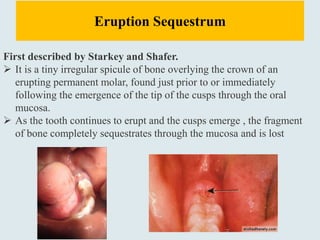
First described by Starkey and Shafer.
 It is a tiny irregular spicule of bone overlying the crown of an
erupting permanent molar, found just prior to or immediately
following the emergence of the tip of the cusps through the oral
mucosa.
 As the tooth continues to erupt and the cusps emerge , the fragment
of bone completely sequestrates through the mucosa and is lost
Eruption Sequestrum
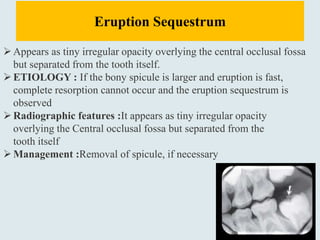
Appears as tiny irregular opacity overlying the central occlusal fossa
but separated from the tooth itself.
ETIOLOGY : If the bony spicule is larger and eruption is fast,
complete resorption cannot occur and the eruption sequestrum is
observed
Radiographic features :It appears as tiny irregular opacity
overlying the Central occlusal fossa but separated from the
tooth itself
Management :Removal of spicule, if necessary
Delayed eruption
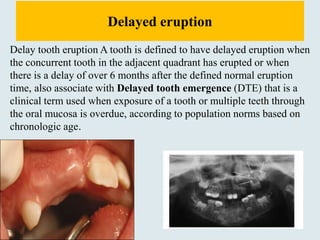
Delay tooth eruption A tooth is defined to have delayed eruption when
the concurrent tooth in the adjacent quadrant has erupted or when
there is a delay of over 6 months after the defined normal eruption
time, also associate with Delayed tooth emergence (DTE) that is a
clinical term used when exposure of a tooth or multiple teeth through
the oral mucosa is overdue, according to population norms based on
chronologic age.
Delayed Eruption
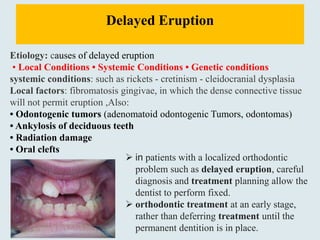
Etiology: causes of delayed eruption
• Local Conditions • Systemic Conditions • Genetic conditions
systemic conditions: such as rickets - cretinism - cleidocranial dysplasia
Local factors: fibromatosis gingivae, in which the dense connective tissue
will not permit eruption ,Also:
• Odontogenic tumors (adenomatoid odontogenic Tumors, odontomas)
• Ankylosis of deciduous teeth
• Radiation damage
• Oral clefts
 in patients with a localized orthodontic
problem such as delayed eruption, careful
diagnosis and treatment planning allow the
dentist to perform fixed.
 orthodontic treatment at an early stage,
rather than deferring treatment until the
permanent dentition is in place.
Multiple Unerupted teeth
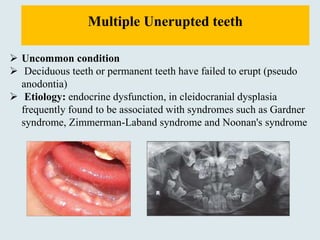
 Uncommon condition
 Deciduous teeth or permanent teeth have failed to erupt (pseudo
anodontia)
 Etiology: endocrine dysfunction, in cleidocranial dysplasia
frequently found to be associated with syndromes such as Gardner
syndrome, Zimmerman-Laband syndrome and Noonan's syndrome
Embedded or Impacted teeth
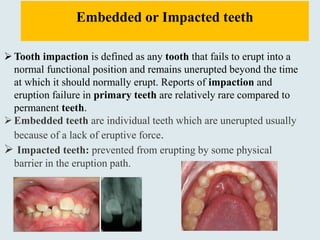
Tooth impaction is defined as any tooth that fails to erupt into a
normal functional position and remains unerupted beyond the time
at which it should normally erupt. Reports of impaction and
eruption failure in primary teeth are relatively rare compared to
permanent teeth.
Embedded teeth are individual teeth which are unerupted usually
because of a lack of eruptive force.
 Impacted teeth: prevented from erupting by some physical
barrier in the eruption path.
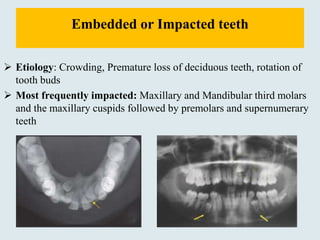
 Etiology: Crowding, Premature loss of deciduous teeth, rotation of
tooth buds
 Most frequently impacted: Maxillary and Mandibular third molars
and the maxillary cuspids followed by premolars and supernumerary
teeth
Embedded or Impacted teeth
Ankylosed deciduous teeth(submerged teeth)
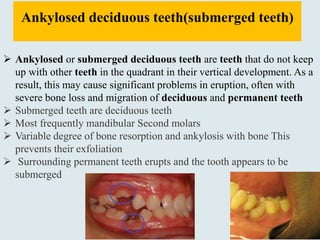
 Ankylosed or submerged deciduous teeth are teeth that do not keep
up with other teeth in the quadrant in their vertical development. As a
result, this may cause significant problems in eruption, often with
severe bone loss and migration of deciduous and permanent teeth
 Submerged teeth are deciduous teeth
 Most frequently mandibular Second molars
 Variable degree of bone resorption and ankylosis with bone This
prevents their exfoliation
 Surrounding permanent teeth erupts and the tooth appears to be
submerged
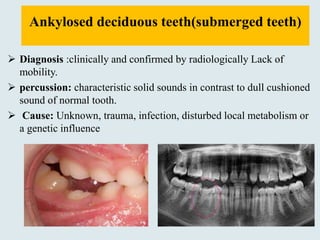
 Diagnosis :clinically and confirmed by radiologically Lack of
mobility.
 percussion: characteristic solid sounds in contrast to dull cushioned
sound of normal tooth.
 Cause: Unknown, trauma, infection, disturbed local metabolism or
a genetic influence
Ankylosed deciduous teeth(submerged teeth)
prevention.ppt

prevention.ppt

  • 1.
    Tooth eruption disordersand its etiology Name: Seyedsaeid Seyedraoufi Subject: Prevention of stomatology disease Lecturer: Prof.Doctor Ekaterine Beshkenadze June 2020 • Shafer’s text book of oral pathology 5th & 6th edition. • Oral and maxillofacial pathology Neville, 2nd edition. • Color atlas of oral diseases Cawson, R. A. 8th edition.
  • 2.
    Type of tootheruption disorders Premature Eruption  Eruption Sequestrum  Delayed Eruption  Multiple Unerupted Teeth  Embedded and Impacted teeth  Ankylosed Deciduous Teeth
  • 3.
     Natal teeth:premature eruption of deciduous teeth erupted in to the oral cavity in infants at birth.  Neonatal teeth: those teeth erupting prematurely in the first 30 days of life Premature eruption We have 2 type of premature eruption NATAL TEETH NEONATAL TEETH
  • 4.
    Premature eruption  Whatare Natal teeth: Deciduous Teeth present at birth in a Child’s oral cavity, Natal teeth are also called as Aberrant Nodules. • Most frequently involved teeth are the mandibular incisors followed by the maxillary incisors • Sex Distribution: more in Females than Males • Etiology: Suspected to have a familial pattern of inheritance which can mostly be a autosomal dominant trait also secretion of several endocrine organs (e.g. thyroid, adrenals and gonads)  What are Neonatal Teeth: Deciduous teeth erupting within 30 days after birth ,these are morphological similar to Natal teeth but only differentiated with eruption time. More frequent in Mandibular than Maxillary. Sex Distribution: Females show more predilection than males . Etiology: is the same as Natal teeth with the tooth germ migrating to the surface prematurely.
  • 5.
    Eruption Sequestrum First describedby Starkey and Shafer.  It is a tiny irregular spicule of bone overlying the crown of an erupting permanent molar, found just prior to or immediately following the emergence of the tip of the cusps through the oral mucosa.  As the tooth continues to erupt and the cusps emerge , the fragment of bone completely sequestrates through the mucosa and is lost
  • 6.
    Eruption Sequestrum Appears astiny irregular opacity overlying the central occlusal fossa but separated from the tooth itself. ETIOLOGY : If the bony spicule is larger and eruption is fast, complete resorption cannot occur and the eruption sequestrum is observed Radiographic features :It appears as tiny irregular opacity overlying the Central occlusal fossa but separated from the tooth itself Management :Removal of spicule, if necessary
  • 7.
    Delayed eruption Delay tootheruption A tooth is defined to have delayed eruption when the concurrent tooth in the adjacent quadrant has erupted or when there is a delay of over 6 months after the defined normal eruption time, also associate with Delayed tooth emergence (DTE) that is a clinical term used when exposure of a tooth or multiple teeth through the oral mucosa is overdue, according to population norms based on chronologic age.
  • 8.
    Delayed Eruption Etiology: causesof delayed eruption • Local Conditions • Systemic Conditions • Genetic conditions systemic conditions: such as rickets - cretinism - cleidocranial dysplasia Local factors: fibromatosis gingivae, in which the dense connective tissue will not permit eruption ,Also: • Odontogenic tumors (adenomatoid odontogenic Tumors, odontomas) • Ankylosis of deciduous teeth • Radiation damage • Oral clefts  in patients with a localized orthodontic problem such as delayed eruption, careful diagnosis and treatment planning allow the dentist to perform fixed.  orthodontic treatment at an early stage, rather than deferring treatment until the permanent dentition is in place.
  • 9.
    Multiple Unerupted teeth Uncommon condition  Deciduous teeth or permanent teeth have failed to erupt (pseudo anodontia)  Etiology: endocrine dysfunction, in cleidocranial dysplasia frequently found to be associated with syndromes such as Gardner syndrome, Zimmerman-Laband syndrome and Noonan's syndrome
  • 10.
    Embedded or Impactedteeth Tooth impaction is defined as any tooth that fails to erupt into a normal functional position and remains unerupted beyond the time at which it should normally erupt. Reports of impaction and eruption failure in primary teeth are relatively rare compared to permanent teeth. Embedded teeth are individual teeth which are unerupted usually because of a lack of eruptive force.  Impacted teeth: prevented from erupting by some physical barrier in the eruption path.
  • 11.
     Etiology: Crowding,Premature loss of deciduous teeth, rotation of tooth buds  Most frequently impacted: Maxillary and Mandibular third molars and the maxillary cuspids followed by premolars and supernumerary teeth Embedded or Impacted teeth
  • 12.
    Ankylosed deciduous teeth(submergedteeth)  Ankylosed or submerged deciduous teeth are teeth that do not keep up with other teeth in the quadrant in their vertical development. As a result, this may cause significant problems in eruption, often with severe bone loss and migration of deciduous and permanent teeth  Submerged teeth are deciduous teeth  Most frequently mandibular Second molars  Variable degree of bone resorption and ankylosis with bone This prevents their exfoliation  Surrounding permanent teeth erupts and the tooth appears to be submerged
  • 13.
     Diagnosis :clinicallyand confirmed by radiologically Lack of mobility.  percussion: characteristic solid sounds in contrast to dull cushioned sound of normal tooth.  Cause: Unknown, trauma, infection, disturbed local metabolism or a genetic influence Ankylosed deciduous teeth(submerged teeth)