Presentations This presentation is based on material from Business Presentations & Public Speaking in English  from www.englishclub.com
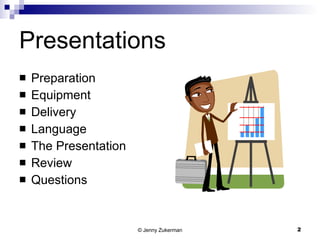
Presentations Preparation Equipment Delivery Language The Presentation Review Questions
What is most important? PREPARATION Why? Confident Less nervous Responsive audience
Preparation Objective Inform Persuade Train Sell If it is not clear to you then it is not clear to others!
Questions to ask yourself Why? Who? Where? When? How? What? Objective Audience Venue Time and length Method Content
Preparation Structure Introduction Body Conclusion Questions
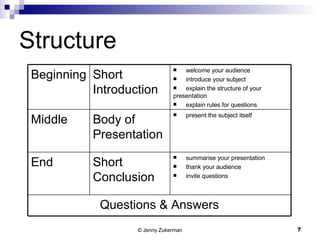
Structure summarise your presentation thank your audience invite questions  Short Conclusion End Questions & Answers present the subject itself  Body of Presentation Middle welcome your audience introduce your subject explain the structure of your  presentation explain rules for questions  Short Introduction Beginning
Preparation Notes DO NOT READ Small cards Title of section Keywords
Rehearsal Practise 2-3 times Familiar Find weaknesses Practise difficult pronunciation Check length
Presentations Preparation Equipment Delivery Language The Presentation Review Questions
Equipment
Equipment YOU
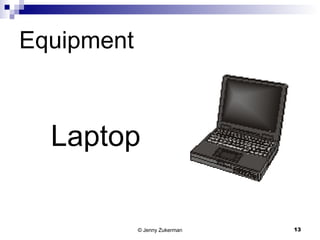
Equipment Laptop
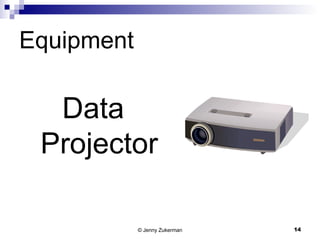
Equipment Data Projector
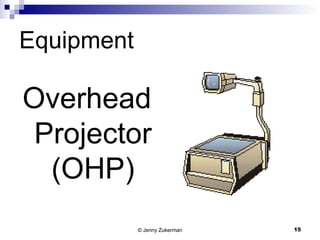
Equipment Overhead Projector (OHP)
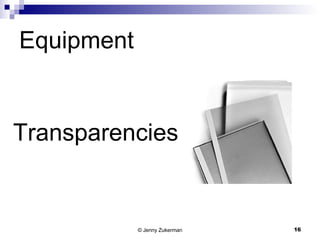
Equipment Transparencies
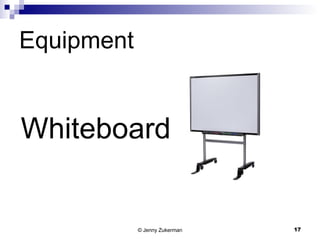
Equipment Whiteboard
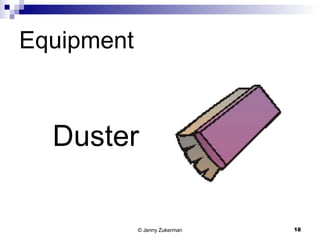
Equipment Duster
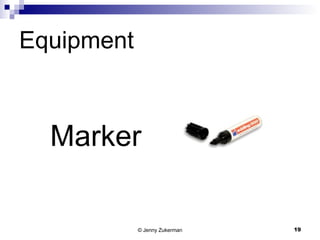
Equipment Marker
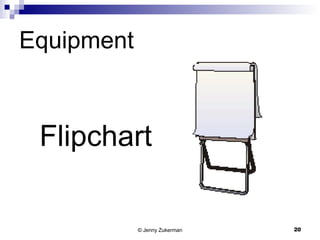
Equipment Flipchart
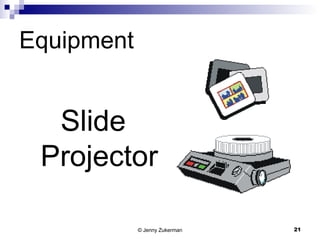
Equipment Slide Projector
Presentations Preparation Equipment Delivery Language The Presentation Review Questions
Delivery Nerves Audience Rapport Body Language Cultural Considerations Voice quality Visual Aids Audience Reaction
Presentations Preparation Equipment Delivery Language The Presentation Review Questions
Language Simple and Clear Short words and short sentences No jargon, eg. EMEA, VOIP Usually facts, not abstract ideas Active verbs instead of passive Two million cars were sold by Toyota last year. Toyota sold two million cars last year.
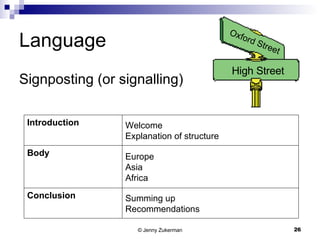
Language Signposting (or signalling) High Street Oxford Street Summing up Recommendations Conclusion Europe Asia Africa Body Welcome Explanation of structure Introduction
Language Useful phrases for signposting: Now we'll move on to... Let me turn now to... Next... Turning to... I'd like now to discuss... Let's look now at... ...and starting another Well, I've told you about... That's all I have to say about... We've looked at... So much for... Finishing one subject... I'd like to start by... Let's begin by... First of all, I'll... Starting with... I'll begin by... Introducing the subject
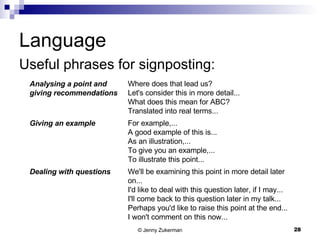
Language Useful phrases for signposting: We'll be examining this point in more detail later on... I'd like to deal with this question later, if I may... I'll come back to this question later in my talk... Perhaps you'd like to raise this point at the end... I won't comment on this now...  Dealing with questions  For example,... A good example of this is... As an illustration,... To give you an example,... To illustrate this point...  Giving an example  Where does that lead us? Let's consider this in more detail... What does this mean for ABC? Translated into real terms...  Analysing a point and giving recommendations
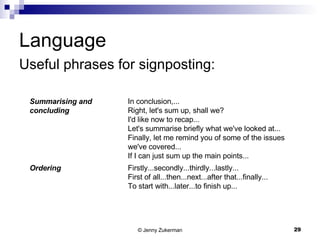
Language Useful phrases for signposting: Firstly...secondly...thirdly...lastly... First of all...then...next...after that...finally... To start with...later...to finish up...  Ordering  In conclusion,... Right, let's sum up, shall we? I'd like now to recap... Let's summarise briefly what we've looked at... Finally, let me remind you of some of the issues we've covered... If I can just sum up the main points...  Summarising and concluding
Presentations Preparation Equipment Delivery Language The Presentation Review Questions
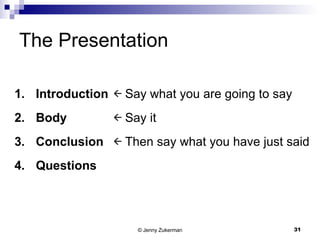
The Presentation Introduction Body Conclusion Questions Say what you are going to say Say it Then say what you have just said
The Presentation Introduction Welcome your audience Introduce your subject Outline the structure of your presentation Give instructions about questions
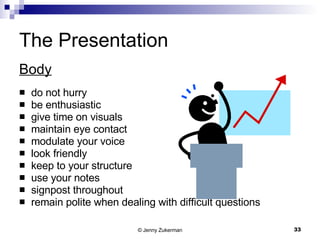
The Presentation Body do not hurry be enthusiastic give time on visuals maintain eye contact modulate your voice look friendly keep to your structure use your notes signpost throughout remain polite when dealing with difficult questions
The Presentation Conclusion Sum up Give recommendations, when appropriate Thank your audience Invite questions
The Presentation Questions Interact Predict Accept questions Polite Reformulate Answer with question Comment from audience
Presentations Preparation Equipment Delivery Language The Presentation Review Questions
Review Preparation to allow plenty of time for preparation to ask the all-important question-words, why? who? where? when? how? and what? to structure your presentation into introduction, body, conclusion and questions to write notes based on keywords to rehearse your presentation several times and modify it as necessary
Review Equipment to select the right equipment for the job to use equipment effectively to make use of clear, powerful visual aids that do not overload your audience
Review Delivery to overcome your nerves to establish audience rapport to be aware of your body language to understand cultural differences to control the quality of your voice
Review Language to use clear, simple language, avoiding jargon to use active verbs and concrete facts to explain the structure of your presentation at the beginning so that your listeners know what to expect to link each section of your presentation to signpost your presentation from beginning to end so that your listeners know where they are
Review The Presentation to say what you are going to say, say it, and say what you have just said to maintain interest by varying the speed, volume and pitch of your voice
Review Questions to deal with listeners' questions politely to respond to your audience positively
Questions

Presentations

  • 1.
    Presentations This presentationis based on material from Business Presentations & Public Speaking in English from www.englishclub.com
  • 2.
    Presentations Preparation EquipmentDelivery Language The Presentation Review Questions
  • 3.
    What is mostimportant? PREPARATION Why? Confident Less nervous Responsive audience
  • 4.
    Preparation Objective InformPersuade Train Sell If it is not clear to you then it is not clear to others!
  • 5.
    Questions to askyourself Why? Who? Where? When? How? What? Objective Audience Venue Time and length Method Content
  • 6.
    Preparation Structure IntroductionBody Conclusion Questions
  • 7.
    Structure summarise yourpresentation thank your audience invite questions Short Conclusion End Questions & Answers present the subject itself Body of Presentation Middle welcome your audience introduce your subject explain the structure of your presentation explain rules for questions Short Introduction Beginning
  • 8.
    Preparation Notes DONOT READ Small cards Title of section Keywords
  • 9.
    Rehearsal Practise 2-3times Familiar Find weaknesses Practise difficult pronunciation Check length
  • 10.
    Presentations Preparation EquipmentDelivery Language The Presentation Review Questions
  • 11.
  • 12.
  • 13.
  • 14.
  • 15.
  • 16.
  • 17.
  • 18.
  • 19.
  • 20.
  • 21.
  • 22.
    Presentations Preparation EquipmentDelivery Language The Presentation Review Questions
  • 23.
    Delivery Nerves AudienceRapport Body Language Cultural Considerations Voice quality Visual Aids Audience Reaction
  • 24.
    Presentations Preparation EquipmentDelivery Language The Presentation Review Questions
  • 25.
    Language Simple andClear Short words and short sentences No jargon, eg. EMEA, VOIP Usually facts, not abstract ideas Active verbs instead of passive Two million cars were sold by Toyota last year. Toyota sold two million cars last year.
  • 26.
    Language Signposting (orsignalling) High Street Oxford Street Summing up Recommendations Conclusion Europe Asia Africa Body Welcome Explanation of structure Introduction
  • 27.
    Language Useful phrasesfor signposting: Now we'll move on to... Let me turn now to... Next... Turning to... I'd like now to discuss... Let's look now at... ...and starting another Well, I've told you about... That's all I have to say about... We've looked at... So much for... Finishing one subject... I'd like to start by... Let's begin by... First of all, I'll... Starting with... I'll begin by... Introducing the subject
  • 28.
    Language Useful phrasesfor signposting: We'll be examining this point in more detail later on... I'd like to deal with this question later, if I may... I'll come back to this question later in my talk... Perhaps you'd like to raise this point at the end... I won't comment on this now... Dealing with questions For example,... A good example of this is... As an illustration,... To give you an example,... To illustrate this point... Giving an example Where does that lead us? Let's consider this in more detail... What does this mean for ABC? Translated into real terms... Analysing a point and giving recommendations
  • 29.
    Language Useful phrasesfor signposting: Firstly...secondly...thirdly...lastly... First of all...then...next...after that...finally... To start with...later...to finish up... Ordering In conclusion,... Right, let's sum up, shall we? I'd like now to recap... Let's summarise briefly what we've looked at... Finally, let me remind you of some of the issues we've covered... If I can just sum up the main points... Summarising and concluding
  • 30.
    Presentations Preparation EquipmentDelivery Language The Presentation Review Questions
  • 31.
    The Presentation IntroductionBody Conclusion Questions Say what you are going to say Say it Then say what you have just said
  • 32.
    The Presentation IntroductionWelcome your audience Introduce your subject Outline the structure of your presentation Give instructions about questions
  • 33.
    The Presentation Bodydo not hurry be enthusiastic give time on visuals maintain eye contact modulate your voice look friendly keep to your structure use your notes signpost throughout remain polite when dealing with difficult questions
  • 34.
    The Presentation ConclusionSum up Give recommendations, when appropriate Thank your audience Invite questions
  • 35.
    The Presentation QuestionsInteract Predict Accept questions Polite Reformulate Answer with question Comment from audience
  • 36.
    Presentations Preparation EquipmentDelivery Language The Presentation Review Questions
  • 37.
    Review Preparation toallow plenty of time for preparation to ask the all-important question-words, why? who? where? when? how? and what? to structure your presentation into introduction, body, conclusion and questions to write notes based on keywords to rehearse your presentation several times and modify it as necessary
  • 38.
    Review Equipment toselect the right equipment for the job to use equipment effectively to make use of clear, powerful visual aids that do not overload your audience
  • 39.
    Review Delivery toovercome your nerves to establish audience rapport to be aware of your body language to understand cultural differences to control the quality of your voice
  • 40.
    Review Language touse clear, simple language, avoiding jargon to use active verbs and concrete facts to explain the structure of your presentation at the beginning so that your listeners know what to expect to link each section of your presentation to signpost your presentation from beginning to end so that your listeners know where they are
  • 41.
    Review The Presentationto say what you are going to say, say it, and say what you have just said to maintain interest by varying the speed, volume and pitch of your voice
  • 42.
    Review Questions todeal with listeners' questions politely to respond to your audience positively
  • 43.