The Language of Presentations
Prof. Shivnath Takte,
Department of English
Shri Saibaba College, Shirdi
DEPARTMENT OF ENGLISH/ STUDY MATERIAL/ 2021- 2022
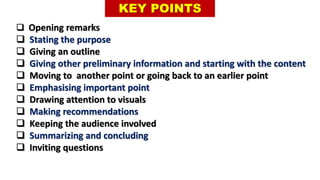
KEY POINTS
 Opening remarks
 Stating the purpose
 Giving an outline
 Giving other preliminary information and starting with the content
 Moving to another point or going back to an earlier point
 Emphasising important point
 Drawing attention to visuals
 Making recommendations
 Keeping the audience involved
 Summarizing and concluding
 Inviting questions
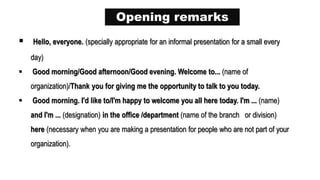
Opening remarks
 Hello, everyone. (specially appropriate for an informal presentation for a small every
day)
 Good morning/Good afternoon/Good evening. Welcome to... (name of
organization)/Thank you for giving me the opportunity to talk to you today.
 Good morning. I'd like to/I'm happy to welcome you all here today. I'm ... (name)
and I'm ... (designation) in the office /department (name of the branch or division)
here (necessary when you are making a presentation for people who are not part of your
organization).
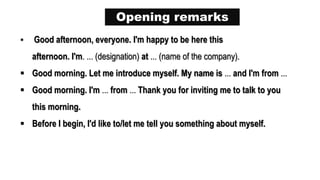
Opening remarks
 Good afternoon, everyone. I'm happy to be here this
afternoon. I'm. ... (designation) at ... (name of the company).
 Good morning. Let me introduce myself. My name is ... and I'm from ...
 Good morning. I'm ... from ... Thank you for inviting me to talk to you
this morning.
 Before I begin, I'd like to/let me tell you something about myself.
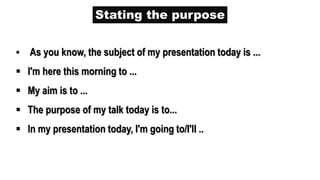
Stating the purpose
 As you know, the subject of my presentation today is ...
 I'm here this morning to ...
 My aim is to ...
 The purpose of my talk today is to...
 In my presentation today, I'm going to/I'll ..
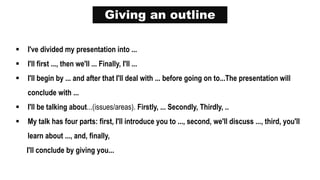
Giving an outline
 I've divided my presentation into ...
 I'll first ..., then we'll ... Finally, I'll ...
 I'll begin by ... and after that I'll deal with ... before going on to...The presentation will
conclude with ...
 I'll be talking about...(issues/areas). Firstly, ... Secondly, Thirdly, ..
 My talk has four parts: first, I'll introduce you to ..., second, we'll discuss ..., third, you'll
learn about ..., and, finally,
I'll conclude by giving you...
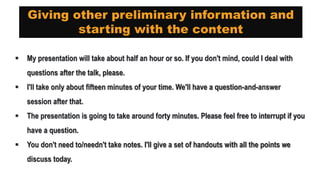
Giving other preliminary information and
starting with the content
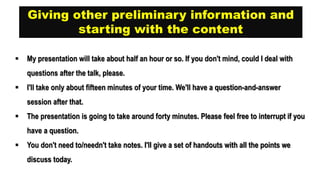
 My presentation will take about half an hour or so. If you don't mind, could I deal with
questions after the talk, please.
 I'll take only about fifteen minutes of your time. We'll have a question-and-answer
session after that.
 The presentation is going to take around forty minutes. Please feel free to interrupt if you
have a question.
 You don't need to/needn't take notes. I'll give a set of handouts with all the points we
discuss today.
Giving other preliminary information and
starting with the content
 My presentation will take about half an hour or so. If you don't mind, could I deal with
questions after the talk, please.
 I'll take only about fifteen minutes of your time. We'll have a question-and-answer
session after that.
 The presentation is going to take around forty minutes. Please feel free to interrupt if you
have a question.
 You don't need to/needn't take notes. I'll give a set of handouts with all the points we
discuss today.
Giving other preliminary information and
starting with the content
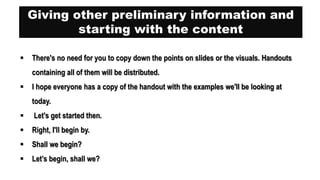
 There's no need for you to copy down the points on slides or the visuals. Handouts
containing all of them will be distributed.
 I hope everyone has a copy of the handout with the examples we'll be looking at
today.
 Let's get started then.
 Right, I'll begin by.
 Shall we begin?
 Let’s begin, shall we?
Moving to another point or going back to
an earlier point
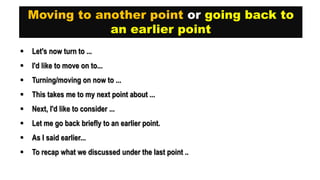
 Let's now turn to ...
 I'd like to move on to...
 Turning/moving on now to ...
 This takes me to my next point about ...
 Next, I'd like to consider ...
 Let me go back briefly to an earlier point.
 As I said earlier...
 To recap what we discussed under the last point ..
Emphasising important points
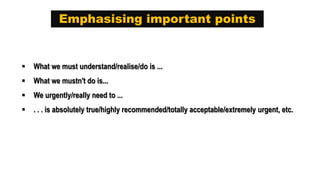
 What we must understand/realise/do is ...
 What we mustn't do is...
 We urgently/really need to ...
 . . . is absolutely true/highly recommended/totally acceptable/extremely urgent, etc.
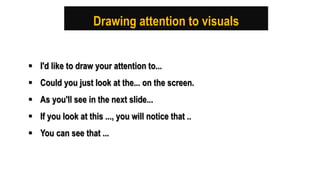
Drawing attention to visuals
 I'd like to draw your attention to...
 Could you just look at the... on the screen.
 As you'll see in the next slide...
 If you look at this ..., you will notice that ..
 You can see that ...
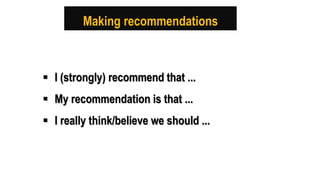
Making recommendations
 I (strongly) recommend that ...
 My recommendation is that ...
 I really think/believe we should ...
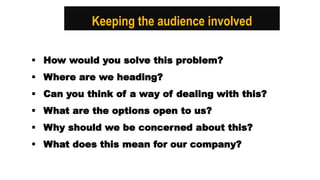
Keeping the audience involved
 How would you solve this problem?
 Where are we heading?
 Can you think of a way of dealing with this?
 What are the options open to us?
 Why should we be concerned about this?
 What does this mean for our company?
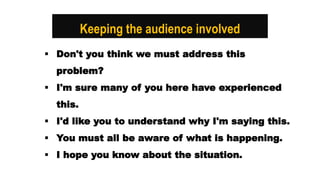
Keeping the audience involved
 Don't you think we must address this
problem?
 I'm sure many of you here have experienced
this.
 I'd like you to understand why I'm saying this.
 You must all be aware of what is happening.
 I hope you know about the situation.
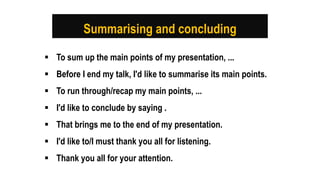
Summarising and concluding
 To sum up the main points of my presentation, ...
 Before I end my talk, I'd like to summarise its main points.
 To run through/recap my main points, ...
 I'd like to conclude by saying .
 That brings me to the end of my presentation.
 I'd like to/I must thank you all for listening.
 Thank you all for your attention.
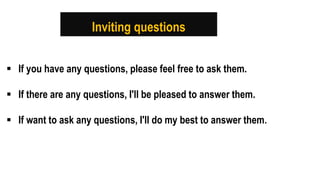
Inviting questions
 If you have any questions, please feel free to ask them.
 If there are any questions, I'll be pleased to answer them.
 If want to ask any questions, I'll do my best to answer them.
THANK
YOU!
Dept. of English
Shri Saibaba College, Shirdi

The Language of Presentations.pptx

  • 1.
    The Language ofPresentations Prof. Shivnath Takte, Department of English Shri Saibaba College, Shirdi DEPARTMENT OF ENGLISH/ STUDY MATERIAL/ 2021- 2022
  • 2.
    KEY POINTS  Openingremarks  Stating the purpose  Giving an outline  Giving other preliminary information and starting with the content  Moving to another point or going back to an earlier point  Emphasising important point  Drawing attention to visuals  Making recommendations  Keeping the audience involved  Summarizing and concluding  Inviting questions
  • 3.
    Opening remarks  Hello,everyone. (specially appropriate for an informal presentation for a small every day)  Good morning/Good afternoon/Good evening. Welcome to... (name of organization)/Thank you for giving me the opportunity to talk to you today.  Good morning. I'd like to/I'm happy to welcome you all here today. I'm ... (name) and I'm ... (designation) in the office /department (name of the branch or division) here (necessary when you are making a presentation for people who are not part of your organization).
  • 4.
    Opening remarks  Goodafternoon, everyone. I'm happy to be here this afternoon. I'm. ... (designation) at ... (name of the company).  Good morning. Let me introduce myself. My name is ... and I'm from ...  Good morning. I'm ... from ... Thank you for inviting me to talk to you this morning.  Before I begin, I'd like to/let me tell you something about myself.
  • 5.
    Stating the purpose As you know, the subject of my presentation today is ...  I'm here this morning to ...  My aim is to ...  The purpose of my talk today is to...  In my presentation today, I'm going to/I'll ..
  • 6.
    Giving an outline I've divided my presentation into ...  I'll first ..., then we'll ... Finally, I'll ...  I'll begin by ... and after that I'll deal with ... before going on to...The presentation will conclude with ...  I'll be talking about...(issues/areas). Firstly, ... Secondly, Thirdly, ..  My talk has four parts: first, I'll introduce you to ..., second, we'll discuss ..., third, you'll learn about ..., and, finally, I'll conclude by giving you...
  • 7.
    Giving other preliminaryinformation and starting with the content  My presentation will take about half an hour or so. If you don't mind, could I deal with questions after the talk, please.  I'll take only about fifteen minutes of your time. We'll have a question-and-answer session after that.  The presentation is going to take around forty minutes. Please feel free to interrupt if you have a question.  You don't need to/needn't take notes. I'll give a set of handouts with all the points we discuss today.
  • 8.
    Giving other preliminaryinformation and starting with the content  My presentation will take about half an hour or so. If you don't mind, could I deal with questions after the talk, please.  I'll take only about fifteen minutes of your time. We'll have a question-and-answer session after that.  The presentation is going to take around forty minutes. Please feel free to interrupt if you have a question.  You don't need to/needn't take notes. I'll give a set of handouts with all the points we discuss today.
  • 9.
    Giving other preliminaryinformation and starting with the content  There's no need for you to copy down the points on slides or the visuals. Handouts containing all of them will be distributed.  I hope everyone has a copy of the handout with the examples we'll be looking at today.  Let's get started then.  Right, I'll begin by.  Shall we begin?  Let’s begin, shall we?
  • 10.
    Moving to anotherpoint or going back to an earlier point  Let's now turn to ...  I'd like to move on to...  Turning/moving on now to ...  This takes me to my next point about ...  Next, I'd like to consider ...  Let me go back briefly to an earlier point.  As I said earlier...  To recap what we discussed under the last point ..
  • 11.
    Emphasising important points What we must understand/realise/do is ...  What we mustn't do is...  We urgently/really need to ...  . . . is absolutely true/highly recommended/totally acceptable/extremely urgent, etc.
  • 12.
    Drawing attention tovisuals  I'd like to draw your attention to...  Could you just look at the... on the screen.  As you'll see in the next slide...  If you look at this ..., you will notice that ..  You can see that ...
  • 13.
    Making recommendations  I(strongly) recommend that ...  My recommendation is that ...  I really think/believe we should ...
  • 14.
    Keeping the audienceinvolved  How would you solve this problem?  Where are we heading?  Can you think of a way of dealing with this?  What are the options open to us?  Why should we be concerned about this?  What does this mean for our company?
  • 15.
    Keeping the audienceinvolved  Don't you think we must address this problem?  I'm sure many of you here have experienced this.  I'd like you to understand why I'm saying this.  You must all be aware of what is happening.  I hope you know about the situation.
  • 16.
    Summarising and concluding To sum up the main points of my presentation, ...  Before I end my talk, I'd like to summarise its main points.  To run through/recap my main points, ...  I'd like to conclude by saying .  That brings me to the end of my presentation.  I'd like to/I must thank you all for listening.  Thank you all for your attention.
  • 17.
    Inviting questions  Ifyou have any questions, please feel free to ask them.  If there are any questions, I'll be pleased to answer them.  If want to ask any questions, I'll do my best to answer them.
  • 18.
    THANK YOU! Dept. of English ShriSaibaba College, Shirdi