Annex D - Alternative Design of Temporary Construction Structure for Bridge Foundations
1
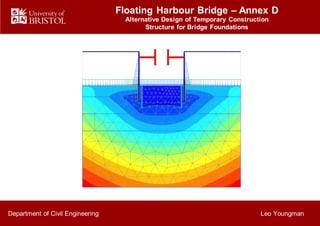
Floating Harbour Bridge – Annex D
Alternative Design of Temporary Construction
Structure for Bridge Foundations
Department of Civil Engineering Leo Youngman
Annex D - Alternative Design of Temporary Construction Structure for Bridge Foundations
1
ExecutiveSummary
The project is an opening pedestrian bridge across Bristol’s
harbour. A temporary sheet pile wall cofferdam was
suggested as an alternative method of construction of the
substructure. The cofferdam was sized and checked against
a number of failure methods. The piping and heave of the
soils was considered with a flow net and the earth and water
pressures were calculated to determine the required depth of
piling. A PLAXIS finite element model was used to determine
the sheet pile wall bending moments and the load applied to
the support prop. The steel support structure was designed
for the applied axial, bending and shear forces. The possible
methods of construction were compared and evaluated and it
was demonstrated that a cofferdam would be a feasible and
appropriate method of construction at this site.
Table of Contents
Executive Summary .................................................................1
Table of Contents .....................................................................1
1 Introduction.........................................................................1
2 Technical Design ...............................................................2
3 PLAXIS Modelling..............................................................3
4 Structural Design ...............................................................5
5 Construction Sequence.....................................................6
6 Further Study and Limitations..........................................6
7 Discussion...........................................................................6
8 Conclusion ..........................................................................6
9 References..........................................................................7
10 Acknowledgements ...........................................................7
1 Introduction
The project is a new opening bridge structure across Bristol’s
harbour. The proposed design of the bridge substructure in
the main report used driven steel circular hollow piles filled
with concrete and installed from a jack up barge using a
piling rig. These would extend from inside the riverbed
through the water to the surface. The pile cap would then be
constructed in the water at the surface around the piles. This
construction method had some limitations and an alternative
construction method was discussed in the design of the
bridge. This option was to design a sheet pile wall cofferdam
as a temporary structure to allow the construction of a pile
group and pile cap at riverbed. This annex will explore that
alternative and assess its feasibility.
1.1 Relevance of Work
The initial decisions made at the feasibility stage of the type
of construction method can significantly affect the costs of
the bridge and also the health and safety of the construction
workers. The elevated level of risk of divers having to work in
the water to install the pile cap formwork of the suggested
design in the main report may be larger than the client or the
contractor are comfortable with and determine the decision
to change the construction method to a cofferdam. A
cofferdam could also allow the bridge to have more stable
foundations constructed at the riverbed and reduce the
rotation and deflections of the entire structure as a result the
opening and closing process of the bridge.
1.2 Objectives
1. Determine design parameters for soils, material
properties and geometry of the excavation.
2. Calculate by hand the earth and water pressures, uplift
and seepage with a flow net (Ibraim, 2015).
3. Select an appropriate model for use in a finite element
software for the type of excavation (Nash, 2016).
4. Create a 2D PLAXIS model of the excavation and
consider the implications of construction sequencing,
seepage, forces, bending moments and deflections.
5. Compare the expected hand calculations to the output
values of PLAXIS for verification.
6. Design the structural waling and strut support system.
7. Evaluate the methods of construction and the strengths
and weaknesses of the options.
1.3 Defining Parameters
The basic ground profile and
soil parameters of the site
are described in Figure 1.
The soil unit weights were
found from soil descriptions
from the boreholes (BS EN
ISO 14688-2:2004, 2007).
The boreholes provided
information on the number of
blows N, for various sample
depths during standard
penetration in situ dynamic
testing (SPT).
Scour and current forces of
the water were not considered in this design as the speed of
water flow at the site is less than 1ms-1 and therefore
negligible and the water flow is not tidal as the environment
is controlled by the locks at the ends of the harbour.
The floating harbour depth is approximately 5m (Anon.,
2015), however 6m is selected as the design depth required
to provide a lumped factor of safety against unknown
variation in the river depth, as a precaution against risk of
waves and flooding and also because the construction
process requires dredging to level the ground initially.
Figure 1 Design
soil profile at site
Annex D - Alternative Design of Temporary Construction Structure for Bridge Foundations
2
Figure 3 Flow net of seepage under cofferdam (Drawn to scale for
calculations and shown not to scale)
2 Technical Design
In order to initially size the cofferdam, a standardised tower
scaffolding system with dimensions of 2x4.5m was selected
to allow access to the 6m deep cofferdam. The dimensions
of the pile cap is approximately 5.5x3m with space for
formwork. This initial sizing also took into account an
estimate of the space taken up by the internal structural
support system and the likely shape of these walings and
struts. A widely used waling and strut pattern was selected
with diagonal struts (see Figure 2). This pattern with diagonal
struts was deemed more appropriate as the larger space in
the centre of the cofferdam would be less of a constriction on
later space requirements for the bridge pier construction.
An 8x8m cofferdam was deemed a reasonable size to be
able to function safely with clear space for safe escape
routes and some working space inside the cofferdam to
complete the construction.
2.1 Failure Mechanisms
There are a number of criteria that need to be checked
against in the design of temporary cofferdams (Tomlinson,
2001, p. 444).
1. Earth pressures and hydrostatic pressure of water
2. Failure due to base heave from water pressure
3. Failure from inwards yielding of structure
4. Failure due to soil piping under hydraulic gradients
2.2 Geotechnical Design
In the preliminary design using a flow net it was discovered
that a critical design consideration at this site was the
likelihood of piping as a result of the hydraulic gradient. A
deeper embedded depth and a wider cofferdam than the
initial size were used to attempt to solve these issues.
2.2.1 Check for Piping Failure
A cofferdam of 10x10m with an embedment of 10m gives a
safe hydraulic gradient at the toe of the corner of the
cofferdam. Refer to Figure 3 for flow net parameters.
Critical hydraulic gradient 𝑖 𝑐 ≈ 1.0 for soil with 𝛾 𝑠𝑎𝑡 = 20𝑘𝑁/𝑚3
Correction factor for corner of square cofferdam = 1.7
Hydraulic Gradient: 𝑖 𝑒 = (
𝐻1 −𝐻2
𝑁 𝑑
) ∗ (
2𝑁 𝑓
𝐵
)
From flow net: 𝑁 𝑑 = 10 𝑁𝑓 = 3 𝐵 = 10𝑚 𝐻1 = 24𝑚 𝐻2 = 18𝑚
𝑖 𝑒 = 0.612 𝐹𝑜𝑆 =
𝑖 𝑐
𝑖 𝑒
FoS against piping = 1.63 > 1.5 OK
2.2.2 Check for Heave Failure
2.2.2.1 Global Heave
Check that the uplift force from the pore water pressure
along base of the cofferdam is less than the soil weight:
Weight of soil block = [(2𝑚 ∗ 18𝑘𝑁/𝑚3)+ (3𝑚 ∗ 20𝑘𝑁/𝑚3)+
(3𝑚 ∗ 21.5𝑘𝑁/𝑚3) + (2𝑚 ∗ 20𝑘𝑁/𝑚3) ] ∗ 10𝑚 = 2005𝑘𝑁/𝑚
Average potential drop from flow net 𝑛 = 6
Potential head: 𝐻 = 𝐻1 − ( 𝐻1 − 𝐻2)
𝑛
𝑁 𝑑
Pressure: 𝑢 = ( 𝐻 − 𝑧) 𝛾 𝑤
Along base: 𝐻 𝑎𝑣 = 20.4𝑚 𝑧 = 8𝑚 above datum 𝑢 = 121.6𝑘𝑃𝑎
Uplift Force: 121.6𝑘𝑃𝑎 ∗ 10𝑚 = 1216𝑘𝑁/𝑚
FoS against heave 1216 < 2005 OK
2.2.2.2 Local Heave
Hydrostatic pressure head is used because the relatively
impermeable alluvium may not be able to let the water flow
through the soil layer quickly enough to safely take the
seepage pore water pressure as the critical design case.
Check against localised heave of the surface alluvium:
Soil pressure = 2𝑚 ∗ 18𝑘𝑁/𝑚3 = 36𝑘𝑃𝑎 Hydrostatic pressure
head is 8m: 𝑢 = 8 ∗ 9.81 = 78.5𝑘𝑃𝑎 36 < 78.5 Not OK.
The alluvium is less permeable than the underlying sandy
layers, therefore there is a significant risk of heave of the
alluvium due to the build-up of water pressure below. It was
decided that in order to mitigate the piping and heave issues,
drains are a far more effective and simpler way to deal with
the problem than increasing the length of embedment and
the width of the cofferdam.
They reduce the pore water pressure inside the cofferdam
which reduces the upwards heave from water pressures and
also reduce the hydraulic gradient at the toe of the
cofferdam. This will allow for reduced length sheet piles
which would be easier to drive into place and remove at the
end of the construction. As a result of this the initial 8x8m
cofferdam is used in the design with the provision that
pumping and drains will be required. Backup pumping
systems, warning procedures and evacuation protocols will
be required due to the critical nature of these components to
the safety of the cofferdam and the construction workers.
Figure 2 Typical plan view of waling and strut support patterns
inside a cofferdam
Annex D - Alternative Design of Temporary Construction Structure for Bridge Foundations
3
Figure 4 Earth and water pressures for different soil
layers on the sheet pile wall of the cofferdam
2.2.3 Pumping required
This is a rough estimate of the pumping required assuming
all the soil was the same permeability, a more complex
PLAXIS model of the soil layers provides greater accuracy.
Flow net estimate of volume of water flow: 𝑄 = 𝑘( 𝐻1 − 𝐻2)
𝑁𝑓
𝑁 𝑑
Average permeability assumed to be: 𝑘 = 1 ∗ 10−4
𝑚/𝑠
𝑄 = 1.8 ∗ 10−4
𝑚3
/𝑠/𝑚 𝑟𝑢𝑛 = 15.6𝑚3
/𝑑𝑎𝑦/𝑚 𝑟𝑢𝑛
𝑇𝑜𝑡𝑎𝑙 𝑄 = 𝑄 ∗ 𝑃𝑒𝑟𝑖𝑚𝑒𝑡𝑒𝑟
For an 8x8m cofferdam = 15.6 ∗ (4 ∗ 8) = 499.2𝑚3
/𝑑𝑎𝑦
2.2.4 Earth and water pressures
The suggested method of analysis is to use the free earth
support method, although conservative, it is widely used in
practice (Azizi, 2013, p. 468). This hand calculation was
done using the following EC7 DA1-2 method for factoring soil
parameters. The un-factored 𝜑′
values are shown in Table 2.
𝛾tan(𝜑′
) = 1.25 𝑡𝑎𝑛 𝜑′
𝑑
=
𝑡𝑎𝑛 𝜑′
𝑘
𝛾tan (𝜑′)
The following equations were used along with linear
interpolation from tabulated solutions of active (Müller-
Breslau, 1906) and passive (Caquot, 1948) lateral earth
pressure coefficients.
𝐾𝑎𝑛 = 𝐾𝑎 𝑐𝑜𝑠 𝛿 𝐾𝑝𝑛 = 𝐾𝑝 𝑐𝑜𝑠 𝛿
Effective stress parameters are used in relatively granular
soils such as the sandy Redcliffe Sandstone to calculate the
earth pressures and the drained active and passive earth
pressures are calculated using the following equations.
𝑝′ 𝑎𝑛 = 𝐾𝑎𝑛 𝜎𝑣 ′ − 2c′√ 𝐾𝑎𝑐 𝑝′ 𝑝𝑛 = 𝐾𝑝𝑛 𝜎𝑣
′
+ 2c′√ 𝐾𝑝𝑐
For temporary cofferdams c’ is usually conservatively taken
as zero for sands and clays when geotechnical parameters
have not been determined from laboratory testing from site
samples (Williams & Waite, 1993). Therefore the equations
can be simplified for this scenario.
𝑝′ 𝑎𝑛 = 𝐾𝑎𝑛 𝜎𝑣 ′ 𝑝′ 𝑝𝑛 = 𝐾𝑝𝑛 𝜎𝑣
′
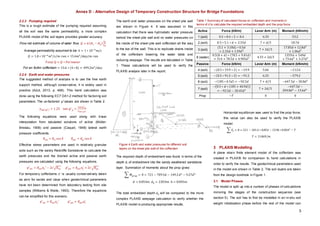
The earth and water pressures on the sheet pile wall
are shown in Figure 4. It was assumed in this
calculation that there was hydrostatic water pressure
behind the sheet pile wall and no water pressures on
the inside of the sheet pile wall cofferdam all the way
to the toe of the wall. This is to replicate drains inside
of the cofferdam lowering the water table and
reducing seepage. The results are tabulated in Table
1. These calculations will be used to verify the
PLAXIS analysis later in the report.
The required depth of embedment was found in terms of the
depth d, of embedment into the sandy weathered sandstone
layer. Summation of moments about the prop gives:
∑ 𝑀 𝑝𝑟𝑜𝑝 = 0 = 721 − 709.5𝑑 − 149.2 𝑑2
− 9.27𝑑3
𝑑 = 0.854𝑚 𝑑0 = 2.854𝑚 ℎ = 8.845𝑚
The total embedded depth 𝑑0 will be compared to the more
complex PLAXIS seepage calculation to verify whether the
PLAXIS model is producing appropriate results.
Horizontal equilibrium was used to find the prop force,
this value can also be used to verify the PLAXIS
model:
∑ 𝐹𝑥 = 0 = 211 − 101.4 ∗ 0.854 − 13.96 ∗0.8542 − 𝑇
𝑇 = 114𝑘𝑁/𝑚
3 PLAXIS Modelling
A plane strain finite element model of the cofferdam was
created in PLAXIS for comparison to hand calculations in
order to verify the results. The geotechnical parameters used
in the model are shown in Table 2. The soil layers are taken
from the design borehole in Figure 1.
3.1 Model Phases
The model is split up into a number of phases of calculations
mirroring the stages of the construction sequence (see
section 5). The soil has to first be modelled in an in-situ soil
weight initialisation phase before the rest of the model can
Active Force (kN/m) Lever Arm (m) Moment (kNm/m)
1 (soil) 0.5 ∗ 8.4 ∗ 2 = 8.4 6.33 53.2
2 (soil) 0.5 ∗ 5.1 ∗ 𝑑 = 2.55𝑑 7 + 𝑑/3 18.7𝑑
3 (soil)
(5.1 + 3.18𝑑) ∗ 0.5𝑑
= 2.55𝑑 + 1.59𝑑2 7 + 2𝑑/3
17.85𝑑 + 12.8𝑑2
+ 1.06𝑑3
8 (water)
0.5(8 + 𝑑) ∗ (78.5 + 9.81𝑑)
= 314 + 78.5𝑑 + 4.905𝑑2 4.33 + 2𝑑/3
1359.6 + 549𝑑
+ 73.6𝑑2
+ 3.27𝑑3
Passive Force (kN/m) Lever Arm (m) Moment (kNm/m)
4 (soil) −(0.5 ∗ 19.9 ∗ 2) = −19.9 5.66 −112.6
5 (soil) −(0.5 ∗ 91.5 ∗ 2) = −91.5 6.33 −579.2
6 (soil) −(185 ∗ 0.5𝑑) = −92.5𝑑 7 + 𝑑/3 −647.5𝑑 − 30.8𝑑2
7 (soil)
− 0.5 ∗ 𝑑 ∗ (185 + 40.9𝑑)
= −92.5𝑑 − 20.45𝑑2 7 + 2𝑑/3
−647.5𝑑 −
204.8𝑑2
− 13.6𝑑3
Prop −𝑇 0 0
Table 1 Summary of calculated forces on cofferdam and moments in
terms of d to calculate the required embedded depth and the prop force
Annex D - Alternative Design of Temporary Construction Structure for Bridge Foundations
4
be constructed. Then the sheet pile walls and props are
installed in the second phase. This is a plastic deformation
calculation with a level phreatic water surface. The third
phase is a dewatering phase where the water flow boundary
conditions are set and the drains in the model are turned on.
This means that a seepage calculation occurs, from which
the pore pressures are then used to do a plastic deformation
calculation. The inside of the cofferdam is then loading with
the site load of 10kPa to check that the soil is safe to be able
to resist general site activities and plant.
3.2 Soil Parameters
The characteristic values for ϕ’ were modified before being
applied to the model according to EC7 DA1-2 i.e. factoring
the material properties with partial factors (BS EN 1997-1,
2007). The ϕ’ values were estimated using a correlation to the
N – SPT values (Peck, et al., 1974). The friction angle 𝛿 for
each side of the steel sheet pile walls that are recommended
(B Williams, 1993) are as follows:
𝛿 =
2
3
𝜑′
(Active) 𝛿 =
1
2
𝜑′ (Passive)
The permeability of the soils were taken from laboratory tests
of some soils from near the site and estimations from soil
descriptions and BS 8004:2015 Code of practice for
foundations. The correlation 𝐶𝑢 = 4.5 ∗ 𝑁 was used to find
the undrained shear strength Cu from the N values of the
borehole SPT tests (Stroud, 1974). Cu was then used to
calculate the soil stiffness E using an approximation 𝐶𝑢 =
300𝐺 and the relationship 𝐺 =
1
3
𝐸. The soil unit weights are
taken from tables of typical ground parameters using the
borehole soil descriptions (B Williams, 1993).
3.3 Boundary Conditions
In order to model water seepage, the flow boundary
conditions were set for the dewatering phase with a steady
state groundwater calculation. Closed boundaries at the
base and the sheet pile wall surfaces. The top of the water
surface in the model was a different boundary condition set
to follow from the previous phase which had phreatic level
water conditions. Seepage boundary conditions were applied
to all the other boundaries of the model. This allowed the
modelling of the water in the harbour as a constant level i.e.
not affected or drawn down by the cofferdam seepage
analysis. Seepage was allowed between the soil layers and
the water.
Modelling the inside of the cofferdam as dry during
dewatering was achieved using a soil type created to
represent the water and used as a soil polygon above the
riverbed. The ‘water’ soil type had the properties 𝛾𝑠𝑎𝑡 =
9.81𝑘𝑁/𝑚3
and 𝛾𝑢𝑛𝑠𝑎𝑡 = 0𝑘𝑁/𝑚3
which meant that when
the soil polygon inside the cofferdam was set to dry water
conditions in the dewatering phase, the weight of the ‘water’
soil element was zero, but otherwise it acted as the weight of
the water on the soil below This is shown as working
appropriately in the results of the water pressures for
different phases of calculations visible in Figure 5. Note the
fixed end anchor structures in PLAXIS are shown in red are
not to scale or this shape, this is just the way they are
displayed in the graphical output.
3.4 Results
The presence of the decalcified, weathered sandstone layer
causes significant seepage due to the high permeability of
what is similar to a dense sandy material. The importance of
the drains to this excavation cannot be overstated. A failure
in the pumping systems installed would cause rapid failure of
the cofferdam due to piping and heave of the soil. The
groundwater flow output is shown in Figure 6 with rapid
seepage arrows in the light blue weathered sandstone soil
element.
Parameters Alluvium
Weathered
Redcliffe
Sandstone
Redcliffe
Sandstone
Mercia
Mudstone
Units
γ 16 17 19 20 kN/m3
γsat 18 20 21.5 20 kN/m3
ϕ’ 28 33 42 44 °
c’ 0 0 0 0 kPa
ν' 0.4 0.4 0.4 0.25 -
E 6300 18000 99000 135000 kPa
Cu 7 20 110 150 kPa
k 1*10-7
0.5*10-3
0.5*10-4
1*10-6
m/s
Table 2 Characteristic geotechnical parameters used in
PLAXIS software and calculations
Figure 5 Water pressures initially and after dewatering the inside of the
cofferdam. Fixed end anchors (Red), Sheet pile walls (Blue), Drains (Light
Blue), Water pressures (Green arrows), Site 10kPa UDL (Blue arrows)
Figure 6 Groundwater flow with seepage arrows
designating the velocity and direction of flow
Annex D - Alternative Design of Temporary Construction Structure for Bridge Foundations
5
Figure 10 Pore water pressures
3.5 Model Verification
The hand calculations verified the PLAXIS model on a
number of counts. The depth of embedment of the sheet pile
wall was tested for 2m, 2.5m and 3m deep. The soil body
failed at 2m and 2.5m but didn’t at 3m deep. In comparison
to the calculated required depth of embedment of 2.85m,
there is a good agreement between the model and
calculated values.
These results provide confidence in the model and the
assumptions made in the earth pressure calculations. The
model was also verified with a comparison of the prop load in
the hand calculations and the fixed end anchors representing
the props in the PLAXIS model. They are in very close
agreement which again provides confidence that the model
is appropriate.
𝐶𝑎𝑙𝑐𝑢𝑙𝑎𝑡𝑒𝑑 𝑇 = 114𝑘𝑁/𝑚 𝐹𝑖𝑥𝑒𝑑 𝐸𝑛𝑑 𝐴𝑛𝑐ℎ𝑜𝑟𝑠 𝑇 = 113𝑘𝑁/𝑚
The groundwater head profile (see Figure 7) shows the
contours of water head reducing from 24m to 14m as you go
towards the drains inside the cofferdam. This is as expected
as the head of the water above the datum is 24m and the toe
of the drain is at 14m.
The pore water pressure diagram (Figure 10) shows the
drains effectively lowering the water table to a metre below
the toe of the sheet pile walls and ensuring that piping and
heave cannot occur.
4 StructuralDesign
Although the required depth of embedment is calculated as
2.85m, the variability of soil layers and lack of geotechnical
data from close to the site means that a larger embedment
depth of 3.5m+ is recommended unless more information
and laboratory testing and soil sampling is completed.
4.1 Sheet pile wall design
The maximum bending moment experienced by the sheet
pile wall in the PLAXIS model is 250𝑘𝑁𝑚/𝑚 (see Figure 8)
which is factored by a partial factor of 1.2 to give the ultimate
design load of 300𝑘𝑁𝑚/𝑚 . S270 grade steel has a yield
stress of 270𝑁/𝑚𝑚2
and a working stress of 270𝑁/𝑚𝑚2
∗
2
3
= 180𝑁/𝑚𝑚2
(AccelorMittal, 2008).
𝑀
𝜎
=
𝐼
𝑦
= 𝑍 𝑍 =
300𝑘𝑁𝑚/𝑚∗1000∗10
180𝑁/𝑚𝑚2∗102
= 166.7𝑐𝑚3
/𝑚
Select sheet pile wall section type AU-18 with a section
modulus of 𝑍 = 1780𝑐𝑚3
/𝑚 1780 > 166.7 OK
(Larger section selected to keep SLS deflections in PLAXIS
model to within acceptable limits).
4.2 Loading on support structure
The majority of the water pressures loading on the support
frame is considered to be dead loading, therefore a partial
factor is applied. 𝑇 = 114𝑘𝑁/𝑚 ∗ 1.35 = 154𝑘𝑁/𝑚 This load is
then applied to a GSA model to determine the axial and shear
forces and bending moments for the waling and strut design (see
Figure 9). The beam elements were modelled as pinned.
4.3 Waling Design
The walings of the support system are the steel beams that
connect to the sheet pile walls and restrain all of the sheet
pile sections against inwards deflection. The walings are
then in turn restrained by the axially loaded diagonal props.
The walings need to be designed for combined axial and
bending. A consideration is the possibility of Lateral
Torsional Bucking (LTB) of the walings. This can only occur if
the compression flange of the steel beam is not restrained
Figure 8 Shear Force and
Bending Moment diagrams
of sheet pile wall
Figure 11 Bending Moment diagram of waling support system
from the GSA model
Figure 9 Loading and deflected shape of a
GSA model of waling and prop support
system
Figure 7 Groundwater head contours after
dewatering with datum at base
Annex D - Alternative Design of Temporary Construction Structure for Bridge Foundations
6
allowing it to buckle up or down. However the friction of the
sheet pile walls against the walings in the sagging regions of
the BM diagram (see Figure 11) will restrain the waling. The
GSA analysis showed that the length of the hogging region in
which the support system is unrestrained by friction is
approximately 1m. This is a short length and LTB is unlikely
but for conservative simple beam sizing, LTB buckling
assumed along entire length of walings. The equation for
combined axial and bending equation with LTB is as follows
(Norman, 2013).
𝑁 𝐸𝑑
𝑁 𝑏,𝑧,𝑅𝑑
+
𝑀 𝑦,𝐸𝑑
𝑀 𝑏,𝑅𝑑
+ 1.5
𝑀 𝑧,𝐸𝑑
𝑀 𝑧,𝑅𝑑
≤ 1.0
4.3.1 Corner Walings
Applied bending moments and axial forces from GSA model,
gravity loading causing a BM around the y-axis is ignored.
Select S355 203x203x100 UC section for a 3m buckling
length (Tata Steel, 2016).
88.2
2200
+ 0 + 1.5
160
377
= 0.68 ≤ 1.0
Also checked this section for the less critical case of the 2m
central waling and recommended for this waling as well for
ease of construction as a continuous member.
4.4 Diagonal Prop Design
Axially loaded diagonal props pinned at both ends so the
effective length is factored by 1.0. The length is 4.24m. Axial
load from GSA is 500kN. Select a 152x152x44 UC section,
for an effective length of 5m it has a worst case compression
resistance of 529kN is the z-axis (Tata Steel, 2016).
529 > 500 OK
5 ConstructionSequence
1. Mark out zone of construction in the river with buoys and
a protective outer ring of sheet piles against collisions
2. Dredge the area to level the riverbed and install the
permanent bridge piles from a jack-up barge
3. Drive sheet pile walls around the permanent piles and
attach them to the waling and prop supports via a crane
4. Excavate the weak and compressible alluvium soils
inside the cofferdam and replace with an engineering fill
whilst the cofferdam is full of water
5. Dewater the inside of the cofferdam
6. Assemble the pile cap and pier formwork and
reinforcement. Pour the concrete and leave it to cure
7. Remove the construction plant and flood the cofferdam
8. Remove the props, waling and the sheet pile walls
6 Further Study and Limitations
In order for this method of construction to be viable in the
detailed design of the bridge, a number of further criteria
need to be achieved. Boreholes, sampling and laboratory
and in situ testing will be required. In particular the vertical
and horizontal permeability and the strength of the soils at
the site are uncertain and could have significant design
implications. The detailing of the connections between the
waling and props and web stiffeners was not considered.
A limitation of the analysis methods used in the design is that
they are planar 2D methods. There are possibly some 3D
effects of water flow and drainage that are not considered in
this report. Careful design of the locations and spacing of the
drainage inside of the cofferdam will be required.
A protective outer barrier of sheet piles may be employed to
avoid accidental collision with the cofferdam by river traffic.
These could be the same section for ease of construction.
7 Discussion
The advantage of using a cofferdam as the method of
construction is that the materials used can be recycled and
allows for safe construction in a dangerous environment
avoiding working in the water. (Nemati, 2005) However, it
has its disadvantages in that it could be expensive, requires
special technical expertise and has a risk of flooding.
However at this site, the risk of water level change is very
small as the floating harbour is a controlled environment and
is therefore suitable. In order to reduce the risk of waves
overtopping the cofferdam, a strict harbour speed limit past
the excavation can be enforced.
In comparison to other construction methods, a cofferdam
has more serious consequences of the possible hazards that
could occur. However at this site, the likelihood is particularly
low, this makes it more attractive as an option to a client or a
contractor who consider safety as a critical priority.
One of the key risks to communicate to the contractor is the
importance of the order of the construction sequence. For
example removing the alluvium to create a good foundation
for the pile cap has to be done whilst the cofferdam is filled
with water for this design as the alluvium contributes to the
passive earth pressures holding the sheet pile wall in place.
If it is done after dewatering due to lack of communication of
the risks, collapse could occur. Alternatively a refined design
could be suggested to drive the piles to a deeper depth to
negate the possibility of this occurring.
8 Conclusion
The preliminary temporary construction method of the bridge
foundations had a number of limitations that could possibly
affect the bridge performance and the safety of the
construction site. It is a relatively unorthodox method which
would have to be fully investigated for suitability for the site in
the detailed design. This report proposed and demonstrated
an alternative viable method. This method would have its
own limitations in terms of cost, noise disruption from pile
driving and construction complexity. However the
construction of the pile group at the base of the river bed
could be beneficial for the long term stability of the bridge,
the reduction in differential settlement and therefore the
whole life cycle cost of repairs to the bridge. It is also
arguably a safer method avoiding working in the water.
Annex D - Alternative Design of Temporary Construction Structure for Bridge Foundations
7
9 References
AccelorMittal, 2008. Piling Handbook, s.l.: s.n.
Anon., 2015. Deputy Harbour Master [Interview] (19
November 2015).
Azizi, F., 2013. Engineering Design in Geotechnics. 2nd ed.
s.l.:Fethi Azizi.
B Williams, D. W., 1993. The design and construction of
sheet pile cofferdams. s.l.:Construction Industry Research &
Information Association CIRIA.
BS EN 1997-1, 2007. Eurocode 7: Geotechnical design.
Brussels: CEN.
BS EN ISO 14688-2:2004, 2007. Geotechnical investigation
and testing-Identification and classification of soil– Part 2:
Principles for a classification.. London: British Standard
Institution.
Caquot, A. I. &. K. J., 1948. Tables for the calculation of
passive pressure, active pressure, and bearing capacity of
foundations.. Libraire du Bureau des Longitudes, p. 120.
Craig, R., 2004. Soil Mechanics. s.l.:Spon Press.
Ibraim, E., 2015. Geotechnics 3 Lecture Notes. Bristol:
Department of Civil Engineering, University of Bristol.
Müller-Breslau, H., 1906. Erddruck auf Stutzmauern.
Nash, D., 2016. Soil Structure Interaction Notes.
s.l.:Department of Civil Engineering University of Bristol .
Nemati, K., 2005. Temporary Structures – Cofferdams.
[Online]
Available at:
http://www.cv.titech.ac.jp/~courses/atce2/Lesson4.pdf.
Norman, J., 2013. Design II - Steel Design. Bristol: University
of Bristol - Department of Civil Engineering.
Peck, R., Hanson, W. & Thornburn, T., 1974. Foundation
engineering. New York: Wiley.
PLAXIS, 2011. PLAXIS 2D Anniversary Edition Reference
Manual. [Online]
Available at: http://www.plaxis.nl/plaxis2d/manuals/
Potts, D., 2001. Finite Element Analysis in Geotechnical
Engineering – Application. s.l.:Thomas Telford..
Puller, M., 1998. Deep Foundations – A Practical Manual.
s.l.:Thomas Telford.
Stroud, M., 1974. The standard penetration test in insensitive
clays and soft rocks.. Stockholm, s.n.
Tata Steel, 2016. Tata Steel Blue Book. [Online]
Available at: http://tsbluebook.steel-
sci.org/EN/Browsers/Main.htm
[Accessed 2 05 2016].
Tomlinson, M., 2001. Foundation Design & Construction.
s.l.:Prentice Hall.
Williams, B. & Waite, D., 1993. The Design and Construction
of Sheet Piled Cofferdams. London: Construction Industry
Research and Information Association.
Wood, D. M., 2004. Geotechnical Modelling. s.l.:CRC Press.
10 Acknowledgements
Some of the geotechnical parameters used in this report
were the result of work done by Vladimir Djuric, a member of
my group in the main design project. He provided me with
the soil stiffness values 𝐸 and the Poisson’s ratio 𝜈 for the
soil layers to use in the PLAXIS software. These were found
from through his research of geotechnical correlations.
I would like to thank Dr David Nash for his assistance with
the PLAXIS modelling and the geotechnical considerations of
the cofferdam. I would also like to thank my supervisor Dr
John Macdonald for his assistance and time during the whole
project.

GROUP_6_YOUNGMAN_L_ANNEX_15-16

  • 1.
    Annex D -Alternative Design of Temporary Construction Structure for Bridge Foundations 1 Floating Harbour Bridge – Annex D Alternative Design of Temporary Construction Structure for Bridge Foundations Department of Civil Engineering Leo Youngman
  • 3.
    Annex D -Alternative Design of Temporary Construction Structure for Bridge Foundations 1 ExecutiveSummary The project is an opening pedestrian bridge across Bristol’s harbour. A temporary sheet pile wall cofferdam was suggested as an alternative method of construction of the substructure. The cofferdam was sized and checked against a number of failure methods. The piping and heave of the soils was considered with a flow net and the earth and water pressures were calculated to determine the required depth of piling. A PLAXIS finite element model was used to determine the sheet pile wall bending moments and the load applied to the support prop. The steel support structure was designed for the applied axial, bending and shear forces. The possible methods of construction were compared and evaluated and it was demonstrated that a cofferdam would be a feasible and appropriate method of construction at this site. Table of Contents Executive Summary .................................................................1 Table of Contents .....................................................................1 1 Introduction.........................................................................1 2 Technical Design ...............................................................2 3 PLAXIS Modelling..............................................................3 4 Structural Design ...............................................................5 5 Construction Sequence.....................................................6 6 Further Study and Limitations..........................................6 7 Discussion...........................................................................6 8 Conclusion ..........................................................................6 9 References..........................................................................7 10 Acknowledgements ...........................................................7 1 Introduction The project is a new opening bridge structure across Bristol’s harbour. The proposed design of the bridge substructure in the main report used driven steel circular hollow piles filled with concrete and installed from a jack up barge using a piling rig. These would extend from inside the riverbed through the water to the surface. The pile cap would then be constructed in the water at the surface around the piles. This construction method had some limitations and an alternative construction method was discussed in the design of the bridge. This option was to design a sheet pile wall cofferdam as a temporary structure to allow the construction of a pile group and pile cap at riverbed. This annex will explore that alternative and assess its feasibility. 1.1 Relevance of Work The initial decisions made at the feasibility stage of the type of construction method can significantly affect the costs of the bridge and also the health and safety of the construction workers. The elevated level of risk of divers having to work in the water to install the pile cap formwork of the suggested design in the main report may be larger than the client or the contractor are comfortable with and determine the decision to change the construction method to a cofferdam. A cofferdam could also allow the bridge to have more stable foundations constructed at the riverbed and reduce the rotation and deflections of the entire structure as a result the opening and closing process of the bridge. 1.2 Objectives 1. Determine design parameters for soils, material properties and geometry of the excavation. 2. Calculate by hand the earth and water pressures, uplift and seepage with a flow net (Ibraim, 2015). 3. Select an appropriate model for use in a finite element software for the type of excavation (Nash, 2016). 4. Create a 2D PLAXIS model of the excavation and consider the implications of construction sequencing, seepage, forces, bending moments and deflections. 5. Compare the expected hand calculations to the output values of PLAXIS for verification. 6. Design the structural waling and strut support system. 7. Evaluate the methods of construction and the strengths and weaknesses of the options. 1.3 Defining Parameters The basic ground profile and soil parameters of the site are described in Figure 1. The soil unit weights were found from soil descriptions from the boreholes (BS EN ISO 14688-2:2004, 2007). The boreholes provided information on the number of blows N, for various sample depths during standard penetration in situ dynamic testing (SPT). Scour and current forces of the water were not considered in this design as the speed of water flow at the site is less than 1ms-1 and therefore negligible and the water flow is not tidal as the environment is controlled by the locks at the ends of the harbour. The floating harbour depth is approximately 5m (Anon., 2015), however 6m is selected as the design depth required to provide a lumped factor of safety against unknown variation in the river depth, as a precaution against risk of waves and flooding and also because the construction process requires dredging to level the ground initially. Figure 1 Design soil profile at site
  • 4.
    Annex D -Alternative Design of Temporary Construction Structure for Bridge Foundations 2 Figure 3 Flow net of seepage under cofferdam (Drawn to scale for calculations and shown not to scale) 2 Technical Design In order to initially size the cofferdam, a standardised tower scaffolding system with dimensions of 2x4.5m was selected to allow access to the 6m deep cofferdam. The dimensions of the pile cap is approximately 5.5x3m with space for formwork. This initial sizing also took into account an estimate of the space taken up by the internal structural support system and the likely shape of these walings and struts. A widely used waling and strut pattern was selected with diagonal struts (see Figure 2). This pattern with diagonal struts was deemed more appropriate as the larger space in the centre of the cofferdam would be less of a constriction on later space requirements for the bridge pier construction. An 8x8m cofferdam was deemed a reasonable size to be able to function safely with clear space for safe escape routes and some working space inside the cofferdam to complete the construction. 2.1 Failure Mechanisms There are a number of criteria that need to be checked against in the design of temporary cofferdams (Tomlinson, 2001, p. 444). 1. Earth pressures and hydrostatic pressure of water 2. Failure due to base heave from water pressure 3. Failure from inwards yielding of structure 4. Failure due to soil piping under hydraulic gradients 2.2 Geotechnical Design In the preliminary design using a flow net it was discovered that a critical design consideration at this site was the likelihood of piping as a result of the hydraulic gradient. A deeper embedded depth and a wider cofferdam than the initial size were used to attempt to solve these issues. 2.2.1 Check for Piping Failure A cofferdam of 10x10m with an embedment of 10m gives a safe hydraulic gradient at the toe of the corner of the cofferdam. Refer to Figure 3 for flow net parameters. Critical hydraulic gradient 𝑖 𝑐 ≈ 1.0 for soil with 𝛾 𝑠𝑎𝑡 = 20𝑘𝑁/𝑚3 Correction factor for corner of square cofferdam = 1.7 Hydraulic Gradient: 𝑖 𝑒 = ( 𝐻1 −𝐻2 𝑁 𝑑 ) ∗ ( 2𝑁 𝑓 𝐵 ) From flow net: 𝑁 𝑑 = 10 𝑁𝑓 = 3 𝐵 = 10𝑚 𝐻1 = 24𝑚 𝐻2 = 18𝑚 𝑖 𝑒 = 0.612 𝐹𝑜𝑆 = 𝑖 𝑐 𝑖 𝑒 FoS against piping = 1.63 > 1.5 OK 2.2.2 Check for Heave Failure 2.2.2.1 Global Heave Check that the uplift force from the pore water pressure along base of the cofferdam is less than the soil weight: Weight of soil block = [(2𝑚 ∗ 18𝑘𝑁/𝑚3)+ (3𝑚 ∗ 20𝑘𝑁/𝑚3)+ (3𝑚 ∗ 21.5𝑘𝑁/𝑚3) + (2𝑚 ∗ 20𝑘𝑁/𝑚3) ] ∗ 10𝑚 = 2005𝑘𝑁/𝑚 Average potential drop from flow net 𝑛 = 6 Potential head: 𝐻 = 𝐻1 − ( 𝐻1 − 𝐻2) 𝑛 𝑁 𝑑 Pressure: 𝑢 = ( 𝐻 − 𝑧) 𝛾 𝑤 Along base: 𝐻 𝑎𝑣 = 20.4𝑚 𝑧 = 8𝑚 above datum 𝑢 = 121.6𝑘𝑃𝑎 Uplift Force: 121.6𝑘𝑃𝑎 ∗ 10𝑚 = 1216𝑘𝑁/𝑚 FoS against heave 1216 < 2005 OK 2.2.2.2 Local Heave Hydrostatic pressure head is used because the relatively impermeable alluvium may not be able to let the water flow through the soil layer quickly enough to safely take the seepage pore water pressure as the critical design case. Check against localised heave of the surface alluvium: Soil pressure = 2𝑚 ∗ 18𝑘𝑁/𝑚3 = 36𝑘𝑃𝑎 Hydrostatic pressure head is 8m: 𝑢 = 8 ∗ 9.81 = 78.5𝑘𝑃𝑎 36 < 78.5 Not OK. The alluvium is less permeable than the underlying sandy layers, therefore there is a significant risk of heave of the alluvium due to the build-up of water pressure below. It was decided that in order to mitigate the piping and heave issues, drains are a far more effective and simpler way to deal with the problem than increasing the length of embedment and the width of the cofferdam. They reduce the pore water pressure inside the cofferdam which reduces the upwards heave from water pressures and also reduce the hydraulic gradient at the toe of the cofferdam. This will allow for reduced length sheet piles which would be easier to drive into place and remove at the end of the construction. As a result of this the initial 8x8m cofferdam is used in the design with the provision that pumping and drains will be required. Backup pumping systems, warning procedures and evacuation protocols will be required due to the critical nature of these components to the safety of the cofferdam and the construction workers. Figure 2 Typical plan view of waling and strut support patterns inside a cofferdam
  • 5.
    Annex D -Alternative Design of Temporary Construction Structure for Bridge Foundations 3 Figure 4 Earth and water pressures for different soil layers on the sheet pile wall of the cofferdam 2.2.3 Pumping required This is a rough estimate of the pumping required assuming all the soil was the same permeability, a more complex PLAXIS model of the soil layers provides greater accuracy. Flow net estimate of volume of water flow: 𝑄 = 𝑘( 𝐻1 − 𝐻2) 𝑁𝑓 𝑁 𝑑 Average permeability assumed to be: 𝑘 = 1 ∗ 10−4 𝑚/𝑠 𝑄 = 1.8 ∗ 10−4 𝑚3 /𝑠/𝑚 𝑟𝑢𝑛 = 15.6𝑚3 /𝑑𝑎𝑦/𝑚 𝑟𝑢𝑛 𝑇𝑜𝑡𝑎𝑙 𝑄 = 𝑄 ∗ 𝑃𝑒𝑟𝑖𝑚𝑒𝑡𝑒𝑟 For an 8x8m cofferdam = 15.6 ∗ (4 ∗ 8) = 499.2𝑚3 /𝑑𝑎𝑦 2.2.4 Earth and water pressures The suggested method of analysis is to use the free earth support method, although conservative, it is widely used in practice (Azizi, 2013, p. 468). This hand calculation was done using the following EC7 DA1-2 method for factoring soil parameters. The un-factored 𝜑′ values are shown in Table 2. 𝛾tan(𝜑′ ) = 1.25 𝑡𝑎𝑛 𝜑′ 𝑑 = 𝑡𝑎𝑛 𝜑′ 𝑘 𝛾tan (𝜑′) The following equations were used along with linear interpolation from tabulated solutions of active (Müller- Breslau, 1906) and passive (Caquot, 1948) lateral earth pressure coefficients. 𝐾𝑎𝑛 = 𝐾𝑎 𝑐𝑜𝑠 𝛿 𝐾𝑝𝑛 = 𝐾𝑝 𝑐𝑜𝑠 𝛿 Effective stress parameters are used in relatively granular soils such as the sandy Redcliffe Sandstone to calculate the earth pressures and the drained active and passive earth pressures are calculated using the following equations. 𝑝′ 𝑎𝑛 = 𝐾𝑎𝑛 𝜎𝑣 ′ − 2c′√ 𝐾𝑎𝑐 𝑝′ 𝑝𝑛 = 𝐾𝑝𝑛 𝜎𝑣 ′ + 2c′√ 𝐾𝑝𝑐 For temporary cofferdams c’ is usually conservatively taken as zero for sands and clays when geotechnical parameters have not been determined from laboratory testing from site samples (Williams & Waite, 1993). Therefore the equations can be simplified for this scenario. 𝑝′ 𝑎𝑛 = 𝐾𝑎𝑛 𝜎𝑣 ′ 𝑝′ 𝑝𝑛 = 𝐾𝑝𝑛 𝜎𝑣 ′ The earth and water pressures on the sheet pile wall are shown in Figure 4. It was assumed in this calculation that there was hydrostatic water pressure behind the sheet pile wall and no water pressures on the inside of the sheet pile wall cofferdam all the way to the toe of the wall. This is to replicate drains inside of the cofferdam lowering the water table and reducing seepage. The results are tabulated in Table 1. These calculations will be used to verify the PLAXIS analysis later in the report. The required depth of embedment was found in terms of the depth d, of embedment into the sandy weathered sandstone layer. Summation of moments about the prop gives: ∑ 𝑀 𝑝𝑟𝑜𝑝 = 0 = 721 − 709.5𝑑 − 149.2 𝑑2 − 9.27𝑑3 𝑑 = 0.854𝑚 𝑑0 = 2.854𝑚 ℎ = 8.845𝑚 The total embedded depth 𝑑0 will be compared to the more complex PLAXIS seepage calculation to verify whether the PLAXIS model is producing appropriate results. Horizontal equilibrium was used to find the prop force, this value can also be used to verify the PLAXIS model: ∑ 𝐹𝑥 = 0 = 211 − 101.4 ∗ 0.854 − 13.96 ∗0.8542 − 𝑇 𝑇 = 114𝑘𝑁/𝑚 3 PLAXIS Modelling A plane strain finite element model of the cofferdam was created in PLAXIS for comparison to hand calculations in order to verify the results. The geotechnical parameters used in the model are shown in Table 2. The soil layers are taken from the design borehole in Figure 1. 3.1 Model Phases The model is split up into a number of phases of calculations mirroring the stages of the construction sequence (see section 5). The soil has to first be modelled in an in-situ soil weight initialisation phase before the rest of the model can Active Force (kN/m) Lever Arm (m) Moment (kNm/m) 1 (soil) 0.5 ∗ 8.4 ∗ 2 = 8.4 6.33 53.2 2 (soil) 0.5 ∗ 5.1 ∗ 𝑑 = 2.55𝑑 7 + 𝑑/3 18.7𝑑 3 (soil) (5.1 + 3.18𝑑) ∗ 0.5𝑑 = 2.55𝑑 + 1.59𝑑2 7 + 2𝑑/3 17.85𝑑 + 12.8𝑑2 + 1.06𝑑3 8 (water) 0.5(8 + 𝑑) ∗ (78.5 + 9.81𝑑) = 314 + 78.5𝑑 + 4.905𝑑2 4.33 + 2𝑑/3 1359.6 + 549𝑑 + 73.6𝑑2 + 3.27𝑑3 Passive Force (kN/m) Lever Arm (m) Moment (kNm/m) 4 (soil) −(0.5 ∗ 19.9 ∗ 2) = −19.9 5.66 −112.6 5 (soil) −(0.5 ∗ 91.5 ∗ 2) = −91.5 6.33 −579.2 6 (soil) −(185 ∗ 0.5𝑑) = −92.5𝑑 7 + 𝑑/3 −647.5𝑑 − 30.8𝑑2 7 (soil) − 0.5 ∗ 𝑑 ∗ (185 + 40.9𝑑) = −92.5𝑑 − 20.45𝑑2 7 + 2𝑑/3 −647.5𝑑 − 204.8𝑑2 − 13.6𝑑3 Prop −𝑇 0 0 Table 1 Summary of calculated forces on cofferdam and moments in terms of d to calculate the required embedded depth and the prop force
  • 6.
    Annex D -Alternative Design of Temporary Construction Structure for Bridge Foundations 4 be constructed. Then the sheet pile walls and props are installed in the second phase. This is a plastic deformation calculation with a level phreatic water surface. The third phase is a dewatering phase where the water flow boundary conditions are set and the drains in the model are turned on. This means that a seepage calculation occurs, from which the pore pressures are then used to do a plastic deformation calculation. The inside of the cofferdam is then loading with the site load of 10kPa to check that the soil is safe to be able to resist general site activities and plant. 3.2 Soil Parameters The characteristic values for ϕ’ were modified before being applied to the model according to EC7 DA1-2 i.e. factoring the material properties with partial factors (BS EN 1997-1, 2007). The ϕ’ values were estimated using a correlation to the N – SPT values (Peck, et al., 1974). The friction angle 𝛿 for each side of the steel sheet pile walls that are recommended (B Williams, 1993) are as follows: 𝛿 = 2 3 𝜑′ (Active) 𝛿 = 1 2 𝜑′ (Passive) The permeability of the soils were taken from laboratory tests of some soils from near the site and estimations from soil descriptions and BS 8004:2015 Code of practice for foundations. The correlation 𝐶𝑢 = 4.5 ∗ 𝑁 was used to find the undrained shear strength Cu from the N values of the borehole SPT tests (Stroud, 1974). Cu was then used to calculate the soil stiffness E using an approximation 𝐶𝑢 = 300𝐺 and the relationship 𝐺 = 1 3 𝐸. The soil unit weights are taken from tables of typical ground parameters using the borehole soil descriptions (B Williams, 1993). 3.3 Boundary Conditions In order to model water seepage, the flow boundary conditions were set for the dewatering phase with a steady state groundwater calculation. Closed boundaries at the base and the sheet pile wall surfaces. The top of the water surface in the model was a different boundary condition set to follow from the previous phase which had phreatic level water conditions. Seepage boundary conditions were applied to all the other boundaries of the model. This allowed the modelling of the water in the harbour as a constant level i.e. not affected or drawn down by the cofferdam seepage analysis. Seepage was allowed between the soil layers and the water. Modelling the inside of the cofferdam as dry during dewatering was achieved using a soil type created to represent the water and used as a soil polygon above the riverbed. The ‘water’ soil type had the properties 𝛾𝑠𝑎𝑡 = 9.81𝑘𝑁/𝑚3 and 𝛾𝑢𝑛𝑠𝑎𝑡 = 0𝑘𝑁/𝑚3 which meant that when the soil polygon inside the cofferdam was set to dry water conditions in the dewatering phase, the weight of the ‘water’ soil element was zero, but otherwise it acted as the weight of the water on the soil below This is shown as working appropriately in the results of the water pressures for different phases of calculations visible in Figure 5. Note the fixed end anchor structures in PLAXIS are shown in red are not to scale or this shape, this is just the way they are displayed in the graphical output. 3.4 Results The presence of the decalcified, weathered sandstone layer causes significant seepage due to the high permeability of what is similar to a dense sandy material. The importance of the drains to this excavation cannot be overstated. A failure in the pumping systems installed would cause rapid failure of the cofferdam due to piping and heave of the soil. The groundwater flow output is shown in Figure 6 with rapid seepage arrows in the light blue weathered sandstone soil element. Parameters Alluvium Weathered Redcliffe Sandstone Redcliffe Sandstone Mercia Mudstone Units γ 16 17 19 20 kN/m3 γsat 18 20 21.5 20 kN/m3 ϕ’ 28 33 42 44 ° c’ 0 0 0 0 kPa ν' 0.4 0.4 0.4 0.25 - E 6300 18000 99000 135000 kPa Cu 7 20 110 150 kPa k 1*10-7 0.5*10-3 0.5*10-4 1*10-6 m/s Table 2 Characteristic geotechnical parameters used in PLAXIS software and calculations Figure 5 Water pressures initially and after dewatering the inside of the cofferdam. Fixed end anchors (Red), Sheet pile walls (Blue), Drains (Light Blue), Water pressures (Green arrows), Site 10kPa UDL (Blue arrows) Figure 6 Groundwater flow with seepage arrows designating the velocity and direction of flow
  • 7.
    Annex D -Alternative Design of Temporary Construction Structure for Bridge Foundations 5 Figure 10 Pore water pressures 3.5 Model Verification The hand calculations verified the PLAXIS model on a number of counts. The depth of embedment of the sheet pile wall was tested for 2m, 2.5m and 3m deep. The soil body failed at 2m and 2.5m but didn’t at 3m deep. In comparison to the calculated required depth of embedment of 2.85m, there is a good agreement between the model and calculated values. These results provide confidence in the model and the assumptions made in the earth pressure calculations. The model was also verified with a comparison of the prop load in the hand calculations and the fixed end anchors representing the props in the PLAXIS model. They are in very close agreement which again provides confidence that the model is appropriate. 𝐶𝑎𝑙𝑐𝑢𝑙𝑎𝑡𝑒𝑑 𝑇 = 114𝑘𝑁/𝑚 𝐹𝑖𝑥𝑒𝑑 𝐸𝑛𝑑 𝐴𝑛𝑐ℎ𝑜𝑟𝑠 𝑇 = 113𝑘𝑁/𝑚 The groundwater head profile (see Figure 7) shows the contours of water head reducing from 24m to 14m as you go towards the drains inside the cofferdam. This is as expected as the head of the water above the datum is 24m and the toe of the drain is at 14m. The pore water pressure diagram (Figure 10) shows the drains effectively lowering the water table to a metre below the toe of the sheet pile walls and ensuring that piping and heave cannot occur. 4 StructuralDesign Although the required depth of embedment is calculated as 2.85m, the variability of soil layers and lack of geotechnical data from close to the site means that a larger embedment depth of 3.5m+ is recommended unless more information and laboratory testing and soil sampling is completed. 4.1 Sheet pile wall design The maximum bending moment experienced by the sheet pile wall in the PLAXIS model is 250𝑘𝑁𝑚/𝑚 (see Figure 8) which is factored by a partial factor of 1.2 to give the ultimate design load of 300𝑘𝑁𝑚/𝑚 . S270 grade steel has a yield stress of 270𝑁/𝑚𝑚2 and a working stress of 270𝑁/𝑚𝑚2 ∗ 2 3 = 180𝑁/𝑚𝑚2 (AccelorMittal, 2008). 𝑀 𝜎 = 𝐼 𝑦 = 𝑍 𝑍 = 300𝑘𝑁𝑚/𝑚∗1000∗10 180𝑁/𝑚𝑚2∗102 = 166.7𝑐𝑚3 /𝑚 Select sheet pile wall section type AU-18 with a section modulus of 𝑍 = 1780𝑐𝑚3 /𝑚 1780 > 166.7 OK (Larger section selected to keep SLS deflections in PLAXIS model to within acceptable limits). 4.2 Loading on support structure The majority of the water pressures loading on the support frame is considered to be dead loading, therefore a partial factor is applied. 𝑇 = 114𝑘𝑁/𝑚 ∗ 1.35 = 154𝑘𝑁/𝑚 This load is then applied to a GSA model to determine the axial and shear forces and bending moments for the waling and strut design (see Figure 9). The beam elements were modelled as pinned. 4.3 Waling Design The walings of the support system are the steel beams that connect to the sheet pile walls and restrain all of the sheet pile sections against inwards deflection. The walings are then in turn restrained by the axially loaded diagonal props. The walings need to be designed for combined axial and bending. A consideration is the possibility of Lateral Torsional Bucking (LTB) of the walings. This can only occur if the compression flange of the steel beam is not restrained Figure 8 Shear Force and Bending Moment diagrams of sheet pile wall Figure 11 Bending Moment diagram of waling support system from the GSA model Figure 9 Loading and deflected shape of a GSA model of waling and prop support system Figure 7 Groundwater head contours after dewatering with datum at base
  • 8.
    Annex D -Alternative Design of Temporary Construction Structure for Bridge Foundations 6 allowing it to buckle up or down. However the friction of the sheet pile walls against the walings in the sagging regions of the BM diagram (see Figure 11) will restrain the waling. The GSA analysis showed that the length of the hogging region in which the support system is unrestrained by friction is approximately 1m. This is a short length and LTB is unlikely but for conservative simple beam sizing, LTB buckling assumed along entire length of walings. The equation for combined axial and bending equation with LTB is as follows (Norman, 2013). 𝑁 𝐸𝑑 𝑁 𝑏,𝑧,𝑅𝑑 + 𝑀 𝑦,𝐸𝑑 𝑀 𝑏,𝑅𝑑 + 1.5 𝑀 𝑧,𝐸𝑑 𝑀 𝑧,𝑅𝑑 ≤ 1.0 4.3.1 Corner Walings Applied bending moments and axial forces from GSA model, gravity loading causing a BM around the y-axis is ignored. Select S355 203x203x100 UC section for a 3m buckling length (Tata Steel, 2016). 88.2 2200 + 0 + 1.5 160 377 = 0.68 ≤ 1.0 Also checked this section for the less critical case of the 2m central waling and recommended for this waling as well for ease of construction as a continuous member. 4.4 Diagonal Prop Design Axially loaded diagonal props pinned at both ends so the effective length is factored by 1.0. The length is 4.24m. Axial load from GSA is 500kN. Select a 152x152x44 UC section, for an effective length of 5m it has a worst case compression resistance of 529kN is the z-axis (Tata Steel, 2016). 529 > 500 OK 5 ConstructionSequence 1. Mark out zone of construction in the river with buoys and a protective outer ring of sheet piles against collisions 2. Dredge the area to level the riverbed and install the permanent bridge piles from a jack-up barge 3. Drive sheet pile walls around the permanent piles and attach them to the waling and prop supports via a crane 4. Excavate the weak and compressible alluvium soils inside the cofferdam and replace with an engineering fill whilst the cofferdam is full of water 5. Dewater the inside of the cofferdam 6. Assemble the pile cap and pier formwork and reinforcement. Pour the concrete and leave it to cure 7. Remove the construction plant and flood the cofferdam 8. Remove the props, waling and the sheet pile walls 6 Further Study and Limitations In order for this method of construction to be viable in the detailed design of the bridge, a number of further criteria need to be achieved. Boreholes, sampling and laboratory and in situ testing will be required. In particular the vertical and horizontal permeability and the strength of the soils at the site are uncertain and could have significant design implications. The detailing of the connections between the waling and props and web stiffeners was not considered. A limitation of the analysis methods used in the design is that they are planar 2D methods. There are possibly some 3D effects of water flow and drainage that are not considered in this report. Careful design of the locations and spacing of the drainage inside of the cofferdam will be required. A protective outer barrier of sheet piles may be employed to avoid accidental collision with the cofferdam by river traffic. These could be the same section for ease of construction. 7 Discussion The advantage of using a cofferdam as the method of construction is that the materials used can be recycled and allows for safe construction in a dangerous environment avoiding working in the water. (Nemati, 2005) However, it has its disadvantages in that it could be expensive, requires special technical expertise and has a risk of flooding. However at this site, the risk of water level change is very small as the floating harbour is a controlled environment and is therefore suitable. In order to reduce the risk of waves overtopping the cofferdam, a strict harbour speed limit past the excavation can be enforced. In comparison to other construction methods, a cofferdam has more serious consequences of the possible hazards that could occur. However at this site, the likelihood is particularly low, this makes it more attractive as an option to a client or a contractor who consider safety as a critical priority. One of the key risks to communicate to the contractor is the importance of the order of the construction sequence. For example removing the alluvium to create a good foundation for the pile cap has to be done whilst the cofferdam is filled with water for this design as the alluvium contributes to the passive earth pressures holding the sheet pile wall in place. If it is done after dewatering due to lack of communication of the risks, collapse could occur. Alternatively a refined design could be suggested to drive the piles to a deeper depth to negate the possibility of this occurring. 8 Conclusion The preliminary temporary construction method of the bridge foundations had a number of limitations that could possibly affect the bridge performance and the safety of the construction site. It is a relatively unorthodox method which would have to be fully investigated for suitability for the site in the detailed design. This report proposed and demonstrated an alternative viable method. This method would have its own limitations in terms of cost, noise disruption from pile driving and construction complexity. However the construction of the pile group at the base of the river bed could be beneficial for the long term stability of the bridge, the reduction in differential settlement and therefore the whole life cycle cost of repairs to the bridge. It is also arguably a safer method avoiding working in the water.
  • 9.
    Annex D -Alternative Design of Temporary Construction Structure for Bridge Foundations 7 9 References AccelorMittal, 2008. Piling Handbook, s.l.: s.n. Anon., 2015. Deputy Harbour Master [Interview] (19 November 2015). Azizi, F., 2013. Engineering Design in Geotechnics. 2nd ed. s.l.:Fethi Azizi. B Williams, D. W., 1993. The design and construction of sheet pile cofferdams. s.l.:Construction Industry Research & Information Association CIRIA. BS EN 1997-1, 2007. Eurocode 7: Geotechnical design. Brussels: CEN. BS EN ISO 14688-2:2004, 2007. Geotechnical investigation and testing-Identification and classification of soil– Part 2: Principles for a classification.. London: British Standard Institution. Caquot, A. I. &. K. J., 1948. Tables for the calculation of passive pressure, active pressure, and bearing capacity of foundations.. Libraire du Bureau des Longitudes, p. 120. Craig, R., 2004. Soil Mechanics. s.l.:Spon Press. Ibraim, E., 2015. Geotechnics 3 Lecture Notes. Bristol: Department of Civil Engineering, University of Bristol. Müller-Breslau, H., 1906. Erddruck auf Stutzmauern. Nash, D., 2016. Soil Structure Interaction Notes. s.l.:Department of Civil Engineering University of Bristol . Nemati, K., 2005. Temporary Structures – Cofferdams. [Online] Available at: http://www.cv.titech.ac.jp/~courses/atce2/Lesson4.pdf. Norman, J., 2013. Design II - Steel Design. Bristol: University of Bristol - Department of Civil Engineering. Peck, R., Hanson, W. & Thornburn, T., 1974. Foundation engineering. New York: Wiley. PLAXIS, 2011. PLAXIS 2D Anniversary Edition Reference Manual. [Online] Available at: http://www.plaxis.nl/plaxis2d/manuals/ Potts, D., 2001. Finite Element Analysis in Geotechnical Engineering – Application. s.l.:Thomas Telford.. Puller, M., 1998. Deep Foundations – A Practical Manual. s.l.:Thomas Telford. Stroud, M., 1974. The standard penetration test in insensitive clays and soft rocks.. Stockholm, s.n. Tata Steel, 2016. Tata Steel Blue Book. [Online] Available at: http://tsbluebook.steel- sci.org/EN/Browsers/Main.htm [Accessed 2 05 2016]. Tomlinson, M., 2001. Foundation Design & Construction. s.l.:Prentice Hall. Williams, B. & Waite, D., 1993. The Design and Construction of Sheet Piled Cofferdams. London: Construction Industry Research and Information Association. Wood, D. M., 2004. Geotechnical Modelling. s.l.:CRC Press. 10 Acknowledgements Some of the geotechnical parameters used in this report were the result of work done by Vladimir Djuric, a member of my group in the main design project. He provided me with the soil stiffness values 𝐸 and the Poisson’s ratio 𝜈 for the soil layers to use in the PLAXIS software. These were found from through his research of geotechnical correlations. I would like to thank Dr David Nash for his assistance with the PLAXIS modelling and the geotechnical considerations of the cofferdam. I would also like to thank my supervisor Dr John Macdonald for his assistance and time during the whole project.