DNA
REPLICATION
AND
TRANSCRIPTION
Before a cell divides, its DNA must first be
copied.
How might the double-helix structure of DNA
make that possible?
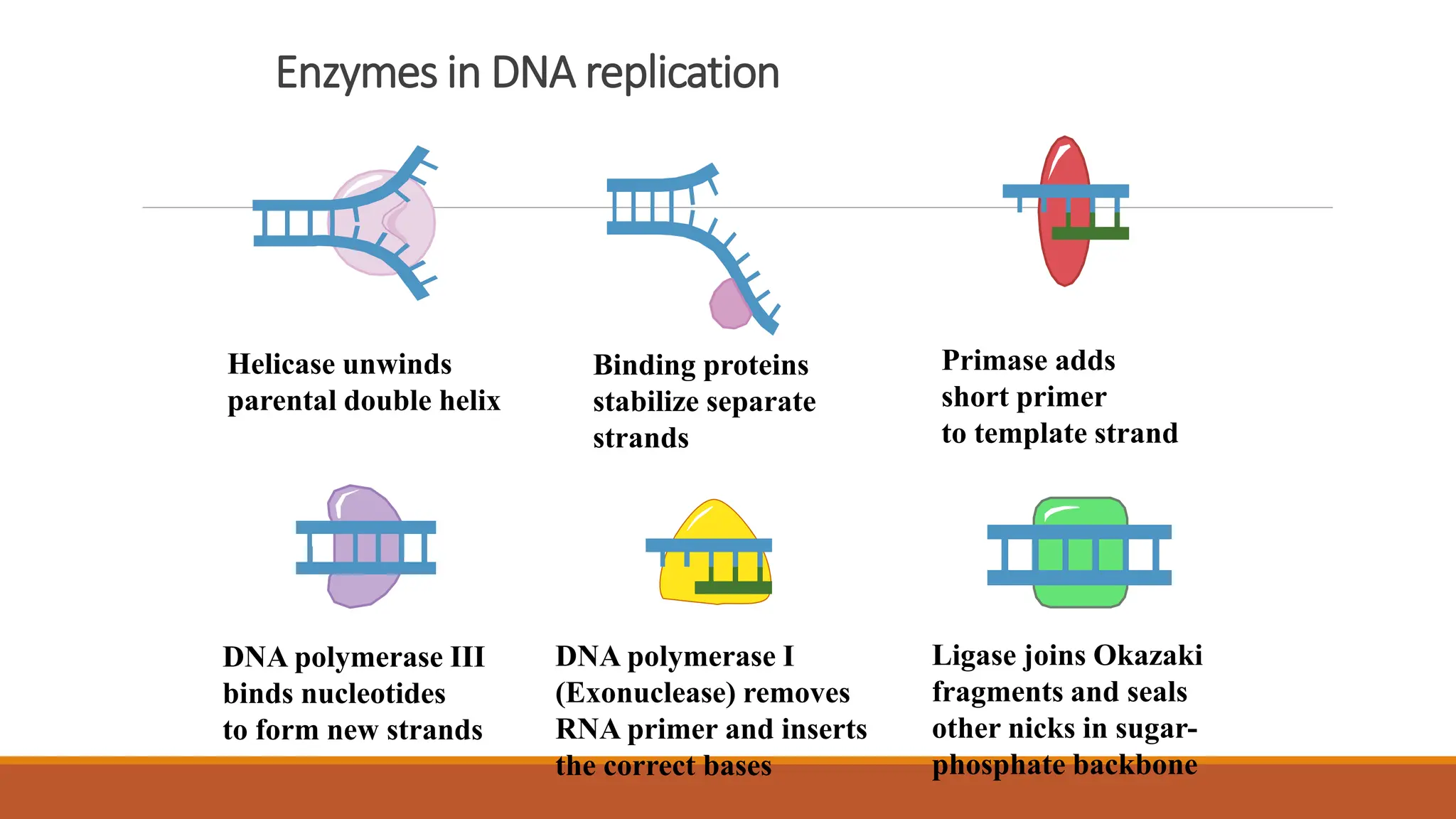
Enzymes in DNA replication
Helicase unwinds
parental double helix
Binding proteins
stabilize separate
strands
DNA polymerase III
binds nucleotides
to form new strands
Ligase joins Okazaki
fragments and seals
other nicks in sugar-
phosphate backbone
Primase adds
short primer
to template strand
DNA polymerase I
(Exonuclease) removes
RNA primer and inserts
the correct bases
DNA replication
The parent molecule unwinds, and two new daughter strands are built
based on base-pairing rules
(a) The parent molecule has two
complementary strands of DNA.
Each base is paired by hydrogen
bonding with its specific partner,
A with T and G with C.
(b) The first step in replication is
separation of the two DNA
strands.
(c) Each parental strand now
serves as a template that
determines the order of
nucleotides along a new,
complementary strand.
(d) The nucleotides are connected
to form the sugar-phosphate
backbones of the new strands.
Each “daughter” DNA
molecule consists of one parental
strand and one new strand.
A
C
T
A
G
A
C
T
A
G
A
C
T
A
G
A
C
T
A
G
T
G
A
T
C
T
G
A
T
C
A
C
T
A
G
A
C
T
A
G
T
G
A
T
C
T
G
A
T
C
T
G
A
T
C
T
G
A
T
C
DNA transcription is the process of creating a
complimentary RNA molecule, called messenger
RNA (mRNA), from a DNA template.
Stages of Transcription
Transcription proceeds in enzymatically catalysed steps
1.Initiation
2.Elongation
3.Termination
•Initiation:
• RNA polymerase (RNAP) recruits to the DNA template.
• RNAP reads the DNA template and positions itself at the binding site.
• RNAP begins to unwind the DNA double helix.
•Elongation:
• RNAP adds nucleotides to the growing RNA chain, in a complementary manner to the DNA template.
• Nucleotides are added in a 5' to 3' direction, opposite to the direction of DNA replication.
• RNAP moves along the DNA template as nucleotides are added, synthesizing the RNA molecule.
•Termination:
• When RNAP reaches the end of the DNA template, it releases the RNA molecule and dissociates from the
DNA.
• The RNA molecule is then transported out of the nucleus and into the cytoplasm for translation.
PresentationNEWOF REPLICATION ANDTRANSCRIPTION.pptx

PresentationNEWOF REPLICATION ANDTRANSCRIPTION.pptx

  • 1.
  • 2.
    Before a celldivides, its DNA must first be copied. How might the double-helix structure of DNA make that possible?
  • 5.
    Enzymes in DNAreplication Helicase unwinds parental double helix Binding proteins stabilize separate strands DNA polymerase III binds nucleotides to form new strands Ligase joins Okazaki fragments and seals other nicks in sugar- phosphate backbone Primase adds short primer to template strand DNA polymerase I (Exonuclease) removes RNA primer and inserts the correct bases
  • 6.
    DNA replication The parentmolecule unwinds, and two new daughter strands are built based on base-pairing rules (a) The parent molecule has two complementary strands of DNA. Each base is paired by hydrogen bonding with its specific partner, A with T and G with C. (b) The first step in replication is separation of the two DNA strands. (c) Each parental strand now serves as a template that determines the order of nucleotides along a new, complementary strand. (d) The nucleotides are connected to form the sugar-phosphate backbones of the new strands. Each “daughter” DNA molecule consists of one parental strand and one new strand. A C T A G A C T A G A C T A G A C T A G T G A T C T G A T C A C T A G A C T A G T G A T C T G A T C T G A T C T G A T C
  • 7.
    DNA transcription isthe process of creating a complimentary RNA molecule, called messenger RNA (mRNA), from a DNA template. Stages of Transcription Transcription proceeds in enzymatically catalysed steps 1.Initiation 2.Elongation 3.Termination
  • 9.
    •Initiation: • RNA polymerase(RNAP) recruits to the DNA template. • RNAP reads the DNA template and positions itself at the binding site. • RNAP begins to unwind the DNA double helix. •Elongation: • RNAP adds nucleotides to the growing RNA chain, in a complementary manner to the DNA template. • Nucleotides are added in a 5' to 3' direction, opposite to the direction of DNA replication. • RNAP moves along the DNA template as nucleotides are added, synthesizing the RNA molecule. •Termination: • When RNAP reaches the end of the DNA template, it releases the RNA molecule and dissociates from the DNA. • The RNA molecule is then transported out of the nucleus and into the cytoplasm for translation.