BANGLADESH DELTA PLAN 2100
Brief Presentation on
Bangladesh Delta Plan 2100
Giasuddin Ahmed Choudhury,
Deputy Team Leader
Background
• The Governments of Bangladesh and the Netherlands signed an MOU
on 22 May 2012 in presence of Hon’ble Prime Minster of Bangladesh
• It envisages closer cooperation in the field of sustainable delta
management, integrated water resources management, disaster
management and adaptation to climate change with special reference
to the development and implementation of a BDP 2100
• General Economic Division of Planning Commission, GOB and The
Embassy of the Kingdom of The Netherlands, GON are jointly directing
the project
• Study Start date : March 2014
End date : September 2016
Salient Features of BDP2100
• A holistic, adaptive and long-term (50 to 100 years) strategic plan for
inter-linked land and water management
• The purpose is to maintain a sustainable living environment for the
people
• BDP provides a vision, scenario and strategies with long-term
interventions and an investment plan
• Long-term planning horizon to capture processes of climate,
economic and demographic change
• Building on GoBs long-term development vision, Perspective Plan of
Bangladesh 2010-21 and other existing sectoral plans
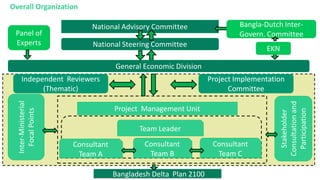
Consultant
Team B
Consultant
Team C
Project Management Unit
National Steering Committee
National Advisory Committee
General Economic Division
Project Implementation
Committee
Consultant
Team A
Team Leader
Panel of
Experts
Inter-Ministerial
FocalPoints
Stakeholder
Consultationand
Participation
Bangla-Dutch Inter-
Govern. Committee
Bangladesh Delta Plan 2100
Independent Reviewers
(Thematic)
EKN
Overall Organization
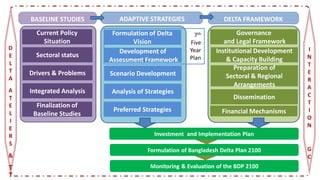
Investment and Implementation Plan
Formulation of Bangladesh Delta Plan 2100
Monitoring & Evaluation of the BDP 2100
D
E
L
T
A
A
T
E
L
I
E
R
S
&
T
T
I
N
T
E
R
A
C
T
I
O
N
G
C
Current Policy
Situation
Sectoral status
Drivers & Problems
Integrated Analysis
Finalization of
Baseline Studies
Formulation of Delta
Vision
Development of
Assessment Framework
Scenario Development
Analysis of Strategies
Preferred Strategies
Governance
and Legal Framework
Institutional Development
& Capacity Building
Preparation of
Sectoral & Regional
Arrangements
Dissemination
Financial Mechanisms
ADAPTIVE STRATEGIESBASELINE STUDIES DELTA FRAMEWORK
7th
Five
Year
Plan
6
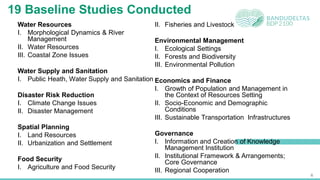
19 Baseline Studies Conducted
Water Resources
I. Morphological Dynamics & River
Management
II. Water Resources
III. Coastal Zone Issues
Water Supply and Sanitation
I. Public Heath, Water Supply and Sanitation
Disaster Risk Reduction
I. Climate Change Issues
II. Disaster Management
Spatial Planning
I. Land Resources
II. Urbanization and Settlement
Food Security
I. Agriculture and Food Security
II. Fisheries and Livestock
Environmental Management
I. Ecological Settings
II. Forests and Biodiversity
III. Environmental Pollution
Economics and Finance
I. Growth of Population and Management in
the Context of Resources Setting
II. Socio-Economic and Demographic
Conditions
III. Sustainable Transportation Infrastructures
Governance
I. Information and Creation of Knowledge
Management Institution
II. Institutional Framework & Arrangements;
Core Governance
III. Regional Cooperation
7
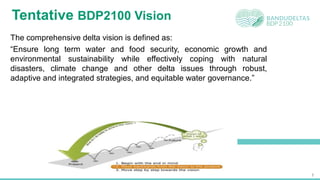
Tentative BDP2100 Vision
The comprehensive delta vision is defined as:
“Ensure long term water and food security, economic growth and
environmental sustainability while effectively coping with natural
disasters, climate change and other delta issues through robust,
adaptive and integrated strategies, and equitable water governance.”
8
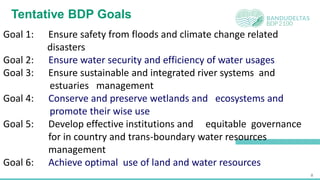
Tentative BDP Goals
Goal 1: Ensure safety from floods and climate change related
disasters
Goal 2: Ensure water security and efficiency of water usages
Goal 3: Ensure sustainable and integrated river systems and
estuaries management
Goal 4: Conserve and preserve wetlands and ecosystems and
promote their wise use
Goal 5: Develop effective institutions and equitable governance
for in country and trans-boundary water resources
management
Goal 6: Achieve optimal use of land and water resources
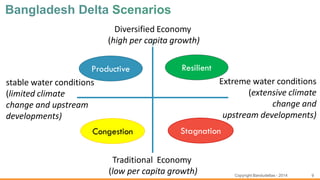
Bangladesh Delta Scenarios
9Copyright Bandudeltas - 2014
Diversified Economy
(high per capita growth)
Traditional Economy
(low per capita growth)
stable water conditions
(limited climate
change and upstream
developments)
Extreme water conditions
(extensive climate
change and
upstream developments)
Productive
Congestion
Resilient
Stagnation
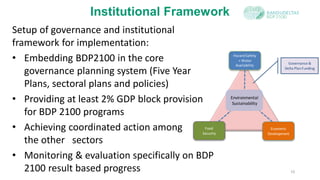
Setup of governance and institutional
framework for implementation:
• Embedding BDP2100 in the core
governance planning system (Five Year
Plans, sectoral plans and policies)
• Providing at least 2% GDP block provision
for BDP 2100 programs
• Achieving coordinated action among
the other sectors
• Monitoring & evaluation specifically on BDP
2100 result based progress 10
Institutional Framework
HazardSafety
+ Water
Availability
Environmental
Sustainability
Economic
Development
Food
Security
Governance &
Delta PlanFunding
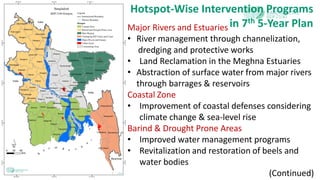
Hotspot-Wise Intervention Programs
in 7th 5-Year PlanMajor Rivers and Estuaries
• River management through channelization,
dredging and protective works
• Land Reclamation in the Meghna Estuaries
• Abstraction of surface water from major rivers
through barrages & reservoirs
Coastal Zone
• Improvement of coastal defenses considering
climate change & sea-level rise
Barind & Drought Prone Areas
• Improved water management programs
• Revitalization and restoration of beels and
water bodies
(Continued)
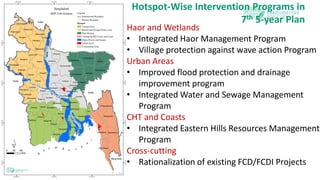
Hotspot-Wise Intervention Programs in
7th 5-year Plan
Haor and Wetlands
• Integrated Haor Management Program
• Village protection against wave action Program
Urban Areas
• Improved flood protection and drainage
improvement program
• Integrated Water and Sewage Management
Program
CHT and Coasts
• Integrated Eastern Hills Resources Management
Program
Cross-cutting
• Rationalization of existing FCD/FCDI Projects
Investment Plan for BDP2100
• On 16 June 2015, an MOU was signed between GoB, GoN,
WB and IFC/ 2030 WRG to strengthen water management of
the BDP2100
• On June 4, Prime Ministers of Bangladesh and Netherlands
agreed to work together closely on the implementation
BDP2100
• WB engaged Consultants to detailed-out the Investment Plan
of BDP2100
• BWDB officials are requested to provide:
– Priority list of short-, medium- and long-term program and projects
– Project concept note
Thank you

Presentation on delta plan 2100

  • 1.
    BANGLADESH DELTA PLAN2100 Brief Presentation on Bangladesh Delta Plan 2100 Giasuddin Ahmed Choudhury, Deputy Team Leader
  • 2.
    Background • The Governmentsof Bangladesh and the Netherlands signed an MOU on 22 May 2012 in presence of Hon’ble Prime Minster of Bangladesh • It envisages closer cooperation in the field of sustainable delta management, integrated water resources management, disaster management and adaptation to climate change with special reference to the development and implementation of a BDP 2100 • General Economic Division of Planning Commission, GOB and The Embassy of the Kingdom of The Netherlands, GON are jointly directing the project • Study Start date : March 2014 End date : September 2016
  • 3.
    Salient Features ofBDP2100 • A holistic, adaptive and long-term (50 to 100 years) strategic plan for inter-linked land and water management • The purpose is to maintain a sustainable living environment for the people • BDP provides a vision, scenario and strategies with long-term interventions and an investment plan • Long-term planning horizon to capture processes of climate, economic and demographic change • Building on GoBs long-term development vision, Perspective Plan of Bangladesh 2010-21 and other existing sectoral plans
  • 4.
    Consultant Team B Consultant Team C ProjectManagement Unit National Steering Committee National Advisory Committee General Economic Division Project Implementation Committee Consultant Team A Team Leader Panel of Experts Inter-Ministerial FocalPoints Stakeholder Consultationand Participation Bangla-Dutch Inter- Govern. Committee Bangladesh Delta Plan 2100 Independent Reviewers (Thematic) EKN Overall Organization
  • 5.
    Investment and ImplementationPlan Formulation of Bangladesh Delta Plan 2100 Monitoring & Evaluation of the BDP 2100 D E L T A A T E L I E R S & T T I N T E R A C T I O N G C Current Policy Situation Sectoral status Drivers & Problems Integrated Analysis Finalization of Baseline Studies Formulation of Delta Vision Development of Assessment Framework Scenario Development Analysis of Strategies Preferred Strategies Governance and Legal Framework Institutional Development & Capacity Building Preparation of Sectoral & Regional Arrangements Dissemination Financial Mechanisms ADAPTIVE STRATEGIESBASELINE STUDIES DELTA FRAMEWORK 7th Five Year Plan
  • 6.
    6 19 Baseline StudiesConducted Water Resources I. Morphological Dynamics & River Management II. Water Resources III. Coastal Zone Issues Water Supply and Sanitation I. Public Heath, Water Supply and Sanitation Disaster Risk Reduction I. Climate Change Issues II. Disaster Management Spatial Planning I. Land Resources II. Urbanization and Settlement Food Security I. Agriculture and Food Security II. Fisheries and Livestock Environmental Management I. Ecological Settings II. Forests and Biodiversity III. Environmental Pollution Economics and Finance I. Growth of Population and Management in the Context of Resources Setting II. Socio-Economic and Demographic Conditions III. Sustainable Transportation Infrastructures Governance I. Information and Creation of Knowledge Management Institution II. Institutional Framework & Arrangements; Core Governance III. Regional Cooperation
  • 7.
    7 Tentative BDP2100 Vision Thecomprehensive delta vision is defined as: “Ensure long term water and food security, economic growth and environmental sustainability while effectively coping with natural disasters, climate change and other delta issues through robust, adaptive and integrated strategies, and equitable water governance.”
  • 8.
    8 Tentative BDP Goals Goal1: Ensure safety from floods and climate change related disasters Goal 2: Ensure water security and efficiency of water usages Goal 3: Ensure sustainable and integrated river systems and estuaries management Goal 4: Conserve and preserve wetlands and ecosystems and promote their wise use Goal 5: Develop effective institutions and equitable governance for in country and trans-boundary water resources management Goal 6: Achieve optimal use of land and water resources
  • 9.
    Bangladesh Delta Scenarios 9CopyrightBandudeltas - 2014 Diversified Economy (high per capita growth) Traditional Economy (low per capita growth) stable water conditions (limited climate change and upstream developments) Extreme water conditions (extensive climate change and upstream developments) Productive Congestion Resilient Stagnation
  • 10.
    Setup of governanceand institutional framework for implementation: • Embedding BDP2100 in the core governance planning system (Five Year Plans, sectoral plans and policies) • Providing at least 2% GDP block provision for BDP 2100 programs • Achieving coordinated action among the other sectors • Monitoring & evaluation specifically on BDP 2100 result based progress 10 Institutional Framework HazardSafety + Water Availability Environmental Sustainability Economic Development Food Security Governance & Delta PlanFunding
  • 11.
    Hotspot-Wise Intervention Programs in7th 5-Year PlanMajor Rivers and Estuaries • River management through channelization, dredging and protective works • Land Reclamation in the Meghna Estuaries • Abstraction of surface water from major rivers through barrages & reservoirs Coastal Zone • Improvement of coastal defenses considering climate change & sea-level rise Barind & Drought Prone Areas • Improved water management programs • Revitalization and restoration of beels and water bodies (Continued)
  • 12.
    Hotspot-Wise Intervention Programsin 7th 5-year Plan Haor and Wetlands • Integrated Haor Management Program • Village protection against wave action Program Urban Areas • Improved flood protection and drainage improvement program • Integrated Water and Sewage Management Program CHT and Coasts • Integrated Eastern Hills Resources Management Program Cross-cutting • Rationalization of existing FCD/FCDI Projects
  • 13.
    Investment Plan forBDP2100 • On 16 June 2015, an MOU was signed between GoB, GoN, WB and IFC/ 2030 WRG to strengthen water management of the BDP2100 • On June 4, Prime Ministers of Bangladesh and Netherlands agreed to work together closely on the implementation BDP2100 • WB engaged Consultants to detailed-out the Investment Plan of BDP2100 • BWDB officials are requested to provide: – Priority list of short-, medium- and long-term program and projects – Project concept note
  • 14.