Group members

IFRAH SYED
NIDA ASLAM
AQSA HASHMI
MAHREEN KHAWJA
-What is Stress ?
-Some Facts
What are Stressors
-Types of Stress
-Adaptation Syndrome
-Symptoms/Effects
-Workplace Stress
-Exam Stress
-Study Stress
-ABC of stress
-How to manage Stress
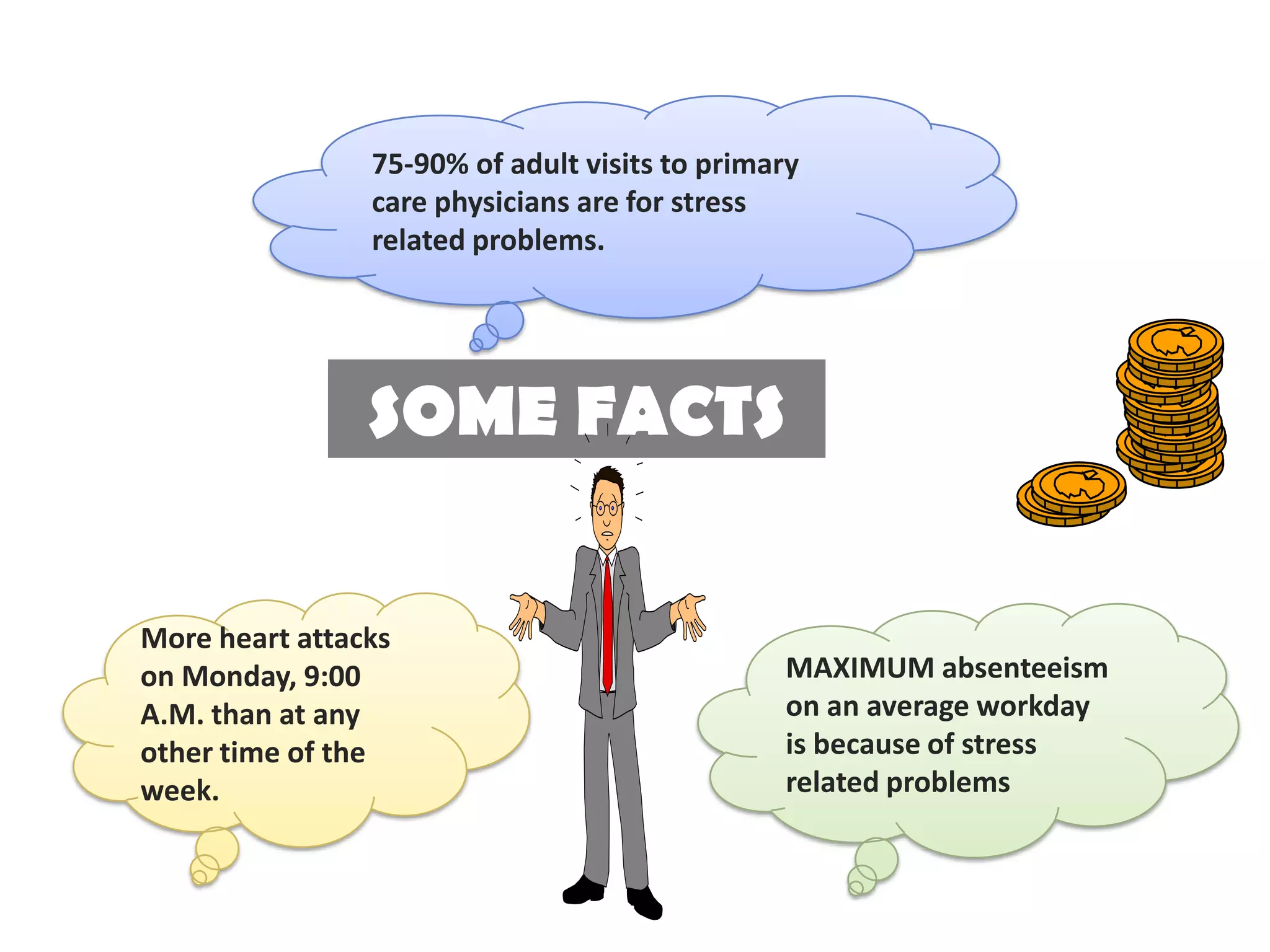
75-90% of adult visits to primary
                care physicians are for stress
                related problems.


                SOME FACTS


More heart attacks
on Monday, 9:00                                MAXIMUM absenteeism
A.M. than at any                               on an average workday
other time of the                              is because of stress
week.                                          related problems
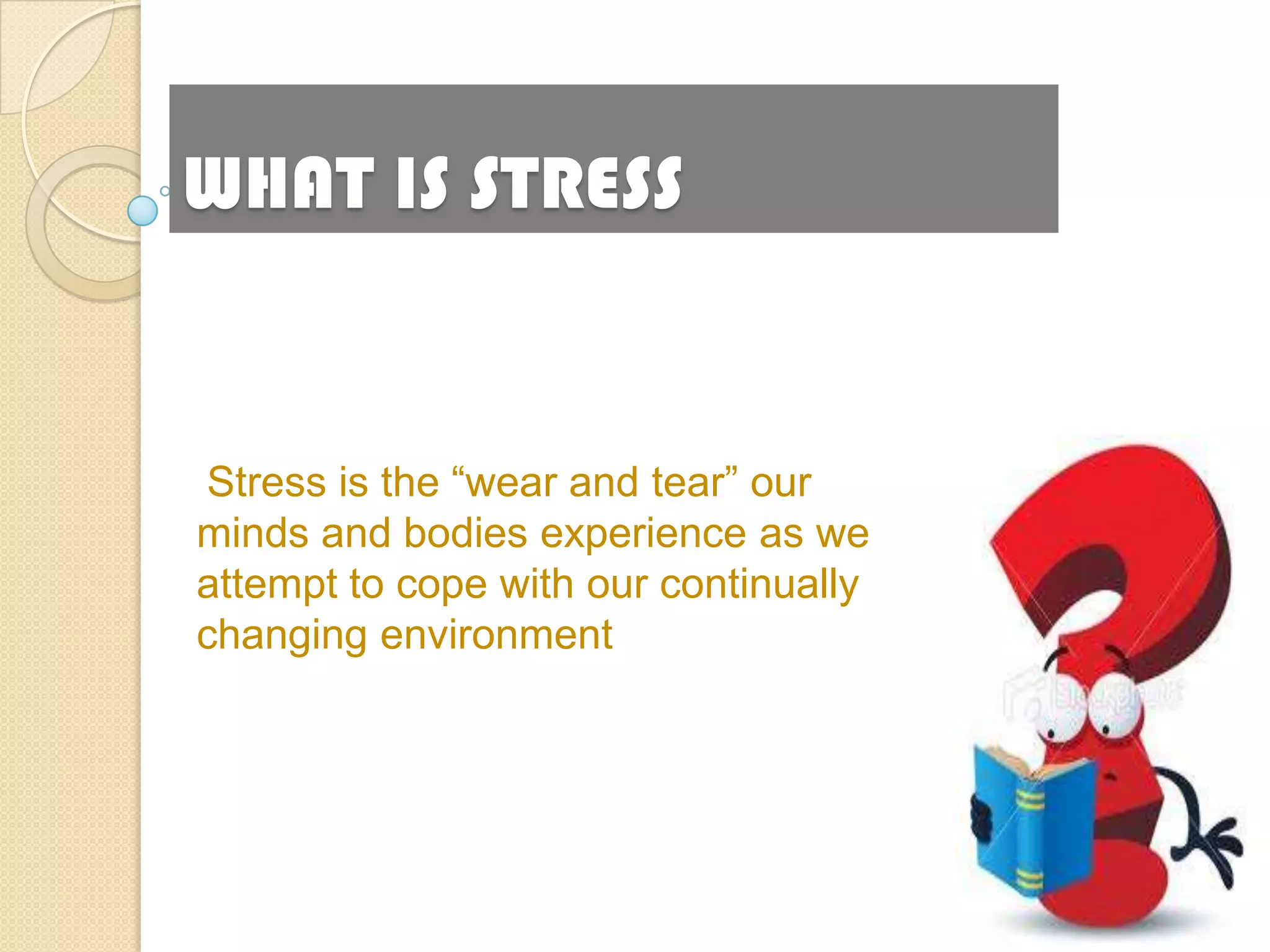
WHAT IS STRESS


Stress is the ―wear and tear‖ our
minds and bodies experience as we
attempt to cope with our continually
changing environment
WHAT ARE STRESSORS?


   Stressors are events that
 threaten or challenge people
TYPES
     1. External Stressors
     2. Internal Stressors
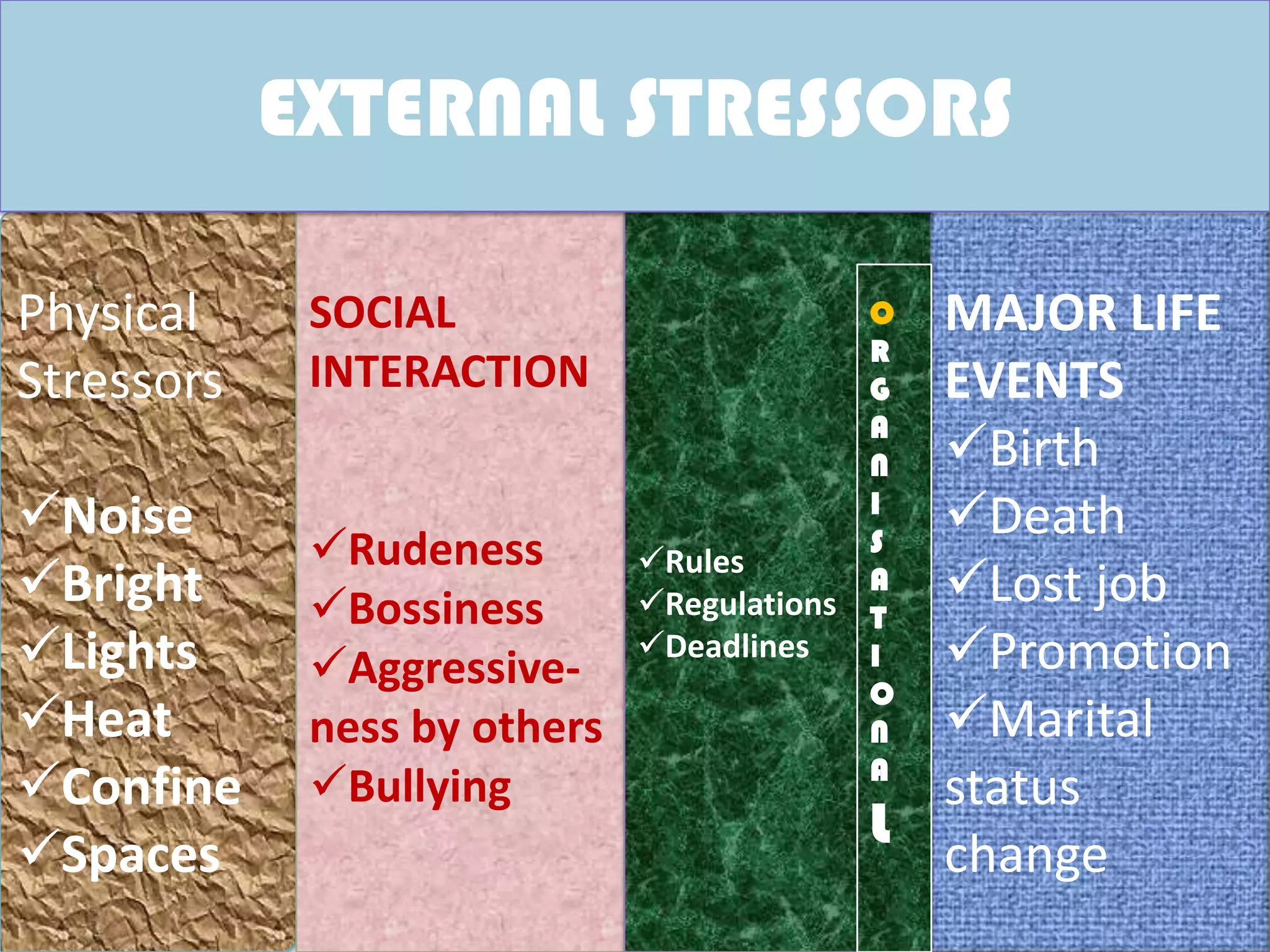
EXTERNAL STRESSORS

Physical     SOCIAL                          O MAJOR LIFE
                                             R
Stressors    INTERACTION                     G EVENTS
                                             A
                                             N Birth
Noise                                       I
                                               Death
             Rudeness        Rules
                                             S
Bright      Bossiness       Regulations
                                             A
                                             T
                                               Lost job
Lights      Aggressive-
                              Deadlines     I Promotion
                                             O
Heat        ness by others                  N Marital
                                             A
Confine     Bullying                         status
                                             L
Spaces                                        change
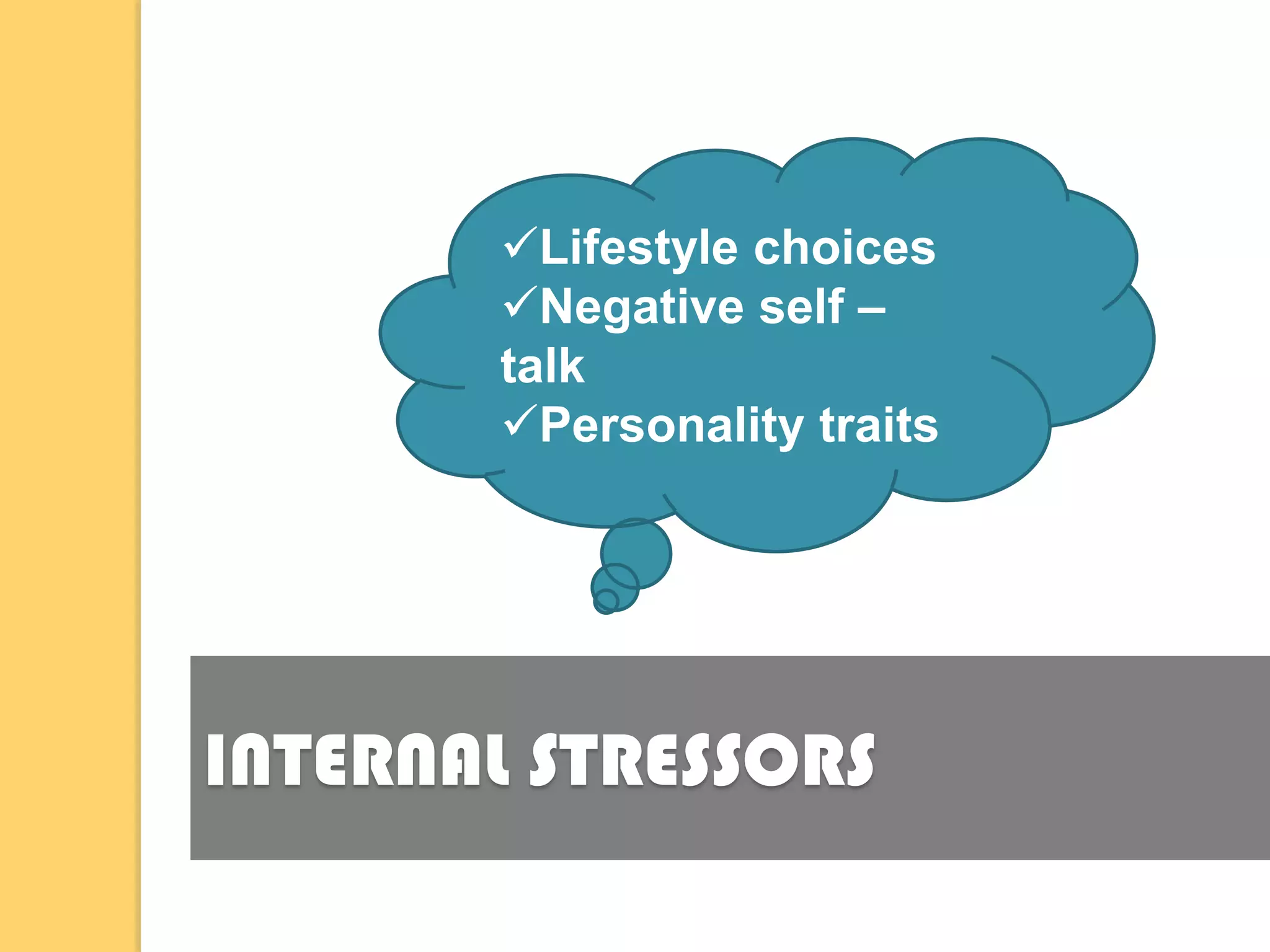
Lifestyle choices
       Negative self –
       talk
       Personality traits


INTERNAL STRESSORS
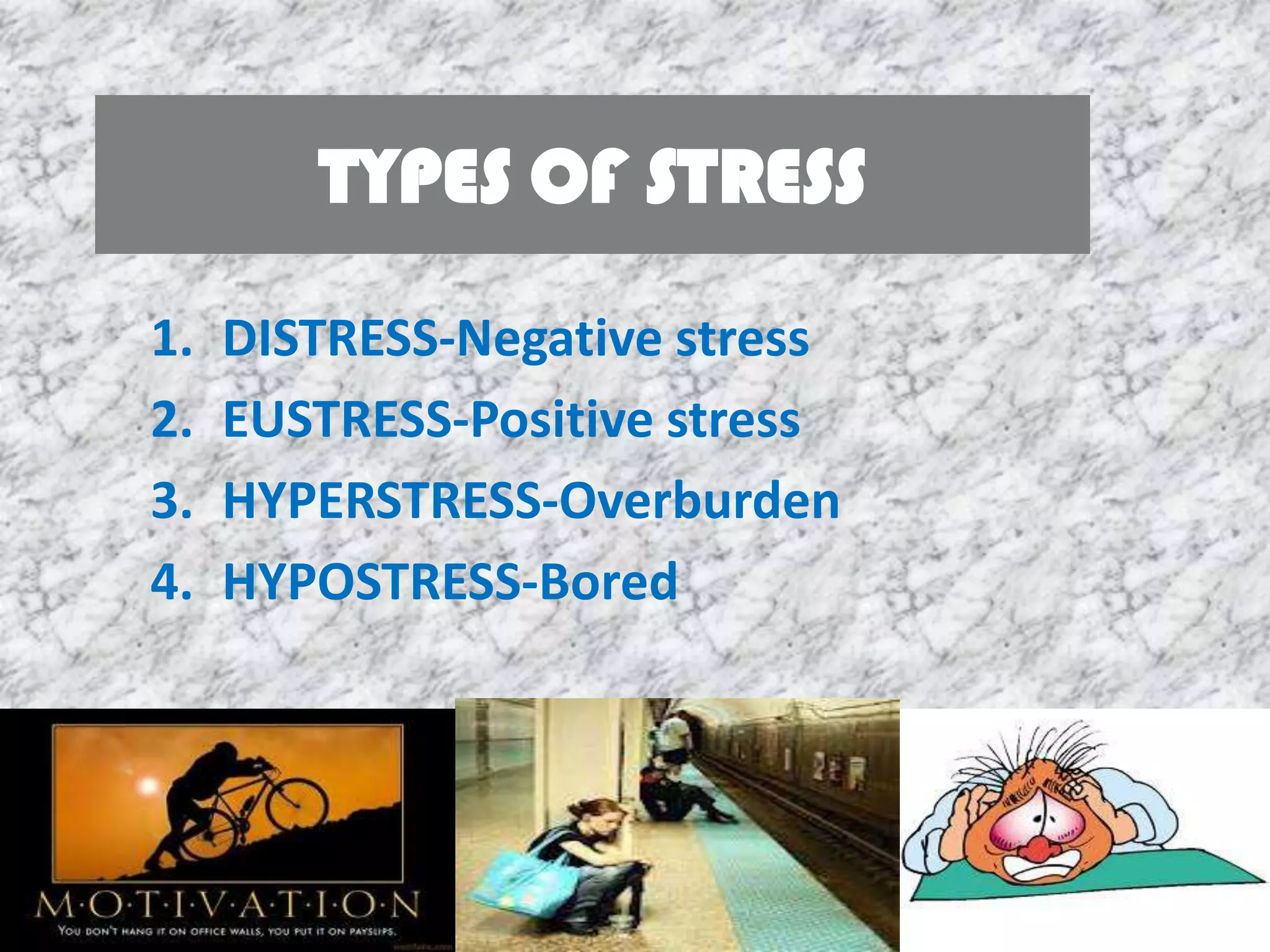
TYPES OF STRESS
1.   DISTRESS-Negative stress
2.   EUSTRESS-Positive stress
3.   HYPERSTRESS-Overburden
4.   HYPOSTRESS-Bored
The individual
• Everyone is different, with unique perception of, and
  reaction to, events. There is no single level of stress
  that is optimal for all people.
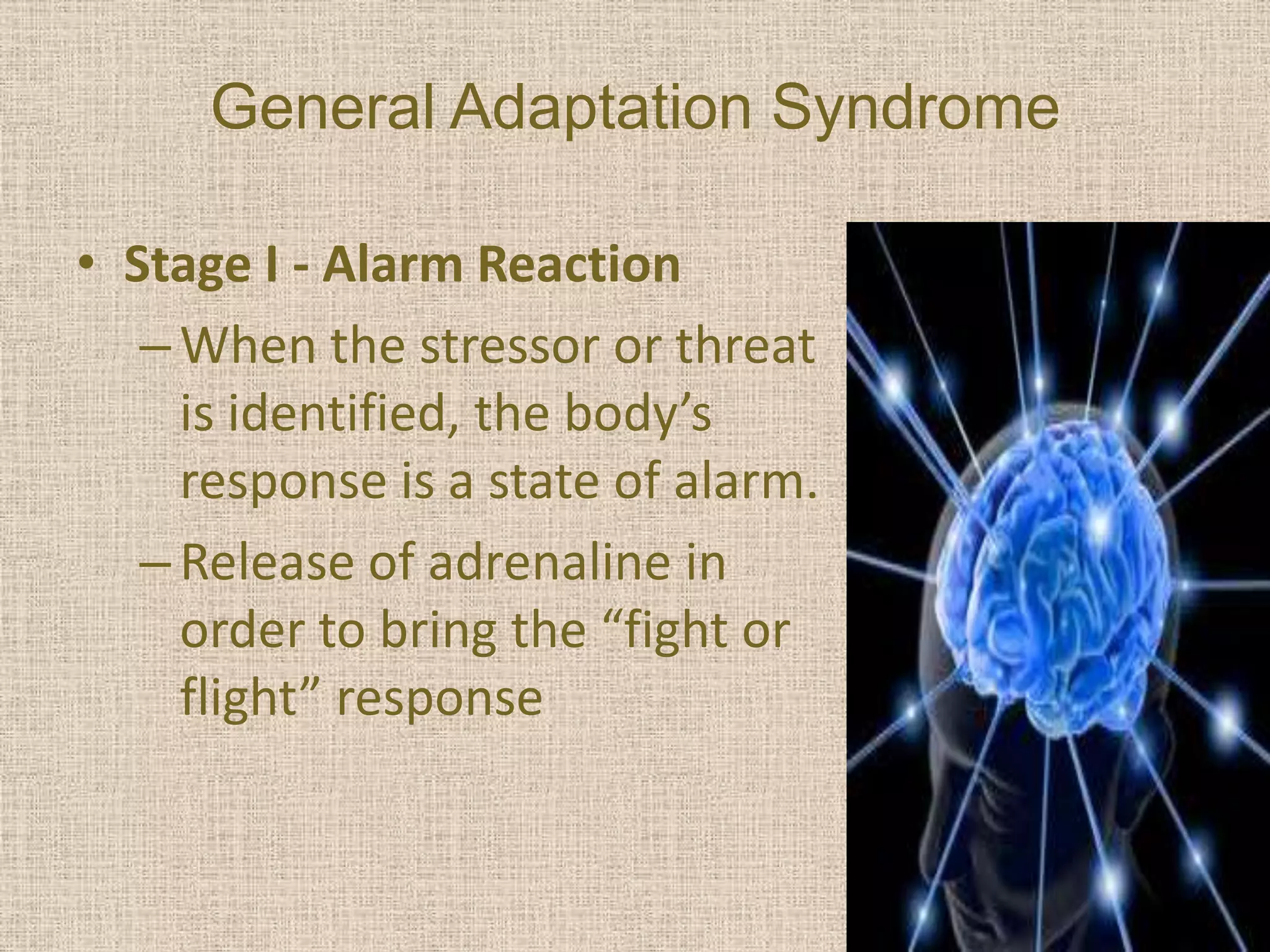
General Adaptation Syndrome

• Stage I - Alarm Reaction
   – When the stressor or threat
     is identified, the body’s
     response is a state of alarm.
   – Release of adrenaline in
     order to bring the “fight or
     flight” response
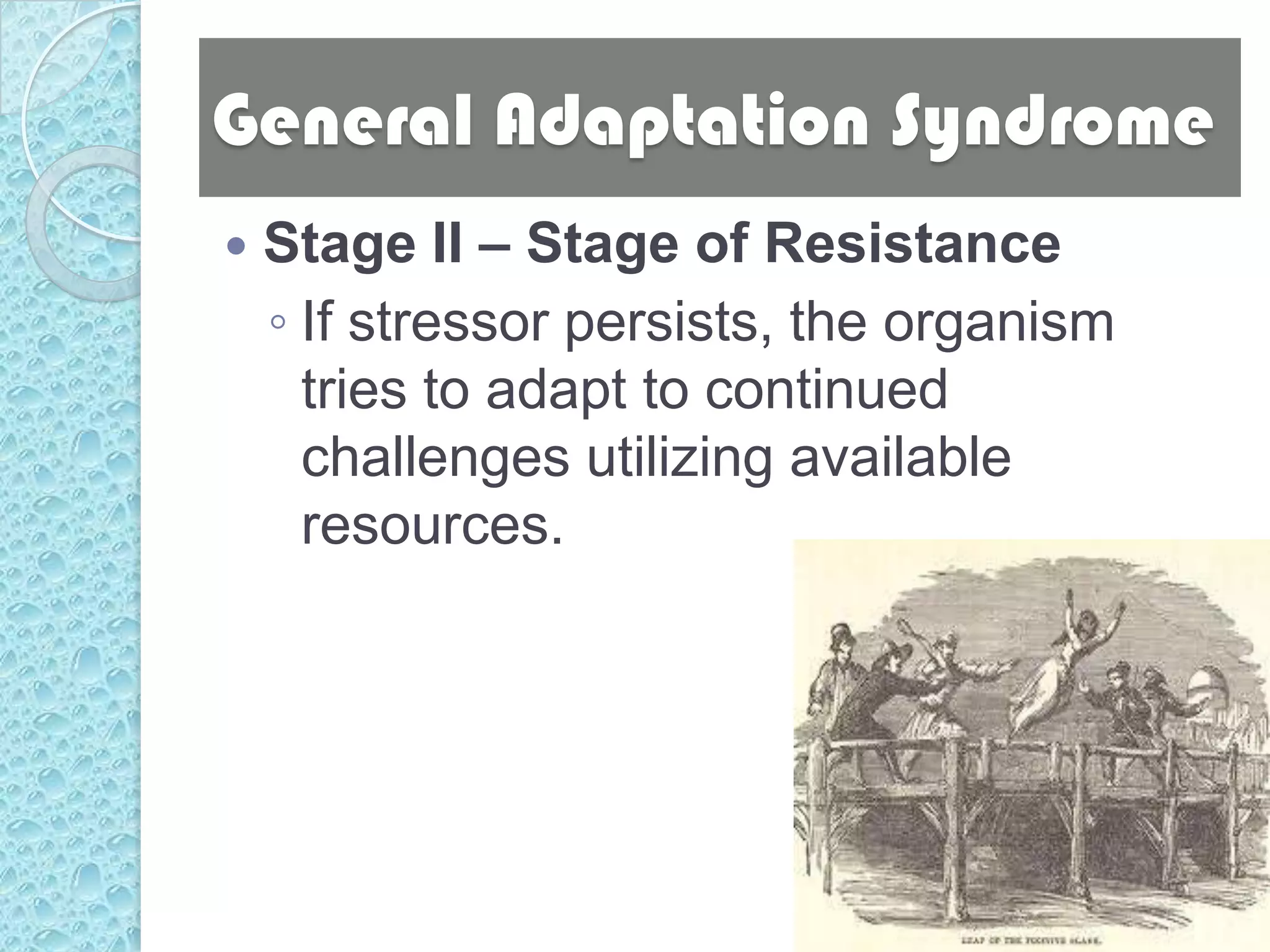
General Adaptation Syndrome
   Stage II – Stage of Resistance
    ◦ If stressor persists, the organism
      tries to adapt to continued
      challenges utilizing available
      resources.
General Adaptation Syndrome
   Stage III – Stage of Exhaustion
    ◦ Stress persists for a long time
    ◦ Environmental demands or
      strains exceeded available
      resources
    ◦ All the body’s available
      resources are eventually
      depleted and the body is unable
      to maintain normal function.
SUMMARY

Up till now we have discussed

-What is Stress ?
-Some Facts
-What are Stressors-external
& Internal Stressors
-Types of Stress
-Adaptation Syndrome
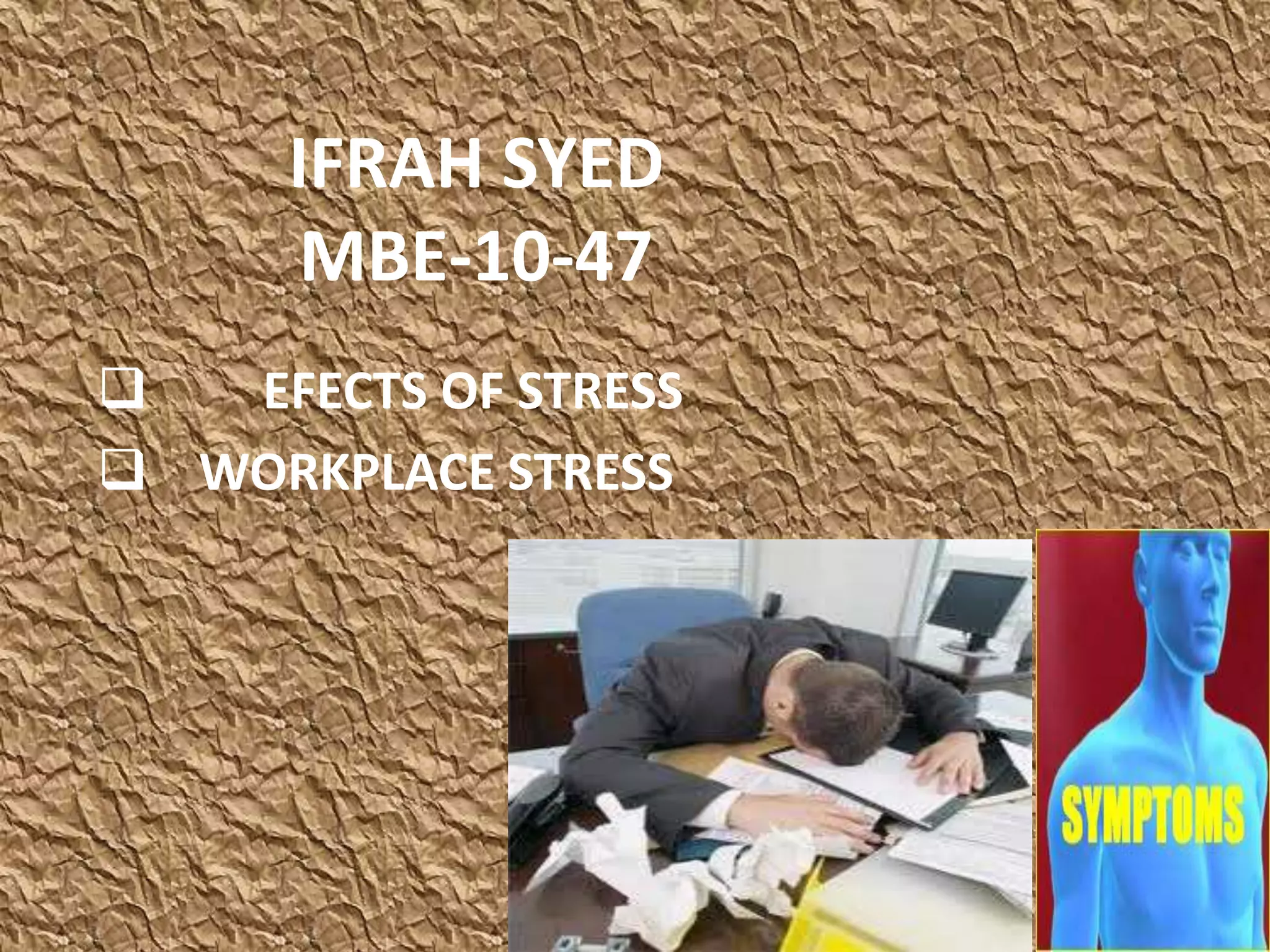
IFRAH SYED
       MBE-10-47
  EFECTS OF STRESS
 WORKPLACE STRESS
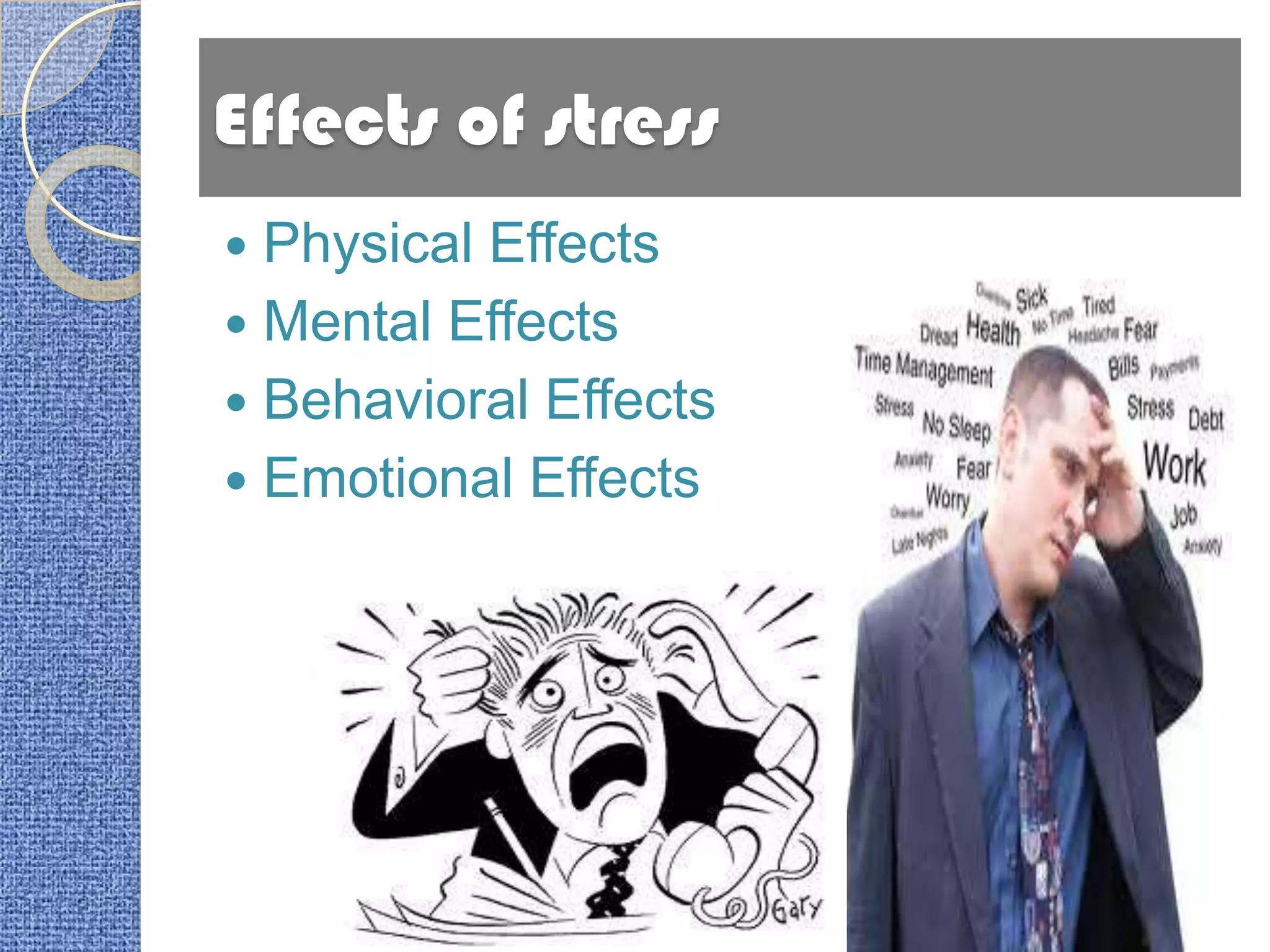
Effects of stress
 Physical Effects
 Mental Effects
 Behavioral Effects
 Emotional Effects
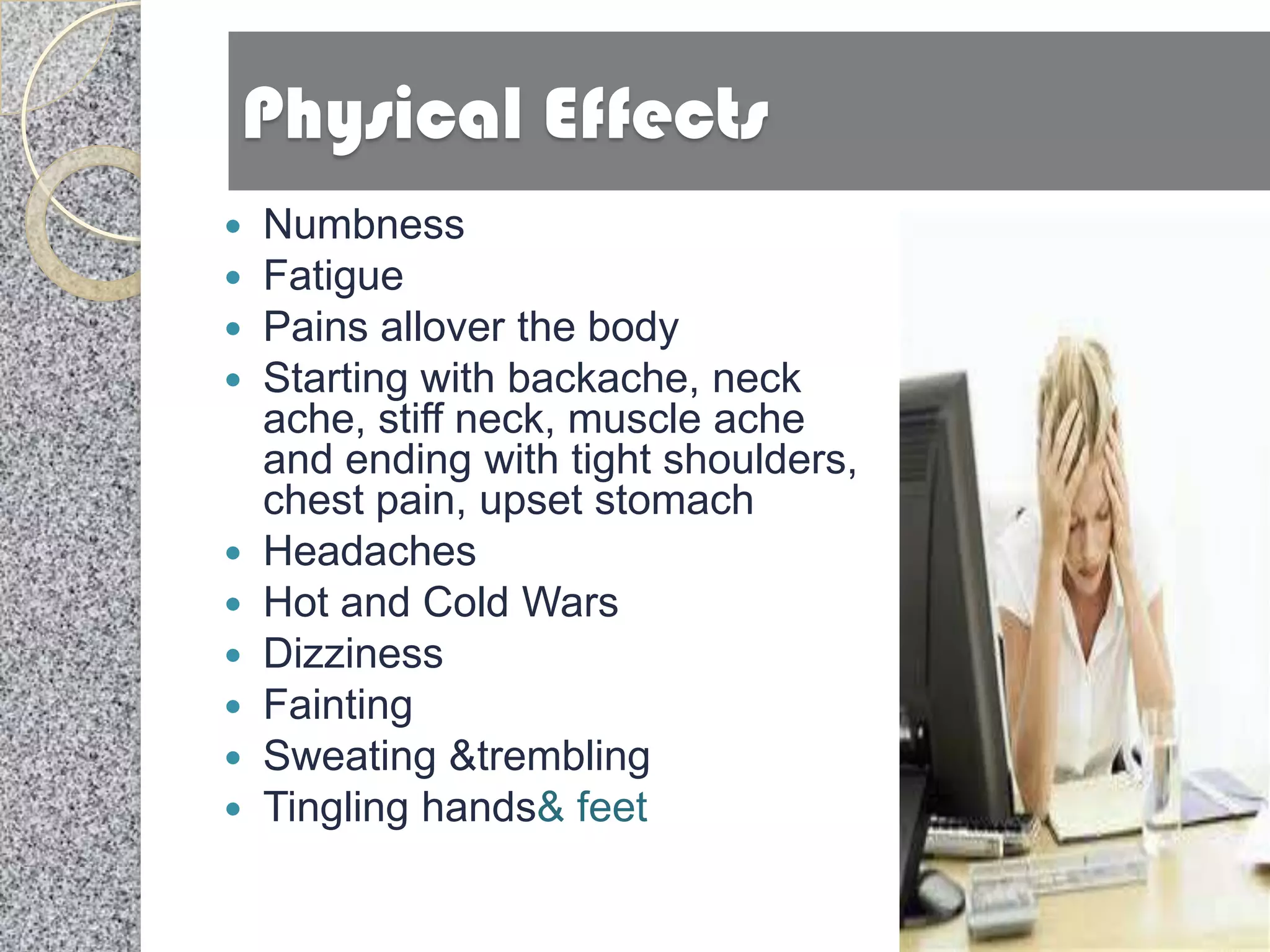
Physical Effects
 Numbness
 Fatigue
 Pains allover the body
 Starting with backache, neck
  ache, stiff neck, muscle ache
  and ending with tight shoulders,
  chest pain, upset stomach
 Headaches
 Hot and Cold Wars
 Dizziness
 Fainting
 Sweating &trembling
 Tingling hands& feet
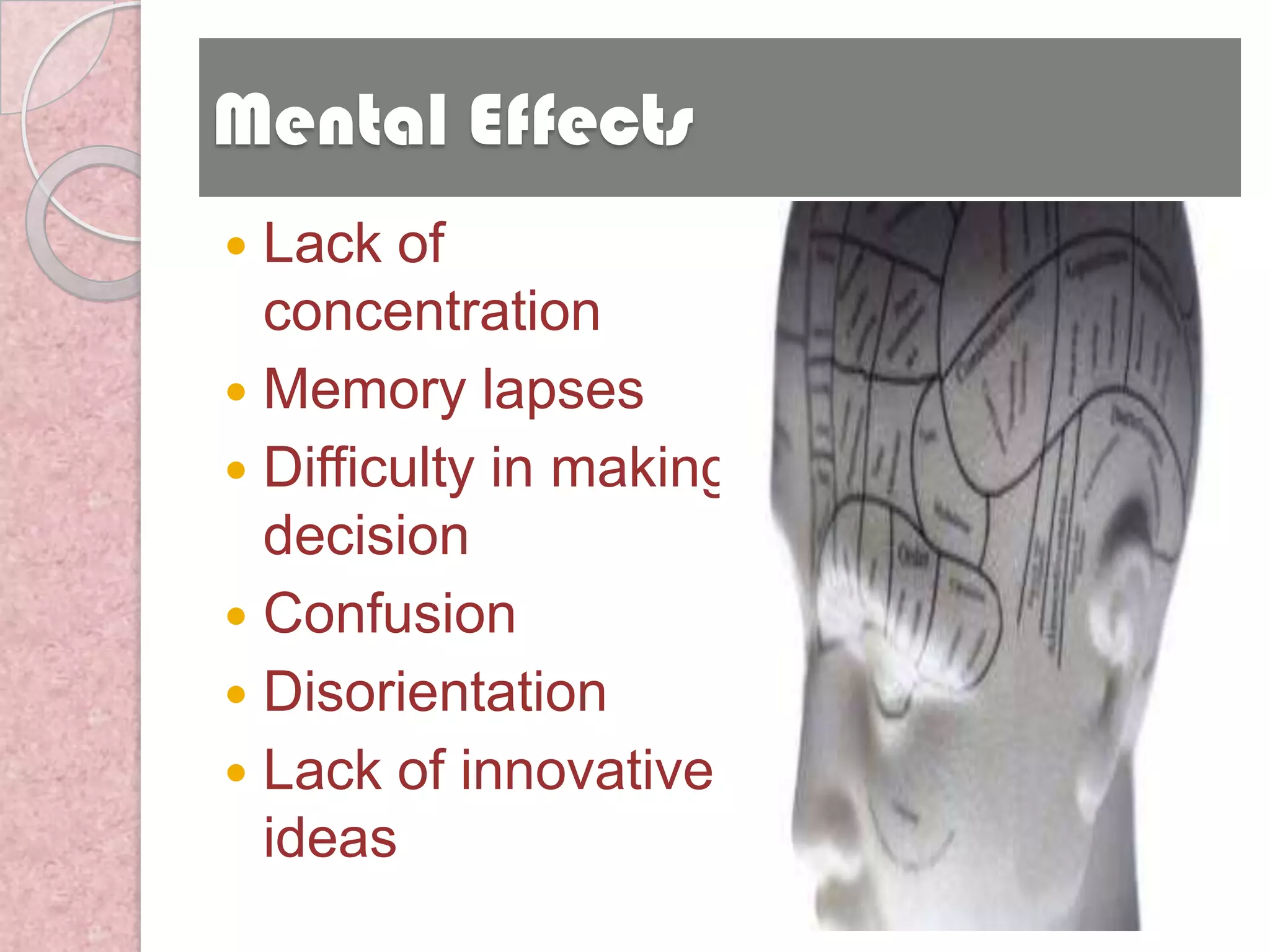
Mental Effects
 Lack of
  concentration
 Memory lapses
 Difficulty in making
  decision
 Confusion
 Disorientation
 Lack of innovative
  ideas
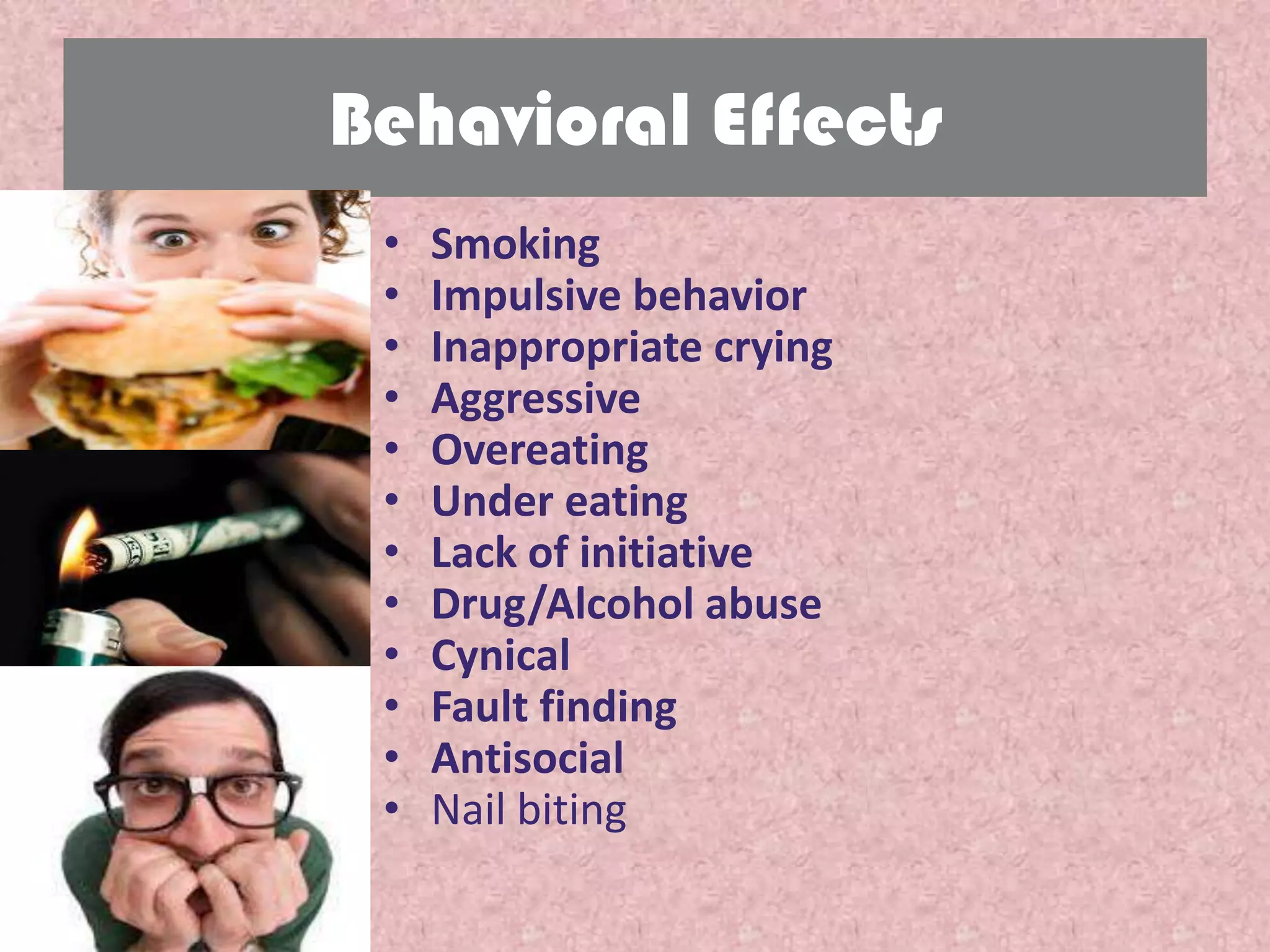
Behavioral Effects
 •   Smoking
 •   Impulsive behavior
 •   Inappropriate crying
 •   Aggressive
 •   Overeating
 •   Under eating
 •   Lack of initiative
 •   Drug/Alcohol abuse
 •   Cynical
 •   Fault finding
 •   Antisocial
 •   Nail biting
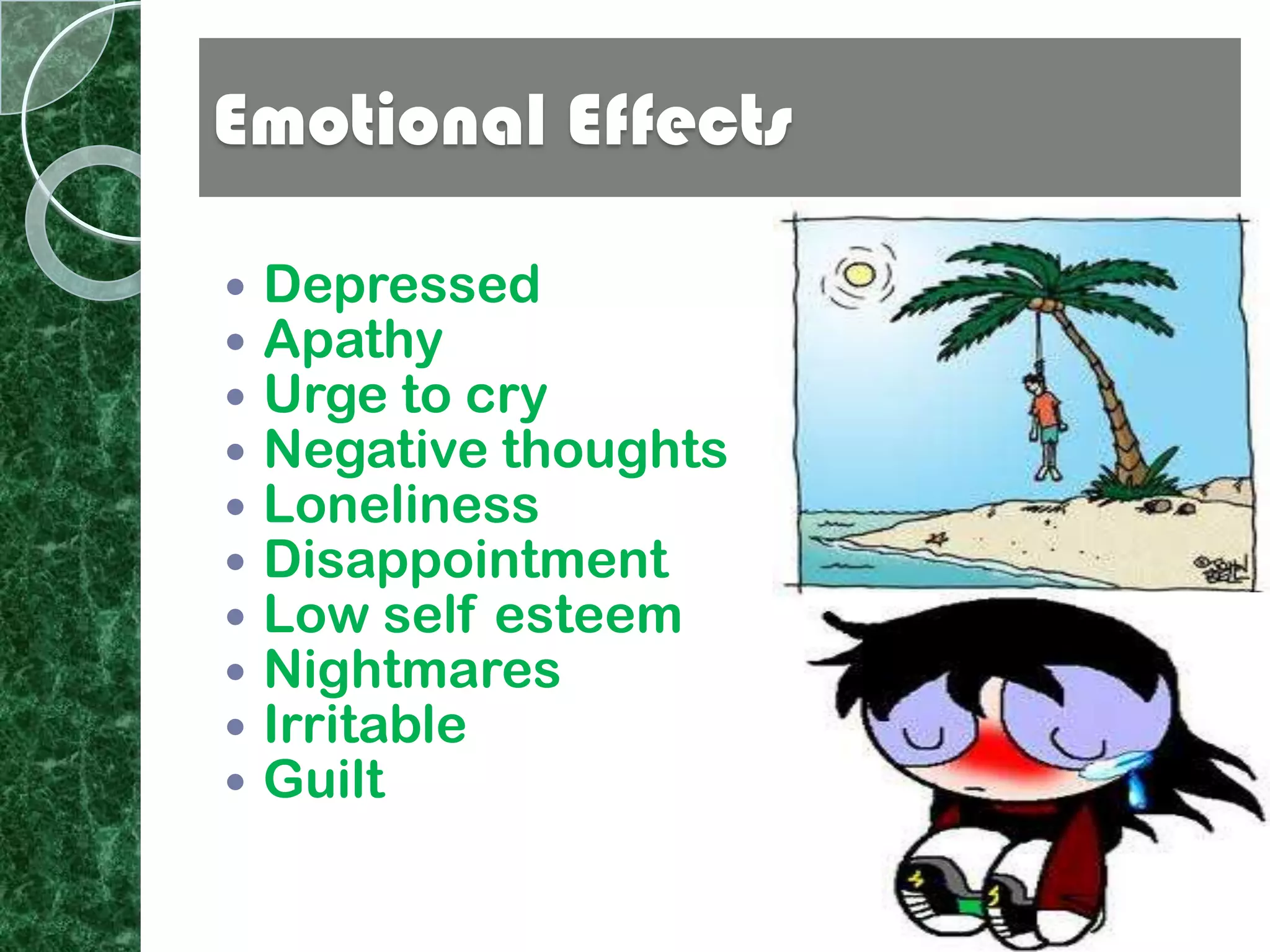
Emotional Effects

   Depressed
   Apathy
   Urge to cry
   Negative thoughts
   Loneliness
   Disappointment
   Low self esteem
   Nightmares
   Irritable
   Guilt
STRESS RELATED ILLNESSES


 Cardiovascular disease
 Immune system disease
 Asthma
 Diabetes
 Ulcers
 Skin complaints
 Headaches and migraines
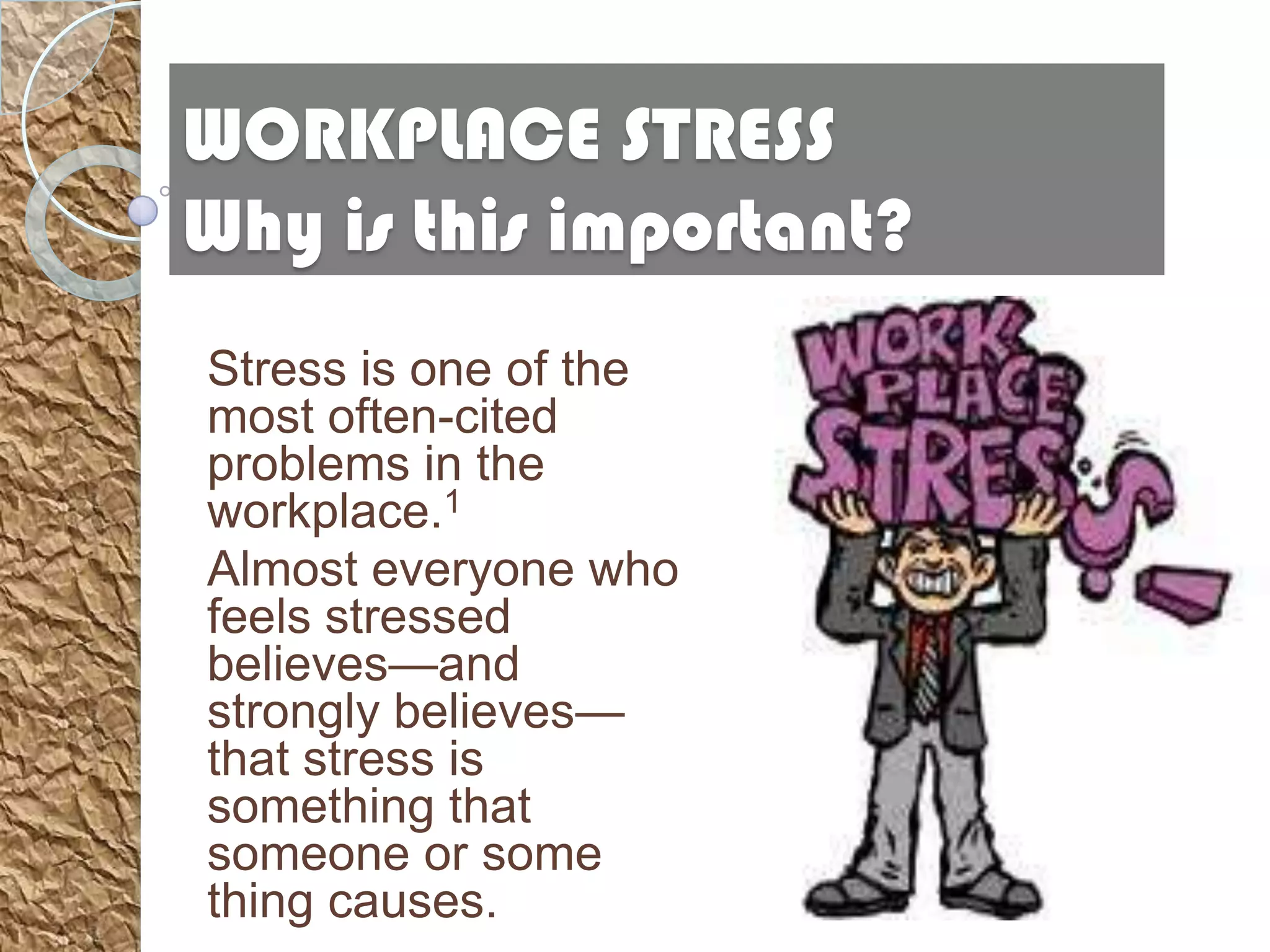
WORKPLACE STRESS
Why is this important?
Stress is one of the
most often-cited
problems in the
workplace.1
Almost everyone who
feels stressed
believes—and
strongly believes—
that stress is
something that
someone or some
thing causes.
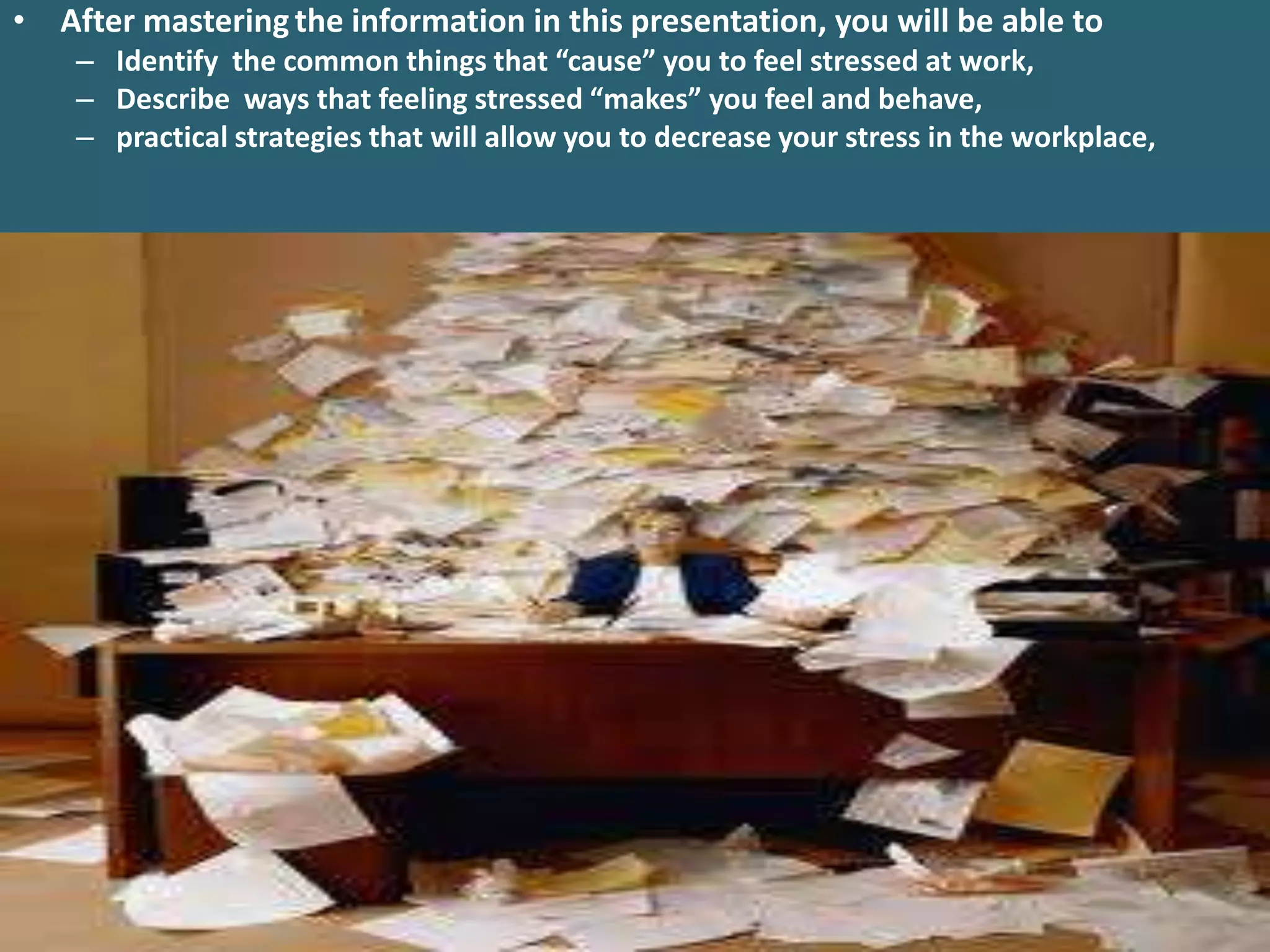
• After mastering the information in this presentation, you will be able to
    – Identify the common things that “cause” you to feel stressed at work,
    – Describe ways that feeling stressed “makes” you feel and behave,
    – practical strategies that will allow you to decrease your stress in the workplace,
What “causes” you to feel stressed
in the workplace?1,2
   Conflict            Time pressure
   Negative            Information overload
    coworkers           Unclear expectations
   Rumors              Unreasonable demands
   Criticism           Troublemakers
   Meaningless work    Incompetent leaders
   Perceived           An uncomfortable
    unfairness           environment
   Excessive           Faulty equipment
    sensitivity         Inadequate training
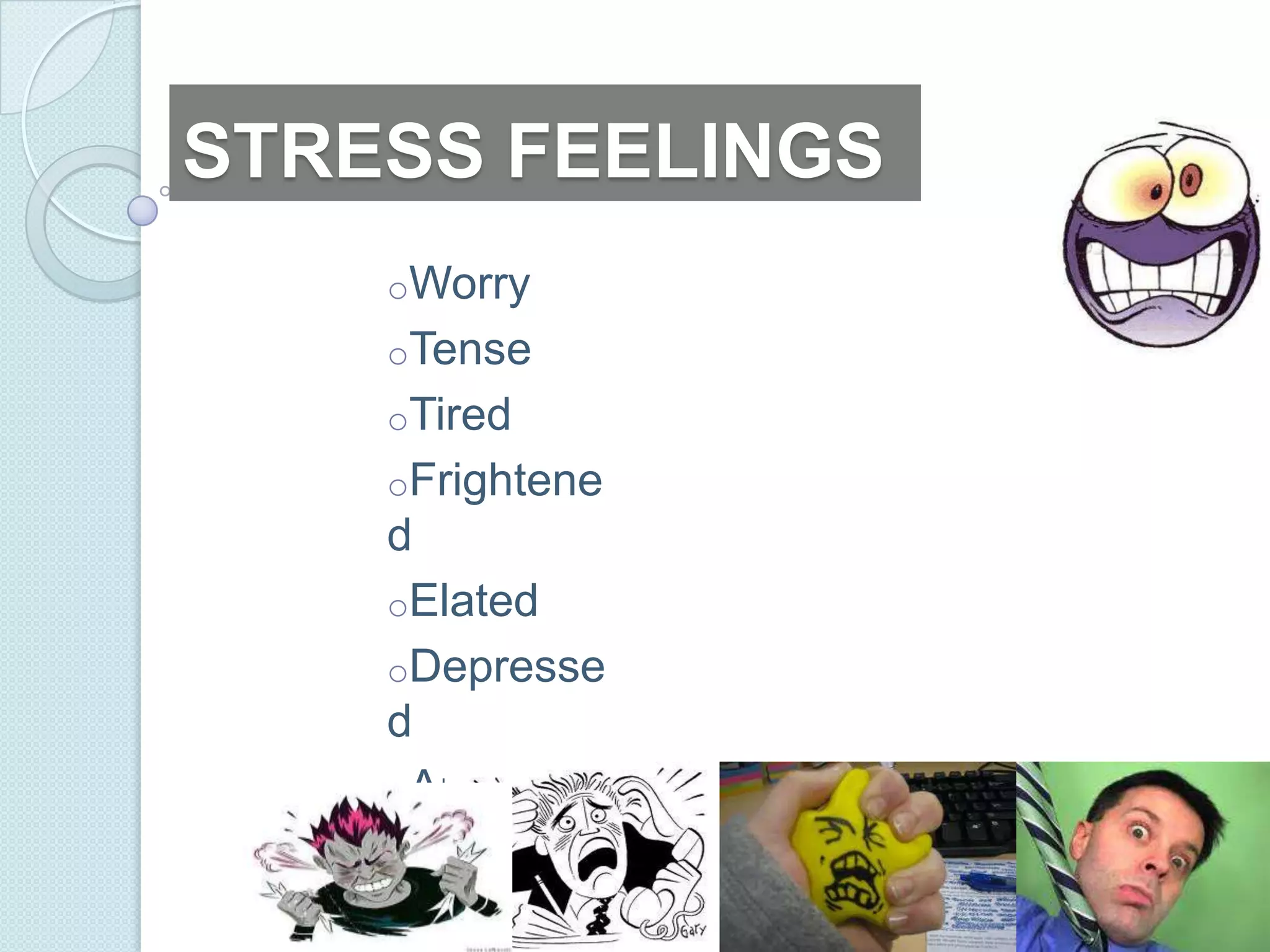
STRESS FEELINGS
    oWorry
    oTense
    oTired
    oFrightene
    d
    oElated
    oDepresse
    d
    oAnxious
    oAnger
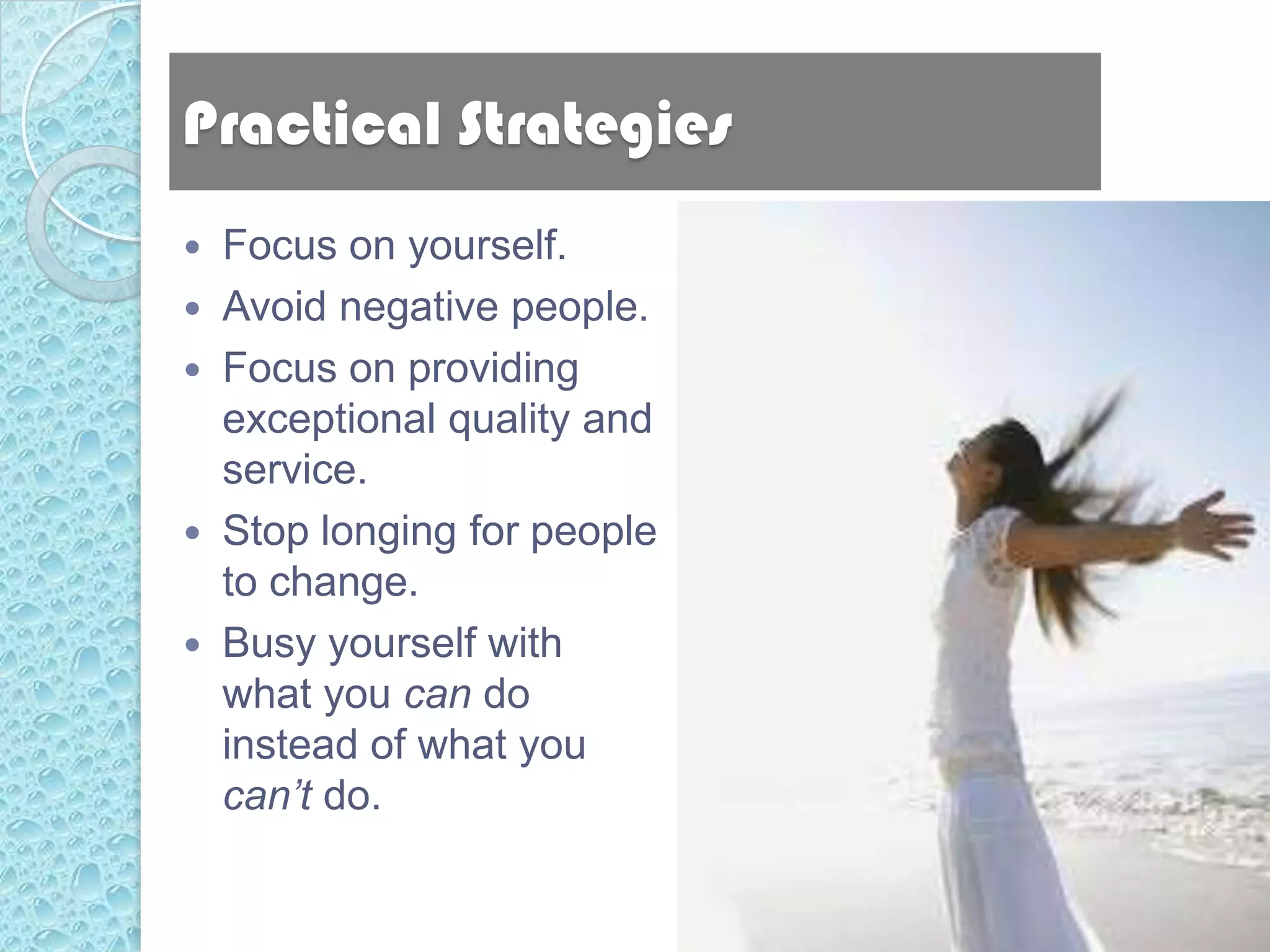
Practical Strategies
   Focus on yourself.
   Avoid negative people.
   Focus on providing
    exceptional quality and
    service.
   Stop longing for people
    to change.
   Busy yourself with
    what you can do
    instead of what you
    can’t do.
Tips on Handling Stress

    Work smarter, not harder.
    Always maintain a short-task list.
    Continually ask yourself, ―What is the
     best use of my time right now?‖
    Be physically active to relieve tension.
    Make quick decisions.
    Carefully mix work & breaks.
    Have a positive attitude.
    Relax.
                     © 2008 MMMTS
SUMMARY

Up till now we have discussed
oEffects of Stress
oDiseases caused by stress
oWhat are causes of
Workplace Stress &
oHow to cope with them
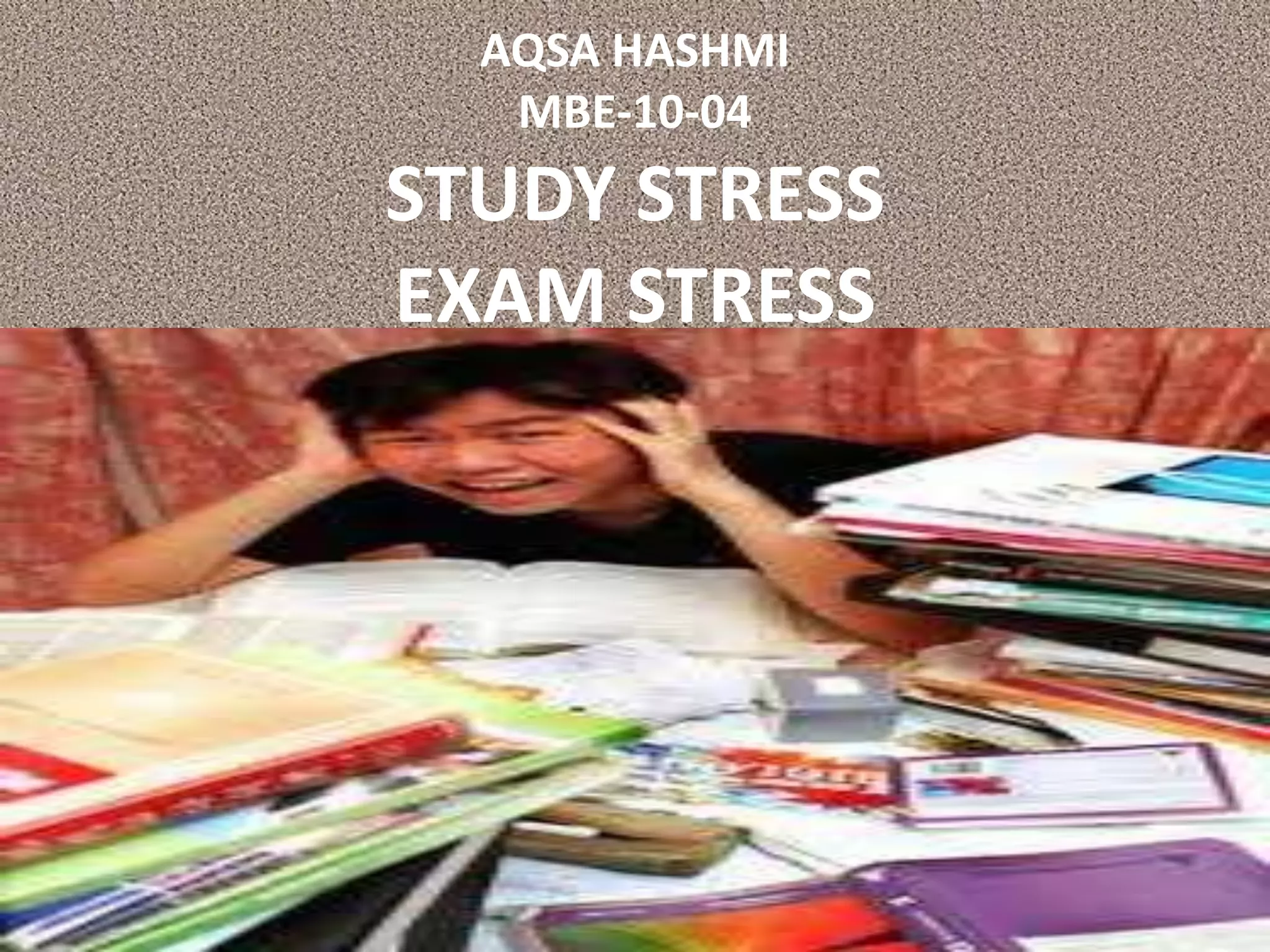
AQSA HASHMI
   MBE-10-04
STUDY STRESS
EXAM STRESS
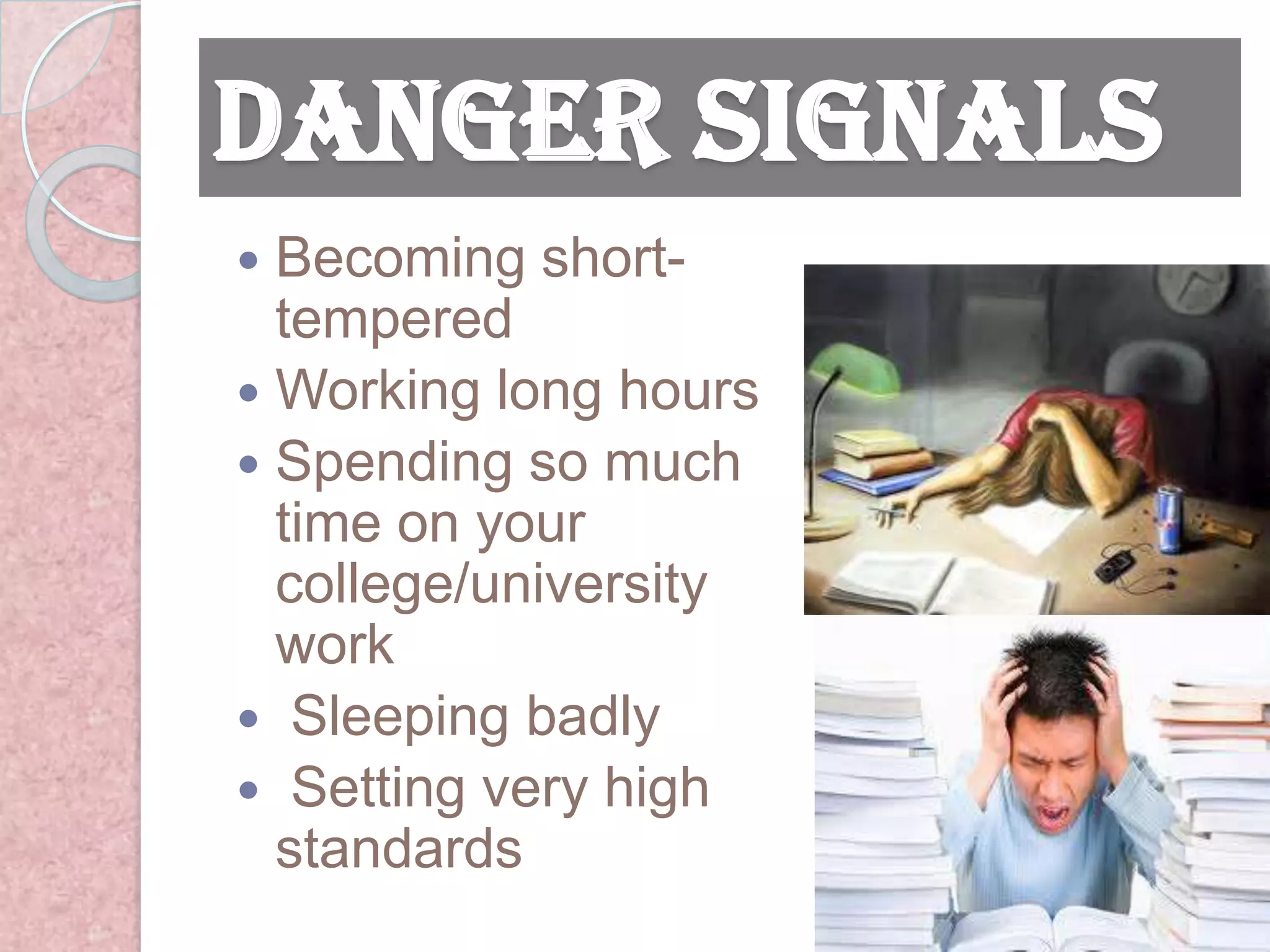
Danger Signals
 Becoming short-
  tempered
 Working long hours
 Spending so much
  time on your
  college/university
  work
 Sleeping badly
 Setting very high
  standards
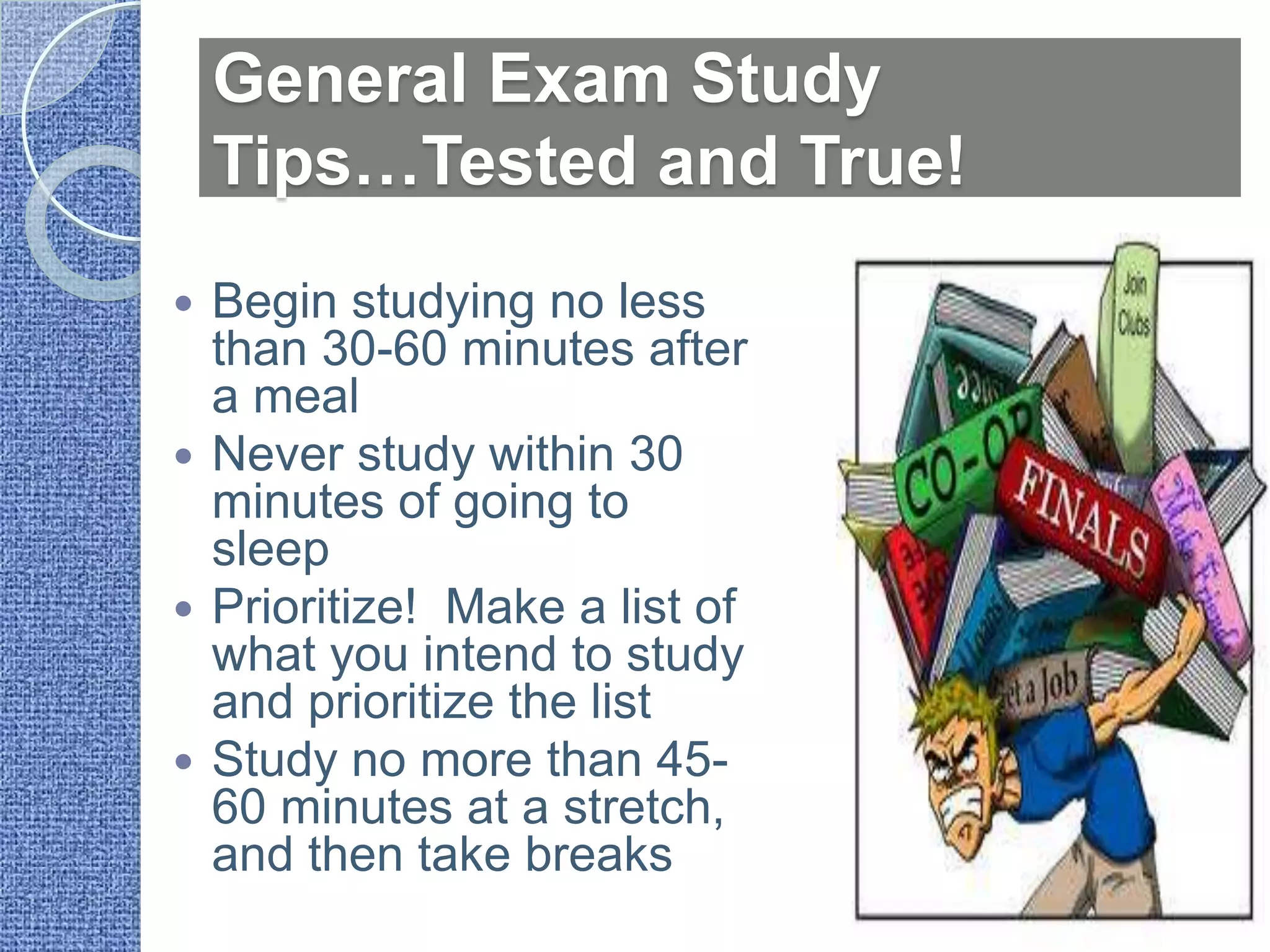
General Exam Study
    Tips…Tested and True!
 Begin studying no less
  than 30-60 minutes after
  a meal
 Never study within 30
  minutes of going to
  sleep
 Prioritize! Make a list of
  what you intend to study
  and prioritize the list
 Study no more than 45-
  60 minutes at a stretch,
  and then take breaks
• Take breaks away from your desk and do something
  different

• Try to continue your daily habits as usual (don’t
  drastically reduce your sleep, eliminate exercise, or
  overeat)
Creating the Right
Environment for Studying
◦ Environment is moderately
  comfortable

◦ Free of distractions

◦ Use your space

◦ Keep the study space
  organized .

◦ Have everything need to
  study
Proven Study Strategies
                SQ3R
    Survey

    Question

    Read

    Recite

    Review
Exam Stress
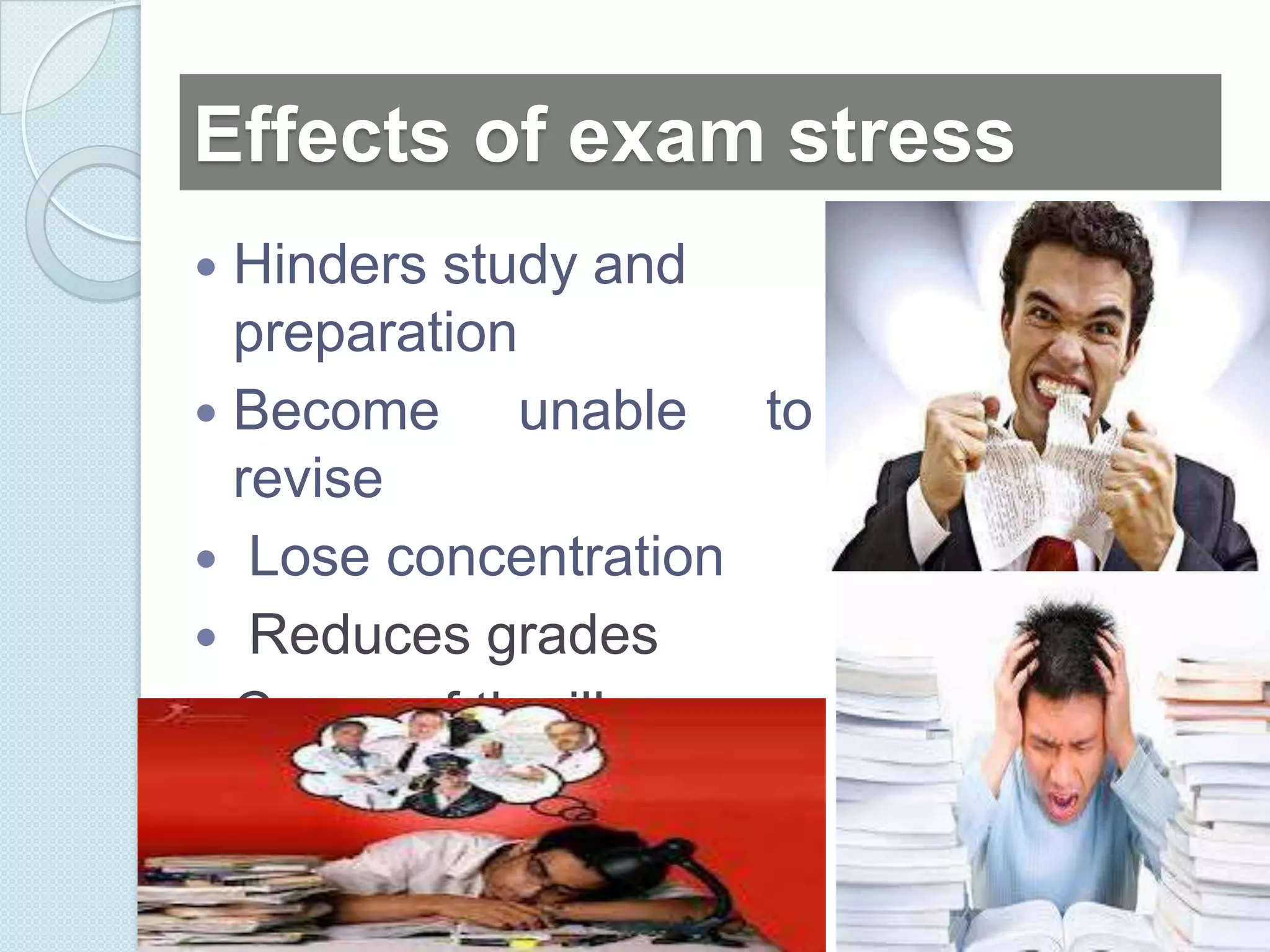
Effects of exam stress
 Hinders study and
  preparation
 Become      unable to
  revise
 Lose concentration
 Reduces grades
 Cause of the illness
Relieve exam stress
  Start preparation
  Visualize success
  Don’t ask your friends
  Time utilized for study
  Be Brave
  Strong faith in God
  Look after
  Limit drugs
  Number of options
Mahreen Khawaja
  MBE-10-18
  Stress
management
Stress management

 How to manage stress?
 How to cope with stress?
 How to manage stressful situations?
 How to steer clear of stressors?
Stress management
 ABC Strategy
 Ten Tips for stress management
 Change your Thinking Reframing
 Change your thinking- positive
  Thinking
 Change your behavior
 Time Management
ABC Strategy
 A = AWARENESS
 What causes you stress? How do you
react?
 B = BALANCE
There is a fine line between positive /
negative stress How much can you cope
with before it becomes negative ?
 C = CONTROL
What can you do to help yourself combat
the negative effects of stress ?
Ten tips for Stress
Management
   Smile            Distract Yourself
   Meditate         Breathe Right
   Exercise         Right Posture
   Be Grateful      Get a Massage
   Eat Healthy      Spend time with
                      Healthy People
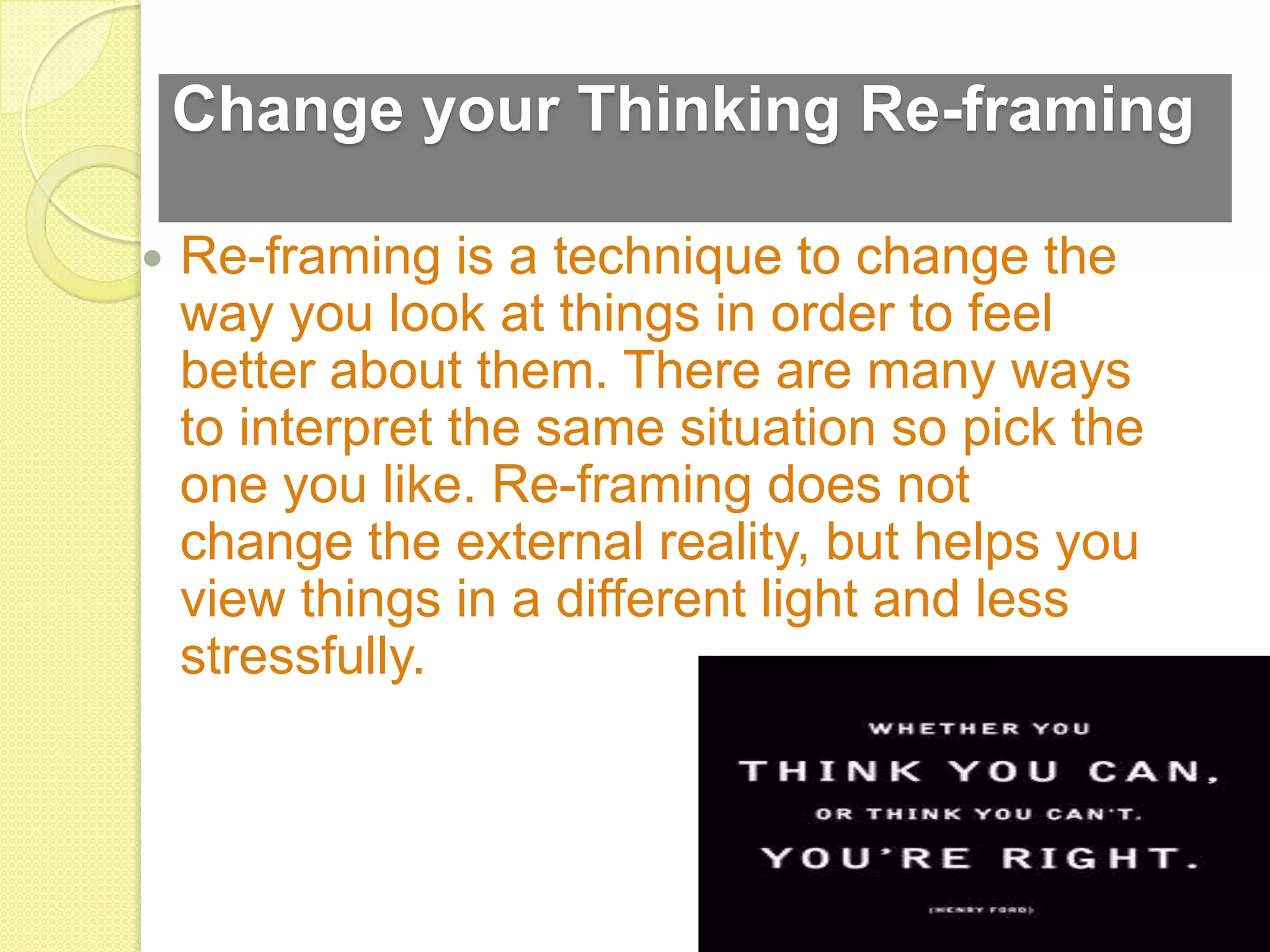
Change your Thinking Re-framing

   Re-framing is a technique to change the
    way you look at things in order to feel
    better about them. There are many ways
    to interpret the same situation so pick the
    one you like. Re-framing does not
    change the external reality, but helps you
    view things in a different light and less
    stressfully.
Change your Thinking Positive
Thinking

 Forget powerlessness, dejection,
  despair, failure Stress leaves us
  vulnerable to negative suggestion so
  focus on positives;
•Focus on your strengths
•Learn from the stress you are under
•Look for opportunities
•Seek out the positive - make a change.
Change your Behavior
•Be assertive
•Get organized
•Humor
•Diversion and distraction
Be Assertive
   Assertiveness helps to manage
    stressful situations, and will , in time,
    help to reduce their frequency. Lack of
    assertiveness often shows low self -
    esteem and low self -confidence. The
    key to assertiveness is verbal and non
    - verbal communication. Extending our
    range of communication skills will
    improve our assertiveness
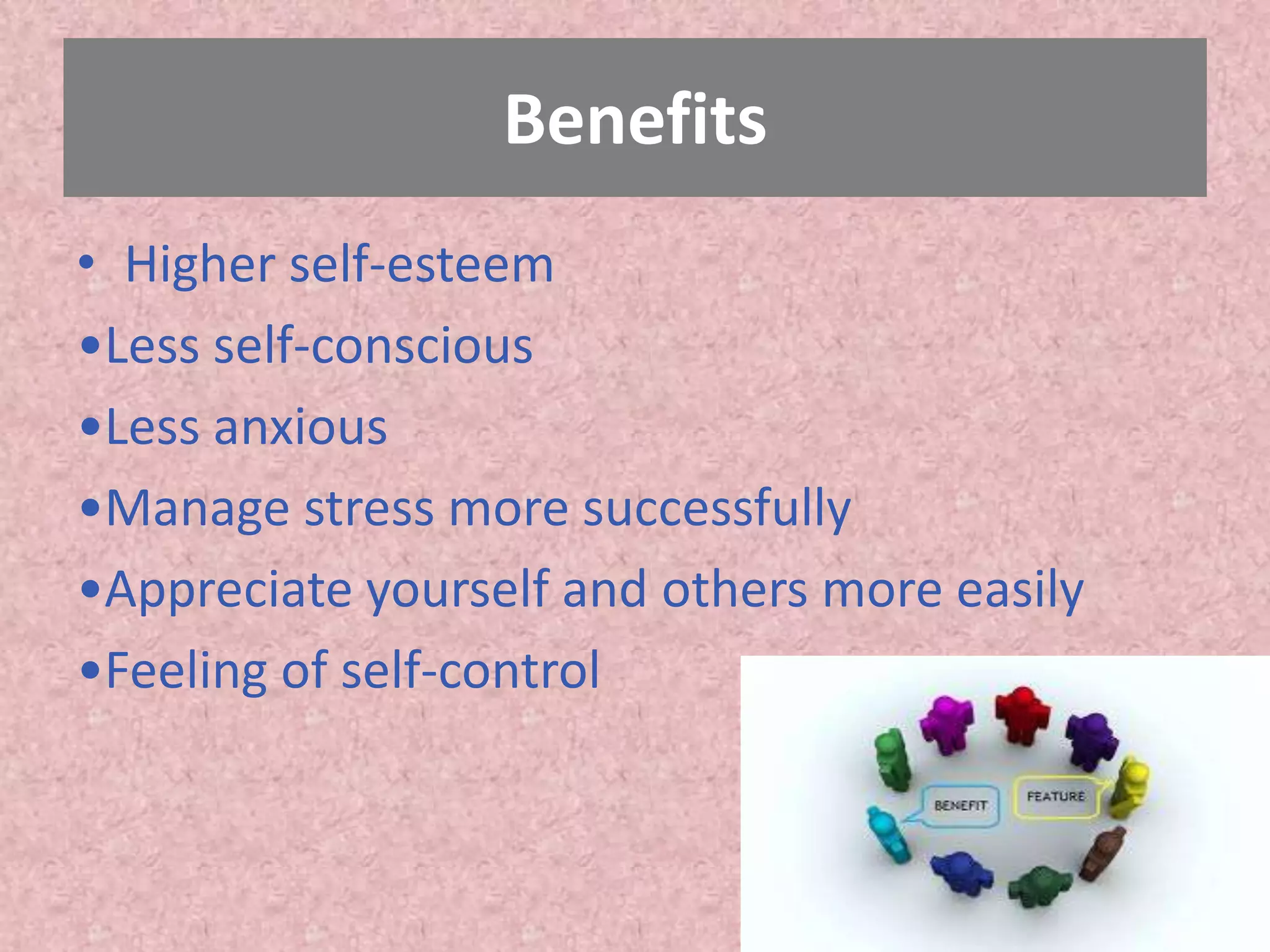
Benefits
• Higher self-esteem
•Less self-conscious
•Less anxious
•Manage stress more successfully
•Appreciate yourself and others more easily
•Feeling of self-control
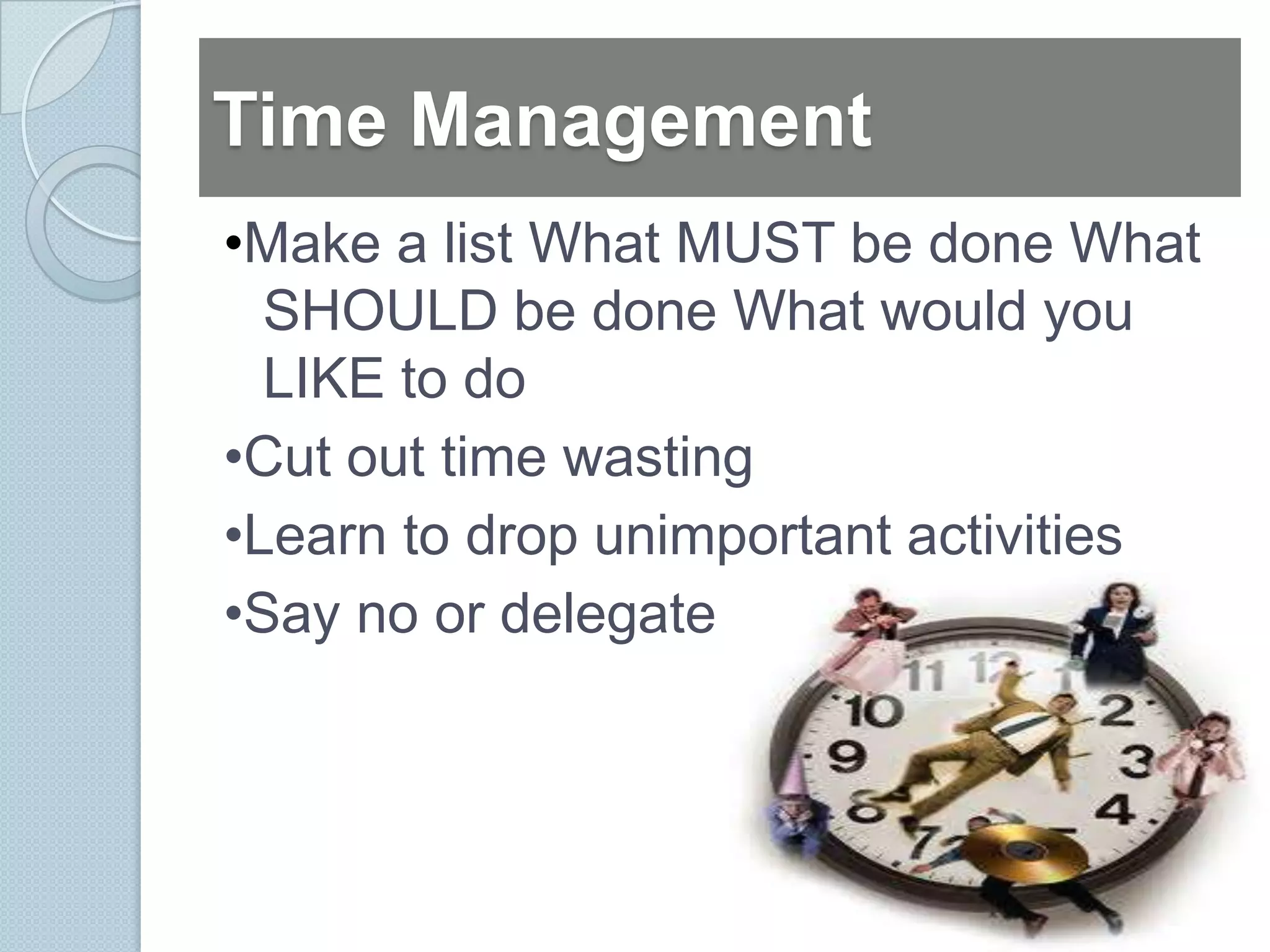
Time Management
•Make a list What MUST be done What
  SHOULD be done What would you
  LIKE to do
•Cut out time wasting
•Learn to drop unimportant activities
•Say no or delegate
Humor
 Good stress - reducer
•Applies at home and work
•Relieves muscular tension
•Improves breathing
•Pumps endorphins into the
  bloodstream -the body’s natural
  painkillers
Diversion and Distraction
 Take time out
•Get away from things that bother you
•Doesn’t solve the problem
•Reduce stress level
•Calm down
•Think logically
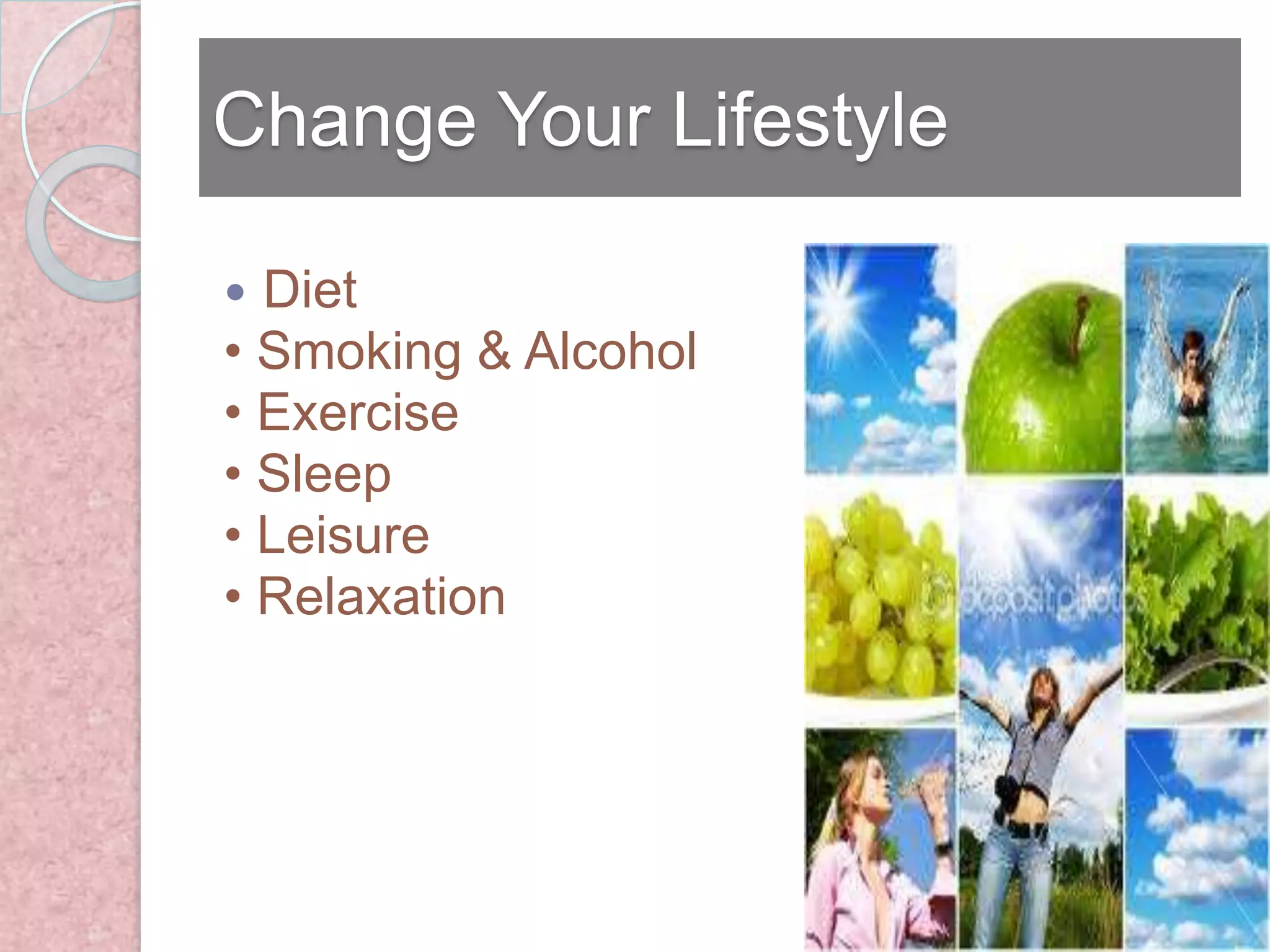
Change Your Lifestyle

 Diet
• Smoking & Alcohol
• Exercise
• Sleep
• Leisure
• Relaxation
Presentation1 stressss

Presentation1 stressss

  • 2.
    Group members IFRAH SYED NIDAASLAM AQSA HASHMI MAHREEN KHAWJA
  • 3.
    -What is Stress? -Some Facts What are Stressors -Types of Stress -Adaptation Syndrome -Symptoms/Effects -Workplace Stress -Exam Stress -Study Stress -ABC of stress -How to manage Stress
  • 4.
    75-90% of adultvisits to primary care physicians are for stress related problems. SOME FACTS More heart attacks on Monday, 9:00 MAXIMUM absenteeism A.M. than at any on an average workday other time of the is because of stress week. related problems
  • 5.
    WHAT IS STRESS Stressis the ―wear and tear‖ our minds and bodies experience as we attempt to cope with our continually changing environment
  • 6.
    WHAT ARE STRESSORS? Stressors are events that threaten or challenge people TYPES 1. External Stressors 2. Internal Stressors
  • 7.
    EXTERNAL STRESSORS Physical SOCIAL O MAJOR LIFE R Stressors INTERACTION G EVENTS A N Birth Noise I Death Rudeness Rules S Bright Bossiness Regulations A T Lost job Lights Aggressive- Deadlines I Promotion O Heat ness by others N Marital A Confine Bullying status L Spaces change
  • 8.
    Lifestyle choices Negative self – talk Personality traits INTERNAL STRESSORS
  • 9.
    TYPES OF STRESS 1. DISTRESS-Negative stress 2. EUSTRESS-Positive stress 3. HYPERSTRESS-Overburden 4. HYPOSTRESS-Bored
  • 10.
    The individual • Everyoneis different, with unique perception of, and reaction to, events. There is no single level of stress that is optimal for all people.
  • 11.
    General Adaptation Syndrome •Stage I - Alarm Reaction – When the stressor or threat is identified, the body’s response is a state of alarm. – Release of adrenaline in order to bring the “fight or flight” response
  • 12.
    General Adaptation Syndrome  Stage II – Stage of Resistance ◦ If stressor persists, the organism tries to adapt to continued challenges utilizing available resources.
  • 13.
    General Adaptation Syndrome  Stage III – Stage of Exhaustion ◦ Stress persists for a long time ◦ Environmental demands or strains exceeded available resources ◦ All the body’s available resources are eventually depleted and the body is unable to maintain normal function.
  • 14.
    SUMMARY Up till nowwe have discussed -What is Stress ? -Some Facts -What are Stressors-external & Internal Stressors -Types of Stress -Adaptation Syndrome
  • 15.
    IFRAH SYED MBE-10-47  EFECTS OF STRESS  WORKPLACE STRESS
  • 16.
    Effects of stress Physical Effects  Mental Effects  Behavioral Effects  Emotional Effects
  • 17.
    Physical Effects  Numbness Fatigue  Pains allover the body  Starting with backache, neck ache, stiff neck, muscle ache and ending with tight shoulders, chest pain, upset stomach  Headaches  Hot and Cold Wars  Dizziness  Fainting  Sweating &trembling  Tingling hands& feet
  • 18.
    Mental Effects  Lackof concentration  Memory lapses  Difficulty in making decision  Confusion  Disorientation  Lack of innovative ideas
  • 19.
    Behavioral Effects • Smoking • Impulsive behavior • Inappropriate crying • Aggressive • Overeating • Under eating • Lack of initiative • Drug/Alcohol abuse • Cynical • Fault finding • Antisocial • Nail biting
  • 20.
    Emotional Effects  Depressed  Apathy  Urge to cry  Negative thoughts  Loneliness  Disappointment  Low self esteem  Nightmares  Irritable  Guilt
  • 21.
    STRESS RELATED ILLNESSES Cardiovascular disease  Immune system disease  Asthma  Diabetes  Ulcers  Skin complaints  Headaches and migraines
  • 22.
    WORKPLACE STRESS Why isthis important? Stress is one of the most often-cited problems in the workplace.1 Almost everyone who feels stressed believes—and strongly believes— that stress is something that someone or some thing causes.
  • 23.
    • After masteringthe information in this presentation, you will be able to – Identify the common things that “cause” you to feel stressed at work, – Describe ways that feeling stressed “makes” you feel and behave, – practical strategies that will allow you to decrease your stress in the workplace,
  • 24.
    What “causes” youto feel stressed in the workplace?1,2  Conflict  Time pressure  Negative  Information overload coworkers  Unclear expectations  Rumors  Unreasonable demands  Criticism  Troublemakers  Meaningless work  Incompetent leaders  Perceived  An uncomfortable unfairness environment  Excessive  Faulty equipment sensitivity  Inadequate training
  • 25.
    STRESS FEELINGS oWorry oTense oTired oFrightene d oElated oDepresse d oAnxious oAnger
  • 26.
    Practical Strategies  Focus on yourself.  Avoid negative people.  Focus on providing exceptional quality and service.  Stop longing for people to change.  Busy yourself with what you can do instead of what you can’t do.
  • 27.
    Tips on HandlingStress  Work smarter, not harder.  Always maintain a short-task list.  Continually ask yourself, ―What is the best use of my time right now?‖  Be physically active to relieve tension.  Make quick decisions.  Carefully mix work & breaks.  Have a positive attitude.  Relax. © 2008 MMMTS
  • 28.
    SUMMARY Up till nowwe have discussed oEffects of Stress oDiseases caused by stress oWhat are causes of Workplace Stress & oHow to cope with them
  • 29.
    AQSA HASHMI MBE-10-04 STUDY STRESS EXAM STRESS
  • 30.
    Danger Signals  Becomingshort- tempered  Working long hours  Spending so much time on your college/university work  Sleeping badly  Setting very high standards
  • 31.
    General Exam Study Tips…Tested and True!  Begin studying no less than 30-60 minutes after a meal  Never study within 30 minutes of going to sleep  Prioritize! Make a list of what you intend to study and prioritize the list  Study no more than 45- 60 minutes at a stretch, and then take breaks
  • 32.
    • Take breaksaway from your desk and do something different • Try to continue your daily habits as usual (don’t drastically reduce your sleep, eliminate exercise, or overeat)
  • 33.
    Creating the Right Environmentfor Studying ◦ Environment is moderately comfortable ◦ Free of distractions ◦ Use your space ◦ Keep the study space organized . ◦ Have everything need to study
  • 34.
    Proven Study Strategies SQ3R Survey Question Read Recite Review
  • 35.
  • 36.
    Effects of examstress  Hinders study and preparation  Become unable to revise  Lose concentration  Reduces grades  Cause of the illness
  • 37.
    Relieve exam stress  Start preparation  Visualize success  Don’t ask your friends  Time utilized for study  Be Brave  Strong faith in God  Look after  Limit drugs  Number of options
  • 38.
    Mahreen Khawaja MBE-10-18 Stress management
  • 39.
    Stress management  Howto manage stress?  How to cope with stress?  How to manage stressful situations?  How to steer clear of stressors?
  • 40.
    Stress management  ABCStrategy  Ten Tips for stress management  Change your Thinking Reframing  Change your thinking- positive Thinking  Change your behavior  Time Management
  • 41.
    ABC Strategy  A= AWARENESS What causes you stress? How do you react?  B = BALANCE There is a fine line between positive / negative stress How much can you cope with before it becomes negative ?  C = CONTROL What can you do to help yourself combat the negative effects of stress ?
  • 42.
    Ten tips forStress Management  Smile  Distract Yourself  Meditate  Breathe Right  Exercise  Right Posture  Be Grateful  Get a Massage  Eat Healthy  Spend time with Healthy People
  • 43.
    Change your ThinkingRe-framing  Re-framing is a technique to change the way you look at things in order to feel better about them. There are many ways to interpret the same situation so pick the one you like. Re-framing does not change the external reality, but helps you view things in a different light and less stressfully.
  • 44.
    Change your ThinkingPositive Thinking  Forget powerlessness, dejection, despair, failure Stress leaves us vulnerable to negative suggestion so focus on positives; •Focus on your strengths •Learn from the stress you are under •Look for opportunities •Seek out the positive - make a change.
  • 45.
    Change your Behavior •Beassertive •Get organized •Humor •Diversion and distraction
  • 46.
    Be Assertive  Assertiveness helps to manage stressful situations, and will , in time, help to reduce their frequency. Lack of assertiveness often shows low self - esteem and low self -confidence. The key to assertiveness is verbal and non - verbal communication. Extending our range of communication skills will improve our assertiveness
  • 47.
    Benefits • Higher self-esteem •Lessself-conscious •Less anxious •Manage stress more successfully •Appreciate yourself and others more easily •Feeling of self-control
  • 48.
    Time Management •Make alist What MUST be done What SHOULD be done What would you LIKE to do •Cut out time wasting •Learn to drop unimportant activities •Say no or delegate
  • 49.
    Humor  Good stress- reducer •Applies at home and work •Relieves muscular tension •Improves breathing •Pumps endorphins into the bloodstream -the body’s natural painkillers
  • 50.
    Diversion and Distraction Take time out •Get away from things that bother you •Doesn’t solve the problem •Reduce stress level •Calm down •Think logically
  • 51.
    Change Your Lifestyle Diet • Smoking & Alcohol • Exercise • Sleep • Leisure • Relaxation