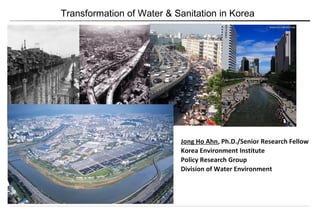
Transformation of Water & Sanitation in Korea
Jong Ho Ahn, Ph.D./Senior Research Fellow
Korea Environment Institute
Policy Research Group
Division of Water Environment
2
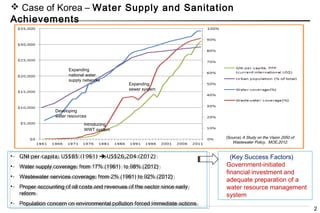
 Case of Korea – Water Supply and Sanitation
Achievements
• GNI per capita: US$85 (1961)  US$26,204 (2012)
• Water supply coverage: from 17% (1961) to 98% (2012)
• Wastewater services coverage: from 2% (1961) to 92% (2012)
• Proper accounting of all costs and revenues of the sector since early
reform
• Population concern on environmental pollution forced immediate actions
• GNI per capita: US$85 (1961)  US$26,204 (2012)
• Water supply coverage: from 17% (1961) to 98% (2012)
• Wastewater services coverage: from 2% (1961) to 92% (2012)
• Proper accounting of all costs and revenues of the sector since early
reform
• Population concern on environmental pollution forced immediate actions
(Source) A Study on the Vision 2050 of
Wastewater Policy, MOE,2012.
(Key Success Factors)
Government-initiated
financial investment and
adequate preparation of a
water resource management
system
Developing
water resources
Introducing
WWT system
Expanding
sewer system
Expanding
national water
supply networks
3
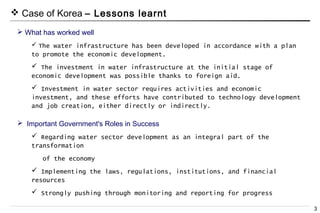
 Important Government's Roles in Success
 Regarding water sector development as an integral part of the
transformation
of the economy
 Implementing the laws, regulations, institutions, and financial
resources
 Strongly pushing through monitoring and reporting for progress
 Case of Korea – Lessons learnt
 What has worked well
 The water infrastructure has been developed in accordance with a plan
to promote the economic development.
 The investment in water infrastructure at the initial stage of
economic development was possible thanks to foreign aid.
 Investment in water sector requires activities and economic
investment, and these efforts have contributed to technology development
and job creation, either directly or indirectly.
4
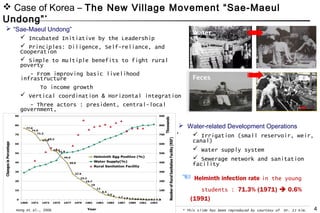
 Case of Korea – The New Village Movement “Sae-Maeul
Undong”*
 “Sae-Maeul Undong”
 Incubated Initiative by the Leadership
 Principles: Diligence, Self-reliance, and
Cooperation
 Simple to multiple benefits to fight rural
poverty
- From improving basic livelihood
infrastructure
To income growth
 Vertical coordination & Horizontal integration
- Three actors : president, central-local
government,
village (leader and
community)
- Education, evaluation, competition, reward,
pride
Water
Feces
 Water-related Development Operations
 Irrigation (small reservoir, weir,
canal)
 Water supply system
 Sewerage network and sanitation
facility
☜ Helminth infection rate in the young
students : 71.3% (1971)  0.6%
(1991)
Hong et al., 2006 * This slide has been reproduced by courtesy of Dr. IJ Kim.

Asian Session: Jong Ho Ahn, KEI, 15th January UN Water Zaragoza Conference 2015

  • 1.
    Transformation of Water& Sanitation in Korea Jong Ho Ahn, Ph.D./Senior Research Fellow Korea Environment Institute Policy Research Group Division of Water Environment
  • 2.
    2  Case ofKorea – Water Supply and Sanitation Achievements • GNI per capita: US$85 (1961)  US$26,204 (2012) • Water supply coverage: from 17% (1961) to 98% (2012) • Wastewater services coverage: from 2% (1961) to 92% (2012) • Proper accounting of all costs and revenues of the sector since early reform • Population concern on environmental pollution forced immediate actions • GNI per capita: US$85 (1961)  US$26,204 (2012) • Water supply coverage: from 17% (1961) to 98% (2012) • Wastewater services coverage: from 2% (1961) to 92% (2012) • Proper accounting of all costs and revenues of the sector since early reform • Population concern on environmental pollution forced immediate actions (Source) A Study on the Vision 2050 of Wastewater Policy, MOE,2012. (Key Success Factors) Government-initiated financial investment and adequate preparation of a water resource management system Developing water resources Introducing WWT system Expanding sewer system Expanding national water supply networks
  • 3.
    3  Important Government'sRoles in Success  Regarding water sector development as an integral part of the transformation of the economy  Implementing the laws, regulations, institutions, and financial resources  Strongly pushing through monitoring and reporting for progress  Case of Korea – Lessons learnt  What has worked well  The water infrastructure has been developed in accordance with a plan to promote the economic development.  The investment in water infrastructure at the initial stage of economic development was possible thanks to foreign aid.  Investment in water sector requires activities and economic investment, and these efforts have contributed to technology development and job creation, either directly or indirectly.
  • 4.
    4  Case ofKorea – The New Village Movement “Sae-Maeul Undong”*  “Sae-Maeul Undong”  Incubated Initiative by the Leadership  Principles: Diligence, Self-reliance, and Cooperation  Simple to multiple benefits to fight rural poverty - From improving basic livelihood infrastructure To income growth  Vertical coordination & Horizontal integration - Three actors : president, central-local government, village (leader and community) - Education, evaluation, competition, reward, pride Water Feces  Water-related Development Operations  Irrigation (small reservoir, weir, canal)  Water supply system  Sewerage network and sanitation facility ☜ Helminth infection rate in the young students : 71.3% (1971)  0.6% (1991) Hong et al., 2006 * This slide has been reproduced by courtesy of Dr. IJ Kim.