FOREX HEDGE ACCOUNTING Creating Cost & Revenue Certainty
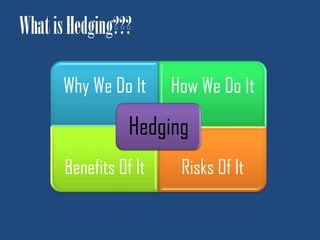
What is Hedging???
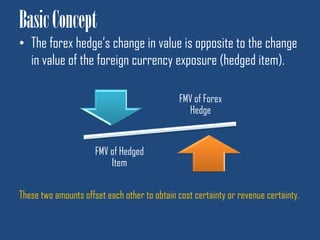
Basic ConceptThe forex hedge’s change in value is opposite to the change in value of the foreign currency exposure (hedged item).These two amounts offset each other to obtain cost certainty or revenue certainty.
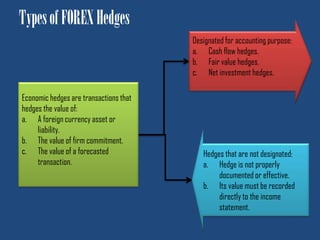
Types of FOREX HedgesDesignated for accounting purpose:Cash flow hedges.Fair value hedges.Net investment hedges.Economic hedges are transactions that hedges the value of:A foreign currency asset or liability.The value of firm commitment.The value of a forecasted transaction.Hedges that are not designated:Hedge is not properly documented or effective.Its value must be recorded directly to the income statement.
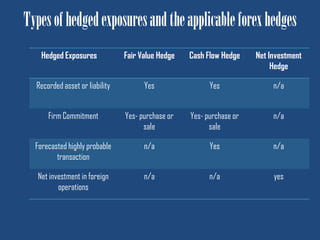
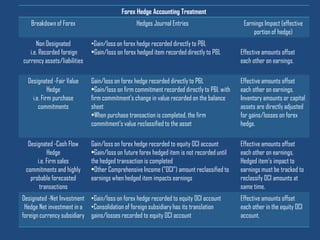
Types of hedged exposures and the applicable forex hedges
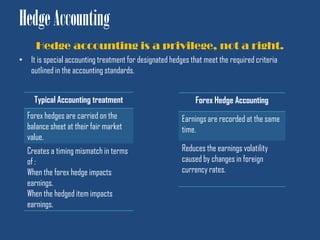
Hedge AccountingHedge accounting is a privilege, not a right. It is special accounting treatment for designated hedges that meet the required criteria outlined in the accounting standards.
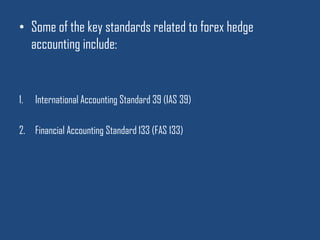
Some of the key standards related to forex hedge accounting include: International Accounting Standard 39 (IAS 39)Financial Accounting Standard 133 (FAS 133)
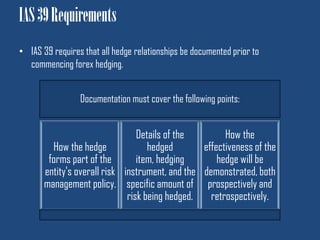
IAS 39 Requirements IAS 39 requires that all hedge relationships be documented prior to commencing forex hedging.
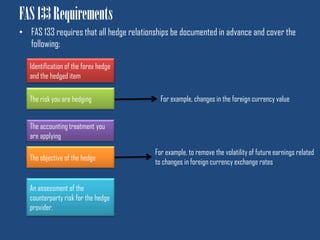
FAS 133 Requirements FAS 133 requires that all hedge relationships be documented in advance and cover the following: Identification of the forex hedge and the hedged item The risk you are hedging For example, changes in the foreign currency value The accounting treatment you are applying For example, to remove the volatility of future earnings related to changes in foreign currency exchange rates The objective of the hedge An assessment of the counterparty risk for the hedge provider.
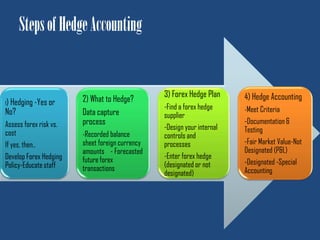
Steps of Hedge Accounting
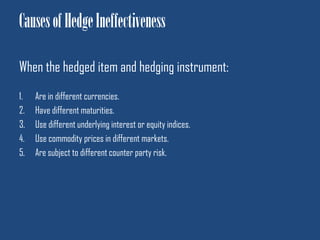
Causes of Hedge IneffectivenessWhen the hedged item and hedging instrument:Are in different currencies.Have different maturities.Use different underlying interest or equity indices.Use commodity prices in different markets.Are subject to different counter party risk.
THANK YOU

Forex Hedge Accounting

  • 1.
    FOREX HEDGE ACCOUNTINGCreating Cost & Revenue Certainty
  • 2.
  • 3.
    Basic ConceptThe forexhedge’s change in value is opposite to the change in value of the foreign currency exposure (hedged item).These two amounts offset each other to obtain cost certainty or revenue certainty.
  • 4.
    Types of FOREXHedgesDesignated for accounting purpose:Cash flow hedges.Fair value hedges.Net investment hedges.Economic hedges are transactions that hedges the value of:A foreign currency asset or liability.The value of firm commitment.The value of a forecasted transaction.Hedges that are not designated:Hedge is not properly documented or effective.Its value must be recorded directly to the income statement.
  • 5.
    Types of hedgedexposures and the applicable forex hedges
  • 6.
    Hedge AccountingHedge accountingis a privilege, not a right. It is special accounting treatment for designated hedges that meet the required criteria outlined in the accounting standards.
  • 7.
    Some of thekey standards related to forex hedge accounting include: International Accounting Standard 39 (IAS 39)Financial Accounting Standard 133 (FAS 133)
  • 8.
    IAS 39 RequirementsIAS 39 requires that all hedge relationships be documented prior to commencing forex hedging.
  • 9.
    FAS 133 RequirementsFAS 133 requires that all hedge relationships be documented in advance and cover the following: Identification of the forex hedge and the hedged item The risk you are hedging For example, changes in the foreign currency value The accounting treatment you are applying For example, to remove the volatility of future earnings related to changes in foreign currency exchange rates The objective of the hedge An assessment of the counterparty risk for the hedge provider.
  • 10.
    Steps of HedgeAccounting
  • 12.
    Causes of HedgeIneffectivenessWhen the hedged item and hedging instrument:Are in different currencies.Have different maturities.Use different underlying interest or equity indices.Use commodity prices in different markets.Are subject to different counter party risk.
  • 13.