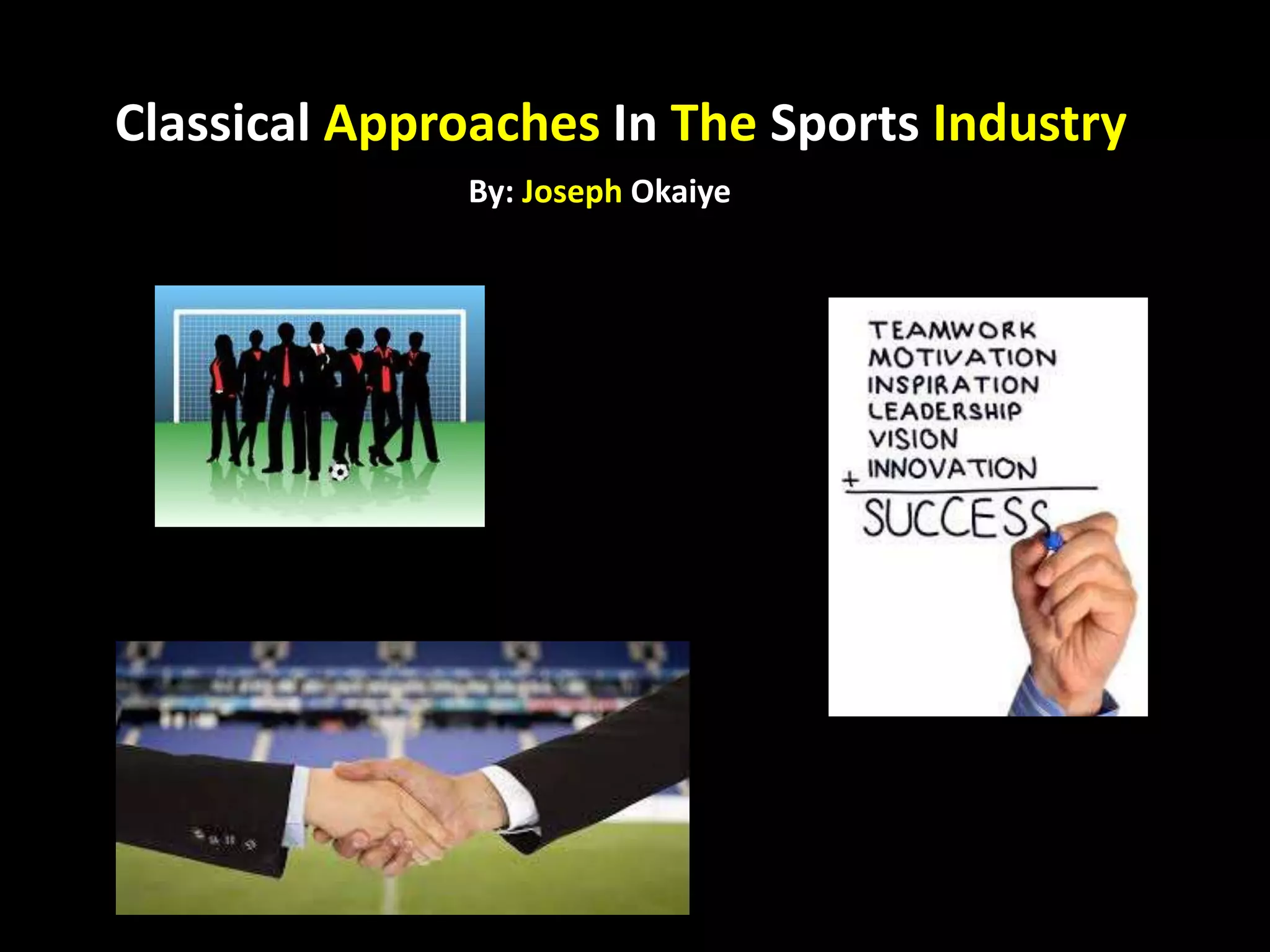
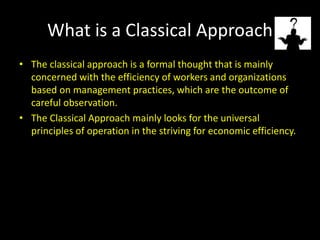
Classical Approaches In The Sports Industry
By: Joseph Okaiye
What is a Classical Approach
• The classical approach is a formal thought that is mainly
concerned with the efficiency of workers and organizations
based on management practices, which are the outcome of
careful observation.
• The Classical Approach mainly looks for the universal
principles of operation in the striving for economic efficiency.
Article Summary
• Risk is an integral element of
sport. Sport without risk, or
any type of management
would cease to be sport,
period. The unique aspect of
sport must be factored into
any discussion of
management within sport
facilities, programs and
events.
The Machine Metaphor
• According to Katherine Miller, the
Machine Metaphor is central to
classical organizations, in terms of
management, specialization,
standardization, and predictability.
The notion, is that we can learn
something about how organizations
operate by considering a disparate
object that an organization
resembles.
Specialization
• For younger people that are under the age of 15, specialization in sing
sport activities is much more often associated with developmental risks
than rewards.
• Positive physical, psychological and social development is more likely to
occur when young people participate in multiple sport activities, as well as
informal activities.
• When we see organizations as machines, we see the same kind of
specialization that requires a car engine to function properly. The
specialization of tasks, often times called the division of labor, helps
illustrate ways in which organizational functioning is seen as machine-like.
Standardization
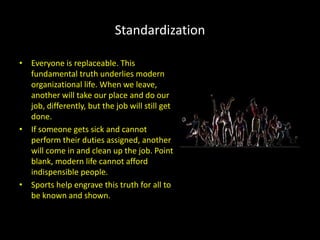
• Everyone is replaceable. This
fundamental truth underlies modern
organizational life. When we leave,
another will take our place and do our
job, differently, but the job will still get
done.
• If someone gets sick and cannot
perform their duties assigned, another
will come in and clean up the job. Point
blank, modern life cannot afford
indispensible people.
• Sports help engrave this truth for all to
be known and shown.
Standardization Cont.
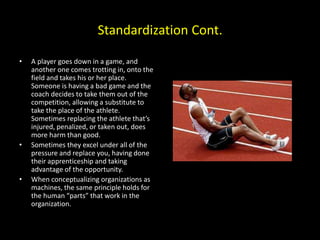
• A player goes down in a game, and
another one comes trotting in, onto the
field and takes his or her place.
Someone is having a bad game and the
coach decides to take them out of the
competition, allowing a substitute to
take the place of the athlete.
Sometimes replacing the athlete that’s
injured, penalized, or taken out, does
more harm than good.
• Sometimes they excel under all of the
pressure and replace you, having done
their apprenticeship and taking
advantage of the opportunity.
• When conceptualizing organizations as
machines, the same principle holds for
the human “parts” that work in the
organization.
Predictability
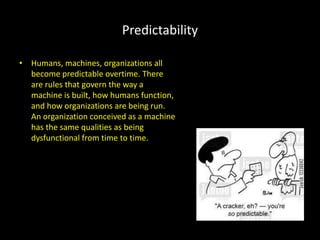
• Humans, machines, organizations all
become predictable overtime. There
are rules that govern the way a
machine is built, how humans function,
and how organizations are being run.
An organization conceived as a machine
has the same qualities as being
dysfunctional from time to time.
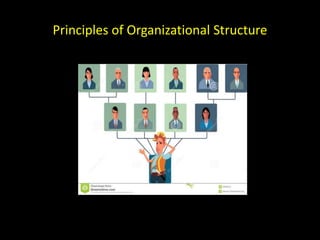
Principles of Organizational Structure
Scalar Chain
• An organization should be arranged in a strict vertical hierarchy, and that
communication should be largely limited to this vertical flow, moving up
and down the organization.
• In the sports setting, you have your franchise/team owners, general
managers, presidents/vice presidents, executives, coaches, players, etc.
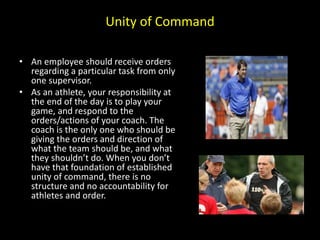
Unity of Command
• An employee should receive orders
regarding a particular task from only
one supervisor.
• As an athlete, your responsibility at
the end of the day is to play your
game, and respond to the
orders/actions of your coach. The
coach is the only one who should be
giving the orders and direction of
what the team should be, and what
they shouldn’t do. When you don’t
have that foundation of established
unity of command, there is no
structure and no accountability for
athletes and order.
Unity of Direction
• Activities having similar goals should be
placed under a single supervisor. Team
members all work together toward
accomplishing a common goal, using the
same plan to reach the shared objective.
• Without direction, there is no focus,
without focus there's no accomplishment.
Organizations leaders, team captains,
managers, etc. Should have a vision and a
sense of direction that enables their
employees, followers and athletes to
follow along on the vision their head
oversees for them.
Division of Labor
• Work can best be accomplished if employees
are assigned to a limited number of
specialized tasks.
• Its crucial to give everyone their fair share of
tasks, helping share equality, specialization
and direction within organizations.
• It is possible to multitask, but with
multitasking comes reduced qualities with
the tasks originally assigned. By having
employees, athletes and team members
assigned to one task at a time, the quality
starts to trump the quantity. And I’m not
sure about others out there, but quality
speaks to me more than quantity.
Order
• There should be an appointed place for each employee and task within
the organization.
• Without order, there's no sense of belonging and that can harm
companies/organizations tremendously.
Span of Control
• Managers will be most effective if
they have control of a limited
number of employees. A limit of
twenty to thirty employees for first
level managers and six employees for
higher-level managers.
• Having any more than what's
suggested as far as employees,
athletes on a team go, it becomes
impossible to attend to everyone's
concerns, needs and placement. No
set goals get accomplished, structure
is thrown out the window.
• Having control, pursues growth.
Direction of Communication Flow
• The most important route for communication is the vertical flow of
information, along the scalar chain of organizational hierarchy.
• The vast majority of communication in organizations flow downward, seen
as in the form of orders, rules, and directives.
• There is little feedback that moves upward from lower-level employees to
higher-level management.
Style of Communication
• More than likely, the tone or style of communication will be highly formal,
as you work your way up the organizational ladder. The vocabulary chosen
for messages will tend to avoid slang terms, opting for highly standardized
language.
• The formality of communication style in a classical organization could also
be seen in nonverbal communication.
• The bureaucratic and professionalized climate of these organizations, lead
to sterile and formal styles of communication.
Communication, Performance, Growth, Brand, Success.
Work Cited
• Miller, Katherine, Daniel Ryan, and Erin Porter. Organizational
Communication. Approaches and Processes. N.p.: n.p., 2002. Print.
• "Sports Management Resources." Key Elements and Best Practices in the
Development of Academic Support Programs. N.p., n.d. Web. 01 Apr. 2016.
• "Point of the Game." : Sports Ethics: Being Replaceable. N.p., n.d. Web. 01
Apr. 2016.
Presentation1

Presentation1

  • 1.
    Classical Approaches InThe Sports Industry By: Joseph Okaiye
  • 2.
    What is aClassical Approach • The classical approach is a formal thought that is mainly concerned with the efficiency of workers and organizations based on management practices, which are the outcome of careful observation. • The Classical Approach mainly looks for the universal principles of operation in the striving for economic efficiency.
  • 3.
    Article Summary • Riskis an integral element of sport. Sport without risk, or any type of management would cease to be sport, period. The unique aspect of sport must be factored into any discussion of management within sport facilities, programs and events.
  • 4.
    The Machine Metaphor •According to Katherine Miller, the Machine Metaphor is central to classical organizations, in terms of management, specialization, standardization, and predictability. The notion, is that we can learn something about how organizations operate by considering a disparate object that an organization resembles.
  • 5.
    Specialization • For youngerpeople that are under the age of 15, specialization in sing sport activities is much more often associated with developmental risks than rewards. • Positive physical, psychological and social development is more likely to occur when young people participate in multiple sport activities, as well as informal activities. • When we see organizations as machines, we see the same kind of specialization that requires a car engine to function properly. The specialization of tasks, often times called the division of labor, helps illustrate ways in which organizational functioning is seen as machine-like.
  • 6.
    Standardization • Everyone isreplaceable. This fundamental truth underlies modern organizational life. When we leave, another will take our place and do our job, differently, but the job will still get done. • If someone gets sick and cannot perform their duties assigned, another will come in and clean up the job. Point blank, modern life cannot afford indispensible people. • Sports help engrave this truth for all to be known and shown.
  • 7.
    Standardization Cont. • Aplayer goes down in a game, and another one comes trotting in, onto the field and takes his or her place. Someone is having a bad game and the coach decides to take them out of the competition, allowing a substitute to take the place of the athlete. Sometimes replacing the athlete that’s injured, penalized, or taken out, does more harm than good. • Sometimes they excel under all of the pressure and replace you, having done their apprenticeship and taking advantage of the opportunity. • When conceptualizing organizations as machines, the same principle holds for the human “parts” that work in the organization.
  • 8.
    Predictability • Humans, machines,organizations all become predictable overtime. There are rules that govern the way a machine is built, how humans function, and how organizations are being run. An organization conceived as a machine has the same qualities as being dysfunctional from time to time.
  • 9.
  • 10.
    Scalar Chain • Anorganization should be arranged in a strict vertical hierarchy, and that communication should be largely limited to this vertical flow, moving up and down the organization. • In the sports setting, you have your franchise/team owners, general managers, presidents/vice presidents, executives, coaches, players, etc.
  • 11.
    Unity of Command •An employee should receive orders regarding a particular task from only one supervisor. • As an athlete, your responsibility at the end of the day is to play your game, and respond to the orders/actions of your coach. The coach is the only one who should be giving the orders and direction of what the team should be, and what they shouldn’t do. When you don’t have that foundation of established unity of command, there is no structure and no accountability for athletes and order.
  • 12.
    Unity of Direction •Activities having similar goals should be placed under a single supervisor. Team members all work together toward accomplishing a common goal, using the same plan to reach the shared objective. • Without direction, there is no focus, without focus there's no accomplishment. Organizations leaders, team captains, managers, etc. Should have a vision and a sense of direction that enables their employees, followers and athletes to follow along on the vision their head oversees for them.
  • 13.
    Division of Labor •Work can best be accomplished if employees are assigned to a limited number of specialized tasks. • Its crucial to give everyone their fair share of tasks, helping share equality, specialization and direction within organizations. • It is possible to multitask, but with multitasking comes reduced qualities with the tasks originally assigned. By having employees, athletes and team members assigned to one task at a time, the quality starts to trump the quantity. And I’m not sure about others out there, but quality speaks to me more than quantity.
  • 14.
    Order • There shouldbe an appointed place for each employee and task within the organization. • Without order, there's no sense of belonging and that can harm companies/organizations tremendously.
  • 15.
    Span of Control •Managers will be most effective if they have control of a limited number of employees. A limit of twenty to thirty employees for first level managers and six employees for higher-level managers. • Having any more than what's suggested as far as employees, athletes on a team go, it becomes impossible to attend to everyone's concerns, needs and placement. No set goals get accomplished, structure is thrown out the window. • Having control, pursues growth.
  • 16.
    Direction of CommunicationFlow • The most important route for communication is the vertical flow of information, along the scalar chain of organizational hierarchy. • The vast majority of communication in organizations flow downward, seen as in the form of orders, rules, and directives. • There is little feedback that moves upward from lower-level employees to higher-level management.
  • 17.
    Style of Communication •More than likely, the tone or style of communication will be highly formal, as you work your way up the organizational ladder. The vocabulary chosen for messages will tend to avoid slang terms, opting for highly standardized language. • The formality of communication style in a classical organization could also be seen in nonverbal communication. • The bureaucratic and professionalized climate of these organizations, lead to sterile and formal styles of communication.
  • 18.
  • 19.
    Work Cited • Miller,Katherine, Daniel Ryan, and Erin Porter. Organizational Communication. Approaches and Processes. N.p.: n.p., 2002. Print. • "Sports Management Resources." Key Elements and Best Practices in the Development of Academic Support Programs. N.p., n.d. Web. 01 Apr. 2016. • "Point of the Game." : Sports Ethics: Being Replaceable. N.p., n.d. Web. 01 Apr. 2016.