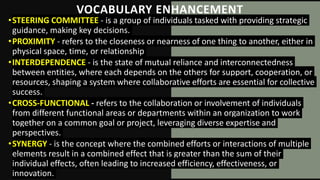
•STEERING COMMITTEE - is a group of individuals tasked with providing strategic
guidance, making key decisions.
•PROXIMITY - refers to the closeness or nearness of one thing to another, either in
physical space, time, or relationship
•INTERDEPENDENCE - is the state of mutual reliance and interconnectedness
between entities, where each depends on the others for support, cooperation, or
resources, shaping a system where collaborative efforts are essential for collective
success.
•CROSS-FUNCTIONAL - refers to the collaboration or involvement of individuals
from different functional areas or departments within an organization to work
together on a common goal or project, leveraging diverse expertise and
perspectives.
•SYNERGY - is the concept where the combined efforts or interactions of multiple
elements result in a combined effect that is greater than the sum of their
individual effects, often leading to increased efficiency, effectiveness, or
innovation.
VOCABULARY ENHANCEMENT
Scenario 1: Problem-solving Task
A collection of individuals gathers for a
meeting to discuss a problem. While they
may share ideas, each person primarily
works independently, without a clear
division of labor or specific goal. They
might not have a structured approach to
problem-solving and may lack
interdependency.
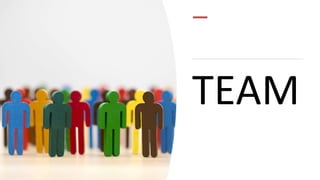
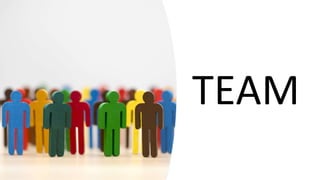
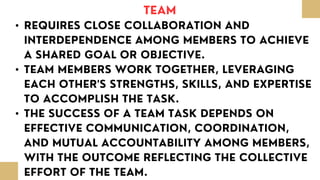
TEAM
Scenario 2: Problem-solving Task
A group of individuals with
complementary skills come together to
solve a complex problem. They
collaborate closely, leveraging each
member's expertise to achieve a common
goal. Each member has specific roles and
responsibilities, and there is a high level
of interdependence among them.
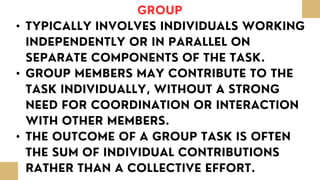
GROUP
Scenario 3: Sports Event
A group of friends gathers at a park to
play soccer casually. While they enjoy
playing together, there might not be a
structured strategy or specific goal
beyond having fun. Each person plays
according to their individual skills and
preferences without much coordination.
GROUP
Scenario 4: Sports Event
A soccer team practices regularly,
strategizes together, and plays
matches with the aim of winning. Each
player has a defined position and plays
a crucial role in achieving victory.
There is a strong sense of unity, trust,
and cooperation among team
members.
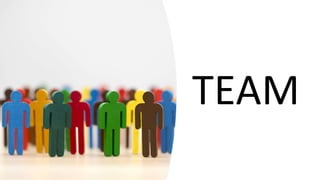
TEAM
Scenario 5: Business Project
A group of employees from different
departments forms a project team to
launch a new product. They hold regular
meetings, delegate tasks based on
expertise, and work together towards the
project's objectives. There is clear
communication, accountability, and
mutual support among team members.
TEAM
Scenario 6: Business Project
A committee is formed within a company
to discuss potential improvements to the
office layout. Members gather periodically
to share ideas, but there is no structured
plan or designated leader. Each person
may pursue their suggestions
independently, and there might not be a
shared sense of responsibility for the
outcome.
GROUP
•
•
•
•
•
•
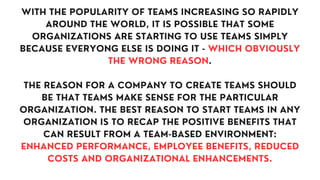
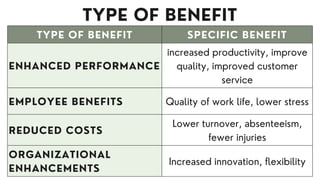
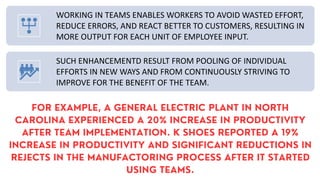
WORKING IN TEAMS ENABLES WORKERS TO AVOID WASTED EFFORT,
REDUCE ERRORS, AND REACT BETTER TO CUSTOMERS, RESULTING IN
MORE OUTPUT FOR EACH UNIT OF EMPLOYEE INPUT.
SUCH ENHANCEMENTD RESULT FROM POOLING OF INDIVIDUAL
EFFORTS IN NEW WAYS AND FROM CONTINUOUSLY STRIVING TO
IMPROVE FOR THE BENEFIT OF THE TEAM.
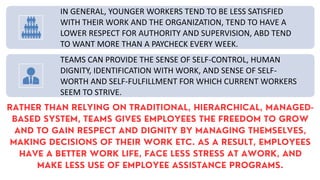
IN GENERAL, YOUNGER WORKERS TEND TO BE LESS SATISFIED
WITH THEIR WORK AND THE ORGANIZATION, TEND TO HAVE A
LOWER RESPECT FOR AUTHORITY AND SUPERVISION, ABD TEND
TO WANT MORE THAN A PAYCHECK EVERY WEEK.
TEAMS CAN PROVIDE THE SENSE OF SELF-CONTROL, HUMAN
DIGNITY, IDENTIFICATION WITH WORK, AND SENSE OF SELF-
WORTH AND SELF-FULFILLMENT FOR WHICH CURRENT WORKERS
SEEM TO STRIVE.
small groups of employees from the same work area who
meet regularly to identify, analyze, and solve work-related
problems.
it is the first type of team created in US organizations most
popular during the 1980s in response to growing Japanese
competitions.
WORK
TEAMS
•Teams that do the daily work of
an organization. Work teams
MAKE AND DO things.
•Encompass various tasks,
projects, or ongoing operations
within an organization.
TEMPORARY teams established to tackle specific problems in
the workplace.
These teams are formed with the purpose of addressing
problems that may arise in various aspects of the
organization's operations, such as processes, products,
services, or customer experiences.
MANAGEMENT TEAMS
Managers from different areas who
coordinate work teams
Responsible for overseeing and
directing various functions,
departments, or aspects of the
business.
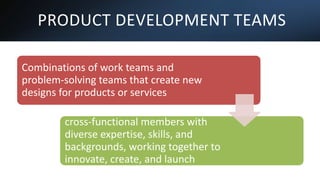
PRODUCT DEVELOPMENT TEAMS
Combinations of work teams and
problem-solving teams that create new
designs for products or services
These teams typically consist of
cross-functional members with
diverse expertise, skills, and
backgrounds, working together to
innovate, create, and launch
successful products.
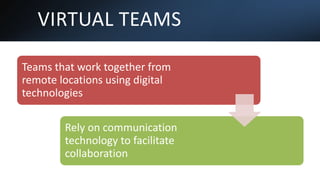
VIRTUAL TEAMS
Teams that work together from
remote locations using digital
technologies
Rely on communication
technology to facilitate
collaboration
MAKING
THE
DECISIONS
Prior to making the
decision, top
management needs to
establish the leadership
for the change, develop
a steering committee,
conduct a feasibility
study, and then make
the GO/NO-GO decision.
MAKING
THE
DECISIONS
•Regardless of the position,
the person leading the
change needs to:
•have a strong belief that
employees want to be
responsible for their own
work
•be able to demonstrate the
team philosophy
•articulate a coherent vision
of the team environment
•have the creativity and
authority to overcome
obstacles as they surface.
PLAN THE
IMPLEMENTATION
•Once the decision is made to
a tam-based organization.
•Preparation consists of the
following five steps:
•Clarifying the mission
•Selecting the site for the first
work teams
•Preparing the design team
•Planning the transfer of
Authority
•Drafting the preliminary plan
1. Clarifying the mission
• discusses the long-range benefits of the company.
• Consistency with the organization’s strategy
• Attempts to stimulate and focus the energy of those
people who need to be involved in the changed.
• Focus on the continuous improvement, employee
involvement, increasing performance, competition,
customer satisfaction, and contributions to society.
2. Selecting the site for the first work teams
• Steering committee needs to decide where teams will
be implemented first.
• involves assessing geographical accessibility,
infrastructure, and the availability of resources
conducive to team collaboration.
• Consider factors such as proximity to key stakeholders
and potential for cross-functional interaction
3. Preparing the design team
• Is a select group of employees, supervisors, and managers
who will work out the staffing and operational details to
make the teams perform well.
• Select the initial members, prepares and plans the transition
from the current state to the new self-managed teams.
• involves assembling a multidisciplinary group of experts,
defining project objectives, and establishing clear roles and
responsibilities to foster creativity and innovation in the
product development process.
4. Planning the transfer of Authority
• Entails delineating decision-making responsibilities,
establishing communication channels, and implementing
governance structures to ensure a smooth transition of
power from leadership to the designated teams while
maintaining organizational alignment and accountability
• Provide training and support to empower team members
and cultivating a culture of trust and collaboration are
crucial for the successful delegation of authority.
5. Drafting the preliminary plan
• Combines the work of steering and design committees
and primary a working document that guides the
continuing work of the design teams and the first work
teams.
• involves outlining the objectives, structure, roles, and
responsibilities of the teams, as well as defining clear
communication channels and establishing performance
metrics to track progress and outcomes effectively
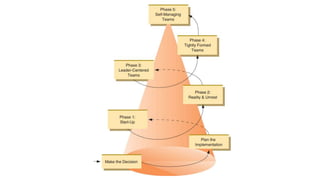
PHASE 1 - START UP
• Focuses on defining team objectives, assembling team
members with complementary skills, establishing team norms
and communication channels, and outlining initial tasks and
timelines to lay the foundation for effective collaboration and
goal achievement.
• providing training and support to team members, clarifying
roles and responsibilities, and fostering a sense of shared
purpose are crucial for building cohesion and setting the
stage for success.
PHASE 2 - REALITY AND UNREST
• involves confronting challenges, addressing resistance to
change, and adapting to unforeseen obstacles as teams
navigate through the initial stages of collaboration and
task execution.
• Effective communication, leadership support, and
proactive problem-solving are essential for managing
tensions, fostering team cohesion, and maintaining
momentum towards achieving desired outcomes.
PHASE 3 - LEADER-CENTERED TEAMS
• emphasizes the role of team leaders in guiding and
coordinating team activities, providing support, and
facilitating decision-making processes to ensure
alignment with organizational goals and objectives.
• Clear direction, effective delegation, and leadership
development are essential for empowering leaders to
inspire trust, motivate team members, and drive
performance during this stage.
PHASE 4 - TIGHTLY FORMED TEAMS
• marks the development of strong cohesion, trust,
constructive performance feedback and collaboration
among team members as they become more familiar
with their roles, processes, and objectives.
• During this stage, teams demonstrate high levels of
effectiveness, efficiency, and synergy, leading to
increased productivity and the achievement of
significant milestones.
PHASE 5 - SELF - MANAGING TEAMS
• sees the transition to greater autonomy and empowerment
among team members, who take ownership of decision-
making, problem-solving, and task execution, resulting in
heightened accountability and innovation within the team.
• During this stage, leaders serve as coaches and facilitators,
supporting team members in developing their skills,
resolving conflicts, and continuously improving team
processes to achieve optimal performance.
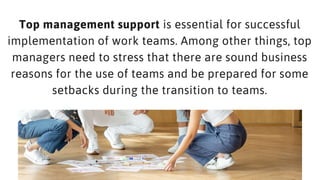
Top management support is essential for successful
implementation of work teams. Among other things, top
managers need to stress that there are sound business
reasons for the use of teams and be prepared for some
setbacks during the transition to teams.
• involves setting realistic short-term and long-term
goals, establishing clear milestones, and regularly
monitoring progress to ensure alignment with
objectives and adapt to changing circumstances.
• Effective time management, communication, and
flexibility are essential for maximizing team
efficiency, fostering collaboration, and achieving
sustainable success over time.
• How employees are rewarded is vital to
the long-term success of an organization.
• The traditional reward and compensation
systems suitable for individual motivation
are simply not appropriate in a team-
based organization.
1. SKILL-BASED PAY
• compensation system where employees are paid
based on their individual skills, knowledge, and
abilities rather than their job title or seniority.
• This approach incentivizes skill development,
rewards performance, and aligns employee
compensation with the value they bring to the
organization.
2. GAIN-SHARING SYSTEMS
• performance-based incentive program where
employees receive bonuses or rewards based on the
achievement of specific organizational goals or
improvements in productivity, quality, or cost reduction.
• This system promotes collaboration, employee
engagement, and alignment of individual and
organizational interests in driving continuous
improvement and shared success.
3. TEAM BONUS PLANS
• Incentive programs where a group of employees
collectively receive bonuses based on the
achievement of team-based goals or performance
targets.
• These plans foster collaboration, teamwork, and
mutual accountability among team members,
motivating them to work together towards common
objectives and driving overall organizational success.
report in HUMAN BEHAVIOR AND OBSERVATION.pptx

report in HUMAN BEHAVIOR AND OBSERVATION.pptx

  • 4.
    •STEERING COMMITTEE -is a group of individuals tasked with providing strategic guidance, making key decisions. •PROXIMITY - refers to the closeness or nearness of one thing to another, either in physical space, time, or relationship •INTERDEPENDENCE - is the state of mutual reliance and interconnectedness between entities, where each depends on the others for support, cooperation, or resources, shaping a system where collaborative efforts are essential for collective success. •CROSS-FUNCTIONAL - refers to the collaboration or involvement of individuals from different functional areas or departments within an organization to work together on a common goal or project, leveraging diverse expertise and perspectives. •SYNERGY - is the concept where the combined efforts or interactions of multiple elements result in a combined effect that is greater than the sum of their individual effects, often leading to increased efficiency, effectiveness, or innovation. VOCABULARY ENHANCEMENT
  • 6.
    Scenario 1: Problem-solvingTask A collection of individuals gathers for a meeting to discuss a problem. While they may share ideas, each person primarily works independently, without a clear division of labor or specific goal. They might not have a structured approach to problem-solving and may lack interdependency.
  • 7.
  • 8.
    Scenario 2: Problem-solvingTask A group of individuals with complementary skills come together to solve a complex problem. They collaborate closely, leveraging each member's expertise to achieve a common goal. Each member has specific roles and responsibilities, and there is a high level of interdependence among them.
  • 9.
  • 10.
    Scenario 3: SportsEvent A group of friends gathers at a park to play soccer casually. While they enjoy playing together, there might not be a structured strategy or specific goal beyond having fun. Each person plays according to their individual skills and preferences without much coordination.
  • 11.
  • 12.
    Scenario 4: SportsEvent A soccer team practices regularly, strategizes together, and plays matches with the aim of winning. Each player has a defined position and plays a crucial role in achieving victory. There is a strong sense of unity, trust, and cooperation among team members.
  • 13.
  • 14.
    Scenario 5: BusinessProject A group of employees from different departments forms a project team to launch a new product. They hold regular meetings, delegate tasks based on expertise, and work together towards the project's objectives. There is clear communication, accountability, and mutual support among team members.
  • 15.
  • 16.
    Scenario 6: BusinessProject A committee is formed within a company to discuss potential improvements to the office layout. Members gather periodically to share ideas, but there is no structured plan or designated leader. Each person may pursue their suggestions independently, and there might not be a shared sense of responsibility for the outcome.
  • 17.
  • 20.
  • 21.
  • 26.
    WORKING IN TEAMSENABLES WORKERS TO AVOID WASTED EFFORT, REDUCE ERRORS, AND REACT BETTER TO CUSTOMERS, RESULTING IN MORE OUTPUT FOR EACH UNIT OF EMPLOYEE INPUT. SUCH ENHANCEMENTD RESULT FROM POOLING OF INDIVIDUAL EFFORTS IN NEW WAYS AND FROM CONTINUOUSLY STRIVING TO IMPROVE FOR THE BENEFIT OF THE TEAM.
  • 28.
    IN GENERAL, YOUNGERWORKERS TEND TO BE LESS SATISFIED WITH THEIR WORK AND THE ORGANIZATION, TEND TO HAVE A LOWER RESPECT FOR AUTHORITY AND SUPERVISION, ABD TEND TO WANT MORE THAN A PAYCHECK EVERY WEEK. TEAMS CAN PROVIDE THE SENSE OF SELF-CONTROL, HUMAN DIGNITY, IDENTIFICATION WITH WORK, AND SENSE OF SELF- WORTH AND SELF-FULFILLMENT FOR WHICH CURRENT WORKERS SEEM TO STRIVE.
  • 32.
    small groups ofemployees from the same work area who meet regularly to identify, analyze, and solve work-related problems. it is the first type of team created in US organizations most popular during the 1980s in response to growing Japanese competitions.
  • 33.
    WORK TEAMS •Teams that dothe daily work of an organization. Work teams MAKE AND DO things. •Encompass various tasks, projects, or ongoing operations within an organization.
  • 34.
    TEMPORARY teams establishedto tackle specific problems in the workplace. These teams are formed with the purpose of addressing problems that may arise in various aspects of the organization's operations, such as processes, products, services, or customer experiences.
  • 35.
    MANAGEMENT TEAMS Managers fromdifferent areas who coordinate work teams Responsible for overseeing and directing various functions, departments, or aspects of the business.
  • 36.
    PRODUCT DEVELOPMENT TEAMS Combinationsof work teams and problem-solving teams that create new designs for products or services These teams typically consist of cross-functional members with diverse expertise, skills, and backgrounds, working together to innovate, create, and launch successful products.
  • 37.
    VIRTUAL TEAMS Teams thatwork together from remote locations using digital technologies Rely on communication technology to facilitate collaboration
  • 40.
    MAKING THE DECISIONS Prior to makingthe decision, top management needs to establish the leadership for the change, develop a steering committee, conduct a feasibility study, and then make the GO/NO-GO decision.
  • 41.
    MAKING THE DECISIONS •Regardless of theposition, the person leading the change needs to: •have a strong belief that employees want to be responsible for their own work •be able to demonstrate the team philosophy •articulate a coherent vision of the team environment •have the creativity and authority to overcome obstacles as they surface.
  • 42.
    PLAN THE IMPLEMENTATION •Once thedecision is made to a tam-based organization. •Preparation consists of the following five steps: •Clarifying the mission •Selecting the site for the first work teams •Preparing the design team •Planning the transfer of Authority •Drafting the preliminary plan
  • 43.
    1. Clarifying themission • discusses the long-range benefits of the company. • Consistency with the organization’s strategy • Attempts to stimulate and focus the energy of those people who need to be involved in the changed. • Focus on the continuous improvement, employee involvement, increasing performance, competition, customer satisfaction, and contributions to society.
  • 44.
    2. Selecting thesite for the first work teams • Steering committee needs to decide where teams will be implemented first. • involves assessing geographical accessibility, infrastructure, and the availability of resources conducive to team collaboration. • Consider factors such as proximity to key stakeholders and potential for cross-functional interaction
  • 45.
    3. Preparing thedesign team • Is a select group of employees, supervisors, and managers who will work out the staffing and operational details to make the teams perform well. • Select the initial members, prepares and plans the transition from the current state to the new self-managed teams. • involves assembling a multidisciplinary group of experts, defining project objectives, and establishing clear roles and responsibilities to foster creativity and innovation in the product development process.
  • 46.
    4. Planning thetransfer of Authority • Entails delineating decision-making responsibilities, establishing communication channels, and implementing governance structures to ensure a smooth transition of power from leadership to the designated teams while maintaining organizational alignment and accountability • Provide training and support to empower team members and cultivating a culture of trust and collaboration are crucial for the successful delegation of authority.
  • 47.
    5. Drafting thepreliminary plan • Combines the work of steering and design committees and primary a working document that guides the continuing work of the design teams and the first work teams. • involves outlining the objectives, structure, roles, and responsibilities of the teams, as well as defining clear communication channels and establishing performance metrics to track progress and outcomes effectively
  • 48.
    PHASE 1 -START UP • Focuses on defining team objectives, assembling team members with complementary skills, establishing team norms and communication channels, and outlining initial tasks and timelines to lay the foundation for effective collaboration and goal achievement. • providing training and support to team members, clarifying roles and responsibilities, and fostering a sense of shared purpose are crucial for building cohesion and setting the stage for success.
  • 49.
    PHASE 2 -REALITY AND UNREST • involves confronting challenges, addressing resistance to change, and adapting to unforeseen obstacles as teams navigate through the initial stages of collaboration and task execution. • Effective communication, leadership support, and proactive problem-solving are essential for managing tensions, fostering team cohesion, and maintaining momentum towards achieving desired outcomes.
  • 50.
    PHASE 3 -LEADER-CENTERED TEAMS • emphasizes the role of team leaders in guiding and coordinating team activities, providing support, and facilitating decision-making processes to ensure alignment with organizational goals and objectives. • Clear direction, effective delegation, and leadership development are essential for empowering leaders to inspire trust, motivate team members, and drive performance during this stage.
  • 51.
    PHASE 4 -TIGHTLY FORMED TEAMS • marks the development of strong cohesion, trust, constructive performance feedback and collaboration among team members as they become more familiar with their roles, processes, and objectives. • During this stage, teams demonstrate high levels of effectiveness, efficiency, and synergy, leading to increased productivity and the achievement of significant milestones.
  • 52.
    PHASE 5 -SELF - MANAGING TEAMS • sees the transition to greater autonomy and empowerment among team members, who take ownership of decision- making, problem-solving, and task execution, resulting in heightened accountability and innovation within the team. • During this stage, leaders serve as coaches and facilitators, supporting team members in developing their skills, resolving conflicts, and continuously improving team processes to achieve optimal performance.
  • 54.
    Top management supportis essential for successful implementation of work teams. Among other things, top managers need to stress that there are sound business reasons for the use of teams and be prepared for some setbacks during the transition to teams.
  • 55.
    • involves settingrealistic short-term and long-term goals, establishing clear milestones, and regularly monitoring progress to ensure alignment with objectives and adapt to changing circumstances. • Effective time management, communication, and flexibility are essential for maximizing team efficiency, fostering collaboration, and achieving sustainable success over time.
  • 56.
    • How employeesare rewarded is vital to the long-term success of an organization. • The traditional reward and compensation systems suitable for individual motivation are simply not appropriate in a team- based organization.
  • 57.
    1. SKILL-BASED PAY •compensation system where employees are paid based on their individual skills, knowledge, and abilities rather than their job title or seniority. • This approach incentivizes skill development, rewards performance, and aligns employee compensation with the value they bring to the organization.
  • 58.
    2. GAIN-SHARING SYSTEMS •performance-based incentive program where employees receive bonuses or rewards based on the achievement of specific organizational goals or improvements in productivity, quality, or cost reduction. • This system promotes collaboration, employee engagement, and alignment of individual and organizational interests in driving continuous improvement and shared success.
  • 59.
    3. TEAM BONUSPLANS • Incentive programs where a group of employees collectively receive bonuses based on the achievement of team-based goals or performance targets. • These plans foster collaboration, teamwork, and mutual accountability among team members, motivating them to work together towards common objectives and driving overall organizational success.