CHAPTER ONE
ORGANIZATION AND
MANAGEMENT IN SPORTS
Basics Of Organization & Management Of
Sport
SPORT:-
 is a fast growing industry where a number of people
engaged in the management, administration of sport, fitness
and exercise at different level.
“sport has the power to change the world, it has the
power to inspire, the power to unit people that little else
has” it is more powerful than governments in breaking
down…. Nelson Mandela
This implies that sport requires good organization,
administration & management.
What is sport industry ??????
Industry
 To understand what the sport industry is, it is necessary to
first discuss what an industry is.
 Is a market where similar, or closely related, products &
services are offered to consumers. Industries are often
categorised according to the types of products & services
they offer.
 The result is that there can be a wide range of
organisations involved in an industry, including
commercial or corporate entities, non-profit organisations,
associations, manufacturers, wholesalers, retailers,
government agencies and small businesses.
Sport Industry is a marketplace where consumers can acquire
products & services that are associated with sport in some way
includes all the suppliers of products & services that satisfy the
needs of sport consumers
 Sport industry may appear to be little more than sport venues,
gymnasiums, clubs and teams, leagues, athletes, sporting
apparel and shoes, merchandise, sporting associations, the
Olympic Games and government sport departments.
 While this is a good start, there are many other organisations
which are part of the sport industry.
Some Scope of Sports Industry
 Sports Infrastructure & Engineering:
 Sports Equipment innovations, Design
 Administration
 Communications/Media:
 Sports Law:
 Sport Marketing:
 Sport Public Relations:
 Sport Travel/Tourism:
 Sports Sponsorship
 Sport Facilities
 Sport Events:
 Sport Finance:
 Education institutions
 Research institutions etc
Definitions of Organization
1. a group of individuals, large or small, that is cooperating under the
direction of executive leadership in accomplishment of certain
common objectives.
2. Is a system of co-operative activities of two or more persons.
3. Is the process of : identifying & grouping the work to be performed,
defining & delegating responsibility & authority & establishing
relationship for the purpose of enabling people to work most
effectively together in accomplishing objectives
 Two or more people who work together in a structured way to achieve a
specific goal or set of goals.
 A sports organization is a social entity involved in Sports industry; it is
goal directed, with consciously structured system & a relatively
identifiable boundary.
 It is a sport entity recognized by the national sports.
 Sport Organizations are: a goal oriented, deliberately structured,
coordinated, exist a system and made up of people with special skills to
achieve the common goals, mission and objectives.
 Goal oriented (mission, vision, …
 Deliberately Structured (simple, team…
 Deliberately Coordinated
 Exist as a system of individuals & groups
 Made up of people with special skills
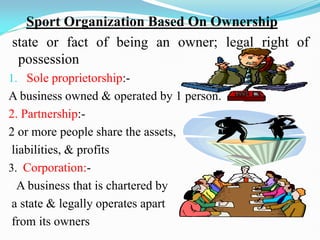
Sport Organization Based On Ownership
state or fact of being an owner; legal right of
possession
1. Sole proprietorship:-
A business owned & operated by 1 person.
2. Partnership:-
2 or more people share the assets,
liabilities, & profits
3. Corporation:-
CA business that is chartered by
a state & legally operates apart
from its owners
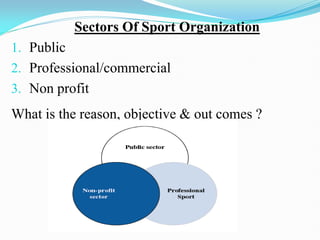
Sectors Of Sport Organization
1. Public
2. Professional/commercial
3. Non profit
What is the reason, objective & out comes ?
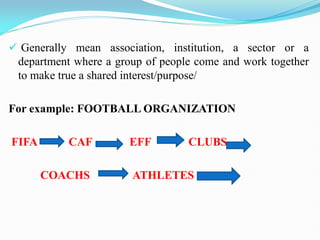
 Generally mean association, institution, a sector or a
department where a group of people come and work together
to make true a shared interest/purpose/
For example: FOOTBALL ORGANIZATION
FIFA CAF EFF CLUBS
COACHS ATHLETES
Administration
1. Difficult to give its short meaning,
2. Has been defined in different ways
For example:
1. It involves all the activities done to coordinate the effort of a
group or it is the way in which the group try to reach their
goals and objectives with the help of things and people.
2. It refers to “ a universal process of organizing resources
effectively towards a common goal.”
3. Is the process or activity running a business, or an
organization. It focuses on day to day’s of a company.
Sports administrator is help to ensure the smooth running of
a sports organization, which may range from reception work
at a local sports club to marketing or human resources at a
major sports club.
MANAGEMENT
 Is a coordinated & integrated process of utilizing an
organizational resource to achieve organizational goals.
 Is the process of working with & through people to achieve
organizational goals.
 Is the total process through which appropriate human and
material resources are made available and made effective for
accomplishing the purpose of the enterprise.
o The process of dealing with or controlling things of people
Sports Management : The study & practices of all peoples,
activities, business or organizations involved in producing,
facilitating, promoting organising any sports related business
or product.
Sport management involves any combination of skills related
to planning, organizing, directing, controlling, budgeting,
leading, and evaluating within the context of an SPORT
organization or department whose primary product or service
is related to sport or physical activity
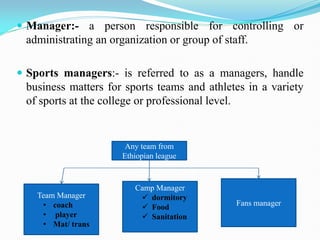
 Manager:- a person responsible for controlling or
administrating an organization or group of staff.
 Sports managers:- is referred to as a managers, handle
business matters for sports teams and athletes in a variety
of sports at the college or professional level.
Any team from
Ethiopian league
Camp Manager
 dormitory
 Food
 Sanitation
Team Manager
• coach
• player
• Mat/ trans
Fans manager
Management Vs Administration
Their difference lie in aspects like:
1. Ability required
2. Nature of their work or function
3. Scope
4. Level of their authority
5. Decision making
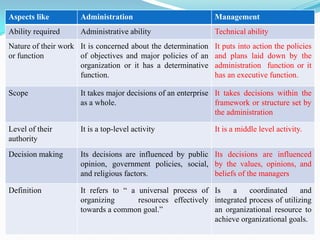
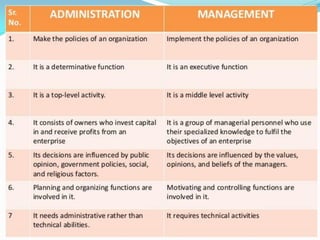
Aspects like Administration Management
Ability required Administrative ability Technical ability
Nature of their work
or function
It is concerned about the determination
of objectives and major policies of an
organization or it has a determinative
function.
It puts into action the policies
and plans laid down by the
administration function or it
has an executive function.
Scope It takes major decisions of an enterprise
as a whole.
It takes decisions within the
framework or structure set by
the administration
Level of their
authority
It is a top-level activity It is a middle level activity.
Decision making Its decisions are influenced by public
opinion, government policies, social,
and religious factors.
Its decisions are influenced
by the values, opinions, and
beliefs of the managers
Definition It refers to “ a universal process of
organizing resources effectively
towards a common goal.”
Is a coordinated and
integrated process of utilizing
an organizational resource to
achieve organizational goals.
Summary
 Management handles the employers / motivates
and controlling them/
 Administration handles the business aspects
such as finance.
Management Functions
 Whatever the organization, sector, department, institution is
…. Administrators/ managers engaged in a common set of
functions or processes to meet the organizational goals.
For example: Planning, Organizing, Coordinating, Directing /
commanding, leading, or staffing/, Evaluating and
controlling, budgeting, solving a problem, Making a decision
etc….
1. Planning
 Is the process of logically and purposefully outlining or
describing the work to be performed, the method to be used,
the time allotted for the work to be done.
 Is the process of deciding what to do, how to do it and who
should do ……it in advance.
 It maps the path from where the organization is to where it
wants to be.
Note: Administration with no plan, goal and purpose is
similar to continue a trip with no plan in mind & planning
involve establishing goals & arranging them in logical order.
Cont...
 Planning involves choosing tasks that must be performed
to attain organizational goals, outlining how the tasks
must be performed, and indicating when they should be
performed.
 Planning activity focuses on attaining goals. Managers
outline exactly what organizations should do to be
successful. Planning is concerned with the success of the
organization in the short term as well as in the long term.
 Planning may be the most important process within the
function of management.
 It is typically starting point of management process. In
the planning sports club manager must
 Identify the outcomes
 Understand what environmental constraints are present
 Establish activities that will lead to the desired
outcomes
 the blue print of what we are going to done
Types of planning:- strategic planning, operational
planning, functional planning &contingent planning
Strategic Planning:
 Management develop a mission and long term
objectives and determines in advance how they will
be accomplished.
 Long term generally means longer than one year,
Strategic plan are typically develops for five years.
 Top level managers generally plans for it.
Operational Planning:
 Management set short term objectives and
determines in advance how they will be
accomplished.
 Short term objectives are those that can be met
in one year.
 Middle managers or first line managers develop
operational plans.
2. Organizing
 Organizing can be thought of as assigning the tasks
developed in the planning stages, to various individuals
or groups within the organization. Organizing is to create
a mechanism to put plans into action.
 People within the organization are given work
assignments that contribute to the company’s goals.
Cont….
Here as a manager, director, leader… so as to get a coordinated effort
among all the element in the organization you have to know:
1. what to organize
2. How to organize
3. Why you organize
Therefore organizing involves identifying responsibilities to be
performed & group or arrange these responsibilities into different
groups or division…….it saves energy & time
In short it is the process of combining & integrating resources for the
achievement of goals.
Cont ….
Principles of organisation
 Unity of command
 Chain of command
 Span of control
 Division of labour
 Coordination
 Clarification of responsibilities
 Delegation & Flexibility
3. Staffing
 Staffing is the process of hiring, positioning &
overseeing employees in an organisation.
 The steps are
Determine the requirement of staff to achieve the
objective.
Recruit under the organizational policy
Provide orientation and training
Plan the communication system with staff
4. Coordinating, Directing, and Leading
 Is the process of typing together or uniting all the
organizational :
decisions
operations
activities
efforts etc
so as to achieve “ unity of actions ”

Cont….
Leading is a process of influencing employees to work
towards achieving objectives.
Influencing is also referred to as motivating, leading or
directing. The purpose of influencing is to increase
productivity.
 Effective leaders have strong people skills and
communication skills. Leaders and mangers are not
necessarily same but unfortunately all mangers are leaders
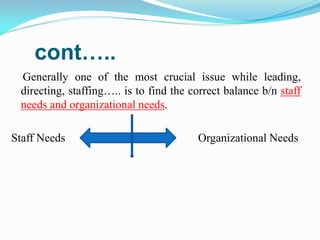
cont…..
Generally one of the most crucial issue while leading,
directing, staffing….. is to find the correct balance b/n staff
needs and organizational needs.
Staff Needs Organizational Needs
5. Controlling/ Evaluation
 Controlling is the process of establishing and
implementing mechanism to ensure that objectives are
achieved.
 An important part of controlling is measuring progress
and taking corrective action when necessary.
 Effective controlling requires technical skills as well as
conceptual and decision making skills.
Cont…..
 Controlling is the following roles played by the manager:
Gather information that measures performance
Compare present performance to pre established
performance norms.
Determine the next action plan and modifications for
meeting the desired performance parameters.
Controlling is an ongoing process.
 Generally controlling or evaluating helps you see that the
operations:
are proceed according to plan
are moving at appropriate speed
In addition to all the above processes all the managers
engaged in activities or roles like:
Budgeting
Solving a problem
Making a decision
Motivation
Feedbacks etc
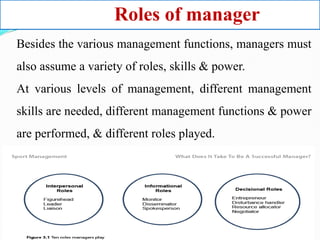
Roles of manager
Besides the various management functions, managers must
also assume a variety of roles, skills & power.
At various levels of management, different management
skills are needed, different management functions & power
are performed, & different roles played.
Interpersonal Roles
use peoples skill & communication skill.
Figurehead: when they present the department &organization in
ceremonial and symbolic activity.
 Example- when the manager is interviewed regarding the teams
performance.
Leader: They are leaders when they motivates, train, communicate with,
& influence others, coordinating the work of followers.
Liaison: the managers are liaison when they interact with the peoples
outside their unit to information and favour. Example- if manager meet with
local business to place advertisement or for sponsorship.
Monitor: They are monitors when they read & talk to others to gather
information, they scan the environment for information about trends &
event that can affect the organization, collect information from verity
of sources as subordinates, peers, superiors, news media, internet etc.
Disseminator: managers are disseminators when they send
information to others.
Spokesperson: This role of manager is like a mouthpiece of the
organization. They transmit organizational massage or information to
persons or group outside their units.
Informational Roles
Entrepreneur:- search for ways & take risks to effect change & improve
their organization. Moreover they innovate & improve product, system or
services.
Disturbance:-Manager also handle the day to day operational problems.
Allocate Resources:- Manager has a responsibility to allocate resources
effectively
Negotiators:- they represent their organization or department during non
routine transactions to gain agreement & commitments as well as Bargaining &
reaching an agreement with any agency or vendor.
Decision Roles
People with strong management skills are in demand.
Gaining experience in the workplace & completing
coursed similar to this one will help you develop these
skills.
In this section we are discussing
1. Technical skills,
2. Interpersonal skills, and
3. Conceptual skills.
Management skills
 refers to the ability to use methods or techniques to perform a
specific task. In sports club technical skills include coaching,
facility management, league, camp & tournament
management. These skills should be in first level and mid
level mangers.
Example:- reading the environmental situation,
Technical skills
It is known as the ability to work well with peoples.
Your human skills are what will make athletes,
parents, employees & other coaches to want to work
with you or for you. It enables the manager to
motivate peoples to achieve their goals, to get
volunteer to work on weekends to host a tournament.
Interpersonal / Human Skills
These skills are the ability to understand abstract ideas. It
involves manager thinking and planning abilities to
ensure that the organization is prepared for the future and
also an ability to think strategically about the
organization.
 Managers need this skill to think out of the box and come
up with creative way to improve performance.
Conceptual skills
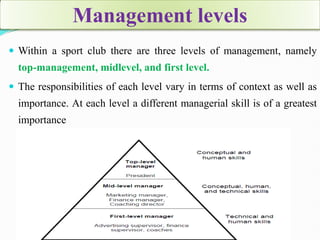
 Within a sport club there are three levels of management, namely
top-management, midlevel, and first level.
 The responsibilities of each level vary in terms of context as well as
importance. At each level a different managerial skill is of a greatest
importance
Management levels
Management/Leadership styles
 Leadership is a function of knowing yourself, having a vision that is
well communicated, building trust among colleagues, and taking
effective action to realize your own leadership potential."
 Is "the behavioral process of influencing individuals and groups
towards set goals".
 Leadership is a process by which a person influences others to
accomplish an objective and directs the organization in a way that
makes it more cohesive (interconnected )and coherent (logical).
 Leadership is a process whereby an individual influences a group of
individuals to achieve a common goal.
Leadership Styles
Basic leadership styles
1. Autocratic
2. Bureaucratic
3. Democratic
4. Laissez-faire
Autocratic Leadership Style
directional or command means the leader dictate the policy, the
procedures and staffs are forced to respect and follow.
Is a one way process of power is there.
Manager retains as much power and decision making authority as
possible
Does not consult staff, nor allowed to give any input
Staff expected to obey orders without receiving any explanations
Structured set of rewards and punishments
Bureaucratic Leadership Style
 Manages “by the book¨
 Everything done according to procedure or policy
 If not covered by the book, referred to the next level above
 A police officer not a leader
Enforces the rules
Democratic Leadership Style
Participative: Members participate on decision making …
involvement is there.
Is a two way process of power is there
Encourages staff to be a part of the decision making, Keeps staff
informed about everything that affects their work and shares
decision making and problem solving responsibilities
A coach who has the final say, but gathers information from staff
before making a decision
Produce high quality and high quantity work for long periods of
time
Democratic cont...
Staff like the trust they receive and respond with cooperation,
team spirit, and high morale
Develops plans to help staff evaluate their own performance
Allows staff to establish goals, Encourages staff to grow on the
job & be promoted
Recognizes & encourages achievement
Most successful when used with highly skilled or experienced
staff or when implementing operational changes or resolving
individual or group problems
Laissez-Faire Leadership Style
 Laissez Faire/ anarchic/ baby sitter Characterized by: Complete
freedom is there to set goals, make decisions
 Here the leader is not a power center at all.
 Also known as the “hands-off¨ style
 The manager provides little or no direction and gives staff as
much freedom as possible
 All authority or power given to the staff and they determine
goals, make decisions, and resolve problems on their own
Critical Thinking in Sport Organizations
 Critical thinking is the ability to effectively analyze
information and form a judgment.
Critical thinking skills help you to:
 Identify credible sources
 Evaluate and respond to arguments
 Assess alternative views points
 Test hypotheses against relevant criteria
Ethics in Sport Organizations
 Employees, managers, and leaders are expected to act ethically
as they undertake their duties and responsibilities within the sport
organization.
 Unfortunately people in organizations do not always act ethically.
The sources included their personal moral codes, professional
codes of conduct, and their organization’s standards, rules, and
procedures.
 Ethical leadership may be an appropriate strategy to help thwart
unethical behaviors within sport organizations.
Ethics cont….
 Ethical leaders are characterized “as honest, caring, and
principled individuals who make fair and balanced decisions”.
 Sport leaders must frequently communicate with their followers
about ethics set clear ethical standards, and use rewards and
punishments to see that those standards are followed. Sport
leaders must also proactively communicate, reinforce, and make
decisions with consideration of the effect of those decisions on
the organization and its stakeholders.

Chapter the best ppt foer studyingOne.pdf

  • 1.
  • 2.
    Basics Of Organization& Management Of Sport
  • 3.
    SPORT:-  is afast growing industry where a number of people engaged in the management, administration of sport, fitness and exercise at different level. “sport has the power to change the world, it has the power to inspire, the power to unit people that little else has” it is more powerful than governments in breaking down…. Nelson Mandela This implies that sport requires good organization, administration & management. What is sport industry ??????
  • 4.
    Industry  To understandwhat the sport industry is, it is necessary to first discuss what an industry is.  Is a market where similar, or closely related, products & services are offered to consumers. Industries are often categorised according to the types of products & services they offer.  The result is that there can be a wide range of organisations involved in an industry, including commercial or corporate entities, non-profit organisations, associations, manufacturers, wholesalers, retailers, government agencies and small businesses.
  • 5.
    Sport Industry isa marketplace where consumers can acquire products & services that are associated with sport in some way includes all the suppliers of products & services that satisfy the needs of sport consumers  Sport industry may appear to be little more than sport venues, gymnasiums, clubs and teams, leagues, athletes, sporting apparel and shoes, merchandise, sporting associations, the Olympic Games and government sport departments.  While this is a good start, there are many other organisations which are part of the sport industry.
  • 6.
    Some Scope ofSports Industry  Sports Infrastructure & Engineering:  Sports Equipment innovations, Design  Administration  Communications/Media:  Sports Law:  Sport Marketing:  Sport Public Relations:  Sport Travel/Tourism:  Sports Sponsorship  Sport Facilities  Sport Events:  Sport Finance:  Education institutions  Research institutions etc
  • 7.
    Definitions of Organization 1.a group of individuals, large or small, that is cooperating under the direction of executive leadership in accomplishment of certain common objectives. 2. Is a system of co-operative activities of two or more persons. 3. Is the process of : identifying & grouping the work to be performed, defining & delegating responsibility & authority & establishing relationship for the purpose of enabling people to work most effectively together in accomplishing objectives
  • 8.
     Two ormore people who work together in a structured way to achieve a specific goal or set of goals.  A sports organization is a social entity involved in Sports industry; it is goal directed, with consciously structured system & a relatively identifiable boundary.  It is a sport entity recognized by the national sports.  Sport Organizations are: a goal oriented, deliberately structured, coordinated, exist a system and made up of people with special skills to achieve the common goals, mission and objectives.  Goal oriented (mission, vision, …  Deliberately Structured (simple, team…  Deliberately Coordinated  Exist as a system of individuals & groups  Made up of people with special skills
  • 9.
    Sport Organization BasedOn Ownership state or fact of being an owner; legal right of possession 1. Sole proprietorship:- A business owned & operated by 1 person. 2. Partnership:- 2 or more people share the assets, liabilities, & profits 3. Corporation:- CA business that is chartered by a state & legally operates apart from its owners
  • 10.
    Sectors Of SportOrganization 1. Public 2. Professional/commercial 3. Non profit What is the reason, objective & out comes ?
  • 11.
     Generally meanassociation, institution, a sector or a department where a group of people come and work together to make true a shared interest/purpose/ For example: FOOTBALL ORGANIZATION FIFA CAF EFF CLUBS COACHS ATHLETES
  • 12.
    Administration 1. Difficult togive its short meaning, 2. Has been defined in different ways For example: 1. It involves all the activities done to coordinate the effort of a group or it is the way in which the group try to reach their goals and objectives with the help of things and people. 2. It refers to “ a universal process of organizing resources effectively towards a common goal.” 3. Is the process or activity running a business, or an organization. It focuses on day to day’s of a company.
  • 13.
    Sports administrator ishelp to ensure the smooth running of a sports organization, which may range from reception work at a local sports club to marketing or human resources at a major sports club.
  • 14.
    MANAGEMENT  Is acoordinated & integrated process of utilizing an organizational resource to achieve organizational goals.  Is the process of working with & through people to achieve organizational goals.  Is the total process through which appropriate human and material resources are made available and made effective for accomplishing the purpose of the enterprise. o The process of dealing with or controlling things of people
  • 15.
    Sports Management :The study & practices of all peoples, activities, business or organizations involved in producing, facilitating, promoting organising any sports related business or product. Sport management involves any combination of skills related to planning, organizing, directing, controlling, budgeting, leading, and evaluating within the context of an SPORT organization or department whose primary product or service is related to sport or physical activity
  • 16.
     Manager:- aperson responsible for controlling or administrating an organization or group of staff.  Sports managers:- is referred to as a managers, handle business matters for sports teams and athletes in a variety of sports at the college or professional level. Any team from Ethiopian league Camp Manager  dormitory  Food  Sanitation Team Manager • coach • player • Mat/ trans Fans manager
  • 17.
    Management Vs Administration Theirdifference lie in aspects like: 1. Ability required 2. Nature of their work or function 3. Scope 4. Level of their authority 5. Decision making
  • 18.
    Aspects like AdministrationManagement Ability required Administrative ability Technical ability Nature of their work or function It is concerned about the determination of objectives and major policies of an organization or it has a determinative function. It puts into action the policies and plans laid down by the administration function or it has an executive function. Scope It takes major decisions of an enterprise as a whole. It takes decisions within the framework or structure set by the administration Level of their authority It is a top-level activity It is a middle level activity. Decision making Its decisions are influenced by public opinion, government policies, social, and religious factors. Its decisions are influenced by the values, opinions, and beliefs of the managers Definition It refers to “ a universal process of organizing resources effectively towards a common goal.” Is a coordinated and integrated process of utilizing an organizational resource to achieve organizational goals.
  • 20.
    Summary  Management handlesthe employers / motivates and controlling them/  Administration handles the business aspects such as finance.
  • 21.
    Management Functions  Whateverthe organization, sector, department, institution is …. Administrators/ managers engaged in a common set of functions or processes to meet the organizational goals. For example: Planning, Organizing, Coordinating, Directing / commanding, leading, or staffing/, Evaluating and controlling, budgeting, solving a problem, Making a decision etc….
  • 22.
    1. Planning  Isthe process of logically and purposefully outlining or describing the work to be performed, the method to be used, the time allotted for the work to be done.  Is the process of deciding what to do, how to do it and who should do ……it in advance.  It maps the path from where the organization is to where it wants to be. Note: Administration with no plan, goal and purpose is similar to continue a trip with no plan in mind & planning involve establishing goals & arranging them in logical order.
  • 23.
    Cont...  Planning involveschoosing tasks that must be performed to attain organizational goals, outlining how the tasks must be performed, and indicating when they should be performed.  Planning activity focuses on attaining goals. Managers outline exactly what organizations should do to be successful. Planning is concerned with the success of the organization in the short term as well as in the long term.
  • 24.
     Planning maybe the most important process within the function of management.  It is typically starting point of management process. In the planning sports club manager must  Identify the outcomes  Understand what environmental constraints are present  Establish activities that will lead to the desired outcomes  the blue print of what we are going to done
  • 25.
    Types of planning:-strategic planning, operational planning, functional planning &contingent planning Strategic Planning:  Management develop a mission and long term objectives and determines in advance how they will be accomplished.  Long term generally means longer than one year, Strategic plan are typically develops for five years.  Top level managers generally plans for it.
  • 26.
    Operational Planning:  Managementset short term objectives and determines in advance how they will be accomplished.  Short term objectives are those that can be met in one year.  Middle managers or first line managers develop operational plans.
  • 27.
    2. Organizing  Organizingcan be thought of as assigning the tasks developed in the planning stages, to various individuals or groups within the organization. Organizing is to create a mechanism to put plans into action.  People within the organization are given work assignments that contribute to the company’s goals.
  • 28.
    Cont…. Here as amanager, director, leader… so as to get a coordinated effort among all the element in the organization you have to know: 1. what to organize 2. How to organize 3. Why you organize Therefore organizing involves identifying responsibilities to be performed & group or arrange these responsibilities into different groups or division…….it saves energy & time In short it is the process of combining & integrating resources for the achievement of goals.
  • 29.
    Cont …. Principles oforganisation  Unity of command  Chain of command  Span of control  Division of labour  Coordination  Clarification of responsibilities  Delegation & Flexibility
  • 30.
    3. Staffing  Staffingis the process of hiring, positioning & overseeing employees in an organisation.  The steps are Determine the requirement of staff to achieve the objective. Recruit under the organizational policy Provide orientation and training Plan the communication system with staff
  • 31.
    4. Coordinating, Directing,and Leading  Is the process of typing together or uniting all the organizational : decisions operations activities efforts etc so as to achieve “ unity of actions ” 
  • 32.
    Cont…. Leading is aprocess of influencing employees to work towards achieving objectives. Influencing is also referred to as motivating, leading or directing. The purpose of influencing is to increase productivity.  Effective leaders have strong people skills and communication skills. Leaders and mangers are not necessarily same but unfortunately all mangers are leaders
  • 33.
    cont….. Generally one ofthe most crucial issue while leading, directing, staffing….. is to find the correct balance b/n staff needs and organizational needs. Staff Needs Organizational Needs
  • 34.
    5. Controlling/ Evaluation Controlling is the process of establishing and implementing mechanism to ensure that objectives are achieved.  An important part of controlling is measuring progress and taking corrective action when necessary.  Effective controlling requires technical skills as well as conceptual and decision making skills.
  • 35.
    Cont…..  Controlling isthe following roles played by the manager: Gather information that measures performance Compare present performance to pre established performance norms. Determine the next action plan and modifications for meeting the desired performance parameters. Controlling is an ongoing process.
  • 36.
     Generally controllingor evaluating helps you see that the operations: are proceed according to plan are moving at appropriate speed In addition to all the above processes all the managers engaged in activities or roles like: Budgeting Solving a problem Making a decision Motivation Feedbacks etc
  • 37.
    Roles of manager Besidesthe various management functions, managers must also assume a variety of roles, skills & power. At various levels of management, different management skills are needed, different management functions & power are performed, & different roles played.
  • 38.
    Interpersonal Roles use peoplesskill & communication skill. Figurehead: when they present the department &organization in ceremonial and symbolic activity.  Example- when the manager is interviewed regarding the teams performance. Leader: They are leaders when they motivates, train, communicate with, & influence others, coordinating the work of followers. Liaison: the managers are liaison when they interact with the peoples outside their unit to information and favour. Example- if manager meet with local business to place advertisement or for sponsorship.
  • 39.
    Monitor: They aremonitors when they read & talk to others to gather information, they scan the environment for information about trends & event that can affect the organization, collect information from verity of sources as subordinates, peers, superiors, news media, internet etc. Disseminator: managers are disseminators when they send information to others. Spokesperson: This role of manager is like a mouthpiece of the organization. They transmit organizational massage or information to persons or group outside their units. Informational Roles
  • 40.
    Entrepreneur:- search forways & take risks to effect change & improve their organization. Moreover they innovate & improve product, system or services. Disturbance:-Manager also handle the day to day operational problems. Allocate Resources:- Manager has a responsibility to allocate resources effectively Negotiators:- they represent their organization or department during non routine transactions to gain agreement & commitments as well as Bargaining & reaching an agreement with any agency or vendor. Decision Roles
  • 41.
    People with strongmanagement skills are in demand. Gaining experience in the workplace & completing coursed similar to this one will help you develop these skills. In this section we are discussing 1. Technical skills, 2. Interpersonal skills, and 3. Conceptual skills. Management skills
  • 42.
     refers tothe ability to use methods or techniques to perform a specific task. In sports club technical skills include coaching, facility management, league, camp & tournament management. These skills should be in first level and mid level mangers. Example:- reading the environmental situation, Technical skills
  • 43.
    It is knownas the ability to work well with peoples. Your human skills are what will make athletes, parents, employees & other coaches to want to work with you or for you. It enables the manager to motivate peoples to achieve their goals, to get volunteer to work on weekends to host a tournament. Interpersonal / Human Skills
  • 44.
    These skills arethe ability to understand abstract ideas. It involves manager thinking and planning abilities to ensure that the organization is prepared for the future and also an ability to think strategically about the organization.  Managers need this skill to think out of the box and come up with creative way to improve performance. Conceptual skills
  • 45.
     Within asport club there are three levels of management, namely top-management, midlevel, and first level.  The responsibilities of each level vary in terms of context as well as importance. At each level a different managerial skill is of a greatest importance Management levels
  • 46.
    Management/Leadership styles  Leadershipis a function of knowing yourself, having a vision that is well communicated, building trust among colleagues, and taking effective action to realize your own leadership potential."  Is "the behavioral process of influencing individuals and groups towards set goals".  Leadership is a process by which a person influences others to accomplish an objective and directs the organization in a way that makes it more cohesive (interconnected )and coherent (logical).  Leadership is a process whereby an individual influences a group of individuals to achieve a common goal.
  • 47.
    Leadership Styles Basic leadershipstyles 1. Autocratic 2. Bureaucratic 3. Democratic 4. Laissez-faire
  • 48.
    Autocratic Leadership Style directionalor command means the leader dictate the policy, the procedures and staffs are forced to respect and follow. Is a one way process of power is there. Manager retains as much power and decision making authority as possible Does not consult staff, nor allowed to give any input Staff expected to obey orders without receiving any explanations Structured set of rewards and punishments
  • 49.
    Bureaucratic Leadership Style Manages “by the book¨  Everything done according to procedure or policy  If not covered by the book, referred to the next level above  A police officer not a leader Enforces the rules
  • 50.
    Democratic Leadership Style Participative:Members participate on decision making … involvement is there. Is a two way process of power is there Encourages staff to be a part of the decision making, Keeps staff informed about everything that affects their work and shares decision making and problem solving responsibilities A coach who has the final say, but gathers information from staff before making a decision Produce high quality and high quantity work for long periods of time
  • 51.
    Democratic cont... Staff likethe trust they receive and respond with cooperation, team spirit, and high morale Develops plans to help staff evaluate their own performance Allows staff to establish goals, Encourages staff to grow on the job & be promoted Recognizes & encourages achievement Most successful when used with highly skilled or experienced staff or when implementing operational changes or resolving individual or group problems
  • 52.
    Laissez-Faire Leadership Style Laissez Faire/ anarchic/ baby sitter Characterized by: Complete freedom is there to set goals, make decisions  Here the leader is not a power center at all.  Also known as the “hands-off¨ style  The manager provides little or no direction and gives staff as much freedom as possible  All authority or power given to the staff and they determine goals, make decisions, and resolve problems on their own
  • 53.
    Critical Thinking inSport Organizations  Critical thinking is the ability to effectively analyze information and form a judgment. Critical thinking skills help you to:  Identify credible sources  Evaluate and respond to arguments  Assess alternative views points  Test hypotheses against relevant criteria
  • 54.
    Ethics in SportOrganizations  Employees, managers, and leaders are expected to act ethically as they undertake their duties and responsibilities within the sport organization.  Unfortunately people in organizations do not always act ethically. The sources included their personal moral codes, professional codes of conduct, and their organization’s standards, rules, and procedures.  Ethical leadership may be an appropriate strategy to help thwart unethical behaviors within sport organizations.
  • 55.
    Ethics cont….  Ethicalleaders are characterized “as honest, caring, and principled individuals who make fair and balanced decisions”.  Sport leaders must frequently communicate with their followers about ethics set clear ethical standards, and use rewards and punishments to see that those standards are followed. Sport leaders must also proactively communicate, reinforce, and make decisions with consideration of the effect of those decisions on the organization and its stakeholders.