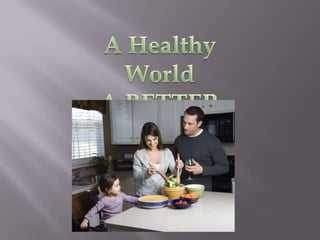
A Healthy WorldA BETTER You
Group Project LeadersDesigning Effective InstructionWalden University6100 Dr. Michael BurkeGroup 4-Natural Design SolutionsApril, 2010
Title and Group LeadersA Healthy World a Better YouGroup Project LeadersAnalysis-Connie JefferiesDesign-Timothy OwensDevelopment-Tonya WilliamsImplementation-Amanda TurnerEvaluation-Maureen Gorman
Purpose and Context		Purpose and Context		Contextual Analysis                                                                                                                                                                        Instructional AnalysisTransfer Analysis					Task AnalysisIntroductionGoalsInstructional GoalsAnalysisAnalysisNeeds AnalysisQuestionsDesignDesign PhaseDesign PhaseEmergent TechnologyFollowingMyPyramidDevelopmentInstructional PlanInstructional PlanImplementationIntroduction Instructional ModuleBackground and GoalsIntroduction Food PyramidLearning ObjectivesInstructional Environment and MaterialsInstructional Environment and MaterialsPre-assessment and EvaluationOverviewSequence of ActivitiesStep by Step InstructionEvaluationLesson PlansDemonstration and ExplanationsSteps to a Healthier YouAnatomy of MyPyramidWorksheetsHow Sweet It IsCharts, Graphs, TablesBe a Healthy Role ModelTen Steps to VegetablesTen Steps to FruitsTen Steps to GrainSweet Treat Ten Tip SheetTips on Low Salt and SodiumSample MenuSample MenuSample MenuStatisticsVideosPhysical FitnessMyPyramid VideoLinksRecipesInteresting http://Cooking with KidsCooking with KidsHealthy Ingredient SubstitutionsConclusionsPhysical FitnessReferencesTable of Contents
Purpose and Context
PurposeThe purpose of this module is to promote healthy eating and living habits by allowing information to be presented in a multimedia fashion.To apply the principles of ADDIE while we design the a module of colorful facts and information that may be retrieved, reflected on, and applied to daily understanding of healthy living practices.
Purpose and Context To educate our communities on the value of making nutritional and lifestyle choices for our youth. To educate through instruction how to make choices while analyzing food and recording input through counting calories, fats, proteins and other essential ingredients.To educate through exploration of the food pyramid and personal reflection.To consider the factors that are important to healthy living.To consider the consequences of unhealthy choices and the absence of daily physical matched activity.
Contextual AnalysisOrienting ContextThe present level of understanding each learner has about nutrition and physical fitness. Design will begin with the learner and end with the learner.   Mindful consideration is needed for each person.  Awareness of abilities, disabilities, and attitudes is essential.Socioeconomic factors are to be considered.Take note of any modifications required.
Environmental ContextThe environment will consist of a classroom with 15-20 desks. One or more computers to explore hyperlinks for instruction.Possible instruction with home school or self-paced learning experience.In the community at events such as Jump Rope for Heart, Start!, Get Moving!At home at the dinner table or at family meetings.
Transfer AnalysisWith the information provided anyone can transfer these ideas to a healthy plan of living.With this module children along with their families can use the internet to further explore the topic of nutrition. They will also analyze food for essential elements and know how to keep a food journal while referring to food labels to count calories.Choose the right foods to eat and participate in a daily routine of exercise.
Task Analysis I .Food Group Pyramid     Identify Vocabulary     Analyze the food pyramid     Apply understanding to menu planning     Formulate principal and rules     Communicate tips and serving rulesll. Nutrition Labels      Serving Size                   Carbohydrates                Vitamins      Calories                                Dietary Fiber              Iron      Fat and Calories                  Sugars          Saturated                   Protein          Unsaturated              Cholesterol          Fat from Calories      Sodium
Task Analysis cont.Physical  Activity	Vocabulary-heart rate, movement 	Principals and rules	If I complete the recommended amount of physical activity, then I will achieve health goals.Procedures    	Games and activities with active movements	Interpersonal in groups or individual activities.
Hyperlinkshttp://americanheart.org/http://www.mypyramid.gov/http://www.livepositively.com/pdf/howsweetishttp://teamnutrition.usda.gov/resources/mpk_worksheet.pdfhttp://www.surveymonkey.com/QuestionBuilde
Introduction
Goals Upon completion of this instructional unit participants will be able to:Explain the difference between nutritious and non-nutritious foods using the food pyramid.Recognize the difference between healthy and unhealthy lifestyles.Explain factors to consider with examples of current health epidemics.
Instructional GoalsEffectively explain nutrition and lifestylesDemonstrate the difference between nutritional and non-nutritional foods.Identify current factors and identify epidemic diseases that require nutritious intervention.Define steps to making healthier food and lifestyle choice.Categorize healthy and unhealthy foods.Plan a nutritious menu.Participate in an individual or group series of physical activities.Name healthy substitution for overused ingredients.Analyze and apply knowledge to a self-care plan.
Analysis
AnalysisProject DescriptionIn this project we will address an existing issue many families in America are dealing with and that is childhood nutrition.First lady Michelle Obama has expanded this subject by starting a campaign to end childhood obesity.Childhood nutrition is a major component of healthy living which needs constant evaluation.   In creating this project we hope to expand the learners knowledge of nutrition, instill a greater understanding of personal management relating to eating choices and participation in regular physical activity.The theme of this project is “A Healthier World a Better You”
Needs AnalysisWhat is the problem we are asked to solve? We want children to make better nutritional choices with the food they eat at home, at school, and on the go.We will educate the learner but the end results will be whether choices are made by each person, family, or school.  The target ages are between 3-14 years but the lessons and information within this module can be applied at any age.We also plan to initiate thoughts about regular physical activity with suggestions for various simple practices with movement that can be enjoyable.  Walking, playing, dancing, running and participating in sports are some examples of ways to stimulate the metabolism and burn energy.We want to motivate anyone who views this module to learn about using the computer to plan meals and acquire information about the food groups and healthy living.  The information provide can reach any person by use of a computer.  If not at home, or school this information can be viewed at any local public library.
QuestionsWhat can children do to learn more about nutritious eating?What children can benefit from this project?What choices are available and can be made for a regular exercise routine?How does a child read the food pyramid and apply it to everyday eating habits?When using the computer, how can the learner acquire information to plan a healthy meal? Who are we targeting and in what context will the learning take place?
Design
Design PhaseIn the design phase we want to begin with a pretest that is brief and gives us an idea of the learner.   This will be a short survey from an online survey.  Using behavior objectives as a starting point considering cognitive, psychomotor and affective domains.Then we want to state our objectives after a brief discussion and review of previous concepts.   With careful consideration apply strategies that use facts, concepts, attitudes, principals, rules while guiding procedures of each learner.
Design PhaseUsing these sequential steps a better understanding of nutritional choice will develop with continued exploration.Introduce the food pyramid and thoroughly examine each group using colors orange, green, red, blue, purple and yellow as a visual aide.Have the children keep a food log or journal of what they eat.Introduce http://www.myfoodpyramid.gov and demonstrate how to login, how to navigate the different topics.  Locate Foodapedia on this same sight and allow time for discovery.
Emergent technologiesWetpaint (wiki)Youtube (video) MyFoodPyramid.gov (Content, applications), Slideshare(Power Point viewing)Computer generated worksheetsWalden Group Discussion ForumMicrosoft OfficePower Point  Personal Computers  Select  web based information sights
MyPyramid OrganizationOne size does not fit all-personalized menu planningInside the PyramidFood groups, healthy eating tips, and moreKnow Your Farmer, Know Your Food Nutrition from farm to tableMyFoodapediaQuick access to food info – food groups, calories & comparisons MyPyramid Menu PlannerPlan menus to reach your personal goalsMyPyramid for Kids and  PreschoolersGet your child's Plan todayMyPyramid for MomsStart out right as a new mom or mom-to-beMyPyramid TrackerGet feedback on your food & physical activityLet's Move! The First Lady's Campaign to Raise Healthier Kids  Look up a food   newSee what's availableGet a personalized PlanLearn healthy eating tipsGet weight loss informationLearn about food groupsPlan a healthy menuAnalyze my dietListen to podcasts  ²Print MyPyramid materialsAsk a questionFirst Lady Michelle Obama launches...   Offer raisins or other dried fruits instead of candy. Follow MyPyramid on   Inside the Pyramid8 Interactive ToolsApps for Healthy Kids ßNEWMyFoodapedia        ßNEWMyPyramid PlanMyPyramid Menu PlannerMyPyramid TrackerChild Cost CalculatorMultimediaAudio PodcastsPublic Service Announcements  (PSAs)MyPyramid AnimationSpecific AudiencesPreschoolers (2-5yrs)Kids (6-11yrs)Pregnant & BreastfeedingGeneral PopulationSteps to a Healthier WeightWhat is a Healthier Weight?What should you eat?How much should you eat?For Professional UseEarn CPE CreditsDevelopment of MyPyramidWIC Fact SheetsRate What YOU AteMyPyramid Print MaterialsßNEWDietary Guidelines for  AmericansAbout the Dietary GuidelinesCurrent Dietary GuidelinesPrevious Dietary GuidelinesPartnering with MyPyramidPartnering with MyPyramidMyPyramid PartnersMyPyramid e-PostAction KitNavigating the SiteHomeAbout UsNews & MediaSite HelpContact UsGot a Question?En EspañolRelated LinksPrint Materials  Grain GroupWhat's in the Grain Group?How much is needed?What counts as an ounce?Health benefits & nutrientsVegetable GroupWhat's in the Vegetable  Group?How much is needed?What counts as a cup?Health benefits & nutrientsFruit GroupWhat's in the Fruit Group?How much is needed?What counts as a cup?Health benefits & nutrientsMilk Group What's in the Milk Group?How much is needed?What counts as a cup?Health benefits & nutrientsMeat & Beans GroupWhat's in the Meat & Beans  Group?How much is needed?What counts as an ounce?Nutrients & health implicationsVegetarian choicesOils What are "oils"?How are oils different from  solid fats?Why is it important to  consume oils?Discretionary CaloriesWhat are "discretionary  calories"?What are "solid fats"?What are "added sugars"?Physical Activity What is physical activity?Why is it important?How much is needed?Calories used in physical  activity Tips & ResourcesGrainsVegetablesFruitsMilkMeat & BeansIncreasing Physical ActivityInside the Pyramid print  pagesMenusCounting Mixed DishesEating OutVegetarian DietsTen Tips Nutrition Education*See all tips      USDA.gov | CNPP | FOIA | Accessibility Statement | Privacy Policy | Non-Discrimination Statement | Information Quality | USA.gov | White House 
Development
Instructional PlanStudent background will be built through whole group instruction using Power Point and a data projector.Students will complete a concept map assessing prior knowledge the attention will be directed to Food Guide Pyramid found on WWW.mypyramid.gov using a data projector.Whole group instruction is the best way to introduce the Food Guide Pyramid at this time in the learning process due to the fact that it iso early in the process.  While whole group instruction has weaknesses such as passiveness and low individual responsibilities., this type is suited for the beginning of our module.Through self-paced learning, students will conduct research using various websites and construct and critique their own daily food journals.  Research for our project has a specific goal in mind and we will allow the students to assess their own eating habits and compare and contrast them to eating habits that follow the Food Guide Pyramid.Small groups of 2 or 3 will be asked to create a product, detailing healthy and alternative food choices.  Products may include a play (readers theater), game board, or a digital media project.  Small group learning will have the strongest impact on our students learning during this module.Peer teaching is often the best way for student to learn.Groups will be self paced, but working together to achieve a goal.  However, weaknesses occur is small groups when tasks are not specifically designed for every member of the group.
Instructional PlanLearning objective #1The learner will communicate in writing, a picture of discussion a sample expressing his or her own understanding of healthy nutrition choices.ContentDemonstration (Instructor)The student will be introduced to the Food Pyramid and a popular webpage using URL http://www.mypyramid.comDemonstrate to the students how to use the sight and determine individual caloric intake along with USDA recommendations.Discuss the meaning of the pyramid and demonstrate how to plan or calculate/count calories using the Menu Planning Tab.Talk about favorite foods and create a collage with pictures taken from magazines and art materials with the overall label INPUT.Demonstrate how to read a product label by using a Powerpoint, overhead & transparency, and varied popular labels that have been saved & placed in an envelope.Explain the varied possible ingredients and discuss and rank the important ingredients according to % or numbers while thoroughly guiding comprehension of calories, serving size, fat carbohydrate, protein.  Discuss the categories of fat, (saturated, trans, polyunsaturated, and monounsaturated fats),  carbohydrates (sugars & dietary fibers) Proteins & Vitamins (Vitamin A, Vitamin C, Calcium, Iron, Thiamin, Riboflavin, Niacin, Folate).Create and provide a chart and explain the recommended daily percentage according to a 2000 calorie or less diet.
Instructional PlanStudent participationStudent Groupings-(Large group with presentations, small groups for categorizing and fish bowl recipe exploration, cooperative groups for projects and art activities, partners for computer practices, individual writing and assignments practices.Pretest may be given online or in writing at the choice of the instructor.Post-test can be multiple choice, rubric graded writing assignment or question and short answer.  Younger students can discuss, draw, write or demonstrate through manipulative practices.The student will use the computer and internet to locate a nutrition webpage using the URL http://www.mypyramid.com.Write and compile a journal using daily food intake and then use the internet to calculate caloric intake, read graphs and use visuals to gain understanding of personal daily eating habits.Identify healthy and unhealth food choices recording data on a chart.Participate in problem solving using case studies or personal experiences.Discuss and question content for known and unknown concepts.View pictures or video with the theme of nutrition and health.Categorize food pictures, manipulatives, or vocabulary according to the labels of food groups.Create an INPUT collage using magazine pictures and art materials.Analyze food labels in small groups and discuss food ingredients from various collected labels.Watch and participate in a demonstration using fish bowl method and healthy recipe.Participate in creative movement exercises and team or noncompetitive sports.Pass out jump ropes and encourage individual and group games.
Implementation
Introduction:  Nutrition ModuleAs an icebreaker chose students to tell anything they know about the Food Pyramid, and nutrition and collect data for future planning.Present the Food Pyramid and have students color the sheet (color coding) to get acquainted with the framework.Create a food log for them to record every meal for about a week.Continue after gaining learners interest to proceed to a sequential plan of in depth instruction.
Background and Goals The final course project for this Instructional Design class, we createda module for an instructional need and applied it to the ADDIE Model.  Our subject area is childhood nutrition which is an issue in today’s society.  Even 1st Lady Michelle Obama started a campaign to combat childhood obesity.  With children today , eating health should be a thing of importance with many children being diagnose with a silent disease, diabetes.  For many, eating healthy is a thing that is not emphasized and we just want to give some insight in eating nutritiously and implementing the Food Pyramid into our learners” daily life.Our main goals are that children will start making healthier food selections when eating and stick to an exercise plan as well.  We choose as our intended learners, children Pre-K to 14 years as participants in this module.  In this unit, the students will learn about the Food Pyramid and the elements of the anatomy along with the food groups associated with it.
Introduction:  Food PyramidIntroduce the anatomy of the pyramid.Optional Youtube video. (USDA)Wikie.Analyze each component of the pyramid.Use color to code the different groups.Discuss the varied slogans.
Learning ObjectivesIdentify the food groups and the foods that are part of the group.What is suggested by the USDA as appropriate daily allowances of calories and servings for each group:Compare the present food log to an updated log of healthier food choices.Identify food groups and how to get the right amount of food from each food group.Review MYPYramid.gov for kids to learn how they should eat more from some food groups than other.Analyze food choices from fast food restaurants and choosing lower fat alternativesDesign a plan to help kids see what they like to eat in their daily intake as healthy. Develop a way to motivate the learner to be more health conscious and discuss this with them.Implement healthy food in the learning units by asking them to purchase foods to try .Evaluate their overall progress and success of this lesson being taught.
Instructional EnvironmentDeliveryClassroom environment with desks/tables/seats for approximately 10-15 participant desksComputer access for each participant with Internet and E-learning capabilityBright overhead lightingOutlets available for all electrical connections5Instructor computer connected to LCD monitor and access to Internet and E-learning capabilityClass whiteboard, whiteboard markers, eraserAccess to indoor gymnasium or outside recreation area, i.e. playground, parkMobile CD PlayerBalls, hula-hoops, jump ropes, parachutes, cones, scarves etc. for physical fitnessOutdoor activities should only take place in weather permitted by assigned Independent School District. i.e. no rain, sleet, or snow, approximately between 50-100 degree
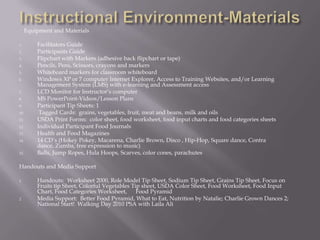
Instructional Environment-MaterialsEquipment and MaterialsFacilitators GuideParticipants GuideFlipchart with Markers (adhesive back flipchart or tape)Pencils, Pens, Scissors, crayons and markersWhiteboard markers for classroom whiteboardWindows XP or 7 computer Internet Explorer, Access to Training Websites, and/or Learning Management System (LMS) with e-learning and Assessment accessLCD Monitor for Instructor’s computerMS PowerPoint-Videos/Lesson PlansParticipant Tip Sheets: 1 Tagged Cards:  grains, vegetables, fruit, meat and beans, milk and oilsUSDA Print Forms:  color sheet, food worksheet, food input charts and food categories sheetsIndividual Participant Food JournalsHealth and Food Magazines14 CD’s (Hokey Pokey, Macarena, Charlie Brown, Disco , Hip-Hop, Square dance, Contra dance, Zumba, free expression to music)Balls, Jump Ropes, Hula Hoops, Scarves, color cones, parachutesHandouts and Media SupportHandouts:  Worksheet 2000, Role Model Tip Sheet, Sodium Tip Sheet, Grains Tip Sheet, Focus on Fruits tip Sheet, Colorful Vegetables Tip sheet, USDA Color Sheet, Food Worksheet, Food Input Chart, Food Categories Worksheet,      Food PyramidMedia Support:  Better Food Pyramid, What to Eat, Nutrition by Natalie; Charlie Grown Dances 2; National Start!  Walking Day 2010 PSA with Laila Ali
Pre-Assessment StrategiesPre-Assessment SurveyPre-Assessment SurveyStudents will log on to computers to take a survey assessing their knowledge of           health and nutrition before unit begins.Pre-Assessment GameGame found at MyPyramid Website, assessing student knowledge.  Students will take before and after unit to compare and contrast their before and after scores.Formative AssessmentStudent journaling.  Students will keep track of their meals and exercise for one week.  They will complete using the MyPyramid matrix for one day.Periodic one minute assessmentsNutrition ExplorationsSummative Assessment      Reflective writing      Traditional test on vocabulary and nutrition concepts
OverviewOverviewThe lesson that we have prepared is just a beginning to attempt to inform and persuade adults. children, teachers, and parent to learn about and commit themselves to a way of life that is natural and healthy.  That includes making wise choices with food consumption, and having a regular routine of exercise and physical activity.  Our target is the person, mostly the child between the ages of 2-14.  The materials can be used in groups, in families, between friends or on an individual basis.  Whether it is used in the classroom or as an independent study we want to foster awareness with the facts of nutrition.  Using information from the YWCA, the American Heart Association, the Coke-a-Cola Company, the United States Agricultural Association, and various celebrities, dieticians and studies a need has been analyzed, and a course of action developed.  This problem of eating, overeating, not eating (input) and lack of matched physical activity (output) is here in America in epidemic proportions  ‘Each person can benefit from a regular daily analysis of self and reflect on the consequences of not planning healthy living patterns.Families feel the pain of loved ones inflicted by diabetes, heart disease, obesity, and cancer which requires rigorous dietary planning.  We may even plan and prepare meals for others in our care and want the essential ingredients to mix into our menus.  Using the love and appeal of food, pictures, recipes and color will be used to stimulate the sense of taste to the natural choice of food rather that the processed watered down, sugarcoated realities that can be harmful to our bodies.  Planning ahead, weighing out options, creating physical movement and exercises, and maximizing energy sources while minimizing fats, sugars, carbohydrates and processed foods all goals to a Healthier World and a Better You”.
Sequence of ActivitiesPretest (activity and food inventory)Brainstorm and discuss present levels of nutrition/physical activityIntroduce restructured Food Pyramid-Use Power Point presentation (video on wiki)Study sessionComputer sessionsGuided instruction http://mypyramid.orgMenu planningWiki videosArt activityWriting activity and food classificationPhysical Fitness time with movement, team sports or noncompetitive games
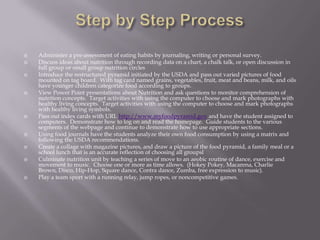
Step by Step ProcessAdminister a pre-assessment of eating habits by journaling, writing or personal survey.Discuss ideas about nutrition through recording data on a chart, a chalk talk, or open discussion in full group or small group nutrition circlesIntroduce the restructured pyramid initiated by the USDA and pass out varied pictures of food mounted on tag board.  With tag card named grains, vegetables, fruit, meat and beans, milk, and oils have younger children categorize food according to groups.View Power Point presentations about Nutrition and ask questions to monitor comprehension of nutrition concepts.  Target activities with using the computer to choose and mark photographs with healthy living concepts.  Target activities with using the computer to choose and mark photographs with healthy living symbols.Pass out index cards with URL http://www.myfoodpyramid.gov and have the student assigned to computers.  Demonstrate how to log on and read the homepage.  Guide students to the various segments of the webpage and continue to demonstrate how to use appropriate sections.Using food journals have the students analyze their own food consumption by using a matrix and following the USDA recommendations.Create a collage with magazine pictures, and draw a picture of the food pyramid, a family meal or a school lunch that is an accurate reflection of choosing all groupslCulminate nutrition unit by teaching a series of move to an aeobic routine of dance, exercise and movement to music.  Choose one or more as time allows.  (Hokey Pokey, Macarena, Charlie Brown, Disco, Hip-Hop, Square dance, Contra dance, Zumba, free expression to music).Play a team sport with a running relay, jump ropes, or noncompetitive games.
Evaluation
Lesson Plans
Demonstration/Explanationhttp://www.bing.com/videos/watch/video/food-pyramid/50a9f390d3424feee8ab50a9f390d3424feee8ab-1781148418162
Steps To a Healthier You
http://www.mypyramid.gov
Steps to a healthier you
Anatomy of MyPyramid
Worksheet
My Pyramid for Kids
Worksheet
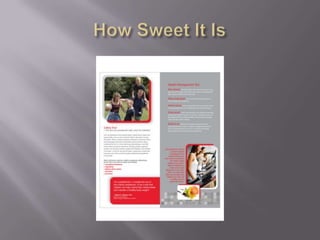
How Sweet It Is
Charts, Tables, Graphs
Be a Healthy Role Model
10 tips about vegetables
Ten tips about fruits
Ten tips about grains
Sweet treats ten tips sheet
Tips on salt and sodium
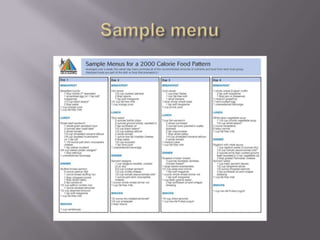
Sample menu
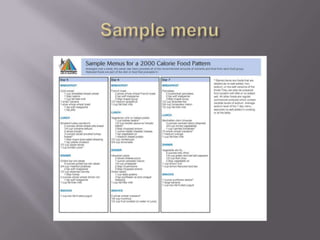
Sample menu
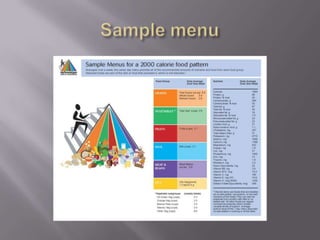
Sample menu
Statistics
A Nation at Risk
Epidemic of Excess
Videos
Physical Fitnesshttp://www.startwalkingnow.org/#http://video.about.com/dance/The-Five-Ballet-Positions.htmhttp://dance.about.com/od/stepsandmoves/ht/Cha_Cha_Slide.htm
My Food Pyramidhttp://www.bing.com/videos/watch/video/mypyramid-commercial/a9dba38732410d0e00a4a9dba38732410d0e00a4-1764326507893http://www.bing.com/videos/watch/video/mypyramid-commercial/a9dba38732410d0e00a4a9dba38732410d0e00a4-1764326507893
Links
Recipes
Chef in the Garden
Interesting http://www.http://www.gotmilk.com/http://www.incredibleegg.org/recipes-and-more/recipeshttp://www.childrensrecipes.com/index.htm
Cooking With KidsSmoothieBlender or food processor1 cup liquid measuring cup 1/4 teaspoon measuring spoon (optional)4 medium-sized glassesIngredients1 cup nonfat vanilla or plain yogurt or lowfat milk1/4 teaspoon vanilla (optional)2 ice cubesAny fruit that you want to use (fresh or frozen)Directions:Rinse and pull of stems of any fruit that needs such attention.Cut up fruits such as apples, mangos, plums, and pears.Add the rest of the ingredients. Shut lid of blender (or processor) tightly.Put  blender (or processor) in place on stand.Blend for about 30-40 seconds or until smooth and creamy.Pour into glasses and enjoy!      Privacy      About Cooking with Kids        Contact         Site Map
Cooking with Kids  A great way to get kids to eat their vegetables!           Fresh Veggie PizzaWhat you need:1 ready made pizza crust8 oz package cream cheese at room temperature1 cup sour cream1 envelope powdered Ranch dressing mix2 cup raw vegetables, chopped fine ( we use broccoli, cauliflower, carrots, cucumbers and tomatoes)What you do:Bake the pizza crust, without toppings, at 350 degrees for 5 to 10 minutes, until lightly browned. Stir together the cream cheese, sour cream, and dressing mix. Spread this on the crust. Top with mixed vegetables.      Privacy      About Cooking with Kids        Contact         Site Map
Healthy Substitutions
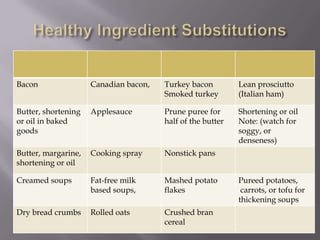
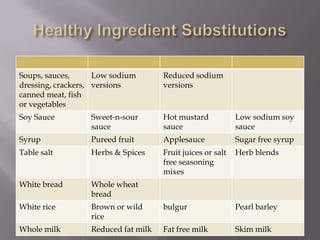
Healthy Ingredient Substitutions
Healthy Ingredient Substitutes
Healthy Ingredient Substitutions
Conclusions
Physical FitnessCharlie BrownShake Your Bodyhttp://www.bing.com/videos/watch/video/shy-fx-move-your-body/c73ca47dc60b5bcee82cc73ca47dc60b5bcee82c-1422990377075http://www.bing.com/videos/watch/video/med-charlie-brown-dance-mov/158e7fc96fc124db607d158e7fc96fc124db607d-1693758193719
References

Presentation1 Nutrition and Healthy Living

  • 1.
  • 2.
    Group Project LeadersDesigningEffective InstructionWalden University6100 Dr. Michael BurkeGroup 4-Natural Design SolutionsApril, 2010
  • 3.
    Title and GroupLeadersA Healthy World a Better YouGroup Project LeadersAnalysis-Connie JefferiesDesign-Timothy OwensDevelopment-Tonya WilliamsImplementation-Amanda TurnerEvaluation-Maureen Gorman
  • 4.
    Purpose and Context Purposeand Context Contextual Analysis Instructional AnalysisTransfer Analysis Task AnalysisIntroductionGoalsInstructional GoalsAnalysisAnalysisNeeds AnalysisQuestionsDesignDesign PhaseDesign PhaseEmergent TechnologyFollowingMyPyramidDevelopmentInstructional PlanInstructional PlanImplementationIntroduction Instructional ModuleBackground and GoalsIntroduction Food PyramidLearning ObjectivesInstructional Environment and MaterialsInstructional Environment and MaterialsPre-assessment and EvaluationOverviewSequence of ActivitiesStep by Step InstructionEvaluationLesson PlansDemonstration and ExplanationsSteps to a Healthier YouAnatomy of MyPyramidWorksheetsHow Sweet It IsCharts, Graphs, TablesBe a Healthy Role ModelTen Steps to VegetablesTen Steps to FruitsTen Steps to GrainSweet Treat Ten Tip SheetTips on Low Salt and SodiumSample MenuSample MenuSample MenuStatisticsVideosPhysical FitnessMyPyramid VideoLinksRecipesInteresting http://Cooking with KidsCooking with KidsHealthy Ingredient SubstitutionsConclusionsPhysical FitnessReferencesTable of Contents
  • 5.
  • 6.
    PurposeThe purpose ofthis module is to promote healthy eating and living habits by allowing information to be presented in a multimedia fashion.To apply the principles of ADDIE while we design the a module of colorful facts and information that may be retrieved, reflected on, and applied to daily understanding of healthy living practices.
  • 7.
    Purpose and ContextTo educate our communities on the value of making nutritional and lifestyle choices for our youth. To educate through instruction how to make choices while analyzing food and recording input through counting calories, fats, proteins and other essential ingredients.To educate through exploration of the food pyramid and personal reflection.To consider the factors that are important to healthy living.To consider the consequences of unhealthy choices and the absence of daily physical matched activity.
  • 8.
    Contextual AnalysisOrienting ContextThepresent level of understanding each learner has about nutrition and physical fitness. Design will begin with the learner and end with the learner. Mindful consideration is needed for each person. Awareness of abilities, disabilities, and attitudes is essential.Socioeconomic factors are to be considered.Take note of any modifications required.
  • 9.
    Environmental ContextThe environmentwill consist of a classroom with 15-20 desks. One or more computers to explore hyperlinks for instruction.Possible instruction with home school or self-paced learning experience.In the community at events such as Jump Rope for Heart, Start!, Get Moving!At home at the dinner table or at family meetings.
  • 10.
    Transfer AnalysisWith theinformation provided anyone can transfer these ideas to a healthy plan of living.With this module children along with their families can use the internet to further explore the topic of nutrition. They will also analyze food for essential elements and know how to keep a food journal while referring to food labels to count calories.Choose the right foods to eat and participate in a daily routine of exercise.
  • 11.
    Task Analysis I.Food Group Pyramid Identify Vocabulary Analyze the food pyramid Apply understanding to menu planning Formulate principal and rules Communicate tips and serving rulesll. Nutrition Labels Serving Size Carbohydrates Vitamins Calories Dietary Fiber Iron Fat and Calories Sugars Saturated Protein Unsaturated Cholesterol Fat from Calories Sodium
  • 12.
    Task Analysis cont.Physical Activity Vocabulary-heart rate, movement Principals and rules If I complete the recommended amount of physical activity, then I will achieve health goals.Procedures Games and activities with active movements Interpersonal in groups or individual activities.
  • 13.
  • 14.
  • 15.
    Goals Upon completionof this instructional unit participants will be able to:Explain the difference between nutritious and non-nutritious foods using the food pyramid.Recognize the difference between healthy and unhealthy lifestyles.Explain factors to consider with examples of current health epidemics.
  • 16.
    Instructional GoalsEffectively explainnutrition and lifestylesDemonstrate the difference between nutritional and non-nutritional foods.Identify current factors and identify epidemic diseases that require nutritious intervention.Define steps to making healthier food and lifestyle choice.Categorize healthy and unhealthy foods.Plan a nutritious menu.Participate in an individual or group series of physical activities.Name healthy substitution for overused ingredients.Analyze and apply knowledge to a self-care plan.
  • 17.
  • 18.
    AnalysisProject DescriptionIn thisproject we will address an existing issue many families in America are dealing with and that is childhood nutrition.First lady Michelle Obama has expanded this subject by starting a campaign to end childhood obesity.Childhood nutrition is a major component of healthy living which needs constant evaluation. In creating this project we hope to expand the learners knowledge of nutrition, instill a greater understanding of personal management relating to eating choices and participation in regular physical activity.The theme of this project is “A Healthier World a Better You”
  • 19.
    Needs AnalysisWhat isthe problem we are asked to solve? We want children to make better nutritional choices with the food they eat at home, at school, and on the go.We will educate the learner but the end results will be whether choices are made by each person, family, or school. The target ages are between 3-14 years but the lessons and information within this module can be applied at any age.We also plan to initiate thoughts about regular physical activity with suggestions for various simple practices with movement that can be enjoyable. Walking, playing, dancing, running and participating in sports are some examples of ways to stimulate the metabolism and burn energy.We want to motivate anyone who views this module to learn about using the computer to plan meals and acquire information about the food groups and healthy living. The information provide can reach any person by use of a computer. If not at home, or school this information can be viewed at any local public library.
  • 20.
    QuestionsWhat can childrendo to learn more about nutritious eating?What children can benefit from this project?What choices are available and can be made for a regular exercise routine?How does a child read the food pyramid and apply it to everyday eating habits?When using the computer, how can the learner acquire information to plan a healthy meal? Who are we targeting and in what context will the learning take place?
  • 21.
  • 22.
    Design PhaseIn thedesign phase we want to begin with a pretest that is brief and gives us an idea of the learner. This will be a short survey from an online survey. Using behavior objectives as a starting point considering cognitive, psychomotor and affective domains.Then we want to state our objectives after a brief discussion and review of previous concepts. With careful consideration apply strategies that use facts, concepts, attitudes, principals, rules while guiding procedures of each learner.
  • 23.
    Design PhaseUsing thesesequential steps a better understanding of nutritional choice will develop with continued exploration.Introduce the food pyramid and thoroughly examine each group using colors orange, green, red, blue, purple and yellow as a visual aide.Have the children keep a food log or journal of what they eat.Introduce http://www.myfoodpyramid.gov and demonstrate how to login, how to navigate the different topics. Locate Foodapedia on this same sight and allow time for discovery.
  • 24.
    Emergent technologiesWetpaint (wiki)Youtube(video) MyFoodPyramid.gov (Content, applications), Slideshare(Power Point viewing)Computer generated worksheetsWalden Group Discussion ForumMicrosoft OfficePower Point Personal Computers Select web based information sights
  • 25.
    MyPyramid OrganizationOne sizedoes not fit all-personalized menu planningInside the PyramidFood groups, healthy eating tips, and moreKnow Your Farmer, Know Your Food Nutrition from farm to tableMyFoodapediaQuick access to food info – food groups, calories & comparisons MyPyramid Menu PlannerPlan menus to reach your personal goalsMyPyramid for Kids and  PreschoolersGet your child's Plan todayMyPyramid for MomsStart out right as a new mom or mom-to-beMyPyramid TrackerGet feedback on your food & physical activityLet's Move! The First Lady's Campaign to Raise Healthier Kids  Look up a food   newSee what's availableGet a personalized PlanLearn healthy eating tipsGet weight loss informationLearn about food groupsPlan a healthy menuAnalyze my dietListen to podcasts  ²Print MyPyramid materialsAsk a questionFirst Lady Michelle Obama launches...   Offer raisins or other dried fruits instead of candy. Follow MyPyramid on   Inside the Pyramid8 Interactive ToolsApps for Healthy Kids ßNEWMyFoodapedia        ßNEWMyPyramid PlanMyPyramid Menu PlannerMyPyramid TrackerChild Cost CalculatorMultimediaAudio PodcastsPublic Service Announcements  (PSAs)MyPyramid AnimationSpecific AudiencesPreschoolers (2-5yrs)Kids (6-11yrs)Pregnant & BreastfeedingGeneral PopulationSteps to a Healthier WeightWhat is a Healthier Weight?What should you eat?How much should you eat?For Professional UseEarn CPE CreditsDevelopment of MyPyramidWIC Fact SheetsRate What YOU AteMyPyramid Print MaterialsßNEWDietary Guidelines for  AmericansAbout the Dietary GuidelinesCurrent Dietary GuidelinesPrevious Dietary GuidelinesPartnering with MyPyramidPartnering with MyPyramidMyPyramid PartnersMyPyramid e-PostAction KitNavigating the SiteHomeAbout UsNews & MediaSite HelpContact UsGot a Question?En EspañolRelated LinksPrint Materials  Grain GroupWhat's in the Grain Group?How much is needed?What counts as an ounce?Health benefits & nutrientsVegetable GroupWhat's in the Vegetable  Group?How much is needed?What counts as a cup?Health benefits & nutrientsFruit GroupWhat's in the Fruit Group?How much is needed?What counts as a cup?Health benefits & nutrientsMilk Group What's in the Milk Group?How much is needed?What counts as a cup?Health benefits & nutrientsMeat & Beans GroupWhat's in the Meat & Beans  Group?How much is needed?What counts as an ounce?Nutrients & health implicationsVegetarian choicesOils What are "oils"?How are oils different from  solid fats?Why is it important to  consume oils?Discretionary CaloriesWhat are "discretionary  calories"?What are "solid fats"?What are "added sugars"?Physical Activity What is physical activity?Why is it important?How much is needed?Calories used in physical  activity Tips & ResourcesGrainsVegetablesFruitsMilkMeat & BeansIncreasing Physical ActivityInside the Pyramid print  pagesMenusCounting Mixed DishesEating OutVegetarian DietsTen Tips Nutrition Education*See all tips      USDA.gov | CNPP | FOIA | Accessibility Statement | Privacy Policy | Non-Discrimination Statement | Information Quality | USA.gov | White House 
  • 26.
  • 27.
    Instructional PlanStudent backgroundwill be built through whole group instruction using Power Point and a data projector.Students will complete a concept map assessing prior knowledge the attention will be directed to Food Guide Pyramid found on WWW.mypyramid.gov using a data projector.Whole group instruction is the best way to introduce the Food Guide Pyramid at this time in the learning process due to the fact that it iso early in the process. While whole group instruction has weaknesses such as passiveness and low individual responsibilities., this type is suited for the beginning of our module.Through self-paced learning, students will conduct research using various websites and construct and critique their own daily food journals. Research for our project has a specific goal in mind and we will allow the students to assess their own eating habits and compare and contrast them to eating habits that follow the Food Guide Pyramid.Small groups of 2 or 3 will be asked to create a product, detailing healthy and alternative food choices. Products may include a play (readers theater), game board, or a digital media project. Small group learning will have the strongest impact on our students learning during this module.Peer teaching is often the best way for student to learn.Groups will be self paced, but working together to achieve a goal. However, weaknesses occur is small groups when tasks are not specifically designed for every member of the group.
  • 28.
    Instructional PlanLearning objective#1The learner will communicate in writing, a picture of discussion a sample expressing his or her own understanding of healthy nutrition choices.ContentDemonstration (Instructor)The student will be introduced to the Food Pyramid and a popular webpage using URL http://www.mypyramid.comDemonstrate to the students how to use the sight and determine individual caloric intake along with USDA recommendations.Discuss the meaning of the pyramid and demonstrate how to plan or calculate/count calories using the Menu Planning Tab.Talk about favorite foods and create a collage with pictures taken from magazines and art materials with the overall label INPUT.Demonstrate how to read a product label by using a Powerpoint, overhead & transparency, and varied popular labels that have been saved & placed in an envelope.Explain the varied possible ingredients and discuss and rank the important ingredients according to % or numbers while thoroughly guiding comprehension of calories, serving size, fat carbohydrate, protein. Discuss the categories of fat, (saturated, trans, polyunsaturated, and monounsaturated fats), carbohydrates (sugars & dietary fibers) Proteins & Vitamins (Vitamin A, Vitamin C, Calcium, Iron, Thiamin, Riboflavin, Niacin, Folate).Create and provide a chart and explain the recommended daily percentage according to a 2000 calorie or less diet.
  • 29.
    Instructional PlanStudent participationStudentGroupings-(Large group with presentations, small groups for categorizing and fish bowl recipe exploration, cooperative groups for projects and art activities, partners for computer practices, individual writing and assignments practices.Pretest may be given online or in writing at the choice of the instructor.Post-test can be multiple choice, rubric graded writing assignment or question and short answer. Younger students can discuss, draw, write or demonstrate through manipulative practices.The student will use the computer and internet to locate a nutrition webpage using the URL http://www.mypyramid.com.Write and compile a journal using daily food intake and then use the internet to calculate caloric intake, read graphs and use visuals to gain understanding of personal daily eating habits.Identify healthy and unhealth food choices recording data on a chart.Participate in problem solving using case studies or personal experiences.Discuss and question content for known and unknown concepts.View pictures or video with the theme of nutrition and health.Categorize food pictures, manipulatives, or vocabulary according to the labels of food groups.Create an INPUT collage using magazine pictures and art materials.Analyze food labels in small groups and discuss food ingredients from various collected labels.Watch and participate in a demonstration using fish bowl method and healthy recipe.Participate in creative movement exercises and team or noncompetitive sports.Pass out jump ropes and encourage individual and group games.
  • 30.
  • 31.
    Introduction: NutritionModuleAs an icebreaker chose students to tell anything they know about the Food Pyramid, and nutrition and collect data for future planning.Present the Food Pyramid and have students color the sheet (color coding) to get acquainted with the framework.Create a food log for them to record every meal for about a week.Continue after gaining learners interest to proceed to a sequential plan of in depth instruction.
  • 32.
    Background and GoalsThe final course project for this Instructional Design class, we createda module for an instructional need and applied it to the ADDIE Model. Our subject area is childhood nutrition which is an issue in today’s society. Even 1st Lady Michelle Obama started a campaign to combat childhood obesity. With children today , eating health should be a thing of importance with many children being diagnose with a silent disease, diabetes. For many, eating healthy is a thing that is not emphasized and we just want to give some insight in eating nutritiously and implementing the Food Pyramid into our learners” daily life.Our main goals are that children will start making healthier food selections when eating and stick to an exercise plan as well. We choose as our intended learners, children Pre-K to 14 years as participants in this module. In this unit, the students will learn about the Food Pyramid and the elements of the anatomy along with the food groups associated with it.
  • 33.
    Introduction: FoodPyramidIntroduce the anatomy of the pyramid.Optional Youtube video. (USDA)Wikie.Analyze each component of the pyramid.Use color to code the different groups.Discuss the varied slogans.
  • 34.
    Learning ObjectivesIdentify thefood groups and the foods that are part of the group.What is suggested by the USDA as appropriate daily allowances of calories and servings for each group:Compare the present food log to an updated log of healthier food choices.Identify food groups and how to get the right amount of food from each food group.Review MYPYramid.gov for kids to learn how they should eat more from some food groups than other.Analyze food choices from fast food restaurants and choosing lower fat alternativesDesign a plan to help kids see what they like to eat in their daily intake as healthy. Develop a way to motivate the learner to be more health conscious and discuss this with them.Implement healthy food in the learning units by asking them to purchase foods to try .Evaluate their overall progress and success of this lesson being taught.
  • 35.
    Instructional EnvironmentDeliveryClassroom environmentwith desks/tables/seats for approximately 10-15 participant desksComputer access for each participant with Internet and E-learning capabilityBright overhead lightingOutlets available for all electrical connections5Instructor computer connected to LCD monitor and access to Internet and E-learning capabilityClass whiteboard, whiteboard markers, eraserAccess to indoor gymnasium or outside recreation area, i.e. playground, parkMobile CD PlayerBalls, hula-hoops, jump ropes, parachutes, cones, scarves etc. for physical fitnessOutdoor activities should only take place in weather permitted by assigned Independent School District. i.e. no rain, sleet, or snow, approximately between 50-100 degree
  • 36.
    Instructional Environment-MaterialsEquipment andMaterialsFacilitators GuideParticipants GuideFlipchart with Markers (adhesive back flipchart or tape)Pencils, Pens, Scissors, crayons and markersWhiteboard markers for classroom whiteboardWindows XP or 7 computer Internet Explorer, Access to Training Websites, and/or Learning Management System (LMS) with e-learning and Assessment accessLCD Monitor for Instructor’s computerMS PowerPoint-Videos/Lesson PlansParticipant Tip Sheets: 1 Tagged Cards: grains, vegetables, fruit, meat and beans, milk and oilsUSDA Print Forms: color sheet, food worksheet, food input charts and food categories sheetsIndividual Participant Food JournalsHealth and Food Magazines14 CD’s (Hokey Pokey, Macarena, Charlie Brown, Disco , Hip-Hop, Square dance, Contra dance, Zumba, free expression to music)Balls, Jump Ropes, Hula Hoops, Scarves, color cones, parachutesHandouts and Media SupportHandouts: Worksheet 2000, Role Model Tip Sheet, Sodium Tip Sheet, Grains Tip Sheet, Focus on Fruits tip Sheet, Colorful Vegetables Tip sheet, USDA Color Sheet, Food Worksheet, Food Input Chart, Food Categories Worksheet, Food PyramidMedia Support: Better Food Pyramid, What to Eat, Nutrition by Natalie; Charlie Grown Dances 2; National Start! Walking Day 2010 PSA with Laila Ali
  • 37.
    Pre-Assessment StrategiesPre-Assessment SurveyPre-AssessmentSurveyStudents will log on to computers to take a survey assessing their knowledge of health and nutrition before unit begins.Pre-Assessment GameGame found at MyPyramid Website, assessing student knowledge. Students will take before and after unit to compare and contrast their before and after scores.Formative AssessmentStudent journaling. Students will keep track of their meals and exercise for one week. They will complete using the MyPyramid matrix for one day.Periodic one minute assessmentsNutrition ExplorationsSummative Assessment Reflective writing Traditional test on vocabulary and nutrition concepts
  • 38.
    OverviewOverviewThe lesson thatwe have prepared is just a beginning to attempt to inform and persuade adults. children, teachers, and parent to learn about and commit themselves to a way of life that is natural and healthy. That includes making wise choices with food consumption, and having a regular routine of exercise and physical activity. Our target is the person, mostly the child between the ages of 2-14. The materials can be used in groups, in families, between friends or on an individual basis. Whether it is used in the classroom or as an independent study we want to foster awareness with the facts of nutrition. Using information from the YWCA, the American Heart Association, the Coke-a-Cola Company, the United States Agricultural Association, and various celebrities, dieticians and studies a need has been analyzed, and a course of action developed. This problem of eating, overeating, not eating (input) and lack of matched physical activity (output) is here in America in epidemic proportions ‘Each person can benefit from a regular daily analysis of self and reflect on the consequences of not planning healthy living patterns.Families feel the pain of loved ones inflicted by diabetes, heart disease, obesity, and cancer which requires rigorous dietary planning. We may even plan and prepare meals for others in our care and want the essential ingredients to mix into our menus. Using the love and appeal of food, pictures, recipes and color will be used to stimulate the sense of taste to the natural choice of food rather that the processed watered down, sugarcoated realities that can be harmful to our bodies. Planning ahead, weighing out options, creating physical movement and exercises, and maximizing energy sources while minimizing fats, sugars, carbohydrates and processed foods all goals to a Healthier World and a Better You”.
  • 39.
    Sequence of ActivitiesPretest(activity and food inventory)Brainstorm and discuss present levels of nutrition/physical activityIntroduce restructured Food Pyramid-Use Power Point presentation (video on wiki)Study sessionComputer sessionsGuided instruction http://mypyramid.orgMenu planningWiki videosArt activityWriting activity and food classificationPhysical Fitness time with movement, team sports or noncompetitive games
  • 40.
    Step by StepProcessAdminister a pre-assessment of eating habits by journaling, writing or personal survey.Discuss ideas about nutrition through recording data on a chart, a chalk talk, or open discussion in full group or small group nutrition circlesIntroduce the restructured pyramid initiated by the USDA and pass out varied pictures of food mounted on tag board. With tag card named grains, vegetables, fruit, meat and beans, milk, and oils have younger children categorize food according to groups.View Power Point presentations about Nutrition and ask questions to monitor comprehension of nutrition concepts. Target activities with using the computer to choose and mark photographs with healthy living concepts. Target activities with using the computer to choose and mark photographs with healthy living symbols.Pass out index cards with URL http://www.myfoodpyramid.gov and have the student assigned to computers. Demonstrate how to log on and read the homepage. Guide students to the various segments of the webpage and continue to demonstrate how to use appropriate sections.Using food journals have the students analyze their own food consumption by using a matrix and following the USDA recommendations.Create a collage with magazine pictures, and draw a picture of the food pyramid, a family meal or a school lunch that is an accurate reflection of choosing all groupslCulminate nutrition unit by teaching a series of move to an aeobic routine of dance, exercise and movement to music. Choose one or more as time allows. (Hokey Pokey, Macarena, Charlie Brown, Disco, Hip-Hop, Square dance, Contra dance, Zumba, free expression to music).Play a team sport with a running relay, jump ropes, or noncompetitive games.
  • 41.
  • 42.
  • 43.
  • 44.
    Steps To aHealthier You
  • 45.
  • 46.
    Steps to ahealthier you
  • 47.
  • 48.
  • 51.
  • 52.
  • 56.
  • 57.
  • 58.
    Be a HealthyRole Model
  • 59.
    10 tips aboutvegetables
  • 60.
  • 61.
  • 62.
  • 63.
    Tips on saltand sodium
  • 64.
  • 65.
  • 66.
  • 67.
  • 68.
  • 69.
  • 87.
  • 88.
  • 89.
  • 90.
  • 91.
  • 92.
  • 93.
  • 95.
    Cooking With KidsSmoothieBlenderor food processor1 cup liquid measuring cup 1/4 teaspoon measuring spoon (optional)4 medium-sized glassesIngredients1 cup nonfat vanilla or plain yogurt or lowfat milk1/4 teaspoon vanilla (optional)2 ice cubesAny fruit that you want to use (fresh or frozen)Directions:Rinse and pull of stems of any fruit that needs such attention.Cut up fruits such as apples, mangos, plums, and pears.Add the rest of the ingredients. Shut lid of blender (or processor) tightly.Put  blender (or processor) in place on stand.Blend for about 30-40 seconds or until smooth and creamy.Pour into glasses and enjoy!      Privacy      About Cooking with Kids        Contact         Site Map
  • 96.
    Cooking with Kids A great way to get kids to eat their vegetables! Fresh Veggie PizzaWhat you need:1 ready made pizza crust8 oz package cream cheese at room temperature1 cup sour cream1 envelope powdered Ranch dressing mix2 cup raw vegetables, chopped fine ( we use broccoli, cauliflower, carrots, cucumbers and tomatoes)What you do:Bake the pizza crust, without toppings, at 350 degrees for 5 to 10 minutes, until lightly browned. Stir together the cream cheese, sour cream, and dressing mix. Spread this on the crust. Top with mixed vegetables.      Privacy      About Cooking with Kids        Contact         Site Map
  • 97.
  • 98.
  • 99.
  • 100.
  • 101.
  • 102.
  • 103.
    Physical FitnessCharlie BrownShakeYour Bodyhttp://www.bing.com/videos/watch/video/shy-fx-move-your-body/c73ca47dc60b5bcee82cc73ca47dc60b5bcee82c-1422990377075http://www.bing.com/videos/watch/video/med-charlie-brown-dance-mov/158e7fc96fc124db607d158e7fc96fc124db607d-1693758193719
  • 104.