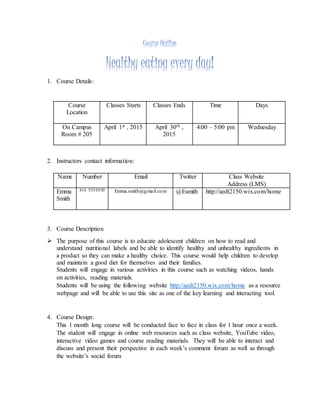
1. Course Details:
Course
Location
Classes Starts Classes Ends Time Days
On Campus
Room # 205
April 1st , 2015 April 30th ,
2015
4:00 – 5:00 pm Wednesday
2. Instructors contact information:
Name Number Email Twitter Class Website
Address (LMS)
Emma
Smith
416 555 0550 Emma.smith@gmail.com @Esmith http://aedt2150.wix.com/home
3. Course Description
 The purpose of this course is to educate adolescent children on how to read and
understand nutritional labels and be able to identify healthy and unhealthy ingredients in
a product so they can make a healthy choice. This course would help children to develop
and maintain a good diet for themselves and their families.
Students will engage in various activities in this course such as watching videos, hands
on activities, reading materials.
Students will be using the following website http://aedt2150.wix.com/home as a resource
webpage and will be able to use this site as one of the key learning and interacting tool.
4. Course Design:
This 1 month long course will be conducted face to face in class for 1 hour once a week.
The student will engage in online web resources such as class website, YouTube video,
interactive video games and course reading materials. They will be able to interact and
discuss and present their perspective in each week’s comment forum as well as through
the website’s social forum
5. Learning Outcomes:
After going through the learning program, 10 to 14 years old children will act as follows:
 Given labels with nutritional values, learners will select healthy items when shopping for
snacks without any adult assistance.
 Given resources, learners will define familiar nutritional labels and brands of products
that are healthy with 90% accuracy.
 Given labels with nutritional values, learners will pick foods that are lower in certain fats,
cholesterol and sodium when making daily food choices.
 Given resources, learners will compare at least two different foods using nutritional facts
label, then choose the one that is healthier with lower calories or fat.
 Given resources, learners will take active part in creating healthy habits as a family(i.e
educate other family members especially siblings)
 Given multimedia resources, learners will discuss the role media and marketing plays in
selling healthy or unhealthy food products
6. Evaluation Tools and Methods:
1. Formative Evaluation: Reading and Understanding Ingredients label
After completion of the third module, the students will be given packaged snacks that clearly
display the ingredient labels. They will be asked to write down the ingredients, define what each
ingredient is and at the end determine if it is healthy or not. This formative evaluation is designed
for learning objective 6 of our course and will be marked out of 20 points.
2. Summative Evaluation: Reading Nutritional Label
At the end of the module students will be handed out several sheets with nutritional labels on
them. Students will be asked questions such as multiple choice questions and true false
questions. This evaluation is designed for learning objectives #4 and #5 of our course. It will
consist of 5 multiple choice questions and 5 true and false questions and it will be marked out of
10 points.
3. Summative Evaluation: How will I eat healthy?
After completing the course students will complete a project that will require the use of
knowledge acquired during the course. The students will work in groups of 4 to 6 and they will
create a presentation/display that would inform other students about how they can implement
healthy diets into their life. The presentation/display can be prepared using a variety of platforms
such as a poster, multimedia presentation, powerpoint/prezi, role playing etc. The purpose of this
Evaluation is to see if students are able to transfer their learning into their daily life style.
The evaluation of the presentation/display will take form of the presentation/display evaluation
and peer evaluation process. Students will be given two rubrics: one for the project evaluation
and one for peer evaluation.
Final Mark
Evaluation Weight
1. Mediaand Kid’sdiet 25%
2. ReadingNutritionallabel 25%
3. Presentation/display 40%
4. Participation 10%
Sample of the presentation/display rubric.
Food and Nutrition Project Rubric
Category 4 Well
Balanced
Diet
3
Healthy
2 Lacks
Nutrients
1
Malnourished
Score
Nutritional
Content
*Evidence of
thorough
knowledge of topic.
*Interesting and
intriguing details
which create
imageryand
captivate audience
*Well organized
*Clear andconcise
*Focusedand
remains on topic
*All informationis
accurate.
* Clearlyanswers
question studied
* Specific
informationis given
to support ideas
*Creative
*Contains veryfew
errors
*Evidence of
knowledge on
topic.
*Interesting
details.
*Captures
audience attention
*Organized
*Message is clear
*Focusedand
remains on topic
* All informationis
Accurate
* Answers
question studied
* Informationis
given to support
ideas
*Creative
*Contains few
errors
*Evidence ofcommon
knowledge of topic.
*Maycapture but not
necessarilyretains
audience attention
*Lacks some organization
*Message maybe
unclear
*Lacks some focus and
accuracy
*Doesn’t answer entire
question.
*Lacks information to
support ideas.
*Original but lacks in
creativity
*Several errors present
*Little evidence of
knowledge of topic.
*Doesn’t capture or hold
audience attention.
*Lacks organization, focus
and accuracy
*Message is unclear
*Lacks focus andaccuracy
*Doesn’t answer question
*Not much information
*Numerous errors
Technology *Student coulddo
another project
similar to this
independently
*Student could
teach others the
technologyused
*Used technology
effectively
Technology
Enhancedproject
*Student usedthe
technology
effectively.
*Technology
enhancedproject.
*Student required
minimal support
with technology
*Requiredsupport with
technology.
*Project mayor may
have not enhanced
project
*Requiredlots of
assistance with
technology.
*Technologydidn’t
enhance project
Oral Presentation *Capturedand
maintained
audience attention
* Well-rehearsed
and organized
*Used excellent oral
presentation
techniques (voice,
eye contact, etc.)
*Captured
audience attention
*Rehearsed and
organized
*Used goodoral
presentation
techniques
*Mayor mayhave not
capturedthe audience
attention
*Neededmore rehearsal
time
*Used fair oral
presentation techniques
*Didn’t capture audience
attention.
*Neededa lot more
rehearsal time and
organization
*Struggledwith oral
presentation techniques
Persuasiveness *Student is able to
express his/her
opinionor
viewpoint about
healthyeating and
influence others ina
persuasive manner.
*Student provides
several specific
relevant facts with
clear explanations.
*The student makes
a strong convincing
argument.
*Student is able to
express his/her
opinionor
viewpoint about
healthyeating and
influence others in
a persuasive
manner.
* Student provides
some facts to
support his/her
viewpoint and
convince the
audience.
*Student is able to give
his/her opinion about
healthyeating but mayor
maynot be able to
influence or persuade
others.
* Little ifanyfacts to
support his/her
viewpoint are present.
* Student opinionabout
healthyeating is not clear
and persuasive.
* Lack of sufficient facts
to support his/her
viewpoint, the student
does not convince the
audience.
Grading: 15-16 points = A
13-14 points = B
10-12 points = C
8-9 points = D
Below 7 = Oops
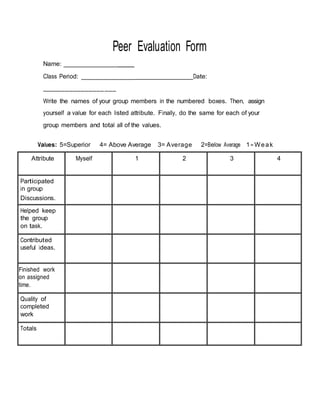
Peer Evaluation Form
Name: _________________
Class Period: _______________ Date:
___________________
Write the names of your group members in the numbered boxes. Then, assign
yourself a value for each listed attribute. Finally, do the same for each of your
group members and total all of the values.
Values: 5=Superior 4= Above Average 3= Average 2=Below Average 1= Weak
Attribute Myself 1 2 3 4
Participated
in group
Discussions.
Helped keep
the group
on task.
Contributed
useful ideas.
Finished work
on assigned
time.
Quality of
completed
work
Totals
7. Weekly Tasks Schedule
Weeks Description Activity/ Reading materials
Week 1 Brief introduction of
Course outline.
Complete diagnostic
quiz to test your
knowledge of how
much you know about
healthy eating and
reading food labels.
Discuss in small groups
about answers to quiz.
Play game.
Two jars will be
labelled, healthy
ingredients and
unhealthy
ingredients.
Smart board will display course outline for whole group.
Highlighting important facts.
Students will complete an online quiz.
http://www.google.com/url?q=http%3A%2F%2Faedt215
0.wix.com%2Fhome%23!week-
1%2Fc1hf2&sa=D&sntz=1&usg=AFQjCNFXnUi2bd6l78
PpkxeePqKzOTVtbw
( The result and feedback of this quiz will be discussed in
week 2)
Discuss in large group and tell your own story about
eating or shopping at the grocery.
In small groups, students will randomly pick an
ingredient from a bag while blindfolded by a friend. After
removing the blindfold he/she will place the selected
item in the healthy jar or unhealthy jar.
They will discuss the findings in a large group at the
end.
Week 2 -
Reading
and
Understan
ding
Nutritional
Labels
In this module
learners will examine
different nutritional
labels and learn the
meaning of different
values and symbols.
Select different packaged products and record product
ingredients and information off the label into the
handout.
Reading material and Video link for week 2 :
https://docs.google.com/a/uoit.net/document/d/1aLs1Ya
kL-Qw8FUa5qBy-pcjhhW7dbwNTJWsAAri2EZc/edit
Link for the online Nutrition Game on Food label:
http://www.nourishinteractive.com/kids/healthy-games/7-ride-the-food-
label-game-nutrient-information
Week 3 -
Reading
and
Understan
ding
Ingredient
s Labels
In this module
learners will examine
the list of ingredients
on the packaged
product and
differentiate between
healthy and
unhealthy
ingredients.
Research different ingredients listed on the package.
Provide definition for each ingredient and record it in the
hand out.
Week3: TalkingNutrition Encyclopedia(game to learn vocab
& meaningof differentingredients)
http://www.nourishinteractive.com/kids/healthy-games/2-
nutrition-encyclopedia-healthy-food-dictionary
YouTube link to watch:
https://www.youtube.com/watch?v=NaWxefC-Dyg
Week 4 -
Making a
Healthy
Choice
In this module
students will learn
how to compare
nutritional values of
similar products and
select products that
are healthier.
Week4: Provide the followinglinkfor studentresource.
http://www.fda.gov/Food/IngredientsPackagingLabeling/Labeli
ngNutrition/ucm274593.htm
YouTube link to watch:
https://www.youtube.com/watch?v=UY70XCqeI8k
Student will do their presentation on:
How will I eat healthy project.
Week 5 -
Media,
Marketing
and Health
foods.
Eating
Healthy
Meals as a
Family
In this module
students will learn
how media and
marketing could
affect their decision
to select health
foods.
In this module
student will learn the
importance of eating
healthy foods as a
family.
Week5: How mediaaffectsour eating
https://www.youtube.com/watch?v=V06upKOrrNs
What influencesme? - Handout

Course outline project updated after comments

  • 1.
    1. Course Details: Course Location ClassesStarts Classes Ends Time Days On Campus Room # 205 April 1st , 2015 April 30th , 2015 4:00 – 5:00 pm Wednesday 2. Instructors contact information: Name Number Email Twitter Class Website Address (LMS) Emma Smith 416 555 0550 Emma.smith@gmail.com @Esmith http://aedt2150.wix.com/home 3. Course Description  The purpose of this course is to educate adolescent children on how to read and understand nutritional labels and be able to identify healthy and unhealthy ingredients in a product so they can make a healthy choice. This course would help children to develop and maintain a good diet for themselves and their families. Students will engage in various activities in this course such as watching videos, hands on activities, reading materials. Students will be using the following website http://aedt2150.wix.com/home as a resource webpage and will be able to use this site as one of the key learning and interacting tool. 4. Course Design: This 1 month long course will be conducted face to face in class for 1 hour once a week. The student will engage in online web resources such as class website, YouTube video, interactive video games and course reading materials. They will be able to interact and discuss and present their perspective in each week’s comment forum as well as through the website’s social forum
  • 2.
    5. Learning Outcomes: Aftergoing through the learning program, 10 to 14 years old children will act as follows:  Given labels with nutritional values, learners will select healthy items when shopping for snacks without any adult assistance.  Given resources, learners will define familiar nutritional labels and brands of products that are healthy with 90% accuracy.  Given labels with nutritional values, learners will pick foods that are lower in certain fats, cholesterol and sodium when making daily food choices.  Given resources, learners will compare at least two different foods using nutritional facts label, then choose the one that is healthier with lower calories or fat.  Given resources, learners will take active part in creating healthy habits as a family(i.e educate other family members especially siblings)  Given multimedia resources, learners will discuss the role media and marketing plays in selling healthy or unhealthy food products 6. Evaluation Tools and Methods: 1. Formative Evaluation: Reading and Understanding Ingredients label After completion of the third module, the students will be given packaged snacks that clearly display the ingredient labels. They will be asked to write down the ingredients, define what each ingredient is and at the end determine if it is healthy or not. This formative evaluation is designed for learning objective 6 of our course and will be marked out of 20 points. 2. Summative Evaluation: Reading Nutritional Label At the end of the module students will be handed out several sheets with nutritional labels on them. Students will be asked questions such as multiple choice questions and true false questions. This evaluation is designed for learning objectives #4 and #5 of our course. It will consist of 5 multiple choice questions and 5 true and false questions and it will be marked out of 10 points. 3. Summative Evaluation: How will I eat healthy?
  • 3.
    After completing thecourse students will complete a project that will require the use of knowledge acquired during the course. The students will work in groups of 4 to 6 and they will create a presentation/display that would inform other students about how they can implement healthy diets into their life. The presentation/display can be prepared using a variety of platforms such as a poster, multimedia presentation, powerpoint/prezi, role playing etc. The purpose of this Evaluation is to see if students are able to transfer their learning into their daily life style. The evaluation of the presentation/display will take form of the presentation/display evaluation and peer evaluation process. Students will be given two rubrics: one for the project evaluation and one for peer evaluation. Final Mark Evaluation Weight 1. Mediaand Kid’sdiet 25% 2. ReadingNutritionallabel 25% 3. Presentation/display 40% 4. Participation 10% Sample of the presentation/display rubric.
  • 4.
    Food and NutritionProject Rubric Category 4 Well Balanced Diet 3 Healthy 2 Lacks Nutrients 1 Malnourished Score Nutritional Content *Evidence of thorough knowledge of topic. *Interesting and intriguing details which create imageryand captivate audience *Well organized *Clear andconcise *Focusedand remains on topic *All informationis accurate. * Clearlyanswers question studied * Specific informationis given to support ideas *Creative *Contains veryfew errors *Evidence of knowledge on topic. *Interesting details. *Captures audience attention *Organized *Message is clear *Focusedand remains on topic * All informationis Accurate * Answers question studied * Informationis given to support ideas *Creative *Contains few errors *Evidence ofcommon knowledge of topic. *Maycapture but not necessarilyretains audience attention *Lacks some organization *Message maybe unclear *Lacks some focus and accuracy *Doesn’t answer entire question. *Lacks information to support ideas. *Original but lacks in creativity *Several errors present *Little evidence of knowledge of topic. *Doesn’t capture or hold audience attention. *Lacks organization, focus and accuracy *Message is unclear *Lacks focus andaccuracy *Doesn’t answer question *Not much information *Numerous errors Technology *Student coulddo another project similar to this independently *Student could teach others the technologyused *Used technology effectively Technology Enhancedproject *Student usedthe technology effectively. *Technology enhancedproject. *Student required minimal support with technology *Requiredsupport with technology. *Project mayor may have not enhanced project *Requiredlots of assistance with technology. *Technologydidn’t enhance project
  • 5.
    Oral Presentation *Capturedand maintained audienceattention * Well-rehearsed and organized *Used excellent oral presentation techniques (voice, eye contact, etc.) *Captured audience attention *Rehearsed and organized *Used goodoral presentation techniques *Mayor mayhave not capturedthe audience attention *Neededmore rehearsal time *Used fair oral presentation techniques *Didn’t capture audience attention. *Neededa lot more rehearsal time and organization *Struggledwith oral presentation techniques Persuasiveness *Student is able to express his/her opinionor viewpoint about healthyeating and influence others ina persuasive manner. *Student provides several specific relevant facts with clear explanations. *The student makes a strong convincing argument. *Student is able to express his/her opinionor viewpoint about healthyeating and influence others in a persuasive manner. * Student provides some facts to support his/her viewpoint and convince the audience. *Student is able to give his/her opinion about healthyeating but mayor maynot be able to influence or persuade others. * Little ifanyfacts to support his/her viewpoint are present. * Student opinionabout healthyeating is not clear and persuasive. * Lack of sufficient facts to support his/her viewpoint, the student does not convince the audience. Grading: 15-16 points = A 13-14 points = B 10-12 points = C 8-9 points = D Below 7 = Oops
  • 6.
    Peer Evaluation Form Name:_________________ Class Period: _______________ Date: ___________________ Write the names of your group members in the numbered boxes. Then, assign yourself a value for each listed attribute. Finally, do the same for each of your group members and total all of the values. Values: 5=Superior 4= Above Average 3= Average 2=Below Average 1= Weak Attribute Myself 1 2 3 4 Participated in group Discussions. Helped keep the group on task. Contributed useful ideas. Finished work on assigned time. Quality of completed work Totals
  • 7.
    7. Weekly TasksSchedule Weeks Description Activity/ Reading materials Week 1 Brief introduction of Course outline. Complete diagnostic quiz to test your knowledge of how much you know about healthy eating and reading food labels. Discuss in small groups about answers to quiz. Play game. Two jars will be labelled, healthy ingredients and unhealthy ingredients. Smart board will display course outline for whole group. Highlighting important facts. Students will complete an online quiz. http://www.google.com/url?q=http%3A%2F%2Faedt215 0.wix.com%2Fhome%23!week- 1%2Fc1hf2&sa=D&sntz=1&usg=AFQjCNFXnUi2bd6l78 PpkxeePqKzOTVtbw ( The result and feedback of this quiz will be discussed in week 2) Discuss in large group and tell your own story about eating or shopping at the grocery. In small groups, students will randomly pick an ingredient from a bag while blindfolded by a friend. After removing the blindfold he/she will place the selected item in the healthy jar or unhealthy jar. They will discuss the findings in a large group at the end. Week 2 - Reading and Understan ding Nutritional Labels In this module learners will examine different nutritional labels and learn the meaning of different values and symbols. Select different packaged products and record product ingredients and information off the label into the handout. Reading material and Video link for week 2 : https://docs.google.com/a/uoit.net/document/d/1aLs1Ya kL-Qw8FUa5qBy-pcjhhW7dbwNTJWsAAri2EZc/edit Link for the online Nutrition Game on Food label: http://www.nourishinteractive.com/kids/healthy-games/7-ride-the-food- label-game-nutrient-information
  • 8.
    Week 3 - Reading and Understan ding Ingredient sLabels In this module learners will examine the list of ingredients on the packaged product and differentiate between healthy and unhealthy ingredients. Research different ingredients listed on the package. Provide definition for each ingredient and record it in the hand out. Week3: TalkingNutrition Encyclopedia(game to learn vocab & meaningof differentingredients) http://www.nourishinteractive.com/kids/healthy-games/2- nutrition-encyclopedia-healthy-food-dictionary YouTube link to watch: https://www.youtube.com/watch?v=NaWxefC-Dyg Week 4 - Making a Healthy Choice In this module students will learn how to compare nutritional values of similar products and select products that are healthier. Week4: Provide the followinglinkfor studentresource. http://www.fda.gov/Food/IngredientsPackagingLabeling/Labeli ngNutrition/ucm274593.htm YouTube link to watch: https://www.youtube.com/watch?v=UY70XCqeI8k Student will do their presentation on: How will I eat healthy project. Week 5 - Media, Marketing and Health foods. Eating Healthy Meals as a Family In this module students will learn how media and marketing could affect their decision to select health foods. In this module student will learn the importance of eating healthy foods as a family. Week5: How mediaaffectsour eating https://www.youtube.com/watch?v=V06upKOrrNs What influencesme? - Handout