Introduction
Name :
Roll No :
Class :
Submitted To :
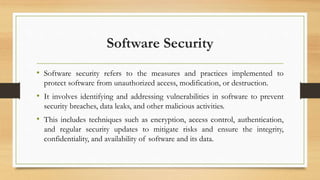
Software Security
• Software security refers to the measures and practices implemented to
protect software from unauthorized access, modification, or destruction.
• It involves identifying and addressing vulnerabilities in software to prevent
security breaches, data leaks, and other malicious activities.
• This includes techniques such as encryption, access control, authentication,
and regular security updates to mitigate risks and ensure the integrity,
confidentiality, and availability of software and its data.
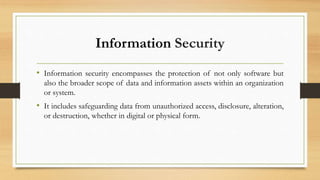
Information Security
• Information security encompasses the protection of not only software but
also the broader scope of data and information assets within an organization
or system.
• It includes safeguarding data from unauthorized access, disclosure, alteration,
or destruction, whether in digital or physical form.
Key components of information security
• Confidentiality:- Ensuring that information is only accessible to authorized individuals
or entities. This is typically achieved through access control mechanisms such as
encryption, authentication, and user permissions.
• Integrity:- Guaranteeing the accuracy and trustworthiness of information by
preventing unauthorized or unintended changes. Techniques such as digital signatures
and checksums are used to detect alterations to data.
• Availability:- Ensuring that information and resources are accessible and usable when
needed. This involves measures to prevent and mitigate disruptions such as denial-of-
service (DoS) attacks, hardware failures, and natural disasters.
• Authentication:-Verifying the identity of users or entities attempting to access
information or resources. This can involve passwords, biometrics, security tokens, or
multifactor authentication.
Key components of information security
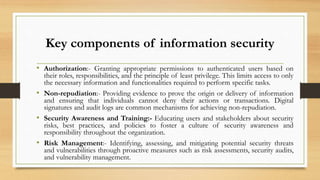
• Authorization:- Granting appropriate permissions to authenticated users based on
their roles, responsibilities, and the principle of least privilege. This limits access to only
the necessary information and functionalities required to perform specific tasks.
• Non-repudiation:- Providing evidence to prove the origin or delivery of information
and ensuring that individuals cannot deny their actions or transactions. Digital
signatures and audit logs are common mechanisms for achieving non-repudiation.
• Security Awareness and Training:- Educating users and stakeholders about security
risks, best practices, and policies to foster a culture of security awareness and
responsibility throughout the organization.
• Risk Management:- Identifying, assessing, and mitigating potential security threats
and vulnerabilities through proactive measures such as risk assessments, security audits,
and vulnerability management.
Advantage of Software Security
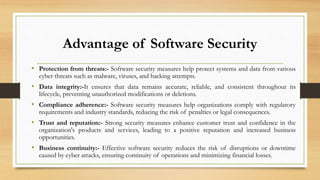
• Protection from threats:- Software security measures help protect systems and data from various
cyber threats such as malware, viruses, and hacking attempts.
• Data integrity:-It ensures that data remains accurate, reliable, and consistent throughout its
lifecycle, preventing unauthorized modifications or deletions.
• Compliance adherence:- Software security measures help organizations comply with regulatory
requirements and industry standards, reducing the risk of penalties or legal consequences.
• Trust and reputation:- Strong security measures enhance customer trust and confidence in the
organization's products and services, leading to a positive reputation and increased business
opportunities.
• Business continuity:- Effective software security reduces the risk of disruptions or downtime
caused by cyber attacks, ensuring continuity of operations and minimizing financial losses.
Disadvantage of Software Security
• Cost:-Implementing robust software security measures can be expensive, requiring investments in
specialized tools, technologies, and skilled personnel.
• Complexity:- Security measures can add complexity to software systems, making them more
difficult to manage, integrate, and maintain.
• Performance impact:- Some security measures, such as encryption and authentication, can
introduce overhead and impact system performance, especially in resource-constrained
environments.
• User experience:- Stringent security measures, such as complex passwords or multiple
authentication steps, can inconvenience users and lead to frustration or resistance to adoption.
• False positives:- Overzealous security measures may generate false positives, flagging legitimate
activities as suspicious or malicious, leading to unnecessary disruptions or alarms.

Presentation topic Software Security.pptx

  • 1.
    Introduction Name : Roll No: Class : Submitted To :
  • 2.
    Software Security • Softwaresecurity refers to the measures and practices implemented to protect software from unauthorized access, modification, or destruction. • It involves identifying and addressing vulnerabilities in software to prevent security breaches, data leaks, and other malicious activities. • This includes techniques such as encryption, access control, authentication, and regular security updates to mitigate risks and ensure the integrity, confidentiality, and availability of software and its data.
  • 3.
    Information Security • Informationsecurity encompasses the protection of not only software but also the broader scope of data and information assets within an organization or system. • It includes safeguarding data from unauthorized access, disclosure, alteration, or destruction, whether in digital or physical form.
  • 4.
    Key components ofinformation security • Confidentiality:- Ensuring that information is only accessible to authorized individuals or entities. This is typically achieved through access control mechanisms such as encryption, authentication, and user permissions. • Integrity:- Guaranteeing the accuracy and trustworthiness of information by preventing unauthorized or unintended changes. Techniques such as digital signatures and checksums are used to detect alterations to data. • Availability:- Ensuring that information and resources are accessible and usable when needed. This involves measures to prevent and mitigate disruptions such as denial-of- service (DoS) attacks, hardware failures, and natural disasters. • Authentication:-Verifying the identity of users or entities attempting to access information or resources. This can involve passwords, biometrics, security tokens, or multifactor authentication.
  • 5.
    Key components ofinformation security • Authorization:- Granting appropriate permissions to authenticated users based on their roles, responsibilities, and the principle of least privilege. This limits access to only the necessary information and functionalities required to perform specific tasks. • Non-repudiation:- Providing evidence to prove the origin or delivery of information and ensuring that individuals cannot deny their actions or transactions. Digital signatures and audit logs are common mechanisms for achieving non-repudiation. • Security Awareness and Training:- Educating users and stakeholders about security risks, best practices, and policies to foster a culture of security awareness and responsibility throughout the organization. • Risk Management:- Identifying, assessing, and mitigating potential security threats and vulnerabilities through proactive measures such as risk assessments, security audits, and vulnerability management.
  • 6.
    Advantage of SoftwareSecurity • Protection from threats:- Software security measures help protect systems and data from various cyber threats such as malware, viruses, and hacking attempts. • Data integrity:-It ensures that data remains accurate, reliable, and consistent throughout its lifecycle, preventing unauthorized modifications or deletions. • Compliance adherence:- Software security measures help organizations comply with regulatory requirements and industry standards, reducing the risk of penalties or legal consequences. • Trust and reputation:- Strong security measures enhance customer trust and confidence in the organization's products and services, leading to a positive reputation and increased business opportunities. • Business continuity:- Effective software security reduces the risk of disruptions or downtime caused by cyber attacks, ensuring continuity of operations and minimizing financial losses.
  • 7.
    Disadvantage of SoftwareSecurity • Cost:-Implementing robust software security measures can be expensive, requiring investments in specialized tools, technologies, and skilled personnel. • Complexity:- Security measures can add complexity to software systems, making them more difficult to manage, integrate, and maintain. • Performance impact:- Some security measures, such as encryption and authentication, can introduce overhead and impact system performance, especially in resource-constrained environments. • User experience:- Stringent security measures, such as complex passwords or multiple authentication steps, can inconvenience users and lead to frustration or resistance to adoption. • False positives:- Overzealous security measures may generate false positives, flagging legitimate activities as suspicious or malicious, leading to unnecessary disruptions or alarms.