Presentation Skills - Student Handout

A Short History of Presentations

Rhetorical Arts (Classical Antiquity ca. 500 BC)
   • The art of persuasion relied on three complimentary skills:
            Ethos: Character Appeal, Credentials
            Logos: Appeal to logic, reason, facts
            Pathos: Emotional Appeal
The Slide Projector (20th Century)
   • A swing towards pathos
The Digital Revolution
   • The domination of logos

Anatomy of a Presentation

Speeches/Stories
    • Resemble a gentle hill in pacing
    • Rise to a series of delivery points (body)
Slide Presentations
    • Every slide is a new wave of information
    • Resembles a staccato heart monitor
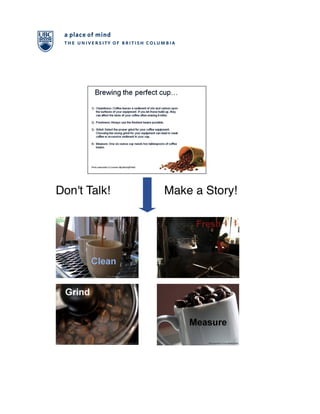
What are Bullet Points for?
    • Bullets are for delivering facts, not talking points
    • Think about how many your audience can take away
    • Your audience should not be choosing between listening and reading the slide

Before you start preparing your presentation:

Expertise
   • How are you the expert?
   • Think about mixture of credibility, logic and emotion required
   • Be confident
Audience
   • Who is your audience?
   • What do they know?
   • What do they want to know?
   • What do they need to know?
   • Why should they care?
Write
   • Start with what you’re going to say
   • Don’t just start typing talking points right into your presentation slides
Your Presentation as a Ship
   • Be the captain
   • Passengers don’t need bullet islands on a map
   • Make memories with each slide

Tips for Getting your Presentation Started

Use a mind map to explore all the topics and their relation

Consider your Presentation Tool
   • Microsoft Powerpoint
   • Apple Keynote
   • Google Docs Presenter
   • Prezi
Analyze the presentation space
   • Dual Screens
   • Digital Projector
   • Wireless Microphone
   • Room to circulate?
   • Room to break out into groups?
Engage your audience
    Polls
    Group exercises?
    Soliciting questions and ideas
    Cut out presentation if necessary
The Last Slide
    End on an invitation to discussion
    Make sure to write down comments / new information
    Leave means of contacting you such as e-mail/website

presentation_skills-handout-strang-2011

  • 1.
    Presentation Skills -Student Handout A Short History of Presentations Rhetorical Arts (Classical Antiquity ca. 500 BC) • The art of persuasion relied on three complimentary skills:  Ethos: Character Appeal, Credentials  Logos: Appeal to logic, reason, facts  Pathos: Emotional Appeal The Slide Projector (20th Century) • A swing towards pathos The Digital Revolution • The domination of logos Anatomy of a Presentation Speeches/Stories • Resemble a gentle hill in pacing • Rise to a series of delivery points (body) Slide Presentations • Every slide is a new wave of information • Resembles a staccato heart monitor What are Bullet Points for? • Bullets are for delivering facts, not talking points • Think about how many your audience can take away • Your audience should not be choosing between listening and reading the slide Before you start preparing your presentation: Expertise • How are you the expert? • Think about mixture of credibility, logic and emotion required • Be confident Audience • Who is your audience? • What do they know? • What do they want to know? • What do they need to know? • Why should they care? Write • Start with what you’re going to say • Don’t just start typing talking points right into your presentation slides
  • 3.
    Your Presentation asa Ship • Be the captain • Passengers don’t need bullet islands on a map • Make memories with each slide Tips for Getting your Presentation Started Use a mind map to explore all the topics and their relation Consider your Presentation Tool • Microsoft Powerpoint • Apple Keynote • Google Docs Presenter • Prezi Analyze the presentation space • Dual Screens • Digital Projector • Wireless Microphone • Room to circulate? • Room to break out into groups? Engage your audience  Polls  Group exercises?  Soliciting questions and ideas  Cut out presentation if necessary The Last Slide  End on an invitation to discussion  Make sure to write down comments / new information  Leave means of contacting you such as e-mail/website