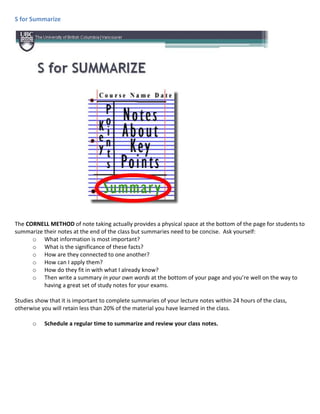
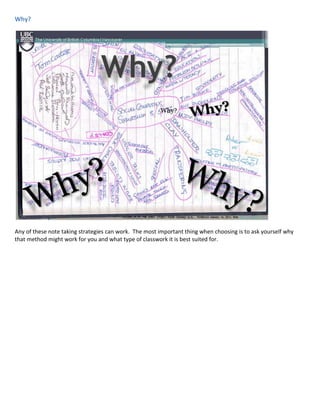
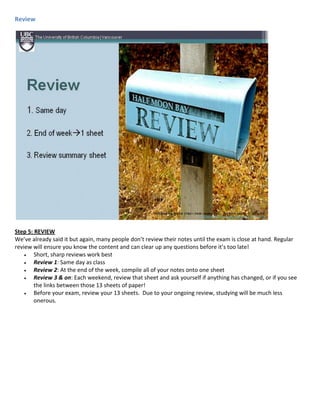
Note Taking (Facilitator's Guide)<br />This guide contains facilitator notes for the Note Taking for University Students Wimba slides. <br />Prior to your presentation, make sure that you have downloaded links available for:<br />Student handout http://cl.ly/3W0K3I2O1W1g0b2U2q07<br />Cornell template  HYPERLINK \"
http://tlef.pbworks.com/w/file/35058150/Cornell%20Notes%20Template.dot\"
 \t \"
_blank\"
 http://cl.ly/3B021e2L3J073R114438<br />Mind map.   HYPERLINK \"
http://tlef.pbworks.com/w/file/34983104/Mindmap_template.doc\"
 \t \"
_blank\"
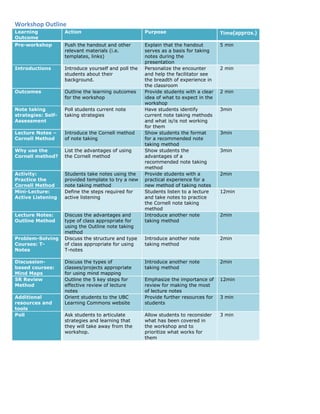
 http://cl.ly/2q0r3d1f0x1u2j1N2I38<br />Learning Commons: study toolkits http://learningcommons.ubc.ca/get-started/study-toolkits/  <br />Textbook reading toolkit. http://learningcommons.ubc.ca/get-started/study-toolkits/textbook-reading-toolkit/<br />Survey http://www.surveyfeedback.ca/surveys/wsb.dll/s/1gaec  <br />Workshop Outline<br />Learning OutcomeActionPurposeTime (approx.)Pre-workshop Push the handout and other relevant materials (i.e. templates, links)Explain that the handout serves as a basis for taking notes during the presentation5 minIntroductionsIntroduce yourself and poll the students about their background.Personalize the encounter and help the facilitator see the breadth of experience in the classroom2 minOutcomesOutline the learning outcomes for the workshopProvide students with a clear idea of what to expect in the workshop2 minNote taking strategies: Self-AssessmentPoll students current note taking strategiesHave students identify current note taking methods and what is/is not working for them3minLecture Notes – Cornell MethodIntroduce the Cornell method of note takingShow students the format for a recommended note taking method3minWhy use the Cornell method?List the advantages of using the Cornell methodShow students the advantages of a recommended note taking method3minActivity: Practice the Cornell MethodStudents take notes using the provided template to try a new note taking methodProvide students with a practical experience for a new method of taking notes2minMini-Lecture: Active Listening Define the steps required for active listeningStudents listen to a lecture and take notes to practice the Cornell note taking method12minLecture Notes: Outline MethodDiscuss the advantages and type of class appropriate for using the Outline note taking methodIntroduce another note taking method2minProblem-Solving Courses: T-NotesDiscuss the structure and type of class appropriate for using T-notesIntroduce another note taking method2minDiscussion-based courses: Mind MapsDiscuss the types of classes/projects appropriate for using mind mappingIntroduce another note taking method2min5R Review MethodOutline the 5 key steps for effective review of lecture notesEmphasize the importance of review for making the most of lecture notes12minAdditional resources and toolsOrient students to the UBC Learning Commons website Provide further resources for students3 minPollAsk students to articulate strategies and learning that they will take away from the workshop.Allow students to reconsider what has been covered in the workshop and to prioritize what works for them3 min<br />Select the relevant content slides<br />It is recommended that you log in to the Learning Commons classroom at least 15 minutes prior to the start of the workshop. When you first log in to the classroom, you will need to select the appropriate slides from the Content dropdown menu. Once you have selected them, click on Go. <br />Workshop Series Title Slide<br />Use this slide to greet the students. Push the handout again as a download link in the text chat area if needed.  If students are having technical troubles, please try to troubleshoot them early on (i.e. Have them exit and re-run Setup Wizard). <br />Facilitator Slide<br />Introduce yourself as the facilitator for the presentation. If you have some special insight or background, make sure to share it with the class.<br />About You Slide<br />Encourage students to share a little bit of their background with you. This helps to personalize the encounter and may help you see the breadth of experience in your classroom. This step should be completed prior to commencing archiving. <br />Introduce the Lecture<br />Remind students again that the presentation will be archived. After you click on the Archiving button, wait for the Archiving announcement to complete before speaking.  (You will also notice that there are now two new listings in the participants representing the archive and encoder. You can ignore these.)<br />Introduce the workshop again for the benefit of the archive record. Remember that this will be the first slide seen/first words heard by later viewers. <br />Outline Learning Outcomes<br />The primary goal of today’s workshop is to help you to take better notes.  A key aspect toward achieving this goal involves active listening and engaging with lecture content or discussion.  We will offer some recommended strategies and methods for note taking and review.  We will also encourage you to consider your personal goals and to identify strategies you can use to meet them.  Finally, we’ll end by directing you to some additional resources for a more in depth study or to examine complimentary topics.<br />Note Taking Self-Assessment<br />We will intersperse today’s session with poll’s much like the one you completed to share your year and field of study.  The reason these reflective exercises are important is that:<br />Sharing your experience/ideas with a group can help you bring awareness to particular aspects of your personal learning style and any areas of strength or weakness.<br />We can learn as much from peers as the instructor.  <br />As such, we encourage questions/comments from you in the text chat area at any time during today’s workshop.<br />Poll: How successful is your current method of note taking?<br />Debrief and encourage brainstorming suggestions/solutions in text chat.<br />While participants are completing polls, it is a good idea to read the questions aloud. This will serve to share the content of the hidden poll slides with people viewing the archive copies and to ensure that there is no period of awkward silence while students are undertaking the activity. <br />Try to verbally summarize the results (i.e. stressing the commonalities of participants, mention that skills will be introduced in the workshop to address issues…).<br />Personalize your Note Taking Strategies<br />It is important to recognize that what works for others might not be right for you.  Part of transitioning to post-secondary study and becoming a more independent student is to choose strategies that suit your own personal learning style, ones that help you achieve your goals.<br />Lecture Notes – Intro to the Cornell Method<br />Choosing learning strategies that are right for you is important to keep in mind, but it’s also necessary to consider what works best for the style of class you are in!  Most university courses are offered as lectures-based courses.  One recommended note taking method for lectures is called the Cornell Method.  Much research has gone into this method and many academics agree that it is one of the best ways to take lecture notes. <br />What is the Cornell Method?<br />It basically involves creating an L on your page with a margin on the left for key concepts or terms and some space on the bottom to summarize your notes.  Remember to include the date and topic heading the way you would for any other note taking method.  Your general, detailed notes are written as usual in the large space on the right side of the page.Why use the Cornell Method?<br />So why is this method considered so successful?  It’s considered a tried and true \"
do-it-right-in-the-first-place\"
 system because it:<br />encourages better organization of class notes.
results in a polished set of notes ready to study from
forces review/summary aids to get information into both short- and long-term memory.
saves time when studying for periodic, mid-term, or final examinations.The summary section is key as a great way to review your class notes and provides an excellent study tool for future tests and exams.<br />Cornell Method Template<br />We’re going to practice the Cornell method of note-taking right now to see what you think.  I’ve included a couple templates on the last 2 pages of your note-taking booklet in case you prefer to take your notes as a Word doc.  You can open one in another window now, or simply fold or draw lines on a piece of paper to set up your page like the slide example.<br />Here’s the hand-out link again with the templates on the last 2 pages and an additional link to a word template.<br />Hand-out<br />http://tlef.pbworks.com/w/file/34977021/Notetaking-Student_handout.doc <br />Cornell Template  <br />http://tlef.pbworks.com/w/file/35058150/Cornell%20Notes%20Template.dot<br />Mini-Lecture<br />MINI-LECTURE: LEARNING HOW TO LISTEN<br />The first step to taking effective and meaningful notes in class is to participate and engage in active listening.  <br />There are 3+ hours of lecture per course each week (i.e. 5 courses = ~15 hours of lecture time/wk).  Most profs base their exam questions primarily on concepts covered in class, so active listening and excellent notes are essential for achieving those high grades! <br />Learn to Listen<br />A common pattern for university students is to:<br />attend class<br />write down everything the prof says<br />shelve or set aside the info for later<br />review all notes at once and end up cramming before the exam.<br />The problem with this method is students are spending all their time writing, not listening & understanding.<br />Ask yourself - Is most of the info you’re being given available somewhere else (i.e. slides, course site, reading list?)  <br />It may be time to transition to a model where learning is taking place during the lecture time (remember that’s 15hrs a week!) and so review for exams is just that, not re-learning content by cramming it into a few days of really stressful study time.<br />L for Lead<br />The first step in taking effective notes is coming to class physically and mentally prepared.<br />Before class: <br />Consult the course outline so you know what topic will be covered in that lecture.<br />Do the assigned reading. If you cannot complete the entire reading, be sure to at least skim the chapter by reading the chapter summary or headings and sub-headings. If it is an article ensure that you have at least read the abstract and conclusion to get the main ideas. <br />Review class notes from the previous class.<br />Being early to class might matter for you! Arriving to class early allows you to get a good seat where you can hear and see the professor clearly and avoid other distractions.<br />I for Ideas<br />I – IDEAS<br />The next step involves breaking the pattern previously mentioned of writing down verbatim the entire lecture without really processing the important key ideas/concepts.<br />It’s common to do this when material becomes increasingly more difficult and complex but by doing so, students tend to miss half of what the instructor says. It is important to only write down the main ideas or concepts with some examples and to leave spaces or identify areas of confusion for later review and questioning. <br />S for Summarize<br />The CORNELL METHOD of note taking actually provides a physical space at the bottom of the page for students to summarize their notes at the end of the class but summaries need to be concise.  Ask yourself: <br />What information is most important?  <br />What is the significance of these facts?   <br />How are they connected to one another? <br />How can I apply them?  <br />How do they fit in with what I already know?  <br />Then write a summary in your own words at the bottom of your page and you’re well on the way to having a great set of study notes for your exams.<br />Studies show that it is important to complete summaries of your lecture notes within 24 hours of the class, otherwise you will retain less than 20% of the material you have learned in the class. <br />Schedule a regular time to summarize and review your class notes.<br />T for Talk<br />Ask questions in class! <br />You’ve heard it 100 times but it bears repeating…Don’t feel shy or embarrassed because if you have a question, it is very likely one or more of your classmates are wondering the same thing. Class discussions also tend to consolidate learning by fixing ideas in your memory.  So speak up and ask for clarifications! <br />Starting a study group is another excellent way to discuss, summarize or clarify trouble areas.  The best way to master something is to teach it to someone else. (We’ll provide resources and contact info for study groups later in the session.) <br />E for End<br />Don’t rush out of the lecture the minute the professor wraps things up or once the lecture ends! The last five minutes of the lecture should be dedicated to: <br />reviewing your class notes<br />identifying any problem areas that might need further clarification<br />asking a friend for any missing information that you may have missed which might be indicated by “holes” in your notes (leave spaces/bring a highlighter/red pen?)<br />asking the professor to clarify anything that you did not understand in the lecture <br />summarizing your class notes at the bottom of your notes page (Skip that expensive latte between class and leave your phone alone ‘til that summary is done ).<br />N for Notes<br />N – NOTES <br />Obviously this entire workshop is devoted to introducing you to strategies that produce effective and meaningful notes, but here are some quick tips to think about as you learn your profs lecture style:<br />Only record the essential points.<br />Listen for “signal” words – which indicate that you should copy down that material.  These can be:<br />Numbered lists<br />Definitions<br />Enumerations – four steps, five characteristics <br />Transitional words – therefore, furthermore <br />Repetitions – write “R” in your notes to indicate that this point was repeated<br />Direct announcements – pay attention to… <br />Examples <br />Draw lines or arrows to connect ideas or concepts. <br />Leave spaces for missed information if you can’t keep up (you can fill these in after class!)<br />Your Turn<br />That concludes our mini-lecture on active listening.  <br />Now take a couple minutes to extract key concepts in the left column of your paper or word doc, and try to construct a concise summary of your notes in the bottom section.  Use your own trigger words that will remind you of the full content.  Consider info that’s particularly relevant to your learning style or that’s useful for the kinds of courses you’re in.  It can be hard to do this well at first, but investing some time to create a habit of summarizing the content with help solidify your learning.<br />This is also your opportunity to ask any questions or text chat comments you have so far…Poll: Cornell Note Taking Method<br />[Give students a couple minutes to reflect on this note taking strategy and how it was useful or not. Sharing their thoughts down in a poll will encourage them to critically think about the process they were just engaged in and whether or not they will use it in the future and pinpoint specific courses for its use.]<br />Debrief and encourage more brainstorming suggestions/solutions in text chat.<br />While participants are completing polls, it is a good idea to read the questions/responses aloud. This will serve to share the content of the hidden poll slides with people viewing the archive copies later on and to ensure that there is no period of awkward silence while students are undertaking the activity. <br />Try to verbally summarize the results (i.e. stressing the commonalities of participants, mention that skills will be introduced in the workshop to address issues…).<br />Top 3 Note Taking Tips<br />If I had to choose my top 3 note taking practices to adopt, it would be these.  <br />Having an example to illustrate a concept often comes in useful when needing to provide evidence in an essay either for an assignment or on an exam.
Relating concepts and ideas either with keywords or symbols in the margin is also useful for writing papers later.
Scheduling time to regularly summarize notes is important to me because otherwise it just never seems to happen until the end of term when the pressure is on.Please feel free to share/comment on your own reflections as well.Lectures – Outline Method<br />The OUTLINE METHOD is another common method for lecture notes.<br />The main advantages of this note taking strategy are that it:<br />illustrates major points and supporting ideas<br />Is helpful for a lecture that may be presented in a disorganized way b/c requires critical thinking throughout the lecture in order to organize ideas<br />Many powerpoint lectures are already organized in an outline style format and it’s tempting to just use these as your notes, highlighting and adding comments as you go. (Recall the LISTEN lecture and how you might to use those strategies for this method. (i.e. re-write in your own words, summarize content, etc.). <br />FYI, Re: New Technology and Note Taking:<br />A 2002 study found that biology students who used only instructor’s lecture notes performed worse on exams than student who avoided using these notes.  (i.e. Instructor’s notes need to be used to improve clarity of lecture and encourage advanced preparation—not as a replacement for your own notes).<br />Problem-Solving Courses – T Notes<br />For PROBLEM-SOLVING COURSES (i.e. MATH, ECONOMICS, ACCOUNTING): T – NOTES method is sometimes used.  This is a variation of the Cornell Method where notes are divided into 2 columns of: Terms Concepts/IdeasVisual DiagramsTheoriesEquations/FormulaDefinitions ExamplesExplanations Evidence/Proof/ExplanationsProof/Explanations/Examples<br />Discussion-based courses – Mind Maps<br />For DISCUSSION-BASED COURSES, MIND MAPS can be very useful.  Mind maps are good for:<br />Summarizing information<br />Consolidating information from different research sources<br />Thinking through complex problems<br />Presenting information that shows the overall structure of your subject<br />Some students mentioned they like this method for psych courses.  Others use it to brainstorm for a paper for papers or presentations.<br />Here is a link for a Mindmap template.  http://tlef.pbworks.com/w/file/34983104/Mindmap_template.doc <br />There are also numerous mind mapping tools available free online such as Text2MindMap. http://www.text2mindmap.com/  <br />Why?<br />Any of these note taking strategies can work.  The most important thing when choosing is to ask yourself why that method might work for you and what type of classwork it is best suited for.<br />Your Turn<br />YOUR TURN:Text chat poll: After considering these other methods do you still think you’ll try the Cornell method or is something like mind mapping better suited to your learning needs? <br />Are there other methods/strategies you’d like to share?<br />Other comments/Questions?<br />So… let’s say you’ve got a method that’s working well for you… What’s next?<br />5R Method<br />Along with the Cornell Method there are recommended strategies for making use of your notes.  The 5R METHOD is recommended for effectively using and reviewing your notes.  It is a 5-step method beginning with…<br />Record<br />Step 1: RECORD<br />The LISTEN skills lecture talked about coming to class prepared.  This involves:<br />Reviewing readings in advance. Doing so means you have a better chance of understanding what the professor is talking about and helps you pick out important points.<br />Learning your professor’s verbal and non verbal cues<br />Laptops or paper and pen? A study that compared conventional note taking to note taking on a PC found that students handwriting notes took more notes and more compact notes than did those working on a PC. There was not significant difference between the two groups on multiple choice and free-recall texts given one week later.
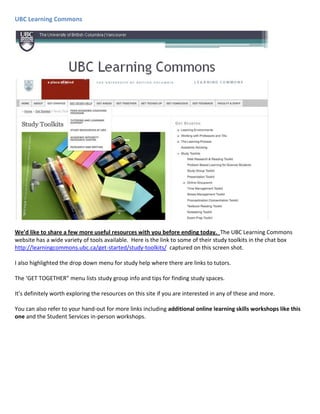
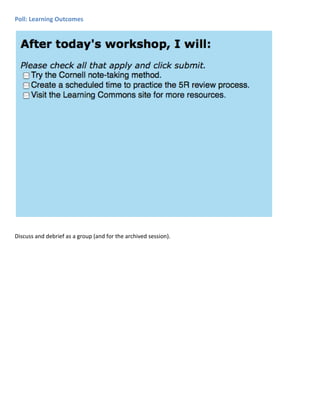
Keep in mind when choosing to take notes with a laptop over paper and pen: lecture notes tend to be full of little diagrams, sketches, circles, arrows, wavy lines and so on. Either have a laptop equipped with a stylus/a tablet PC, or bring a pen and paper along for back-up.Are you in a class where you find the instructor speaks quickly or there is simply too much information presented to get down? Try Pair Notes?!?!:  <br />Pair up with someone in your lecture<br />One member takes notes for half the lecture, while the other listens carefully<br />Reverse roles mid lecture<br />After class, go over notes together to fill in missing points<br />Reduce<br />Step 2: REDUCE<br />80% of material is lost with a 24-hour period if you don’t review<br />Doing reduction quickly after class (10-15 minutes) allows you to:<br />identify the key point while they are still fresh<br />identify concepts you didn’t understand fully (or can’t remember)<br />come up with questions to resolve with you textbook/asking your professor<br />summarize key points (reduce to 1page/week and you only have 13 pages to study for exams!!)<br />Recite<br />Step 3: RECITE<br />Studies show that saying material aloud helps with information retention (Think about where/how you study best?  Do you plan for a study routine that optimizes these needs? Do you need to consider a study group?).  <br />Reflect<br />Step 4: REFLECT<br />Things to ask yourself:<br />Where does this lecture fit into the objectives of the course?<br />What does this information tell you about the larger world?  What does it connect to? <br />Why is this information important? How can it be used?<br />What kind of exam questions could be extracted from this material?<br />Review<br />Step 5: REVIEWWe’ve already said it but again, many people don’t review their notes until the exam is close at hand. Regular review will ensure you know the content and can clear up any questions before it’s too late! <br />Short, sharp reviews work best<br />Review 1: Same day as class<br />Review 2: At the end of the week, compile all of your notes onto one sheet<br />Review 3 & on: Each weekend, review that sheet and ask yourself if anything has changed, or if you see the links between those 13 sheets of paper!<br />Before your exam, review your 13 sheets.  Due to your ongoing review, studying will be much less onerous.<br />Your Turn<br />In the text chat area share the step you feel is most important from the 5R method and say why. (See? Reflection and review forces you to engage with the content, recite it back and potentially apply your learning)<br />UBC Learning Commons<br />We’d like to share a few more useful resources with you before ending today.  The UBC Learning Commons website has a wide variety of tools available.  Here is the link to some of their study toolkits in the chat box http://learningcommons.ubc.ca/get-started/study-toolkits/  captured on this screen shot.<br />I also highlighted the drop down menu for study help where there are links to tutors. <br />The ‘GET TOGETHER” menu lists study group info and tips for finding study spaces.<br />It’s definitely worth exploring the resources on this site if you are interested in any of these and more.<br />You can also refer to your hand-out for more links including additional online learning skills workshops like this one and the Student Services in-person workshops.Ready, Set, Action<br />After tonight’s session, I’d really encourage you to choose a specific note taking method (i.e. could just as simple as scheduling time to summarize and review within 24hrs of each class) and try it for a week or 2.  <br />Poll: Learning Outcomes<br />Discuss and debrief as a group (and for the archived session).Stay in Touch<br />If you are comfortable fielding questions after the workshop, you can offer your email in the text chat area.<br />Ask students to complete the online survey.  Emphasize that it is a quick 2-3 minute poll survey.<br />Survey  http://www.surveyfeedback.ca/surveys/wsb.dll/s/1gaec<br />Turn archive OFF!!<br />
note_taking_facilitator_guide(goerzen2011)

note_taking_facilitator_guide(goerzen2011)

  • 1.
    Note Taking (Facilitator'sGuide)<br />This guide contains facilitator notes for the Note Taking for University Students Wimba slides. <br />Prior to your presentation, make sure that you have downloaded links available for:<br />Student handout http://cl.ly/3W0K3I2O1W1g0b2U2q07<br />Cornell template HYPERLINK \" http://tlef.pbworks.com/w/file/35058150/Cornell%20Notes%20Template.dot\" \t \" _blank\" http://cl.ly/3B021e2L3J073R114438<br />Mind map.  HYPERLINK \" http://tlef.pbworks.com/w/file/34983104/Mindmap_template.doc\" \t \" _blank\" http://cl.ly/2q0r3d1f0x1u2j1N2I38<br />Learning Commons: study toolkits http://learningcommons.ubc.ca/get-started/study-toolkits/ <br />Textbook reading toolkit. http://learningcommons.ubc.ca/get-started/study-toolkits/textbook-reading-toolkit/<br />Survey http://www.surveyfeedback.ca/surveys/wsb.dll/s/1gaec <br />Workshop Outline<br />Learning OutcomeActionPurposeTime (approx.)Pre-workshop Push the handout and other relevant materials (i.e. templates, links)Explain that the handout serves as a basis for taking notes during the presentation5 minIntroductionsIntroduce yourself and poll the students about their background.Personalize the encounter and help the facilitator see the breadth of experience in the classroom2 minOutcomesOutline the learning outcomes for the workshopProvide students with a clear idea of what to expect in the workshop2 minNote taking strategies: Self-AssessmentPoll students current note taking strategiesHave students identify current note taking methods and what is/is not working for them3minLecture Notes – Cornell MethodIntroduce the Cornell method of note takingShow students the format for a recommended note taking method3minWhy use the Cornell method?List the advantages of using the Cornell methodShow students the advantages of a recommended note taking method3minActivity: Practice the Cornell MethodStudents take notes using the provided template to try a new note taking methodProvide students with a practical experience for a new method of taking notes2minMini-Lecture: Active Listening Define the steps required for active listeningStudents listen to a lecture and take notes to practice the Cornell note taking method12minLecture Notes: Outline MethodDiscuss the advantages and type of class appropriate for using the Outline note taking methodIntroduce another note taking method2minProblem-Solving Courses: T-NotesDiscuss the structure and type of class appropriate for using T-notesIntroduce another note taking method2minDiscussion-based courses: Mind MapsDiscuss the types of classes/projects appropriate for using mind mappingIntroduce another note taking method2min5R Review MethodOutline the 5 key steps for effective review of lecture notesEmphasize the importance of review for making the most of lecture notes12minAdditional resources and toolsOrient students to the UBC Learning Commons website Provide further resources for students3 minPollAsk students to articulate strategies and learning that they will take away from the workshop.Allow students to reconsider what has been covered in the workshop and to prioritize what works for them3 min<br />Select the relevant content slides<br />It is recommended that you log in to the Learning Commons classroom at least 15 minutes prior to the start of the workshop. When you first log in to the classroom, you will need to select the appropriate slides from the Content dropdown menu. Once you have selected them, click on Go. <br />Workshop Series Title Slide<br />Use this slide to greet the students. Push the handout again as a download link in the text chat area if needed. If students are having technical troubles, please try to troubleshoot them early on (i.e. Have them exit and re-run Setup Wizard). <br />Facilitator Slide<br />Introduce yourself as the facilitator for the presentation. If you have some special insight or background, make sure to share it with the class.<br />About You Slide<br />Encourage students to share a little bit of their background with you. This helps to personalize the encounter and may help you see the breadth of experience in your classroom. This step should be completed prior to commencing archiving. <br />Introduce the Lecture<br />Remind students again that the presentation will be archived. After you click on the Archiving button, wait for the Archiving announcement to complete before speaking. (You will also notice that there are now two new listings in the participants representing the archive and encoder. You can ignore these.)<br />Introduce the workshop again for the benefit of the archive record. Remember that this will be the first slide seen/first words heard by later viewers. <br />Outline Learning Outcomes<br />The primary goal of today’s workshop is to help you to take better notes. A key aspect toward achieving this goal involves active listening and engaging with lecture content or discussion. We will offer some recommended strategies and methods for note taking and review. We will also encourage you to consider your personal goals and to identify strategies you can use to meet them. Finally, we’ll end by directing you to some additional resources for a more in depth study or to examine complimentary topics.<br />Note Taking Self-Assessment<br />We will intersperse today’s session with poll’s much like the one you completed to share your year and field of study. The reason these reflective exercises are important is that:<br />Sharing your experience/ideas with a group can help you bring awareness to particular aspects of your personal learning style and any areas of strength or weakness.<br />We can learn as much from peers as the instructor. <br />As such, we encourage questions/comments from you in the text chat area at any time during today’s workshop.<br />Poll: How successful is your current method of note taking?<br />Debrief and encourage brainstorming suggestions/solutions in text chat.<br />While participants are completing polls, it is a good idea to read the questions aloud. This will serve to share the content of the hidden poll slides with people viewing the archive copies and to ensure that there is no period of awkward silence while students are undertaking the activity. <br />Try to verbally summarize the results (i.e. stressing the commonalities of participants, mention that skills will be introduced in the workshop to address issues…).<br />Personalize your Note Taking Strategies<br />It is important to recognize that what works for others might not be right for you. Part of transitioning to post-secondary study and becoming a more independent student is to choose strategies that suit your own personal learning style, ones that help you achieve your goals.<br />Lecture Notes – Intro to the Cornell Method<br />Choosing learning strategies that are right for you is important to keep in mind, but it’s also necessary to consider what works best for the style of class you are in! Most university courses are offered as lectures-based courses. One recommended note taking method for lectures is called the Cornell Method. Much research has gone into this method and many academics agree that it is one of the best ways to take lecture notes. <br />What is the Cornell Method?<br />It basically involves creating an L on your page with a margin on the left for key concepts or terms and some space on the bottom to summarize your notes. Remember to include the date and topic heading the way you would for any other note taking method. Your general, detailed notes are written as usual in the large space on the right side of the page.Why use the Cornell Method?<br />So why is this method considered so successful? It’s considered a tried and true \" do-it-right-in-the-first-place\" system because it:<br />encourages better organization of class notes.
  • 2.
    results in apolished set of notes ready to study from
  • 3.
    forces review/summary aidsto get information into both short- and long-term memory.
  • 4.
    saves time whenstudying for periodic, mid-term, or final examinations.The summary section is key as a great way to review your class notes and provides an excellent study tool for future tests and exams.<br />Cornell Method Template<br />We’re going to practice the Cornell method of note-taking right now to see what you think. I’ve included a couple templates on the last 2 pages of your note-taking booklet in case you prefer to take your notes as a Word doc. You can open one in another window now, or simply fold or draw lines on a piece of paper to set up your page like the slide example.<br />Here’s the hand-out link again with the templates on the last 2 pages and an additional link to a word template.<br />Hand-out<br />http://tlef.pbworks.com/w/file/34977021/Notetaking-Student_handout.doc <br />Cornell Template <br />http://tlef.pbworks.com/w/file/35058150/Cornell%20Notes%20Template.dot<br />Mini-Lecture<br />MINI-LECTURE: LEARNING HOW TO LISTEN<br />The first step to taking effective and meaningful notes in class is to participate and engage in active listening. <br />There are 3+ hours of lecture per course each week (i.e. 5 courses = ~15 hours of lecture time/wk). Most profs base their exam questions primarily on concepts covered in class, so active listening and excellent notes are essential for achieving those high grades! <br />Learn to Listen<br />A common pattern for university students is to:<br />attend class<br />write down everything the prof says<br />shelve or set aside the info for later<br />review all notes at once and end up cramming before the exam.<br />The problem with this method is students are spending all their time writing, not listening & understanding.<br />Ask yourself - Is most of the info you’re being given available somewhere else (i.e. slides, course site, reading list?) <br />It may be time to transition to a model where learning is taking place during the lecture time (remember that’s 15hrs a week!) and so review for exams is just that, not re-learning content by cramming it into a few days of really stressful study time.<br />L for Lead<br />The first step in taking effective notes is coming to class physically and mentally prepared.<br />Before class: <br />Consult the course outline so you know what topic will be covered in that lecture.<br />Do the assigned reading. If you cannot complete the entire reading, be sure to at least skim the chapter by reading the chapter summary or headings and sub-headings. If it is an article ensure that you have at least read the abstract and conclusion to get the main ideas. <br />Review class notes from the previous class.<br />Being early to class might matter for you! Arriving to class early allows you to get a good seat where you can hear and see the professor clearly and avoid other distractions.<br />I for Ideas<br />I – IDEAS<br />The next step involves breaking the pattern previously mentioned of writing down verbatim the entire lecture without really processing the important key ideas/concepts.<br />It’s common to do this when material becomes increasingly more difficult and complex but by doing so, students tend to miss half of what the instructor says. It is important to only write down the main ideas or concepts with some examples and to leave spaces or identify areas of confusion for later review and questioning. <br />S for Summarize<br />The CORNELL METHOD of note taking actually provides a physical space at the bottom of the page for students to summarize their notes at the end of the class but summaries need to be concise. Ask yourself: <br />What information is most important? <br />What is the significance of these facts? <br />How are they connected to one another? <br />How can I apply them? <br />How do they fit in with what I already know? <br />Then write a summary in your own words at the bottom of your page and you’re well on the way to having a great set of study notes for your exams.<br />Studies show that it is important to complete summaries of your lecture notes within 24 hours of the class, otherwise you will retain less than 20% of the material you have learned in the class. <br />Schedule a regular time to summarize and review your class notes.<br />T for Talk<br />Ask questions in class! <br />You’ve heard it 100 times but it bears repeating…Don’t feel shy or embarrassed because if you have a question, it is very likely one or more of your classmates are wondering the same thing. Class discussions also tend to consolidate learning by fixing ideas in your memory. So speak up and ask for clarifications! <br />Starting a study group is another excellent way to discuss, summarize or clarify trouble areas. The best way to master something is to teach it to someone else. (We’ll provide resources and contact info for study groups later in the session.) <br />E for End<br />Don’t rush out of the lecture the minute the professor wraps things up or once the lecture ends! The last five minutes of the lecture should be dedicated to: <br />reviewing your class notes<br />identifying any problem areas that might need further clarification<br />asking a friend for any missing information that you may have missed which might be indicated by “holes” in your notes (leave spaces/bring a highlighter/red pen?)<br />asking the professor to clarify anything that you did not understand in the lecture <br />summarizing your class notes at the bottom of your notes page (Skip that expensive latte between class and leave your phone alone ‘til that summary is done ).<br />N for Notes<br />N – NOTES <br />Obviously this entire workshop is devoted to introducing you to strategies that produce effective and meaningful notes, but here are some quick tips to think about as you learn your profs lecture style:<br />Only record the essential points.<br />Listen for “signal” words – which indicate that you should copy down that material. These can be:<br />Numbered lists<br />Definitions<br />Enumerations – four steps, five characteristics <br />Transitional words – therefore, furthermore <br />Repetitions – write “R” in your notes to indicate that this point was repeated<br />Direct announcements – pay attention to… <br />Examples <br />Draw lines or arrows to connect ideas or concepts. <br />Leave spaces for missed information if you can’t keep up (you can fill these in after class!)<br />Your Turn<br />That concludes our mini-lecture on active listening. <br />Now take a couple minutes to extract key concepts in the left column of your paper or word doc, and try to construct a concise summary of your notes in the bottom section. Use your own trigger words that will remind you of the full content. Consider info that’s particularly relevant to your learning style or that’s useful for the kinds of courses you’re in. It can be hard to do this well at first, but investing some time to create a habit of summarizing the content with help solidify your learning.<br />This is also your opportunity to ask any questions or text chat comments you have so far…Poll: Cornell Note Taking Method<br />[Give students a couple minutes to reflect on this note taking strategy and how it was useful or not. Sharing their thoughts down in a poll will encourage them to critically think about the process they were just engaged in and whether or not they will use it in the future and pinpoint specific courses for its use.]<br />Debrief and encourage more brainstorming suggestions/solutions in text chat.<br />While participants are completing polls, it is a good idea to read the questions/responses aloud. This will serve to share the content of the hidden poll slides with people viewing the archive copies later on and to ensure that there is no period of awkward silence while students are undertaking the activity. <br />Try to verbally summarize the results (i.e. stressing the commonalities of participants, mention that skills will be introduced in the workshop to address issues…).<br />Top 3 Note Taking Tips<br />If I had to choose my top 3 note taking practices to adopt, it would be these. <br />Having an example to illustrate a concept often comes in useful when needing to provide evidence in an essay either for an assignment or on an exam.
  • 5.
    Relating concepts andideas either with keywords or symbols in the margin is also useful for writing papers later.
  • 6.
    Scheduling time toregularly summarize notes is important to me because otherwise it just never seems to happen until the end of term when the pressure is on.Please feel free to share/comment on your own reflections as well.Lectures – Outline Method<br />The OUTLINE METHOD is another common method for lecture notes.<br />The main advantages of this note taking strategy are that it:<br />illustrates major points and supporting ideas<br />Is helpful for a lecture that may be presented in a disorganized way b/c requires critical thinking throughout the lecture in order to organize ideas<br />Many powerpoint lectures are already organized in an outline style format and it’s tempting to just use these as your notes, highlighting and adding comments as you go. (Recall the LISTEN lecture and how you might to use those strategies for this method. (i.e. re-write in your own words, summarize content, etc.). <br />FYI, Re: New Technology and Note Taking:<br />A 2002 study found that biology students who used only instructor’s lecture notes performed worse on exams than student who avoided using these notes. (i.e. Instructor’s notes need to be used to improve clarity of lecture and encourage advanced preparation—not as a replacement for your own notes).<br />Problem-Solving Courses – T Notes<br />For PROBLEM-SOLVING COURSES (i.e. MATH, ECONOMICS, ACCOUNTING): T – NOTES method is sometimes used. This is a variation of the Cornell Method where notes are divided into 2 columns of: Terms Concepts/IdeasVisual DiagramsTheoriesEquations/FormulaDefinitions ExamplesExplanations Evidence/Proof/ExplanationsProof/Explanations/Examples<br />Discussion-based courses – Mind Maps<br />For DISCUSSION-BASED COURSES, MIND MAPS can be very useful. Mind maps are good for:<br />Summarizing information<br />Consolidating information from different research sources<br />Thinking through complex problems<br />Presenting information that shows the overall structure of your subject<br />Some students mentioned they like this method for psych courses. Others use it to brainstorm for a paper for papers or presentations.<br />Here is a link for a Mindmap template. http://tlef.pbworks.com/w/file/34983104/Mindmap_template.doc <br />There are also numerous mind mapping tools available free online such as Text2MindMap. http://www.text2mindmap.com/ <br />Why?<br />Any of these note taking strategies can work. The most important thing when choosing is to ask yourself why that method might work for you and what type of classwork it is best suited for.<br />Your Turn<br />YOUR TURN:Text chat poll: After considering these other methods do you still think you’ll try the Cornell method or is something like mind mapping better suited to your learning needs? <br />Are there other methods/strategies you’d like to share?<br />Other comments/Questions?<br />So… let’s say you’ve got a method that’s working well for you… What’s next?<br />5R Method<br />Along with the Cornell Method there are recommended strategies for making use of your notes. The 5R METHOD is recommended for effectively using and reviewing your notes. It is a 5-step method beginning with…<br />Record<br />Step 1: RECORD<br />The LISTEN skills lecture talked about coming to class prepared. This involves:<br />Reviewing readings in advance. Doing so means you have a better chance of understanding what the professor is talking about and helps you pick out important points.<br />Learning your professor’s verbal and non verbal cues<br />Laptops or paper and pen? A study that compared conventional note taking to note taking on a PC found that students handwriting notes took more notes and more compact notes than did those working on a PC. There was not significant difference between the two groups on multiple choice and free-recall texts given one week later.
  • 7.
    Keep in mindwhen choosing to take notes with a laptop over paper and pen: lecture notes tend to be full of little diagrams, sketches, circles, arrows, wavy lines and so on. Either have a laptop equipped with a stylus/a tablet PC, or bring a pen and paper along for back-up.Are you in a class where you find the instructor speaks quickly or there is simply too much information presented to get down? Try Pair Notes?!?!: <br />Pair up with someone in your lecture<br />One member takes notes for half the lecture, while the other listens carefully<br />Reverse roles mid lecture<br />After class, go over notes together to fill in missing points<br />Reduce<br />Step 2: REDUCE<br />80% of material is lost with a 24-hour period if you don’t review<br />Doing reduction quickly after class (10-15 minutes) allows you to:<br />identify the key point while they are still fresh<br />identify concepts you didn’t understand fully (or can’t remember)<br />come up with questions to resolve with you textbook/asking your professor<br />summarize key points (reduce to 1page/week and you only have 13 pages to study for exams!!)<br />Recite<br />Step 3: RECITE<br />Studies show that saying material aloud helps with information retention (Think about where/how you study best? Do you plan for a study routine that optimizes these needs? Do you need to consider a study group?). <br />Reflect<br />Step 4: REFLECT<br />Things to ask yourself:<br />Where does this lecture fit into the objectives of the course?<br />What does this information tell you about the larger world? What does it connect to? <br />Why is this information important? How can it be used?<br />What kind of exam questions could be extracted from this material?<br />Review<br />Step 5: REVIEWWe’ve already said it but again, many people don’t review their notes until the exam is close at hand. Regular review will ensure you know the content and can clear up any questions before it’s too late! <br />Short, sharp reviews work best<br />Review 1: Same day as class<br />Review 2: At the end of the week, compile all of your notes onto one sheet<br />Review 3 & on: Each weekend, review that sheet and ask yourself if anything has changed, or if you see the links between those 13 sheets of paper!<br />Before your exam, review your 13 sheets. Due to your ongoing review, studying will be much less onerous.<br />Your Turn<br />In the text chat area share the step you feel is most important from the 5R method and say why. (See? Reflection and review forces you to engage with the content, recite it back and potentially apply your learning)<br />UBC Learning Commons<br />We’d like to share a few more useful resources with you before ending today. The UBC Learning Commons website has a wide variety of tools available. Here is the link to some of their study toolkits in the chat box http://learningcommons.ubc.ca/get-started/study-toolkits/ captured on this screen shot.<br />I also highlighted the drop down menu for study help where there are links to tutors. <br />The ‘GET TOGETHER” menu lists study group info and tips for finding study spaces.<br />It’s definitely worth exploring the resources on this site if you are interested in any of these and more.<br />You can also refer to your hand-out for more links including additional online learning skills workshops like this one and the Student Services in-person workshops.Ready, Set, Action<br />After tonight’s session, I’d really encourage you to choose a specific note taking method (i.e. could just as simple as scheduling time to summarize and review within 24hrs of each class) and try it for a week or 2. <br />Poll: Learning Outcomes<br />Discuss and debrief as a group (and for the archived session).Stay in Touch<br />If you are comfortable fielding questions after the workshop, you can offer your email in the text chat area.<br />Ask students to complete the online survey. Emphasize that it is a quick 2-3 minute poll survey.<br />Survey http://www.surveyfeedback.ca/surveys/wsb.dll/s/1gaec<br />Turn archive OFF!!<br />