



SECTIONS OF A
PRESENTATION
There are 4 main parts to a
   formal presentation
There are 4 main parts to a
   formal presentation
1. the introduction

2. develop your outline

3. use materials, people etc.

4. concluding your presentation
Each part has a specific
      function:
Each part has a specific
          function:
                THE INTRODUCTION

This is to tell the audience who you are, why they are
listening, what they will hear, how they will see the
information, and what they should do (questions,
participation etc.)
Each part has a specific
          function:
     THE BODY (developing your presentation)

This is the most important part – it is why people are
listening to you. If you have two pieces of information,
say them. If you only have one, then only say ONE. Do
not waste people’s time for your own presentation.

This is also the most difficult – you need to maintain
your audience’s attention, usually through personality
and relevant facts.
Each part has a specific
          function:
                   CONCLUDING

This is finishing your presentation of information or
ideas. It is usually not a conclusion (except in
undergraduate courses). The presentation continues –
with the audience asking questions.

So, you finish, but the presentation should hopefully
continue.
A presenter relies on
Implicit Knowledge
This is language knowledge you use without thinking, without
stopping. It is very slow to learn, but fast to use.
The plan is Explicit
Knowledge
Explicit knowledge is information you think about. You need to
constantly think about where your presentation is going, where it
has been, and what you are doing in terms of Presentation Outline.
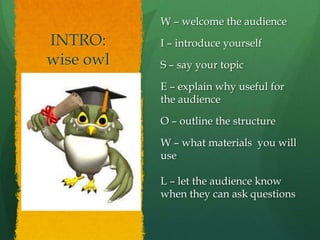
W – welcome the audience
INTRO:     I – introduce yourself
wise owl   S – say your topic

           E – explain why useful for
           the audience

           O – outline the structure

           W – what materials you will
           use

           L – let the audience know
           when they can ask questions
B – briefly state your topic

 BODY:      E – explain objective / aim

best shot   S – signal the beginning of each
            part

            T – talk about the topic

            S – signal the end of each part

            H – highlight important points

            O– outline points in bullet
            points

            T – tell the audience you’ve
            finished the body
Now your turn to practice!

Presentation sections

  • 1.
  • 2.
    There are 4main parts to a formal presentation
  • 3.
    There are 4main parts to a formal presentation 1. the introduction 2. develop your outline 3. use materials, people etc. 4. concluding your presentation
  • 4.
    Each part hasa specific function:
  • 5.
    Each part hasa specific function: THE INTRODUCTION This is to tell the audience who you are, why they are listening, what they will hear, how they will see the information, and what they should do (questions, participation etc.)
  • 6.
    Each part hasa specific function: THE BODY (developing your presentation) This is the most important part – it is why people are listening to you. If you have two pieces of information, say them. If you only have one, then only say ONE. Do not waste people’s time for your own presentation. This is also the most difficult – you need to maintain your audience’s attention, usually through personality and relevant facts.
  • 7.
    Each part hasa specific function: CONCLUDING This is finishing your presentation of information or ideas. It is usually not a conclusion (except in undergraduate courses). The presentation continues – with the audience asking questions. So, you finish, but the presentation should hopefully continue.
  • 8.
    A presenter relieson Implicit Knowledge This is language knowledge you use without thinking, without stopping. It is very slow to learn, but fast to use.
  • 9.
    The plan isExplicit Knowledge Explicit knowledge is information you think about. You need to constantly think about where your presentation is going, where it has been, and what you are doing in terms of Presentation Outline.
  • 10.
    W – welcomethe audience INTRO: I – introduce yourself wise owl S – say your topic E – explain why useful for the audience O – outline the structure W – what materials you will use L – let the audience know when they can ask questions
  • 11.
    B – brieflystate your topic BODY: E – explain objective / aim best shot S – signal the beginning of each part T – talk about the topic S – signal the end of each part H – highlight important points O– outline points in bullet points T – tell the audience you’ve finished the body
  • 12.
    Now your turnto practice!