Public Speaking &
Presentations
 Public speaking is speaking to a group of
people in a structured, deliberate manner
intended to inform, influence, or entertain
the listeners.
 A good Speaker should be able to change
the emotions of their listener, not just
inform them.
2
 It is more complex and is delivered before a
knowledgeable audience .
 Its purpose is more concretely and precisely
defined.
 Its purpose is to inform,explain or present a
point of view It is followed by a Q & A Session
3
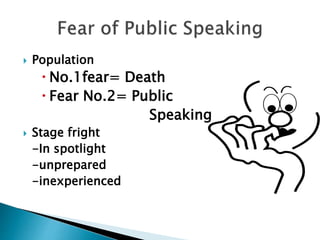
 Population
 No.1fear= Death
 Fear No.2= Public
Speaking
 Stage fright
-In spotlight
-unprepared
-inexperienced
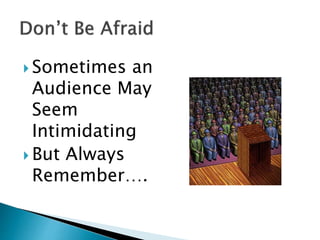
 Sometimes an
Audience May
Seem
Intimidating
 But Always
Remember….
 Imagine
that you are
addressing
your friend
or a small
group of
friends
 Basic Elements
 Speaker/Presenter
 Audience
 Content
7
INTRODUCTION 8
 Matter
 Language
 Style
 Preparation
◦ Research
◦ Format the speech
Introduction
Body
Conclusion
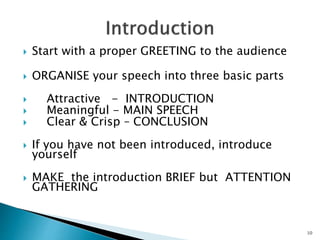
 Start with a proper GREETING to the audience
 ORGANISE your speech into three basic parts
 Attractive - INTRODUCTION
 Meaningful - MAIN SPEECH
 Clear & Crisp – CONCLUSION
 If you have not been introduced, introduce
yourself
 MAKE the introduction BRIEF but ATTENTION
GATHERING
10
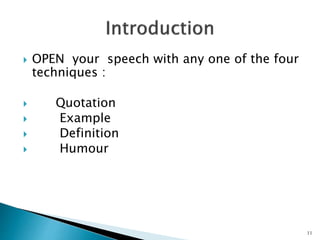
 OPEN your speech with any one of the four
techniques :
 Quotation
 Example
 Definition
 Humour
11
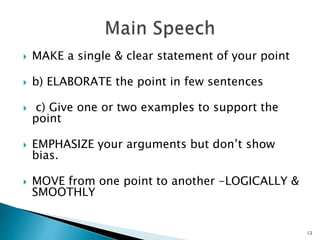
 MAKE a single & clear statement of your point
 b) ELABORATE the point in few sentences
 c) Give one or two examples to support the
point
 EMPHASIZE your arguments but don’t show
bias.
 MOVE from one point to another -LOGICALLY &
SMOOTHLY
12
 Try not to read your speech, but to speak with
the audience as you would speak with friends
 Use notes & refer as & when required
 AVOID grammatical faults
 USE correct pronunciation
 USE simple sentences.
 USE pauses appropriately
 AVOID Putting on an unnatural / foreign
accent
13
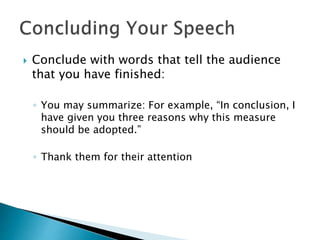
 Conclude with words that tell the audience
that you have finished:
◦ You may summarize: For example, “In conclusion, I
have given you three reasons why this measure
should be adopted.”
◦ Thank them for their attention
 Prepare your speech or notes so you can refer
to your presentation easily
 Dress the way you want people to perceive
you
 nervousness- fright is common so.. before
speaking, make sure all is fine, take a deep
breath & and say to yourself: “I can do this.”
 Practice your hand gestures so they are
natural to you
 WALK at your normal pace to the dais when
called to speak
 STAND erect, but not stiff
 LOOK at the audience and SMILE
 SPEAK at your natural speed But FLUENTLY
 LOOK at different sections of the audience
once in a while.
16
 Personal appearance
 Body language
 Use of voice
 Vary the Pitch
 Vary the speaking speed
 Vary the emphasis
17
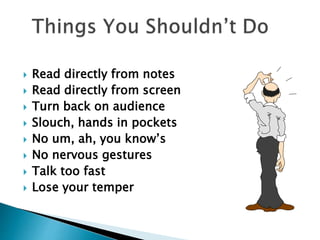
 Read directly from notes
 Read directly from screen
 Turn back on audience
 Slouch, hands in pockets
 No um, ah, you know’s
 No nervous gestures
 Talk too fast
 Lose your temper
 Make an outline of your case
 Choose your evidence and arguments
 Arrange them in the right order
 Give “road signs” to the audience so they
know what to expect
 Create a strong opening and closing
 Prepare your speech or notes so you can refer
to your presentation easily
 Dress the way you want people to perceive
you
 Before speaking, try to find a private place to
stand before a mirror, look at yourself, make
sure all is ok, and say to yourself: “I can do
this.”
 Ask a small group of friends – or even one
friend – to let you practice and to give you
useful tips about how to improve
 Learn your speech so you can refer to it
without reading it
 Practice speaking very clearly
 Practice speaking – NOT reading
 Practice your hand gestures so they are
natural to you
 Use a timer (for example, a watch) so that you
will know how long you have spoken. (You
may be surprised!)
 Listen to your friends and try to use their
comments to improve your speech
 Decide whether you will use a podium
 Try to look in the mirror and reassure
yourself first
 Be sure that you are introduced or that you
introduce yourself
 Be sure that there is a glass of water for
you
 Choose to use the podium or to speak
without a podium
 If you have not been introduced, introduce
yourself and thank the audience for coming
 Make your speech
◦ Be sure to make some eye contact with the
audience
 Draw on both reason and emotion
◦ Be reasonable and calm so that you can appeal to
the reason of those whom you wish to persuade
◦ Be emotional so that you can move to action those
whom you wish to move to action
 Try not to read your speech, but to speak
with the audience as you would speak with
friends
 Conclude with words that tell the audience
that you have finished:
◦ You may summarize: For example, “In conclusion, I
have given you three reasons why this measure
should be adopted.”
◦ Thank them for their attention
 If there is time and opportunity, invite them
to a conversation
 If you receive questions, be polite and listen
and then thank the questioner for the
question, even if it is hostile
 When time for questions and responses is
finished, thank them again for their attention
 You have made an effective speech.
 You have:
◦ Informed some fellow citizens
◦ Persuaded some fellow citizens
◦ Moved some fellow citizens to action

presentation _public speaking

  • 1.
  • 2.
     Public speakingis speaking to a group of people in a structured, deliberate manner intended to inform, influence, or entertain the listeners.  A good Speaker should be able to change the emotions of their listener, not just inform them. 2
  • 3.
     It ismore complex and is delivered before a knowledgeable audience .  Its purpose is more concretely and precisely defined.  Its purpose is to inform,explain or present a point of view It is followed by a Q & A Session 3
  • 4.
     Population  No.1fear=Death  Fear No.2= Public Speaking  Stage fright -In spotlight -unprepared -inexperienced
  • 5.
     Sometimes an AudienceMay Seem Intimidating  But Always Remember….
  • 6.
     Imagine that youare addressing your friend or a small group of friends
  • 7.
     Basic Elements Speaker/Presenter  Audience  Content 7
  • 8.
  • 9.
     Preparation ◦ Research ◦Format the speech Introduction Body Conclusion
  • 10.
     Start witha proper GREETING to the audience  ORGANISE your speech into three basic parts  Attractive - INTRODUCTION  Meaningful - MAIN SPEECH  Clear & Crisp – CONCLUSION  If you have not been introduced, introduce yourself  MAKE the introduction BRIEF but ATTENTION GATHERING 10
  • 11.
     OPEN yourspeech with any one of the four techniques :  Quotation  Example  Definition  Humour 11
  • 12.
     MAKE asingle & clear statement of your point  b) ELABORATE the point in few sentences  c) Give one or two examples to support the point  EMPHASIZE your arguments but don’t show bias.  MOVE from one point to another -LOGICALLY & SMOOTHLY 12
  • 13.
     Try notto read your speech, but to speak with the audience as you would speak with friends  Use notes & refer as & when required  AVOID grammatical faults  USE correct pronunciation  USE simple sentences.  USE pauses appropriately  AVOID Putting on an unnatural / foreign accent 13
  • 14.
     Conclude withwords that tell the audience that you have finished: ◦ You may summarize: For example, “In conclusion, I have given you three reasons why this measure should be adopted.” ◦ Thank them for their attention
  • 15.
     Prepare yourspeech or notes so you can refer to your presentation easily  Dress the way you want people to perceive you  nervousness- fright is common so.. before speaking, make sure all is fine, take a deep breath & and say to yourself: “I can do this.”  Practice your hand gestures so they are natural to you
  • 16.
     WALK atyour normal pace to the dais when called to speak  STAND erect, but not stiff  LOOK at the audience and SMILE  SPEAK at your natural speed But FLUENTLY  LOOK at different sections of the audience once in a while. 16
  • 17.
     Personal appearance Body language  Use of voice  Vary the Pitch  Vary the speaking speed  Vary the emphasis 17
  • 18.
     Read directlyfrom notes  Read directly from screen  Turn back on audience  Slouch, hands in pockets  No um, ah, you know’s  No nervous gestures  Talk too fast  Lose your temper
  • 19.
     Make anoutline of your case  Choose your evidence and arguments  Arrange them in the right order  Give “road signs” to the audience so they know what to expect  Create a strong opening and closing
  • 20.
     Prepare yourspeech or notes so you can refer to your presentation easily  Dress the way you want people to perceive you  Before speaking, try to find a private place to stand before a mirror, look at yourself, make sure all is ok, and say to yourself: “I can do this.”
  • 21.
     Ask asmall group of friends – or even one friend – to let you practice and to give you useful tips about how to improve  Learn your speech so you can refer to it without reading it  Practice speaking very clearly  Practice speaking – NOT reading
  • 22.
     Practice yourhand gestures so they are natural to you  Use a timer (for example, a watch) so that you will know how long you have spoken. (You may be surprised!)  Listen to your friends and try to use their comments to improve your speech  Decide whether you will use a podium
  • 23.
     Try tolook in the mirror and reassure yourself first  Be sure that you are introduced or that you introduce yourself  Be sure that there is a glass of water for you
  • 24.
     Choose touse the podium or to speak without a podium  If you have not been introduced, introduce yourself and thank the audience for coming  Make your speech ◦ Be sure to make some eye contact with the audience
  • 25.
     Draw onboth reason and emotion ◦ Be reasonable and calm so that you can appeal to the reason of those whom you wish to persuade ◦ Be emotional so that you can move to action those whom you wish to move to action  Try not to read your speech, but to speak with the audience as you would speak with friends
  • 26.
     Conclude withwords that tell the audience that you have finished: ◦ You may summarize: For example, “In conclusion, I have given you three reasons why this measure should be adopted.” ◦ Thank them for their attention
  • 27.
     If thereis time and opportunity, invite them to a conversation  If you receive questions, be polite and listen and then thank the questioner for the question, even if it is hostile  When time for questions and responses is finished, thank them again for their attention
  • 28.
     You havemade an effective speech.  You have: ◦ Informed some fellow citizens ◦ Persuaded some fellow citizens ◦ Moved some fellow citizens to action

Editor's Notes