http://copelabs.ulusofona.pt
PERSONALIZED SENSING SYSTEM
Macaba Pedro
MsThesis – 2014
Leader Teacher: Paulo Mendes
Mestrado em Engenharia Informática e Sistemas de Informação
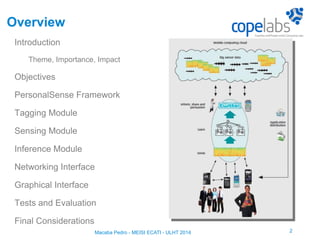
Overview
Introduction
Theme, Importance, Impact
Objectives
PersonalSense Framework
Tagging Module
Sensing Module
Inference Module
Networking Interface
Graphical Interface
Tests and Evaluation
Final Considerations
2Macaba Pedro - MEISI ECATI - ULHT 2014
Personalized Sensing System
3
Introduction
Theme, Importance and Impact
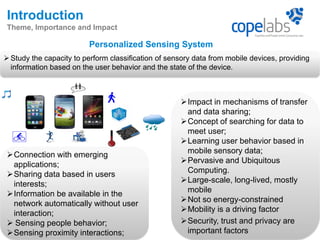
Study the capacity to perform classification of sensory data from mobile devices, providing
information based on the user behavior and the state of the device.
Impact in mechanisms of transfer
and data sharing;
Concept of searching for data to
meet user;
Learning user behavior based in
mobile sensory data;
Pervasive and Ubiquitous
Computing.
Large-scale, long-lived, mostly
mobile
Not so energy-constrained
Mobility is a driving factor
Security, trust and privacy are
important factors
Connection with emerging
applications;
Sharing data based in users
interests;
Information be available in the
network automatically without user
interaction;
 Sensing people behavior;
Sensing proximity interactions;
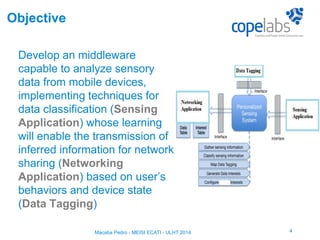
Develop an middleware
capable to analyze sensory
data from mobile devices,
implementing techniques for
data classification (Sensing
Application) whose learning
will enable the transmission of
inferred information for network
sharing (Networking
Application) based on user’s
behaviors and device state
(Data Tagging)
4
Objective
Macaba Pedro - MEISI ECATI - ULHT 2014
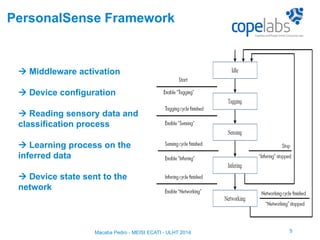
 Middleware activation
 Device configuration
 Reading sensory data and
classification process
 Learning process on the
inferred data
 Device state sent to the
network
5
PersonalSense Framework
Macaba Pedro - MEISI ECATI - ULHT 2014
6
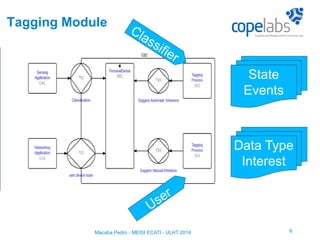
Tagging Module
Macaba Pedro - MEISI ECATI - ULHT 2014
State
Events
Data Type
Interest
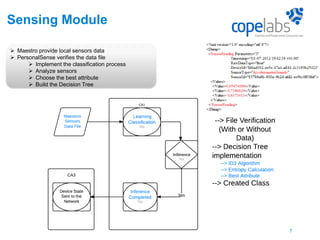
Sensing Module
 Maestro provide local sensors data
 PersonalSense verifies the data file
 Implement the classification process
 Analyze sensors
 Choose the best attribute
 Build the Decision Tree
7
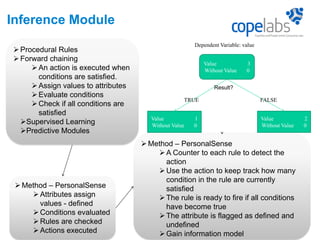
Inference Module
Procedural Rules
Forward chaining
An action is executed when
conditions are satisfied.
Assign values to attributes
Evaluate conditions
Check if all conditions are
satisfied
Supervised Learning
Predictive Modules
8
Method – PersonalSense
Attributes assign
values - defined
Conditions evaluated
Rules are checked
Actions executed
Method – PersonalSense
A Counter to each rule to detect the
action
Use the action to keep track how many
condition in the rule are currently
satisfied
The rule is ready to fire if all conditions
have become true
The attribute is flagged as defined and
undefined
Gain information model
Value 3
Without Value 0
Value 2
Without Value 0
Value 1
Without Value 0
Result?
Dependent Variable: value
FALSETRUE
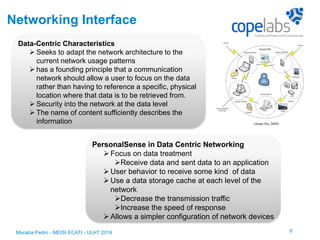
Networking Interface
Data-Centric Characteristics
 Seeks to adapt the network architecture to the
current network usage patterns
 has a founding principle that a communication
network should allow a user to focus on the data
rather than having to reference a specific, physical
location where that data is to be retrieved from.
 Security into the network at the data level
 The name of content sufficiently describes the
information
PersonalSense in Data Centric Networking
Focus on data treatment
Receive data and sent data to an application
User behavior to receive some kind of data
Use a data storage cache at each level of the
network
Decrease the transmission traffic
Increase the speed of response
Allows a simpler configuration of network devices
9Macaba Pedro - MEISI ECATI - ULHT 2014
(Smart Pin, 2009)
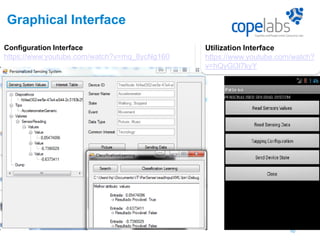
Graphical Interface
Configuration Interface
https://www.youtube.com/watch?v=mq_8ycNg160
10
(Smart Pin, 2009)
Utilization Interface
https://www.youtube.com/watch?
v=hQyGl3l7kyY
Final Considerations
Service integration and
communication
Automatic provision of
information in the network
relying in opportunistics
meetings between devices
Classification of data
collected from the sensory
capabilities of devices, and
knowledge acquisition and
generation of behavioral
profiles
11
(Smart Pin, 2009)
Test more mobile sensors
Test the interaction with
Maestroo and ICON in a
mobile device
Test with other classifier
algorithms
Elaboration of an
algorithm for classification
of collected sensor data
from mobile devices
Macaba Pedro - MEISI ECATI -
ULHT 2014

Personalized Sensing System

  • 1.
    http://copelabs.ulusofona.pt PERSONALIZED SENSING SYSTEM MacabaPedro MsThesis – 2014 Leader Teacher: Paulo Mendes Mestrado em Engenharia Informática e Sistemas de Informação
  • 2.
    Overview Introduction Theme, Importance, Impact Objectives PersonalSenseFramework Tagging Module Sensing Module Inference Module Networking Interface Graphical Interface Tests and Evaluation Final Considerations 2Macaba Pedro - MEISI ECATI - ULHT 2014
  • 3.
    Personalized Sensing System 3 Introduction Theme,Importance and Impact Study the capacity to perform classification of sensory data from mobile devices, providing information based on the user behavior and the state of the device. Impact in mechanisms of transfer and data sharing; Concept of searching for data to meet user; Learning user behavior based in mobile sensory data; Pervasive and Ubiquitous Computing. Large-scale, long-lived, mostly mobile Not so energy-constrained Mobility is a driving factor Security, trust and privacy are important factors Connection with emerging applications; Sharing data based in users interests; Information be available in the network automatically without user interaction;  Sensing people behavior; Sensing proximity interactions;
  • 4.
    Develop an middleware capableto analyze sensory data from mobile devices, implementing techniques for data classification (Sensing Application) whose learning will enable the transmission of inferred information for network sharing (Networking Application) based on user’s behaviors and device state (Data Tagging) 4 Objective Macaba Pedro - MEISI ECATI - ULHT 2014
  • 5.
     Middleware activation Device configuration  Reading sensory data and classification process  Learning process on the inferred data  Device state sent to the network 5 PersonalSense Framework Macaba Pedro - MEISI ECATI - ULHT 2014
  • 6.
    6 Tagging Module Macaba Pedro- MEISI ECATI - ULHT 2014 State Events Data Type Interest
  • 7.
    Sensing Module  Maestroprovide local sensors data  PersonalSense verifies the data file  Implement the classification process  Analyze sensors  Choose the best attribute  Build the Decision Tree 7
  • 8.
    Inference Module Procedural Rules Forwardchaining An action is executed when conditions are satisfied. Assign values to attributes Evaluate conditions Check if all conditions are satisfied Supervised Learning Predictive Modules 8 Method – PersonalSense Attributes assign values - defined Conditions evaluated Rules are checked Actions executed Method – PersonalSense A Counter to each rule to detect the action Use the action to keep track how many condition in the rule are currently satisfied The rule is ready to fire if all conditions have become true The attribute is flagged as defined and undefined Gain information model Value 3 Without Value 0 Value 2 Without Value 0 Value 1 Without Value 0 Result? Dependent Variable: value FALSETRUE
  • 9.
    Networking Interface Data-Centric Characteristics Seeks to adapt the network architecture to the current network usage patterns  has a founding principle that a communication network should allow a user to focus on the data rather than having to reference a specific, physical location where that data is to be retrieved from.  Security into the network at the data level  The name of content sufficiently describes the information PersonalSense in Data Centric Networking Focus on data treatment Receive data and sent data to an application User behavior to receive some kind of data Use a data storage cache at each level of the network Decrease the transmission traffic Increase the speed of response Allows a simpler configuration of network devices 9Macaba Pedro - MEISI ECATI - ULHT 2014 (Smart Pin, 2009)
  • 10.
    Graphical Interface Configuration Interface https://www.youtube.com/watch?v=mq_8ycNg160 10 (SmartPin, 2009) Utilization Interface https://www.youtube.com/watch? v=hQyGl3l7kyY
  • 11.
    Final Considerations Service integrationand communication Automatic provision of information in the network relying in opportunistics meetings between devices Classification of data collected from the sensory capabilities of devices, and knowledge acquisition and generation of behavioral profiles 11 (Smart Pin, 2009) Test more mobile sensors Test the interaction with Maestroo and ICON in a mobile device Test with other classifier algorithms Elaboration of an algorithm for classification of collected sensor data from mobile devices
  • 12.
    Macaba Pedro -MEISI ECATI - ULHT 2014