WHO AM I
• Sr. Tester and Graphics Designer
• Researcher and Reader in free time
DISCLAIMER
• Feel free to use this presentation for practice or
education purpose.
• It’s no way related to my employer – It’s my own
research and ideas.
• This presentation is intended for educational purposes
only and I cannot be held liable for any kind of damages
done whatsoever to your machine, or other damages.
What is Bug ?
AGENDA
Bug Life Cycle
Differences between Error, Bug and Defect
Severity and Priority of a Bug
WHAT IS BUG ?
• Error which found during the testing process is called
Bug.
• Bug can be defined as the abnormal behavior of the
software.
• In software development process, the bug has a life
cycle. Every bug should go through the life cycle to be
closed.
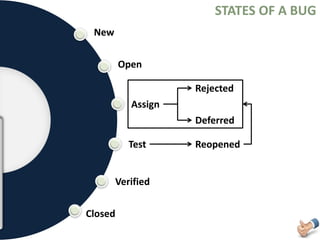
• The bug attains different states in the life cycle.
New
Open
Assign
Test
Verified
Closed
STATES OF A BUG
Rejected
Deferred
Reopened
DESCRIPTION OF VARIOUS STAGES
• When the bug is posted for the first time, its state will
be “NEW”. This means that the bug is not yet approved.
OPEN:
• After a tester has posted a bug, the lead of the tester
approves that the bug is genuine and lead changes the
state as “OPEN”.
NEW:
Cont..
• Once the lead changes the state as “OPEN”, he assigns
the bug to corresponding developer or developer team.
The state of the bug now is changed to “ASSIGN”.
ASSIGN:
• If the developer feels that the bug is not genuine,
developer rejects the bug. Then the state of the bug is
changed to “REJECTED”.
REJECTED:
Cont..
• The bug is expected to be fixed in next releases.
Because of priority of the bug may be low, lack of time
for the release or the bug may not have major effect on
the software.
DEFERRED:
• Once the developer fixes the bug, developer has to
assign the bug to the testing team for next round of
testing. Before releases the software developer
changes the state of bug to “TEST”.
TEST:
Cont..
• If the bug is repeated twice or the two bugs mention
the same concept of the bug, then one bug status is
changed to “DUPLICATE”.
DUPLICATE:
• Once the bug is fixed, the tester tests the bug. If the
bug is not present in the software, tester approves that
the bug is fixed and changes the status to “VERIFIED”.
VERIFIED:
Cont..
• If the bug still exists, the tester changes the state of bug
to “REOPENED”. The bug traverses the life cycle once
again.
REOPENED:
• Once the bug is fixed, it is tested by the tester. If the
tester feels that the bug no longer exists in the
software, tester changes the status of the bug to
“CLOSED”. This state means that the bug is fixed, tested
and approved.
CLOSED:
SEVERITY AND PRIORITY OF A BUG
Severity
Priority
How badly its harms to the system.
Severity can be of following types: Critical,
Major and Minor.
How urgently bug is needed to be fix.
Priority can be of following types: High,
Medium and Low.
SCENARIOS RELATED TO THE
SEVERITY AND PRIORITY
High Priority & High Severity
An error which occurs on the basic
functionality of the application and will not
allow the user to use the system.
For example: A site maintaining the student
details, on saving record if it, doesn’t allow
to save the record then this is high priority
and high severity bug.
SCENARIOS RELATED TO THE
SEVERITY AND PRIORITY
High Severity & Low Priority
This happens when the bug causes major
problems, but it only happens in very rare
conditions or situations.
For example: Customers who use very old
browsers cannot continue with their
purchase of a product. Because the number
of customers with very old browsers is very
low, it is not a high priority to fix the issue.
SCENARIOS RELATED TO THE
SEVERITY AND PRIORITY
High Priority & Low Severity
The spelling mistakes that happens on the
system. It is important to fix the issue as
soon as possible, although it may not cause
a lot of damage.
For example: The spelling mistakes that
happens on the cover page or heading or
title of an application.
SCENARIOS RELATED TO THE
SEVERITY AND PRIORITY
Low Priority and Low Severity
For cases where the bug doesn’t cause
disaster and only affects very small number.
For example: Any cosmetic or spelling
issues which is within a paragraph or in the
report (Not on cover page, heading, title).
ERROR BUG DEFECT
A mistake done by a
programmer in
coding is called Error.
Error which found
during the testing
process is called Bug.
If testers find any
deviation between
expected and actual
results will say it as
Defect.
For example to say,
instead of A+b,
he/she has mention
A-B
For example to say,
clicking on link is not
directing to page.
For example to say,
customer raises 21
issues, tester raises
267 Issues but there
were 17 invalid
defects (because of
wrong tests? mistake
by tester)
Then your Defect
Leakage Ratio would
be:
[21/(267-17)] x 100 =
8.4%
Any Questions ?

Knowledge sharing

  • 2.
    WHO AM I •Sr. Tester and Graphics Designer • Researcher and Reader in free time
  • 4.
    DISCLAIMER • Feel freeto use this presentation for practice or education purpose. • It’s no way related to my employer – It’s my own research and ideas. • This presentation is intended for educational purposes only and I cannot be held liable for any kind of damages done whatsoever to your machine, or other damages.
  • 5.
    What is Bug? AGENDA Bug Life Cycle Differences between Error, Bug and Defect Severity and Priority of a Bug
  • 6.
    WHAT IS BUG? • Error which found during the testing process is called Bug. • Bug can be defined as the abnormal behavior of the software. • In software development process, the bug has a life cycle. Every bug should go through the life cycle to be closed. • The bug attains different states in the life cycle.
  • 7.
  • 8.
    DESCRIPTION OF VARIOUSSTAGES • When the bug is posted for the first time, its state will be “NEW”. This means that the bug is not yet approved. OPEN: • After a tester has posted a bug, the lead of the tester approves that the bug is genuine and lead changes the state as “OPEN”. NEW:
  • 9.
    Cont.. • Once thelead changes the state as “OPEN”, he assigns the bug to corresponding developer or developer team. The state of the bug now is changed to “ASSIGN”. ASSIGN: • If the developer feels that the bug is not genuine, developer rejects the bug. Then the state of the bug is changed to “REJECTED”. REJECTED:
  • 10.
    Cont.. • The bugis expected to be fixed in next releases. Because of priority of the bug may be low, lack of time for the release or the bug may not have major effect on the software. DEFERRED: • Once the developer fixes the bug, developer has to assign the bug to the testing team for next round of testing. Before releases the software developer changes the state of bug to “TEST”. TEST:
  • 11.
    Cont.. • If thebug is repeated twice or the two bugs mention the same concept of the bug, then one bug status is changed to “DUPLICATE”. DUPLICATE: • Once the bug is fixed, the tester tests the bug. If the bug is not present in the software, tester approves that the bug is fixed and changes the status to “VERIFIED”. VERIFIED:
  • 12.
    Cont.. • If thebug still exists, the tester changes the state of bug to “REOPENED”. The bug traverses the life cycle once again. REOPENED: • Once the bug is fixed, it is tested by the tester. If the tester feels that the bug no longer exists in the software, tester changes the status of the bug to “CLOSED”. This state means that the bug is fixed, tested and approved. CLOSED:
  • 13.
    SEVERITY AND PRIORITYOF A BUG Severity Priority How badly its harms to the system. Severity can be of following types: Critical, Major and Minor. How urgently bug is needed to be fix. Priority can be of following types: High, Medium and Low.
  • 14.
    SCENARIOS RELATED TOTHE SEVERITY AND PRIORITY High Priority & High Severity An error which occurs on the basic functionality of the application and will not allow the user to use the system. For example: A site maintaining the student details, on saving record if it, doesn’t allow to save the record then this is high priority and high severity bug.
  • 15.
    SCENARIOS RELATED TOTHE SEVERITY AND PRIORITY High Severity & Low Priority This happens when the bug causes major problems, but it only happens in very rare conditions or situations. For example: Customers who use very old browsers cannot continue with their purchase of a product. Because the number of customers with very old browsers is very low, it is not a high priority to fix the issue.
  • 16.
    SCENARIOS RELATED TOTHE SEVERITY AND PRIORITY High Priority & Low Severity The spelling mistakes that happens on the system. It is important to fix the issue as soon as possible, although it may not cause a lot of damage. For example: The spelling mistakes that happens on the cover page or heading or title of an application.
  • 17.
    SCENARIOS RELATED TOTHE SEVERITY AND PRIORITY Low Priority and Low Severity For cases where the bug doesn’t cause disaster and only affects very small number. For example: Any cosmetic or spelling issues which is within a paragraph or in the report (Not on cover page, heading, title).
  • 18.
    ERROR BUG DEFECT Amistake done by a programmer in coding is called Error. Error which found during the testing process is called Bug. If testers find any deviation between expected and actual results will say it as Defect. For example to say, instead of A+b, he/she has mention A-B For example to say, clicking on link is not directing to page. For example to say, customer raises 21 issues, tester raises 267 Issues but there were 17 invalid defects (because of wrong tests? mistake by tester) Then your Defect Leakage Ratio would be: [21/(267-17)] x 100 = 8.4%
  • 19.