SILK
MD.NAHID HOSSAIN NAHID 2015000400089
MD.MOMINUL ISLAM 2015000400095
TASIN IBNA JAHUR CHOWDHURY 2015000400096
MD.ROKIBUL HASAN KHAN 2015000400097
Physical properties
 Tenacity : the silk filament is strong . The strength is due to
its linear and very crystalline polymer system. These two
factors permit many more hydrogen bonds to be formed in a
much more regular manner.
 Elastic plastic nature : Silk is considered to be more plastic
then elastic because it’s very crystalline. Polymer system does
not permit the amount of polymer movement which could
occur in a more amorphous system . Hence if the silk textile
material is stretched excessively, the silk polymers which are
already in a stretched state will slide past each other.
 Thermal properties :silk is more sensitive to heat than wool . This is considered to bepartly
due to lack of any covalent cross links in the polymer system of silk , comparedwith the
disulphide bonds which occurin the polymer system of wool. The existing peptide bonds ,
salt linkage andhydrogen bonds of the silk polymer system tend to break down oncewhen
the temperature exceeds 100%c.
 Action of light :Silk is more sensitive to light than any other nature fiber. Prolonged exposure
to sunlight can causepartially spotted colorchanges. The effect of sunlight can causepartially
spotted colorchanges. Theeffect of sunlightis more pronounced in presenceof atmospheric
oxygen. Curtains make of silk should betherefore protected from the degradation of sun light
giving an extra lining to the light shade.
Solubility: Silk does not dissolve in water and it withstands the effect of boiling
water better than wool. Prolonged boiling trends to cause a loss of strength.
Effect of bleaching agent: Silk dissolves in solution of Zincchloride, Calcium
chloride, alkalithayocyanates and ammonia solutions of copper or nickel.Silk
fibroin is attackedby oxidizing agents; bleaches suchan H2O2 must be used with
care.
Effect of acids: Silk is readily soluble in cold concentrated mineral acids. The solubility in cold
concentrated HCl may beused of to determine the percentage of silk present whereit is in a
mixture with wool. In moderate concentrated acids cause a contraction in silk. This shrinkage is
used to bring about crepe effect in silk fabrics; called `scroop’ of handle.
Effect of heat: Silk will withstand higher temperature than wool without decomposition. Heated
1400C, it will remain unaffected for prolonged period. It decomposes quickly at 1750C.Silk burns
emitting a characteristics smell like that of burning hair orhorn.
Effectofalkalis:Coldconcentratedsolutionsofcausticalkaliappeartohavelittleaffect
whencontactisshortindurationandwhenrinsingfollowsimmediately.Thusmixed
cottonandsilkfabricsmay bemercerizedwhenthecontractionofcottongivena
crimpedeffect. ProlongedactionofcoldconcentratedNaOHcausesthefibrointo
becomedissolvedwithultimatebreakdownintosodiumsaltsof-aminoacids.More
concentratedsolutionsofcausticalkaliswilldestroythelustureandcauselossof
strength.Silkdissolvedinsolutionsofconcentratedcausticalkalis.
Effect of age: Silk is attacked by atmospheric oxygen and may
suffer a gradual loss of strength if not carefully stored.
Effect of sunlight: Sunlight tends to encourage the
decomposition of silk by atmospheric oxygen.
Dye-ability: Need lower temperature than any other natural
fibre. Give brighter shade with direct acid, basic and vat.
Attack by Moth: No
Attack by mildew: Yes.
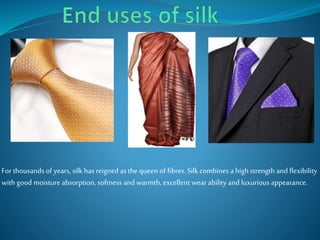
For thousands of years, silk has reigned as the queen of fibres. Silk combines a high strength and flexibility
with good moisture absorption, softness and warmth, excellent wear ability and luxurious appearance.
 Silk is so versatile that it is woven and knitted into a wide variety of fabrics.
 It is used also making ties pile fabrics, woven dress materials, knitted goods, shirts and a
variety ofunion fabrics.
 It has found a field of usefulness in the optical industry as cross line in various
instruments.
 The intersection of the two tent fibers of silk is used to mark the optical center of
telescopes microscopes and other instruments.
 Silk has a wide variety of uses in upholstery and military fields.
 When fluffy evening dresses areis vague, they aremade from chiffons, georgettes and voiles’
where as satins, cantoncrops and velvets aremore apartto beused for regal dinnerdresses.
Life Cycle Of Silk worm
 Thebombyxmorieggswere takenoutofcoldstorageonmarch17.Ifyoulook
carefully,youcanseethecaterpillarcurledinsidesomeofeggs.Thebabycatsare
curledheadtotaillikea letterC. they’llgrowfaster andbehealthierbetween78’and
85’F
 Youcanseethesophisticatedandclassyegg-hatchingsetup.It’sa saladcontainer
froma fastfoodplace.Thereare probablyeightor ninehundredeggshere.
 Ittypicallytakes 10-14daysfortheeggstothestartshatchingdependsonseveral
factors,temperature,humidity,andthelevelofdevelopmentbeforetheeggswent
intothefridge.March24,2004.
 This is what the kegos look like really close up . This
caterpillar is about 2 mm long.
 Overall, they were still quiet small march 26.
 A couple of days letter later, the kegos are changing their
skins.
 This is the amount of leaves they are eating right now . The
basic idea is to have enough leave to entirely cover the worms
; the more you feed them, the faster they grow.
 Here , you can see a worm that has just shed its second skin.
Note that the head is large and gray ; it will darken over the
next few hours.
THE END

Presentation on silk

  • 2.
  • 3.
    MD.NAHID HOSSAIN NAHID2015000400089 MD.MOMINUL ISLAM 2015000400095 TASIN IBNA JAHUR CHOWDHURY 2015000400096 MD.ROKIBUL HASAN KHAN 2015000400097
  • 4.
    Physical properties  Tenacity: the silk filament is strong . The strength is due to its linear and very crystalline polymer system. These two factors permit many more hydrogen bonds to be formed in a much more regular manner.  Elastic plastic nature : Silk is considered to be more plastic then elastic because it’s very crystalline. Polymer system does not permit the amount of polymer movement which could occur in a more amorphous system . Hence if the silk textile material is stretched excessively, the silk polymers which are already in a stretched state will slide past each other.
  • 5.
     Thermal properties:silk is more sensitive to heat than wool . This is considered to bepartly due to lack of any covalent cross links in the polymer system of silk , comparedwith the disulphide bonds which occurin the polymer system of wool. The existing peptide bonds , salt linkage andhydrogen bonds of the silk polymer system tend to break down oncewhen the temperature exceeds 100%c.  Action of light :Silk is more sensitive to light than any other nature fiber. Prolonged exposure to sunlight can causepartially spotted colorchanges. The effect of sunlight can causepartially spotted colorchanges. Theeffect of sunlightis more pronounced in presenceof atmospheric oxygen. Curtains make of silk should betherefore protected from the degradation of sun light giving an extra lining to the light shade.
  • 6.
    Solubility: Silk doesnot dissolve in water and it withstands the effect of boiling water better than wool. Prolonged boiling trends to cause a loss of strength. Effect of bleaching agent: Silk dissolves in solution of Zincchloride, Calcium chloride, alkalithayocyanates and ammonia solutions of copper or nickel.Silk fibroin is attackedby oxidizing agents; bleaches suchan H2O2 must be used with care.
  • 7.
    Effect of acids:Silk is readily soluble in cold concentrated mineral acids. The solubility in cold concentrated HCl may beused of to determine the percentage of silk present whereit is in a mixture with wool. In moderate concentrated acids cause a contraction in silk. This shrinkage is used to bring about crepe effect in silk fabrics; called `scroop’ of handle. Effect of heat: Silk will withstand higher temperature than wool without decomposition. Heated 1400C, it will remain unaffected for prolonged period. It decomposes quickly at 1750C.Silk burns emitting a characteristics smell like that of burning hair orhorn.
  • 8.
  • 9.
    Effect of age:Silk is attacked by atmospheric oxygen and may suffer a gradual loss of strength if not carefully stored. Effect of sunlight: Sunlight tends to encourage the decomposition of silk by atmospheric oxygen. Dye-ability: Need lower temperature than any other natural fibre. Give brighter shade with direct acid, basic and vat. Attack by Moth: No Attack by mildew: Yes.
  • 10.
    For thousands ofyears, silk has reigned as the queen of fibres. Silk combines a high strength and flexibility with good moisture absorption, softness and warmth, excellent wear ability and luxurious appearance.
  • 11.
     Silk isso versatile that it is woven and knitted into a wide variety of fabrics.  It is used also making ties pile fabrics, woven dress materials, knitted goods, shirts and a variety ofunion fabrics.  It has found a field of usefulness in the optical industry as cross line in various instruments.  The intersection of the two tent fibers of silk is used to mark the optical center of telescopes microscopes and other instruments.
  • 12.
     Silk hasa wide variety of uses in upholstery and military fields.  When fluffy evening dresses areis vague, they aremade from chiffons, georgettes and voiles’ where as satins, cantoncrops and velvets aremore apartto beused for regal dinnerdresses.
  • 14.
    Life Cycle OfSilk worm  Thebombyxmorieggswere takenoutofcoldstorageonmarch17.Ifyoulook carefully,youcanseethecaterpillarcurledinsidesomeofeggs.Thebabycatsare curledheadtotaillikea letterC. they’llgrowfaster andbehealthierbetween78’and 85’F  Youcanseethesophisticatedandclassyegg-hatchingsetup.It’sa saladcontainer froma fastfoodplace.Thereare probablyeightor ninehundredeggshere.  Ittypicallytakes 10-14daysfortheeggstothestartshatchingdependsonseveral factors,temperature,humidity,andthelevelofdevelopmentbeforetheeggswent intothefridge.March24,2004.
  • 15.
     This iswhat the kegos look like really close up . This caterpillar is about 2 mm long.  Overall, they were still quiet small march 26.  A couple of days letter later, the kegos are changing their skins.  This is the amount of leaves they are eating right now . The basic idea is to have enough leave to entirely cover the worms ; the more you feed them, the faster they grow.  Here , you can see a worm that has just shed its second skin. Note that the head is large and gray ; it will darken over the next few hours.
  • 16.