The Learning Tree
NET and SET Classes
 Mrs. Ashvini S Bedre
 Ph. D., NET and SET in Home Science Textile and Clothing
Natural Fibers
 Animal Fibers
 1. Silk:- It is popularly Known as Queen of Fabrics.
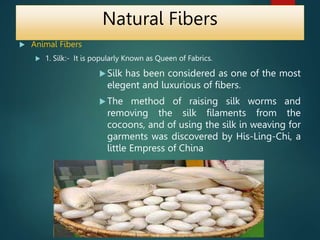
Silk has been considered as one of the most
elegent and luxurious of fibers.
The method of raising silk worms and
removing the silk filaments from the
cocoons, and of using the silk in weaving for
garments was discovered by His-Ling-Chi, a
little Empress of China
 Commercial silk is
produced by the
cultivated silkworm,
Bombyx mori, a
caterpillar, that feeds on
mulberry leaves.
 The eggs laid by the
moth are stored in
winter and stored out
on trays to hatch in a
warm shed.
 Mulberry leaves are
placed as soon as the
worms appear, for them
to eat.
 Fifth age silkworm
feeding on mulberry
leaves.
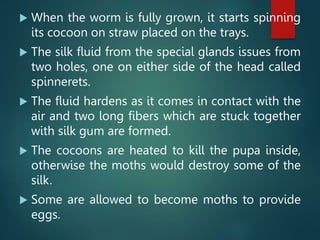
 When the worm is fully grown, it starts spinning
its cocoon on straw placed on the trays.
 The silk fluid from the special glands issues from
two holes, one on either side of the head called
spinnerets.
 The fluid hardens as it comes in contact with the
air and two long fibers which are stuck together
with silk gum are formed.
 The cocoons are heated to kill the pupa inside,
otherwise the moths would destroy some of the
silk.
 Some are allowed to become moths to provide
eggs.
Manufacturing Process
Reeling
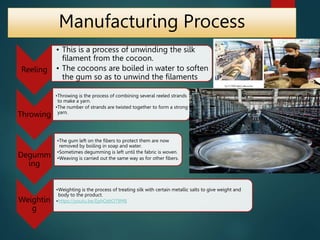
• This is a process of unwinding the silk
filament from the cocoon.
• The cocoons are boiled in water to soften
the gum so as to unwind the filaments
Throwing
•Throwing is the process of combining several reeled strands
to make a yarn.
•The number of strands are twisted together to form a strong
yarn.
Degumm
ing
•The gum left on the fibers to protect them are now
removed by boiling in soap and water.
•Sometimes degumming is left until the fabric is woven.
•Weaving is carried out the same way as for other fibers.
Weightin
g
•Weighting is the process of treating silk with certain metallic salts to give weight and
body to the product.
•https://youtu.be/EphOdtOT9M8
Identification of fibers
 Cultivated silk is smooth, cylindrical and generally
uniform in thickness, like glass rods.
 Longitudinally, degummed silk appears as a smooth,
lustrous, translucent filament like a glass rod.
 In cross-section silk show triangular fibers with no
markings.
 Silk fiber has a double rod-like structure, covered
with lumps of gum.
 Wild silk fiber is very irregular and resembles
flattened, wavy ribbons with longitudinal markings.
Microscopic appearance of silk
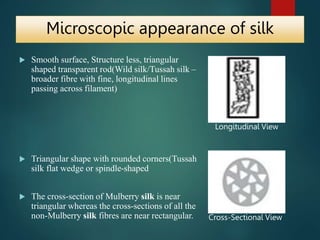
 Smooth surface, Structure less, triangular
shaped transparent rod(Wild silk/Tussah silk –
broader fibre with fine, longitudinal lines
passing across filament)
 Triangular shape with rounded corners(Tussah
silk flat wedge or spindle-shaped
 The cross-section of Mulberry silk is near
triangular whereas the cross-sections of all the
non-Mulberry silk fibres are near rectangular.
Longitudinal View
Cross-Sectional View
Physical appearance of silk
 Silk filaments are very fine and long.
 It is one of the strongest fibers.
 It has good elasticity and moderate
elongation and resilience.
 Silk fabrics have good resistance to stretch
& shrinkage when dry-cleaned.
Thermal Properties of silk
 Silk burns directly in the path of flame.
 It extinguishes itself when removed from flame and gives an odour of
burning hair.
 Silk scorches if ironed at too high temperatures.
 Silk fibre is normally stable up to 140°C and the thermal decomposition
temperature is greater than 1500°C. The densities of silk fibres are in the
range of 1320–1400 kg/m3 with sericin and 1300–1380 kg/m3 without
sericin.
Chemical properties of Silk
 Silk is damaged by strong acids and alkalis.
 Silk is not affected by cleaning solvents.
 Silk emitted by the silkworm consists of two main
proteins, Sericin and fibroin, fibroin being the structural center of
the silk, and serecin being the sticky material surrounding it.
 Fibroin is made up of the amino acids Gly-Ser-Gly-Ala-Gly-Ala and
forms beta pleated sheets.
• Hydrogen bonds form between chains, and side chains form
above and below the plane of the hydrogen bond network.
Silk is resistant to most mineral acids, except for sulfuric acid,
which dissolves it. It is yellowed by perspiration. Chlorine
bleach will also destroy silk fabrics.
Biological Properties of Silk
 Silk is resistant to attack by mild dew, bacteria and
fungi.
 Carpet beetles will eat it.
 Silk fibres are biodegradable and highly crystalline
with a well-aligned structure.
Use of Silk
 Silk fabrics are noted for their soft, luxurious handle,
rich luster, warmth, resilience, crease resistance,
strength and excellent draping quality.
 A wide range of fabrics are made ranging from sheer
chiffon to firmer dress and suiting material, to heavy
brocades to the rich pile velvet.
 Silk serves best for ceremonial occasions, evening or
day wear and lingerie.
Thank
You

2. silk.pptx

  • 1.
    The Learning Tree NETand SET Classes  Mrs. Ashvini S Bedre  Ph. D., NET and SET in Home Science Textile and Clothing
  • 2.
    Natural Fibers  AnimalFibers  1. Silk:- It is popularly Known as Queen of Fabrics. Silk has been considered as one of the most elegent and luxurious of fibers. The method of raising silk worms and removing the silk filaments from the cocoons, and of using the silk in weaving for garments was discovered by His-Ling-Chi, a little Empress of China
  • 3.
     Commercial silkis produced by the cultivated silkworm, Bombyx mori, a caterpillar, that feeds on mulberry leaves.  The eggs laid by the moth are stored in winter and stored out on trays to hatch in a warm shed.  Mulberry leaves are placed as soon as the worms appear, for them to eat.  Fifth age silkworm feeding on mulberry leaves.
  • 4.
     When theworm is fully grown, it starts spinning its cocoon on straw placed on the trays.  The silk fluid from the special glands issues from two holes, one on either side of the head called spinnerets.  The fluid hardens as it comes in contact with the air and two long fibers which are stuck together with silk gum are formed.  The cocoons are heated to kill the pupa inside, otherwise the moths would destroy some of the silk.  Some are allowed to become moths to provide eggs.
  • 5.
    Manufacturing Process Reeling • Thisis a process of unwinding the silk filament from the cocoon. • The cocoons are boiled in water to soften the gum so as to unwind the filaments Throwing •Throwing is the process of combining several reeled strands to make a yarn. •The number of strands are twisted together to form a strong yarn. Degumm ing •The gum left on the fibers to protect them are now removed by boiling in soap and water. •Sometimes degumming is left until the fabric is woven. •Weaving is carried out the same way as for other fibers. Weightin g •Weighting is the process of treating silk with certain metallic salts to give weight and body to the product. •https://youtu.be/EphOdtOT9M8
  • 6.
    Identification of fibers Cultivated silk is smooth, cylindrical and generally uniform in thickness, like glass rods.  Longitudinally, degummed silk appears as a smooth, lustrous, translucent filament like a glass rod.  In cross-section silk show triangular fibers with no markings.  Silk fiber has a double rod-like structure, covered with lumps of gum.  Wild silk fiber is very irregular and resembles flattened, wavy ribbons with longitudinal markings.
  • 7.
    Microscopic appearance ofsilk  Smooth surface, Structure less, triangular shaped transparent rod(Wild silk/Tussah silk – broader fibre with fine, longitudinal lines passing across filament)  Triangular shape with rounded corners(Tussah silk flat wedge or spindle-shaped  The cross-section of Mulberry silk is near triangular whereas the cross-sections of all the non-Mulberry silk fibres are near rectangular. Longitudinal View Cross-Sectional View
  • 8.
    Physical appearance ofsilk  Silk filaments are very fine and long.  It is one of the strongest fibers.  It has good elasticity and moderate elongation and resilience.  Silk fabrics have good resistance to stretch & shrinkage when dry-cleaned.
  • 9.
    Thermal Properties ofsilk  Silk burns directly in the path of flame.  It extinguishes itself when removed from flame and gives an odour of burning hair.  Silk scorches if ironed at too high temperatures.  Silk fibre is normally stable up to 140°C and the thermal decomposition temperature is greater than 1500°C. The densities of silk fibres are in the range of 1320–1400 kg/m3 with sericin and 1300–1380 kg/m3 without sericin.
  • 10.
    Chemical properties ofSilk  Silk is damaged by strong acids and alkalis.  Silk is not affected by cleaning solvents.  Silk emitted by the silkworm consists of two main proteins, Sericin and fibroin, fibroin being the structural center of the silk, and serecin being the sticky material surrounding it.  Fibroin is made up of the amino acids Gly-Ser-Gly-Ala-Gly-Ala and forms beta pleated sheets.
  • 11.
    • Hydrogen bondsform between chains, and side chains form above and below the plane of the hydrogen bond network. Silk is resistant to most mineral acids, except for sulfuric acid, which dissolves it. It is yellowed by perspiration. Chlorine bleach will also destroy silk fabrics.
  • 12.
    Biological Properties ofSilk  Silk is resistant to attack by mild dew, bacteria and fungi.  Carpet beetles will eat it.  Silk fibres are biodegradable and highly crystalline with a well-aligned structure.
  • 13.
    Use of Silk Silk fabrics are noted for their soft, luxurious handle, rich luster, warmth, resilience, crease resistance, strength and excellent draping quality.  A wide range of fabrics are made ranging from sheer chiffon to firmer dress and suiting material, to heavy brocades to the rich pile velvet.  Silk serves best for ceremonial occasions, evening or day wear and lingerie.
  • 14.