TOPIC FOR PRESENTATION:
LENINISM.
Presented by : NUML Students
Urooj Ilyas
Sheryar Jamil
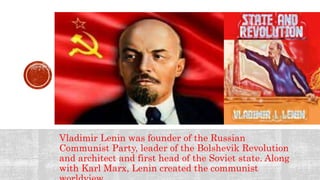
Vladimir Lenin was founder of the Russian
Communist Party, leader of the Bolshevik Revolution
and architect and first head of the Soviet state. Along
with Karl Marx, Lenin created the communist
BIOGRAPHY OF VLADIMIR
LENIN
 Vladimir Lenin is also called Vladimir Ilich Lenin.
 Original name of Vladimir Lenin is Vladimir Ilich Ulyanov.
 He was born on April 22 1870 in Simbirsk, Russia.
 Ilya Nikolayevich Ulyanov, father of Lenin was a Russian public figure in the field of
public education.
 Maria Alexandrovna Ulyanov, mother of Lenin, was daughter of a physician.
 He had eight siblings out of which two died as infants.
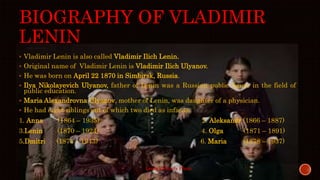
1. Anna (1864 – 1935) 2. Aleksandr (1866 – 1887)
3.Lenin (1870 – 1924) 4. Olga (1871 – 1891)
5.Dmitri (1874 – 1943) 6. Maria (1878 – 1937)
 Lenin’s Family Photo.
CONTINUAT
ION
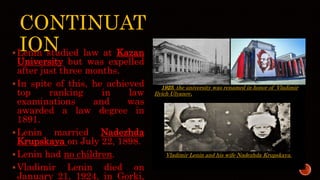
Lenin studied law at Kazan
University but was expelled
after just three months.
In spite of this, he achieved
top ranking in law
examinations and was
awarded a law degree in
1891.
Lenin married Nadezhda
Krupskaya on July 22, 1898.
Lenin had no children.
Vladimir Lenin died on
January 21, 1924, in Gorki,
In 1925, the university was renamed in honor of Vladimir
Ilyich Ulyanov.
Vladimir Lenin and his wife Nadezhda Krupskaya.
REVOLUTIONARY
SERVICES
In March 1898, Lenin
joined the Social
Democratic Party (the
first Russian Marxist
party).
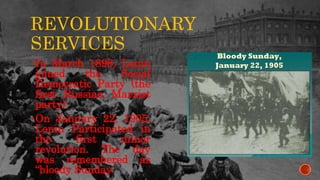
On January 22, 1905,
Lenin Participated in
the first minor
revolution. The day
was remembered as
“bloody Sunday”.
 .
CONTINUATION
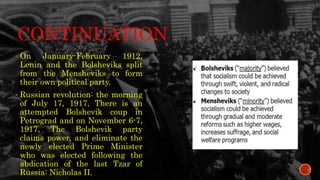
 On January-February 1912,
Lenin and the Bolsheviks split
from the Mensheviks to form
their own political party.
 Russian revolution: the morning
of July 17, 1917, There is an
attempted Bolshevik coup in
Petrograd and on November 6-7,
1917, The Bolshevik party
claims power, and eliminate the
newly elected Prime Minister
who was elected following the
abdication of the last Tzar of
Russia: Nicholas II.
.
CONTIN
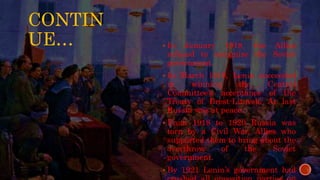
UE…  In January 1918, the Allies
refused to recognize the Soviet
government.
 In March 1918, Lenin succeeded
in winning the Central
Committee’s acceptance of the
Treaty of Brest-Litovsk. At last
Russia was at peace.
 From 1918 to 1920 Russia was
torn by a Civil War, Allies who
supported them to bring about the
overthrow of the Soviet
government.
 By 1921 Lenin’s government had
ATTEMPT OF
ASSASSINATION ON
LENIN
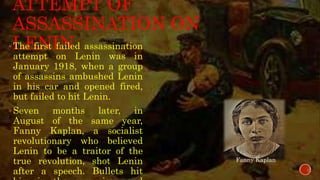
The first failed assassination
attempt on Lenin was in
January 1918, when a group
of assassins ambushed Lenin
in his car and opened fired,
but failed to hit Lenin.
Seven months later, in
August of the same year,
Fanny Kaplan, a socialist
revolutionary who believed
Lenin to be a traitor of the
true revolution, shot Lenin
after a speech. Bullets hit
Fanny Kaplan
ILLNESS AND DEATH OF
LENIN
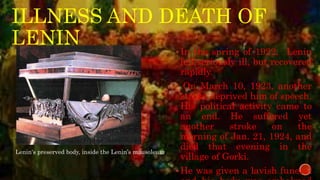
In the spring of 1922, Lenin
fell seriously ill, but recovered
rapidly.
 On March 10, 1923, another
stroke deprived him of speech.
His political activity came to
an end. He suffered yet
another stroke on the
morning of Jan. 21, 1924, and
died that evening in the
village of Gorki.
He was given a lavish funeral
Lenin's preserved body, inside the Lenin’s mausoleum
CONTINU
E…
His attitude towards the
development of the Soviet
Union drastically shaped
Russia’s progress in the 20 th
century. This later shaped the
development of future Leninist
models.
LENINISM was a Organization
of a communist party and
governance to unite & to lead
Proletariats domination.
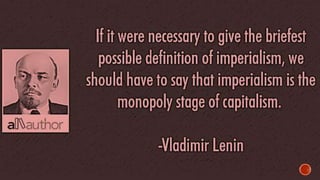
Imperialism is highest stage of
Capitalism. Socialism is a
THEORY OF LENINISM
Leninism is a political ideology developed by Russian
Marxist revolutionary Vladimir
Lenin that proposes the establishment of the
dictatorship of the proletariat , led by a revolutionary
vanguard party.
Leninism aims at the implementation of both political
and socialist economic theories that have been
developed from Marxism.
LENIN’S MAJOR CONTRIBUTIONS TO M
 His analysis and condemnation of imperialism (stressing,
among other things, the
importance of colonial areas as the breeding ground for
revolution).
 His concept of a revolutionary party as a highly disciplined
unit.
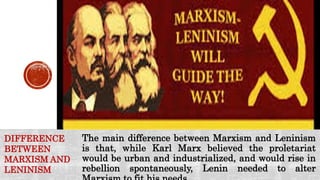
The main difference between Marxism and Leninism
is that, while Karl Marx believed the proletariat
would be urban and industrialized, and would rise in
rebellion spontaneously, Lenin needed to alter
DIFFERENCE
BETWEEN
MARXISM AND
LENINISM
CONTINUATION
According to Leninism, the proletariat would be
agrarian, as they were in Russia, and would rise in
rebellion with the leadership of a vanguard party,
which in his case was the Bolshevik party.
THEORY OF IMPERIALISM
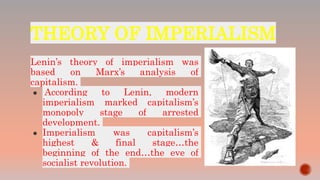
Lenin’s theory of imperialism was
based on Marx’s analysis of
capitalism.
● According to Lenin, modern
imperialism marked capitalism’s
monopoly stage of arrested
development.
● Imperialism was capitalism’s
highest & final stage…the
beginning of the end…the eve of
socialist revolution.
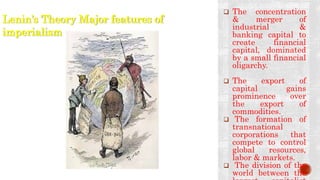
 The concentration
& merger of
industrial &
banking capital to
create financial
capital, dominated
by a small financial
oligarchy.
 The export of
capital gains
prominence over
the export of
commodities.
 The formation of
transnational
corporations that
compete to control
global resources,
labor & markets.
 The division of the
world between the
Lenin’s Theory Major features of
imperialism
CONCLUSION
● Vladimir Lenin was both a politician and a murderer.
The revolution which he set into motion, his affect on the
international populations and how he entertained a
political and social philosophy that would cause the
death of countless Soviets and their enemies alike, made
Lenin, a significant figure in the 20th Century.
● Lenin's conviction that the war signified that capitalism
had finally exhausted its progressive potential was no
doubt shared by many socialists. What he now had to do
was to…
CONTIN
UE…
● Convince them that the prospects for a 'growing over'
of capitalism into socialism was neither possible nor
compatible with basic Marxist method with regard to
epochal transformation.
● As a distinctive ideology of the modern world, grew out
of Lenin's response to the outbreak of the First World
War. It was this event that lead Lenin to reappraise
the nature of contemporary capitalism and its
historical evolution; it was this event that led to a
radical redefinition of the nature of socialism and the
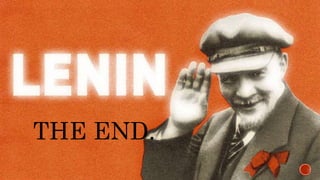
THE END.

Presentation on Leninism

  • 1.
    TOPIC FOR PRESENTATION: LENINISM. Presentedby : NUML Students Urooj Ilyas Sheryar Jamil
  • 2.
    Vladimir Lenin wasfounder of the Russian Communist Party, leader of the Bolshevik Revolution and architect and first head of the Soviet state. Along with Karl Marx, Lenin created the communist
  • 3.
    BIOGRAPHY OF VLADIMIR LENIN Vladimir Lenin is also called Vladimir Ilich Lenin.  Original name of Vladimir Lenin is Vladimir Ilich Ulyanov.  He was born on April 22 1870 in Simbirsk, Russia.  Ilya Nikolayevich Ulyanov, father of Lenin was a Russian public figure in the field of public education.  Maria Alexandrovna Ulyanov, mother of Lenin, was daughter of a physician.  He had eight siblings out of which two died as infants. 1. Anna (1864 – 1935) 2. Aleksandr (1866 – 1887) 3.Lenin (1870 – 1924) 4. Olga (1871 – 1891) 5.Dmitri (1874 – 1943) 6. Maria (1878 – 1937)  Lenin’s Family Photo.
  • 4.
    CONTINUAT ION Lenin studied lawat Kazan University but was expelled after just three months. In spite of this, he achieved top ranking in law examinations and was awarded a law degree in 1891. Lenin married Nadezhda Krupskaya on July 22, 1898. Lenin had no children. Vladimir Lenin died on January 21, 1924, in Gorki, In 1925, the university was renamed in honor of Vladimir Ilyich Ulyanov. Vladimir Lenin and his wife Nadezhda Krupskaya.
  • 5.
    REVOLUTIONARY SERVICES In March 1898,Lenin joined the Social Democratic Party (the first Russian Marxist party). On January 22, 1905, Lenin Participated in the first minor revolution. The day was remembered as “bloody Sunday”.  .
  • 6.
    CONTINUATION  On January-February1912, Lenin and the Bolsheviks split from the Mensheviks to form their own political party.  Russian revolution: the morning of July 17, 1917, There is an attempted Bolshevik coup in Petrograd and on November 6-7, 1917, The Bolshevik party claims power, and eliminate the newly elected Prime Minister who was elected following the abdication of the last Tzar of Russia: Nicholas II. .
  • 7.
    CONTIN UE…  InJanuary 1918, the Allies refused to recognize the Soviet government.  In March 1918, Lenin succeeded in winning the Central Committee’s acceptance of the Treaty of Brest-Litovsk. At last Russia was at peace.  From 1918 to 1920 Russia was torn by a Civil War, Allies who supported them to bring about the overthrow of the Soviet government.  By 1921 Lenin’s government had
  • 8.
    ATTEMPT OF ASSASSINATION ON LENIN Thefirst failed assassination attempt on Lenin was in January 1918, when a group of assassins ambushed Lenin in his car and opened fired, but failed to hit Lenin. Seven months later, in August of the same year, Fanny Kaplan, a socialist revolutionary who believed Lenin to be a traitor of the true revolution, shot Lenin after a speech. Bullets hit Fanny Kaplan
  • 9.
    ILLNESS AND DEATHOF LENIN In the spring of 1922, Lenin fell seriously ill, but recovered rapidly.  On March 10, 1923, another stroke deprived him of speech. His political activity came to an end. He suffered yet another stroke on the morning of Jan. 21, 1924, and died that evening in the village of Gorki. He was given a lavish funeral Lenin's preserved body, inside the Lenin’s mausoleum
  • 10.
    CONTINU E… His attitude towardsthe development of the Soviet Union drastically shaped Russia’s progress in the 20 th century. This later shaped the development of future Leninist models. LENINISM was a Organization of a communist party and governance to unite & to lead Proletariats domination. Imperialism is highest stage of Capitalism. Socialism is a
  • 11.
    THEORY OF LENINISM Leninismis a political ideology developed by Russian Marxist revolutionary Vladimir Lenin that proposes the establishment of the dictatorship of the proletariat , led by a revolutionary vanguard party. Leninism aims at the implementation of both political and socialist economic theories that have been developed from Marxism.
  • 12.
    LENIN’S MAJOR CONTRIBUTIONSTO M  His analysis and condemnation of imperialism (stressing, among other things, the importance of colonial areas as the breeding ground for revolution).  His concept of a revolutionary party as a highly disciplined unit.
  • 13.
    The main differencebetween Marxism and Leninism is that, while Karl Marx believed the proletariat would be urban and industrialized, and would rise in rebellion spontaneously, Lenin needed to alter DIFFERENCE BETWEEN MARXISM AND LENINISM
  • 14.
    CONTINUATION According to Leninism,the proletariat would be agrarian, as they were in Russia, and would rise in rebellion with the leadership of a vanguard party, which in his case was the Bolshevik party.
  • 15.
    THEORY OF IMPERIALISM Lenin’stheory of imperialism was based on Marx’s analysis of capitalism. ● According to Lenin, modern imperialism marked capitalism’s monopoly stage of arrested development. ● Imperialism was capitalism’s highest & final stage…the beginning of the end…the eve of socialist revolution.
  • 16.
     The concentration &merger of industrial & banking capital to create financial capital, dominated by a small financial oligarchy.  The export of capital gains prominence over the export of commodities.  The formation of transnational corporations that compete to control global resources, labor & markets.  The division of the world between the Lenin’s Theory Major features of imperialism
  • 18.
    CONCLUSION ● Vladimir Leninwas both a politician and a murderer. The revolution which he set into motion, his affect on the international populations and how he entertained a political and social philosophy that would cause the death of countless Soviets and their enemies alike, made Lenin, a significant figure in the 20th Century. ● Lenin's conviction that the war signified that capitalism had finally exhausted its progressive potential was no doubt shared by many socialists. What he now had to do was to…
  • 19.
    CONTIN UE… ● Convince themthat the prospects for a 'growing over' of capitalism into socialism was neither possible nor compatible with basic Marxist method with regard to epochal transformation. ● As a distinctive ideology of the modern world, grew out of Lenin's response to the outbreak of the First World War. It was this event that lead Lenin to reappraise the nature of contemporary capitalism and its historical evolution; it was this event that led to a radical redefinition of the nature of socialism and the
  • 20.