FINANCIAL MARKETS
ANNA MAE ISOY
CHERY MAE LUMAWOD
What is Financial market?
•Financial Market it is a place where individuals are
involved in any kind of financial transaction.
•Financial market is a platform where buyers and
sellers are involved in sale and purchase of
financial products like shares, mutual funds,
bonds and so on.
•The financial sector is composed of two important
segments:
Financial markets and Institutions
•WHAT ARE FINANCIAL MARKETS
There are lots of individuals and firms with surplus
funds. At the same time, there are people and firms
whose need for funds are greater than their current
incomes. They need a reliable source of loanable funds.
•Individuals and firms who want to borrow
money are brought together with those who
want to lend in the financial markets. These
markets provide a permanent venue for savers
and borrowers, and which render financial
services wherever required by their customers.
These services are made possible by the financial
markets through expediting the creation and
trading of financial instruments (securities).
BENEFITS OF FINANCIAL MARKETS
The operation of financial markets offer advantages which
covers the following:
• Funds are directed to DSUs that can use them most
efficiently;
• Liquidity is provided to savers.
Financial markets, just like any market, operate in the demand
and supply of funds. DSUs that can use borrowed funds in the
most productive manner can afford to pay higher interest
rates. Because of this, they have an edge in the bidding for
loanable funds. Higher interest rates will then motivate savers
to save more so they will have more funds for lending.
• An additional benefit provided by financial market is
liquidity. Without the intervention of financial markets,
savers will directly lend to borrowers. This arrangement
forces the lender to wait for maturity date of the loan
before he gets his money back. The lender will be at a
great disadvantage if he happens to need the loaned
amount before maturity. This problem is eliminated when
financial markets are tapped. This happens because
financial instruments are issued to lenders, which in turn,
can be converted to cash even before maturity, by
endorsement or sale.
HOW FINANCIAL MARKETS STIMULATE SAVINGS AND
BORROWINGS
By using financial intermediaries, financial markets stimulate
savings and borrowings.
Ways to Stimulate Savings
1. Denomination (size) Intermediation
2. Maturity Intermediation
3. Credit- Risk Intermediation
4. Interest Rate Sensitivity
5. Foreign Currency Intermediation
6. Higher Net Interest Rates
Ways to Stimulate Borrowings
1. Denomination (size) Intermediation
2. Maturity Intermediation
3. Interest Rate Sensitivity Intermediation
4. Foreign Currency Intermediation
5. Lower Net Interest Cost
6. Information and Assistance Services
CLASSIFICATION OF FINANCIAL MARKETS
1. Primary Market A financial market on which newly issued primary
and secondary securities are traded for the first time is called primary
market. Investors who buy these new issues are supplying funds to
DSUs which issue the securities.
2. Secondary Market A secondary market is that financial market
through which existing financial securities are traded. SSUs which
bought new securities from the primary market may sell the same to
the secondary market anytime they wish to change their portfolios
before maturity dates. As such, the secondary market provides liquidity
to the SSUs with securities held.
3. Money MarketThe money market is that
financial market on which debt securities with an
original maturity of one year or less are traded.
Long-term securities may also be traded in the
money market if they have six months or less left
to maturity.
4. Capital MarketThe capital market is that
portion of the financial market where trading is
undertaken for securities with maturity of more
than one year.
The capital market is subdivided into three parts:
• the bond market
• the mortgage, market, and
• the stock market.
5. Bond Market The market for debt instrument of any kind is
called the bond market. The involvement of large companies
like the Dutch banking giant ABN AMRO in the issuance of
10 year bond is an indication that the bond market is very
active. ABN AMRO lead managed the issue of the bonds by
Electricity Generating Authority of Thailand. The bonds are
valued at $300 million and guaranteed by the world bank’s
international Bank for Reconstruction and Development.
6.Stock Market The stock market is that financial
market where the common and preferred stocks
issued by corporations are traded. When the Social
security system (SSS) bought 25.2 million shares
of stock of the Union bank valued at P460 million,
the sale was a stock market transaction.
components: (1) the organized exchange, and (2) the
less formal over-the-counter markets.
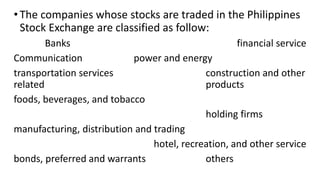
•The companies whose stocks are traded in the Philippines
Stock Exchange are classified as follow:
Banks financial service
Communication power and energy
transportation services construction and other
related products
foods, beverages, and tobacco
holding firms
manufacturing, distribution and trading
hotel, recreation, and other service
bonds, preferred and warrants others
7. Mortgage Market The mortgage is that portion of the
financial market which deals with loans on residential,
commercial, and industrial estate, and on farmland.
Universal and commercial banks tapped the mortgage by
extending real estate loans amounting to P717.68 billion
for the year ended June 2014.
The National Home Mortgage Finance Corporation (NHMFC)
is another component of the mortgage market that grants
mortgage loans, secured by house and lot collateral.
8. Consumer Credit Market The market involved in loans
an autos, appliances, education, travel, etc. is referred to
as an the consumer credit market. As there are millions
of consumers tapping the credit market, a number of
financing institutions caters to the credit needs of these
consumers needing credit.
9. Auction Market The auction market is one where
trading is conducted by an independent third party
according to a matching of prices on orders received to
buy and to sell a particular security. Stocks are sold to
the highest bidder, on the trading floors.
•example of an auction market is the Philippine Stock Exchange.
10. Negotiation Market When buyers and sellers of
securities negotiate with each other regarding price
and volume, either directly or through a broker or dealer,
they are engaged in the financial market called negotiation
market.
11.Organized Market The organized market is that
financial market with fixed trading rules. It is situated at a
central location in the financial district in which trading is
generally conducted by auction. Another name for
organized markets are exchanges like the Philippine Stock
Exchange and the Australian Stock Exchange. Common
and preferred stocks, bonds, and warrants are sold at the
Philippine Stock Exchange.
12. Over-the-Counter Market The over-the-counter market is that
market consisting of a large collection of brokers and dealers,
connected electronically by telephones and computers, that
provides for trading in unlisted securities. All securities not traded
in the stock exchange for one reason or another are traded over-
the-counter. The over-the-counter market consists of facilities
namely,
• relatively few dealers who hold inventories of over the counter
securities and act as a securities market.
• the many brokers who act as agents in bringing these dealers
together with investors, and
• the computers, terminals, and electronic networks that provide a
communications link between dealers and brokers.
13. Spot Market When securities are traded for
immediate delivery and payment, the market referred to is
the spot market. The spot price is the feature of the spot
market and which is actually the price paid for a security that
will be delivered on the spot or immediately. The term
“immediately” may actually mean one or two days to one
week depending on the facilities used or the tradition in the
area. Spot market is an alternative to the futures market.
14. Futures Market Futures market is that market
where contracts are originated and traded that give the
holder the right to buy something in the future at a price
specified by the contracts.
15. Option Market The options market is one
where stock options are traded. A stock option is
a contract giving the owner the right to either buy
or sell a fixed number of shares of a stock (usually
100) at any time before an expiration date at a
price specified in the option.
Options contracts may cover items like gold and
treasury bonds. Options are traded in organized
securities exchanges like the Philippine Stock
Exchange.
16. Foreign Exchange Market The foreign exchange
market is the market where people buy and sell foreign
currencies. This market is composed of the following:
•banks throughout the world buying and selling foreign
monies, in the form of foreign currencies and deposits in
foreign banks;
•foreign exchange dealers; and
•currency exchanges catering mostly to tourist and are
found in the downtown area, airports and railroad stations
in major tourist centers.
Thank you
!

Financial markets

  • 1.
    FINANCIAL MARKETS ANNA MAEISOY CHERY MAE LUMAWOD
  • 2.
    What is Financialmarket? •Financial Market it is a place where individuals are involved in any kind of financial transaction. •Financial market is a platform where buyers and sellers are involved in sale and purchase of financial products like shares, mutual funds, bonds and so on.
  • 3.
    •The financial sectoris composed of two important segments: Financial markets and Institutions •WHAT ARE FINANCIAL MARKETS There are lots of individuals and firms with surplus funds. At the same time, there are people and firms whose need for funds are greater than their current incomes. They need a reliable source of loanable funds.
  • 4.
    •Individuals and firmswho want to borrow money are brought together with those who want to lend in the financial markets. These markets provide a permanent venue for savers and borrowers, and which render financial services wherever required by their customers. These services are made possible by the financial markets through expediting the creation and trading of financial instruments (securities).
  • 5.
    BENEFITS OF FINANCIALMARKETS The operation of financial markets offer advantages which covers the following: • Funds are directed to DSUs that can use them most efficiently; • Liquidity is provided to savers. Financial markets, just like any market, operate in the demand and supply of funds. DSUs that can use borrowed funds in the most productive manner can afford to pay higher interest rates. Because of this, they have an edge in the bidding for loanable funds. Higher interest rates will then motivate savers to save more so they will have more funds for lending.
  • 6.
    • An additionalbenefit provided by financial market is liquidity. Without the intervention of financial markets, savers will directly lend to borrowers. This arrangement forces the lender to wait for maturity date of the loan before he gets his money back. The lender will be at a great disadvantage if he happens to need the loaned amount before maturity. This problem is eliminated when financial markets are tapped. This happens because financial instruments are issued to lenders, which in turn, can be converted to cash even before maturity, by endorsement or sale.
  • 7.
    HOW FINANCIAL MARKETSSTIMULATE SAVINGS AND BORROWINGS By using financial intermediaries, financial markets stimulate savings and borrowings. Ways to Stimulate Savings 1. Denomination (size) Intermediation 2. Maturity Intermediation 3. Credit- Risk Intermediation 4. Interest Rate Sensitivity 5. Foreign Currency Intermediation 6. Higher Net Interest Rates
  • 8.
    Ways to StimulateBorrowings 1. Denomination (size) Intermediation 2. Maturity Intermediation 3. Interest Rate Sensitivity Intermediation 4. Foreign Currency Intermediation 5. Lower Net Interest Cost 6. Information and Assistance Services
  • 9.
    CLASSIFICATION OF FINANCIALMARKETS 1. Primary Market A financial market on which newly issued primary and secondary securities are traded for the first time is called primary market. Investors who buy these new issues are supplying funds to DSUs which issue the securities. 2. Secondary Market A secondary market is that financial market through which existing financial securities are traded. SSUs which bought new securities from the primary market may sell the same to the secondary market anytime they wish to change their portfolios before maturity dates. As such, the secondary market provides liquidity to the SSUs with securities held.
  • 10.
    3. Money MarketThemoney market is that financial market on which debt securities with an original maturity of one year or less are traded. Long-term securities may also be traded in the money market if they have six months or less left to maturity. 4. Capital MarketThe capital market is that portion of the financial market where trading is undertaken for securities with maturity of more than one year.
  • 11.
    The capital marketis subdivided into three parts: • the bond market • the mortgage, market, and • the stock market. 5. Bond Market The market for debt instrument of any kind is called the bond market. The involvement of large companies like the Dutch banking giant ABN AMRO in the issuance of 10 year bond is an indication that the bond market is very active. ABN AMRO lead managed the issue of the bonds by Electricity Generating Authority of Thailand. The bonds are valued at $300 million and guaranteed by the world bank’s international Bank for Reconstruction and Development.
  • 12.
    6.Stock Market Thestock market is that financial market where the common and preferred stocks issued by corporations are traded. When the Social security system (SSS) bought 25.2 million shares of stock of the Union bank valued at P460 million, the sale was a stock market transaction. components: (1) the organized exchange, and (2) the less formal over-the-counter markets.
  • 13.
    •The companies whosestocks are traded in the Philippines Stock Exchange are classified as follow: Banks financial service Communication power and energy transportation services construction and other related products foods, beverages, and tobacco holding firms manufacturing, distribution and trading hotel, recreation, and other service bonds, preferred and warrants others
  • 14.
    7. Mortgage MarketThe mortgage is that portion of the financial market which deals with loans on residential, commercial, and industrial estate, and on farmland. Universal and commercial banks tapped the mortgage by extending real estate loans amounting to P717.68 billion for the year ended June 2014. The National Home Mortgage Finance Corporation (NHMFC) is another component of the mortgage market that grants mortgage loans, secured by house and lot collateral.
  • 15.
    8. Consumer CreditMarket The market involved in loans an autos, appliances, education, travel, etc. is referred to as an the consumer credit market. As there are millions of consumers tapping the credit market, a number of financing institutions caters to the credit needs of these consumers needing credit. 9. Auction Market The auction market is one where trading is conducted by an independent third party according to a matching of prices on orders received to buy and to sell a particular security. Stocks are sold to the highest bidder, on the trading floors. •example of an auction market is the Philippine Stock Exchange.
  • 16.
    10. Negotiation MarketWhen buyers and sellers of securities negotiate with each other regarding price and volume, either directly or through a broker or dealer, they are engaged in the financial market called negotiation market. 11.Organized Market The organized market is that financial market with fixed trading rules. It is situated at a central location in the financial district in which trading is generally conducted by auction. Another name for organized markets are exchanges like the Philippine Stock Exchange and the Australian Stock Exchange. Common and preferred stocks, bonds, and warrants are sold at the Philippine Stock Exchange.
  • 17.
    12. Over-the-Counter MarketThe over-the-counter market is that market consisting of a large collection of brokers and dealers, connected electronically by telephones and computers, that provides for trading in unlisted securities. All securities not traded in the stock exchange for one reason or another are traded over- the-counter. The over-the-counter market consists of facilities namely, • relatively few dealers who hold inventories of over the counter securities and act as a securities market. • the many brokers who act as agents in bringing these dealers together with investors, and • the computers, terminals, and electronic networks that provide a communications link between dealers and brokers.
  • 18.
    13. Spot MarketWhen securities are traded for immediate delivery and payment, the market referred to is the spot market. The spot price is the feature of the spot market and which is actually the price paid for a security that will be delivered on the spot or immediately. The term “immediately” may actually mean one or two days to one week depending on the facilities used or the tradition in the area. Spot market is an alternative to the futures market. 14. Futures Market Futures market is that market where contracts are originated and traded that give the holder the right to buy something in the future at a price specified by the contracts.
  • 19.
    15. Option MarketThe options market is one where stock options are traded. A stock option is a contract giving the owner the right to either buy or sell a fixed number of shares of a stock (usually 100) at any time before an expiration date at a price specified in the option. Options contracts may cover items like gold and treasury bonds. Options are traded in organized securities exchanges like the Philippine Stock Exchange.
  • 20.
    16. Foreign ExchangeMarket The foreign exchange market is the market where people buy and sell foreign currencies. This market is composed of the following: •banks throughout the world buying and selling foreign monies, in the form of foreign currencies and deposits in foreign banks; •foreign exchange dealers; and •currency exchanges catering mostly to tourist and are found in the downtown area, airports and railroad stations in major tourist centers.
  • 21.