Objectives
At the endof this lesson, the students
should be able to:
• Identify the components and
formats of the income statement and
cash flow statement
• Differentiate revenue recognition
and expense recognition
• Determine the nonrecurring items
and non-operating items
• Analyze income and cash flow
statements
3.
Income Statement
Components
are thedirect costs of producing
the goods being offered by the
entity. This would include the
materials, labor, and other
resources required for
production.
Cost of Goods Sold
is the money an entity receives from
the sale of goods or services. Other
terms frequently used for revenue
are sales, net sales, or sale revenue.
It is also referred to as the “top line”
because revenues are reported at
the top of the income statement.
Revenue
4.
Income Statement
Components
are theamount an entity
expends to maintain and
operate the general business.
Operating expenses include
research and development,
marketing, general and
administrative, amortization of
intangible assets (i.e. patents,
good will, etc.), etc.
Operating Expenses
is the difference between the
revenue received for the product
less the cost of goods sold.
Gross Profit
5.
Income Statement
Components
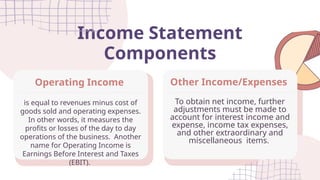
To obtainnet income, further
adjustments must be made to
account for interest income and
expense, income tax expenses,
and other extraordinary and
miscellaneous items.
Other Income/Expenses
is equal to revenues minus cost of
goods sold and operating expenses.
In other words, it measures the
profits or losses of the day to day
operations of the business. Another
name for Operating Income is
Earnings Before Interest and Taxes
(EBIT).
Operating Income
6.
Income Statement
Components
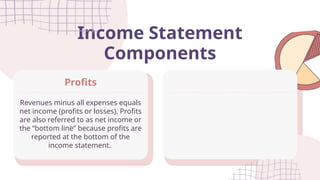
Revenues minusall expenses equals
net income (profits or losses). Profits
are also referred to as net income or
the “bottom line” because profits are
reported at the bottom of the
income statement.
Profits
7.
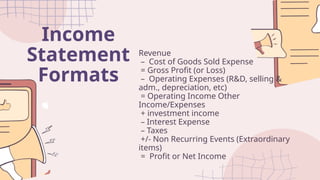
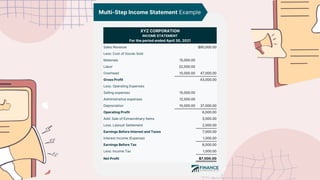
Income
Statement
Formats
Revenue
– Cost ofGoods Sold Expense
= Gross Profit (or Loss)
– Operating Expenses (R&D, selling &
adm., depreciation, etc)
= Operating Income Other
Income/Expenses
+ investment income
– Interest Expense
– Taxes
+/- Non Recurring Events (Extraordinary
items)
= Profit or Net Income
9.
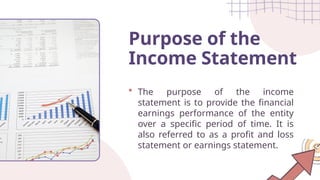
The purpose ofthe income
statement is to provide the financial
earnings performance of the entity
over a specific period of time. It is
also referred to as a profit and loss
statement or earnings statement.
Purpose of the
Income Statement
10.
WHAT IS REVENUE
RECOGNITIONPRINCIPLE?
Revenue recognition is a generally accepted
accounting principle (GAAP) that identifies the
specific conditions in which revenue is
recognized and determines how to account for
it. Typically, revenue is recognized when a
critical event has occurred, and the dollar
amount is easily measurable to the company.
11.
WHAT IS REVENUE
RECOGNITIONPRINCIPLE?
On May 28, 2014, the Financial Accounting
Standards Board (FASB) and International
Accounting Standards Board (IASB) jointly
issued Accounting Standards Codification (ASC)
606, regarding revenue from contracts with
customers. ASC 606 provides a uniform
framework for recognizing revenue from
contracts with customers.
12.
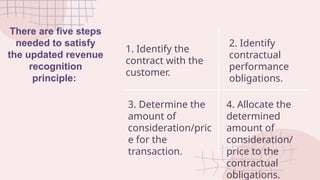
There are fivesteps
needed to satisfy
the updated revenue
recognition
principle:
1. Identify the
contract with the
customer.
2. Identify
contractual
performance
obligations.
3. Determine the
amount of
consideration/pric
e for the
transaction.
4. Allocate the
determined
amount of
consideration/
price to the
contractual
obligations.
13.
There are fivesteps
needed to satisfy
the updated revenue
recognition
principle:
5. Recognize
revenue when the
performing party
satisfies the
performance
obligation
14.
What is Expense
RecognitionPrinciple?
The expense recognition principle states
that expenses should be recognized in the
same period as the revenues to which they
relate. If this were not the case, expenses
would likely be recognized as incurred, which
might predate or follow the period in which the
related amount of revenue is recognized.
15.
What is Expense
RecognitionPrinciple?
This principle also has an impact on the
timing of income taxes. In the example, income
taxes will be underpaid in the current month,
since expenses are too high, and overpaid in
the following month, when expenses are too
low.
16.
When to Usethe Expense
Recognition Principle?
The expense recognition principle is a core
element of the accrual basis of accounting,
which holds that revenues are recognized when
earned and expenses when consumed. If a
business were to instead recognize expenses
when it pays suppliers, this is known as the
cash basis of accounting.
17.
When to Usethe Expense
Recognition Principle?
If a company wants to have its financial
statements audited, it must use the expense
recognition principle when recording business
transactions. Otherwise, the auditors will refuse
to render an opinion on the financial
statements.
18.
Nonrecurring Items and
Non-OperatingItems
There are four types of non-recurring items
in an income statement.
1. Discontinued operations
Discontinued operations are not
a component of persistent or
recurring net income from
continuing operations. To qualify,
the assets, results of operations, and
investing and financing activities of a
business segment must be
separable from those of the
company.
19.
Nonrecurring Items and
Non-OperatingItems
There are four types of non-recurring items
in an income statement.
2. Extraordinary items
Extraordinary items are both
unusual in nature and infrequent in
occurrence, and material in amount.
They must be reported separately
(below the line) net of income tax.
20.
Nonrecurring Items and
Non-OperatingItems
There are four types of non-recurring items
in an income statement.
3. Unusual or infrequent items
These are either unusual in nature or
infrequent in occurrence but not both.
They may be disclosed separately (as a
single-line item) as a component of
income from continuing operations. They
are reported pre-tax in the income
statement and appear "above the line,"
while the other three categories are
reported on an after-tax basis and "below
the line" and excluded from net income
from continuing operations.
21.
Nonrecurring Items and
Non-OperatingItems
There are four types of non-recurring items
in an income statement.
4. Changes in accounting
principles
Changes in accounting principles,
such as from LIFO to another inventory
method or from the percentage-of-
completion method to the completed-
contract method, can be either voluntary
changes or changes mandated by new
accounting standards.
22.
Nonrecurring Items and
Non-OperatingItems
There are four types of non-recurring items
in an income statement.
4. Changes in accounting
principles
Changes in accounting estimates,
such as changes in asset lives or salvage
value when recording depreciation
expenses, are not considered changes in
accounting principles. The impact of such
a change is only prospective, and no
retroactive or cumulative effects are
recognized. A change from an incorrect to
an acceptable accounting method is
treated as an error and its impact is
reported as a prior period adjustment.
23.
Nonrecurring Items and
Non-OperatingItems
Non-operating Items: Investing and
Financing Activities
Non-operating items are reported
separately from operating items.
For example, if a non-financial service
company invests in equity or debt
securities issued by another company,
any interest, dividends, or profits from
sales of these securities will be shown as
non-operating income.
24.
Analysis of Income
Statement
Investorscan use income statement
analysis to calculate financial ratios that can be
used to compare the same company year over
year, or to compare one company to another.
25.
Analysis of Income
Statement
Forinstance, you can compare one
company's profits to those of its competitors by
looking at a number of figures that express
margins, such as gross profit margin, operating
profit margin, and net profit margin. Or you
could compare one company's earnings per
share (EPS) to any other's, to show you what a
shareholder would receive per share in the
event that assets were made liquid, or if each
company were to distribute its net income.
26.
Analysis of Income
Statement
Whenyou compare each line up and down
the statement to the top line (which is revenue),
this is called "vertical analysis." Each line item
becomes a percentage of a base figure. This
method can be used to compare one line item
to another very simply, such as to check how
each may affect cash flow, or it can be used to
show how the cost of one line item stands up
against the cost of any other.
• Vertical Analysis
27.
Analysis of Income
Statement
Thismethod is most often used for spotting
trends. A single line item can be looked at over
a long span of time, to view changes from year
to year. For instance, you might wish to hone in
on what factors may be driving a certain
company's success (or failure) over the last few
years. Some investors use this method to
predict how well a company will perform in the
months or years to come.
• Horizontal Analysis
28.
Analysis of Income
Statement
Becauseincome statements have a few
limits, they may not always be the best source
to consult. It depends on what you're looking
for. Capital structure and cash flow, just to
name two, can make or break a firm, and you'll
want to have correct figures.
Limits of Income Statements
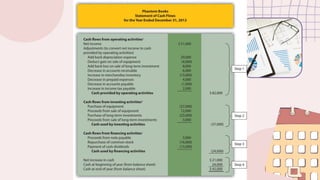
A cash flowstatement is a financial statement that
summarizes the amount of cash and cash equivalents
entering and leaving a company.
The cash flow statement measures how well a
company manages its cash position, meaning how
well the company generates cash to pay its debt
obligations and fund its operating expenses.
The cash flow statement complements the balance
sheet and income statement and is a mandatory part
of a company's financial reports since 1987
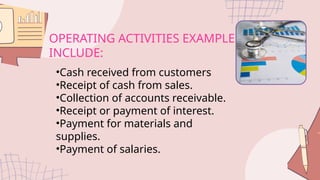
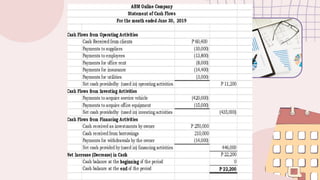
OPERATING ACTIVITIES EXAMPLES
INCLUDE:
•Cashreceived from customers
•Receipt of cash from sales.
•Collection of accounts receivable.
•Receipt or payment of interest.
•Payment for materials and
supplies.
•Payment of salaries.
34.
INVESTING
ACTIVITIES
Any cash flowsfrom the acquisition
and disposal of longterm assets and
other investments not included in
cash equivalents
FINANCING
ACTIVITIES
Any cash flowsthat result in changes
in the size and composition of the
contributed equity capital or
borrowings of the entity (i.e., bonds,
stock, dividends)
Two Methods of
CalculatingCash Flow
The direct method adds up all the various types of cash
payments and receipts, including cash paid to
suppliers, cash receipts from customers, and cash paid
out in salaries. These figures are calculated by using
the beginning and ending balances of a variety of
business accounts and examining the net decrease or
increase in the accounts.
Direct Method
40.
Two Methods of
CalculatingCash Flow
With the indirect method, cash flow from operating
activities is calculated by first taking the net income off
of a company's income statement. Because a
company’s income statement is prepared on an accrual
basis, revenue is only recognized when it is earned and
not when it is received.
Indirect Method
42.
Cash Flow Statement
Analysis
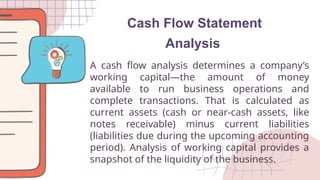
Acash flow analysis determines a company’s
working capital—the amount of money
available to run business operations and
complete transactions. That is calculated as
current assets (cash or near-cash assets, like
notes receivable) minus current liabilities
(liabilities due during the upcoming accounting
period). Analysis of working capital provides a
snapshot of the liquidity of the business.
43.
Five Steps toCash
Flow Analysis
There are a few major items to look out for trends and outliers
that can tell you a lot about the health of the business.
When operating income exceeds net income,
it’s a strong indicator of a company’s ability to
remain solvent and sustainably grow its
operations
1. Aim for positive cash flow
44.
Five Steps toCash
Flow Analysis
There are a few major items to look out for trends and outliers
that can tell you a lot about the health of the business.
On the other hand, positive investing cash flow
and negative operating cash flow could signal
problems. For example, it could indicate a
company is selling off assets to pay its
operating expenses, which is not always
sustainable.
2. Be circumspect about positive cash flow
45.
Five Steps toCash
Flow Analysis
There are a few major items to look out for trends and outliers
that can tell you a lot about the health of the business.
When it comes to investing cash flow analysis, negative
cash flow isn’t necessarily a bad thing. It could mean the
business is making investments in property and
equipment to make more products. A positive operating
cash flow and a negative investing cash flow could mean
the company is making money and spending it to grow.
3. Analyze your negative cash flow
46.
Five Steps toCash
Flow Analysis
There are a few major items to look out for trends and outliers
that can tell you a lot about the health of the business.
What you have left after you pay for operating
expenditures and capital expenditures is free cash flow.
This can be used to pay down principal, interest, buy back
stock or acquire another company.
4. Calculate your free cash flow
47.
Five Steps toCash
Flow Analysis
There are a few major items to look out for trends and outliers
that can tell you a lot about the health of the business.
The operating cash flow margin ratio measures cash from
operating activities as a percentage of sales revenue in a
given period. A positive margin demonstrates profitability,
efficiency and earnings quality.
5. Operating cash flow margin builds trust
48.
Conclusion
Cash flow analysishelps your
finance team better manage
cash inflow and cash outflow,
ensuring that there will be
enough money to run—and
grow—the business.