Bioengineered, or "BE" for short, is the federal government's term for GMOs. Under the bioengineered food labeling law, certain BE foods containing detectable modified genetic material must disclose the presence of BE ingredients.
BIOLOGICAL ENGINEERING
Bioengineering combinesprinciples from biology, medicine,
and engineering to develop technologies that improve
health and the environment. It's all about using our
understanding of living systems to create sustainable and
effective solutions.
3.
In bioengineering, wefocus
on several key areas: tissue
engineering, genetic
engineering, and
biomedical devices. Each
area plays a crucial role in
advancing healthcare and
enhancing the quality of life
for many individuals.
Key Areas of Focus
4.
What Are GMO's?
GeneticallyModified
Organisms (GMOs) are plants or
animals whose genetic material
(DNA) has been altered in a way
that does not occur naturally by
mating or natural
recombination. This process
aims to enhance certain traits,
such as disease resistance or
nutritional value.
5.
The Science BehindGMOs
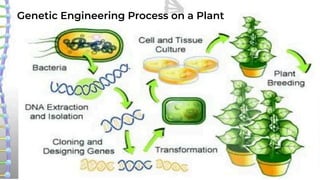
GMOs are developed through biotechnology, which allows
scientists to manipulate genes for desired traits. This process can
lead to crops that require fewer pesticides and have better yield.
The science is complex, but the benefits can be significant for food
production.
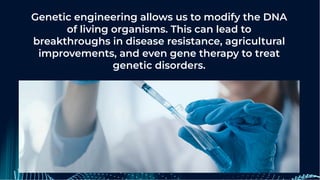
Genetic engineering allowsus to modify the DNA
of living organisms. This can lead to
breakthroughs in disease resistance, agricultural
improvements, and even gene therapy to treat
genetic disorders.
8.
GMO's in Food
andAgriculture
Industries
The Center for Ecogenetics and Environmental
Health (CEEH, 2013) identified the following
roles of GMOs in the food and agricultural
industries:
9.
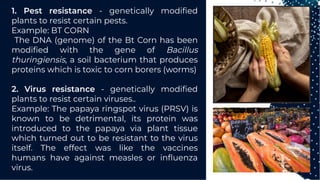
1. Pest resistance- genetically modified
plants to resist certain pests.
Example: BT CORN
The DNA (genome) of the Bt Corn has been
modified with the gene of Bacillus
thuringiensis, a soil bacterium that produces
proteins which is toxic to corn borers (worms)
2. Virus resistance - genetically modified
plants to resist certain viruses..
Example: The papaya ringspot virus (PRSV) is
known to be detrimental, its protein was
introduced to the papaya via plant tissue
which turned out to be resistant to the virus
itself. The effect was like the vaccines
humans have against measles or influenza
virus.
10.
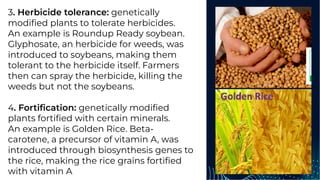
3. Herbicide tolerance:genetically
modified plants to tolerate herbicides.
An example is Roundup Ready soybean.
Glyphosate, an herbicide for weeds, was
introduced to soybeans, making them
tolerant to the herbicide itself. Farmers
then can spray the herbicide, killing the
weeds but not the soybeans.
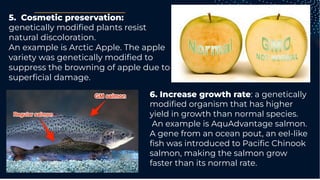
4. Fortification: genetically modified
plants fortified with certain minerals.
An example is Golden Rice. Beta-
carotene, a precursor of vitamin A, was
introduced through biosynthesis genes to
the rice, making the rice grains fortified
with vitamin A
11.
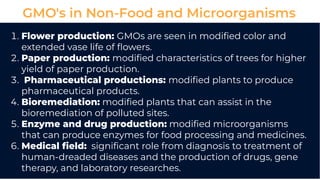
5. Cosmetic preservation:
geneticallymodified plants resist
natural discoloration.
An example is Arctic Apple. The apple
variety was genetically modified to
suppress the browning of apple due to
superficial damage.
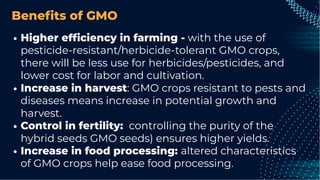
6. Increase growth rate: a genetically
modified organism that has higher
yield in growth than normal species.
An example is AquAdvantage salmon.
A gene from an ocean pout, an eel-like
fish was introduced to Pacific Chinook
salmon, making the salmon grow
faster than its normal rate.
12.
GMO's in Non-Foodand Microorganisms
. Flower production: GMOs are seen in modified color and
extended vase life of flowers.
. Paper production: modified characteristics of trees for higher
yield of paper production.
. Pharmaceutical productions: modified plants to produce
pharmaceutical products.
. Bioremediation: modified plants that can assist in the
bioremediation of polluted sites.
. Enzyme and drug production: modified microorganisms
that can produce enzymes for food processing and medicines.
. Medical field: significant role from diagnosis to treatment of
human-dreaded diseases and the production of drugs, gene
therapy, and laboratory researches.
13.
Benefits of GMO
Higherefficiency in farming - with the use of
pesticide-resistant/herbicide-tolerant GMO crops,
there will be less use for herbicides/pesticides, and
lower cost for labor and cultivation.
Increase in harvest: GMO crops resistant to pests and
diseases means increase in potential growth and
harvest.
Control in fertility: controlling the purity of the
hybrid seeds GMO seeds) ensures higher yields.
Increase in food processing: altered characteristics
of GMO crops help ease food processing.
14.
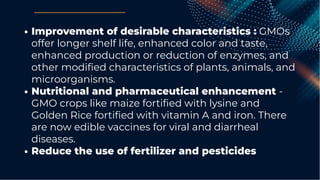
Improvement of desirablecharacteristics : GMOs
offer longer shelf life, enhanced color and taste,
enhanced production or reduction of enzymes, and
other modified characteristics of plants, animals, and
microorganisms.
Nutritional and pharmaceutical enhancement -
GMO crops like maize fortified with lysine and
Golden Rice fortified with vitamin A and iron. There
are now edible vaccines for viral and diarrheal
diseases.
Reduce the use of fertilizer and pesticides
15.
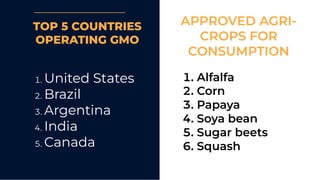
TOP 5 COUNTRIES
OPERATINGGMO
. United States
. Brazil
. Argentina
. India
. Canada
. Alfalfa
. Corn
. Papaya
. Soya bean
. Sugar beets
. Squash
APPROVED AGRI-
CROPS FOR
CONSUMPTION
16.
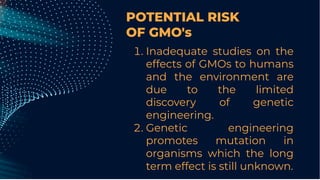
POTENTIAL RISK
OF GMO's
.Inadequate studies on the
effects of GMOs to humans
and the environment are
due to the limited
discovery of genetic
engineering.
. Genetic engineering
promotes mutation in
organisms which the long
term effect is still unknown.
17.
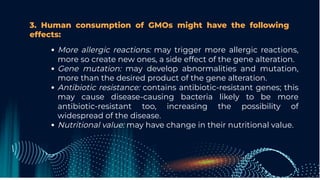
3. Human consumptionof GMOs might have the following
effects:
More allergic reactions: may trigger more allergic reactions,
more so create new ones, a side effect of the gene alteration.
Gene mutation: may develop abnormalities and mutation,
more than the desired product of the gene alteration.
Antibiotic resistance: contains antibiotic-resistant genes; this
may cause disease-causing bacteria likely to be more
antibiotic-resistant too, increasing the possibility of
widespread of the disease.
Nutritional value: may have change in their nutritional value.
18.
Conclusion: Stay
Informed
As wewrap up, remember that
being informed is key to making
choices about GMOs. Whether
you support or oppose them,
knowledge empowers you to
engage in meaningful
conversations and understand
the implications of your food
choices.