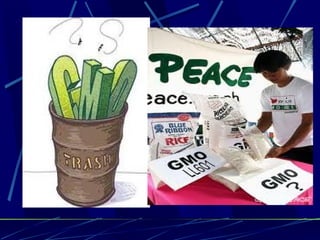
What are   genetically changed organisms   and why leave the origin species of each country? Mr.  Shane J. Velasco  BSED I-C
Traditional biotechnology and genetic engeneering What are the GMO?  (history,developement of gene engeneering) Purpose of gentic engeneering on plants  Gentic engeneering methodes  EU legislation Uses of GMO-advantages Uses of GMO-disadvantages and risks  Care for the authochthonic/ original vegetation  GMO of next generation Contents:
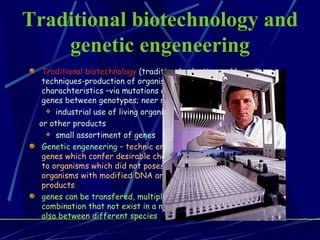
Traditional biotechnology and genetic engeneering Traditional biotechnology  (traditional selection and breeding techniques-production of organisms with more desirable charachteristics –via mutations and recombinations of existing genes between genotypes; neer relationships industrial use of living organisms to produce foods,drugs or other products small assortiment of genes   Genetic engeneering  – technic enable the identification of many genes which confer desirable charachteristics and transfer them to organisms which did not posess them before; single-celled organisms with modified DNA are used to produce different products  genes can be transfered, multiplied,retained or expressed in new combination that not exist in a nature; genes can be transfered also between different species
Biotechnology in service of mankind Traditional selection and breeding techniques as fermentation processes, used live organisms such as yeast and bacteria for production of bread, cheese, yoghourt, beer, vine etc.  More extensive use of GMO at present leeds to intensive production of useful substances such as insuline (1979), growth hormone or the blood clotting factor. Human genes encoding for these products have been successfully transfered into the DNA of microorganisms. This allows large scale production of these substances for medical use in so called  “bioreactors” .
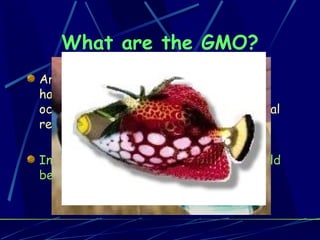
What are the GMO? Are organisms in which genetic material has been altered in a way that does not occur naturally by mating and / or natural recombination In principle, genes from any species could be inserted into any other species
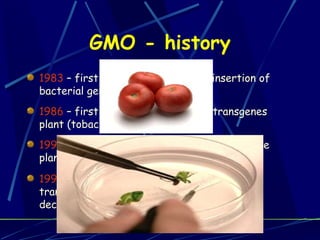
GMO - history 1983  – first plant transforma tion  ( insertion of bacterial gene   in  toba cco plant ) 1986  –  first field experiment with transgenes plant  (toba cco plant ) 1992  –  first   economic  pr oduct i on of transgene plant  ( virus resistant tobacco plant ,  China ) 1994  –  first   economic (market)  pr oduct i on of transgene plant   for food  ( tomato with slow decrease of softening USA)
Purpose of gentic engeneering on plants Resistance to diseases and pathogenes (bacteria, fungi, viruses, insects…) Resistance to novel herbicides Protection against abiotic stress – salinity, drought, frost… Functional food (cancer protecting tomato, …) Improved nutritional value in different food products Increased amount of vitamins in products (golden rice – provitamin A) Improved aroma, taste and structure of agricultural products Improved fiber quality (cotton)
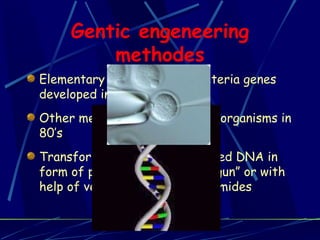
Gentic engeneering methodes Elementary methodes for bacteria genes developed in early 60’s Other methodes for different organisms in 80’s Transformation = insert of naked DNA in form of plasmides using “gene gun” or with help of vectors – bacterial plasmides
TECHNOLOGY OF RECOMBINATION Isolation of DNA molecule from donor organism, cut with enzymes ( restriction endonucleases ) and join with other DNA from s.c. clone carrier ( vector ) – new recombinant DNA  New DNA is inserted in to a host cell (plant or bacterial) = TRANSFORMATION ; the foreign DNA becomes a permanent feature of the host, being replicated and passed on to daughter cells along with the rest of its DNA  3.  Host cells which already have inserted DNA are separated from other cells which are not yet transformed
The most frequent transformation places Apical- meristematic cells Reproduction cells (gametes) Embrios
Range of transformation Laboratories ( 100 different plant species) Field experiments (more then 50 plant species) Market production (21 different plant species with 85 different genetic elements (2002)
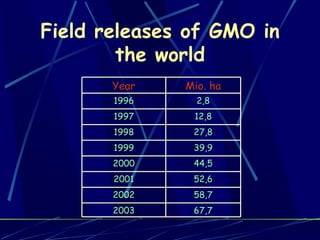
Field releases of GMO in the world Year Mio. ha 1996 2,8 1997 12,8 1998 27,8 1999 39,9 2000 44,5 2001 52,6 2002 58,7 2003 67,7
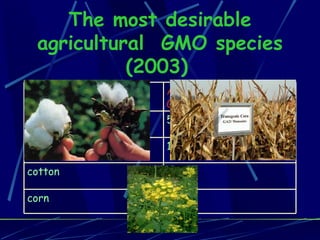
The most desirable agricultural  GMO species (2003)   GMO field species Area of field used for GMO (%) soybean 55 rape 16 cotton 21 corn 11
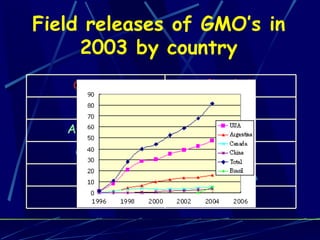
Field releases of GMO’s in 2003 by country Country %  of all USA 64 Argentina 21 Canada 6 China 4 Other 5
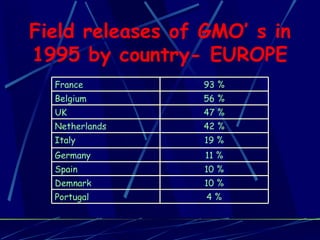
Field releases of GMO’ s in 1995 by country- EUROPE France 93 % Belgium 56 % UK 47 % Netherlands 42 % Italy 19 % Germany 11 % Spain 10 % Demnark 10 % Portugal 4 %
EU legislation For protection of health of citizens and the environment As well as ensuring a single unified market for biotechnology
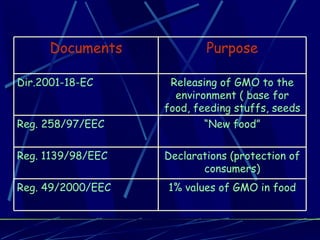
Documents Purpose Dir.2001-18-EC Releasing of GMO to the environment ( base for food, feeding stuffs, seeds Reg. 258/97/EEC “ New food” Reg. 1139/98/EEC Declarations (protection of consumers) Reg. 49/2000/EEC 1% values of GMO in food
Disadvantages, risks Gene expression   –Mendel’ s law of independent assortiment - every gene determinate one charachteristics  –  more genes determines one characteristics or more genes determine more characteristics   =>changing one gene may influence in change of more features  Gene dynamics – during the lifetime of the cell expression of genes may change –one period are active some genes and second period another genes – how to determine exactely expression of a new inserted gene?
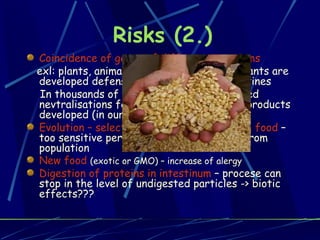
Risks (2.) Coincidence of genes of different organisms exl: plants, animals, people eating plants-plants are developed defense against herbivores- toxines In thousands of years genetically supported nevtralisations for undesirable vegetable products developed (in our saliva)   Evolution – selection are always linked with food  – too sensitive persons (food) dissapeared from population New food   (exotic or GMO) – increase of alergy Digestion of proteins in intestinum  – procese can stop in the level of undigested particles -> biotic effects???
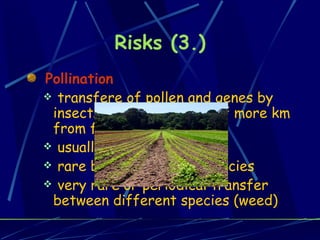
Pollination transfere of pollen and genes by insects even in the area of more km from field with GMO usually inside the species  rare between relative species very rare or periodical transfer between different species (weed) Risks (3.)
Risks (4.) Transfer of genes from GMO to weed plant - develope of high tolerante weeds GM plant become weed  – high herbicide tolerance –difficulties with control of growth The migration of inserted genes  from cultivated plants to wild species Artificially created selection pressure  could lead to a dominance of GMO
Risks (5.)  Transfer of genes to microorganisms Appereance of high tolerant injurer  (insects, viruses, bacteria)   Toxical properties for nontarget organisms  (corn butterfly-> monarch butterfly; bees, birds… )
Polithic strathegy in EU countries EU  - possibilities for all types of agriculture (classic, ecological, GMO…) Consumer must have possibility to choose between GMO and others; declarations on food articles are obligated Each EU country can choose freelly  her own strathegy for use of GMO;by consideration of EU Directives
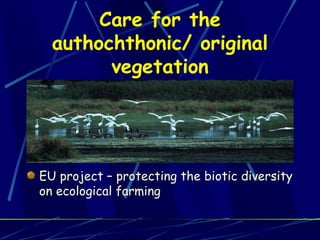
Care for the authochthonic/ original vegetation International convention of biotic diversity FAO contract on plant and genetic food and agriculture resources EU common programme for plant gene resources net EU project – protecting the biotic diversity on ecological farming
GMO of next generation Improving of nourishing values of food macronutrients (peptides, carbohydrates, lipids) micronutrients (vitamins, minerals) New applications target proteins transformation of plastids (chloroplasts) oral vaccine matter and medicines elimination of selection genes
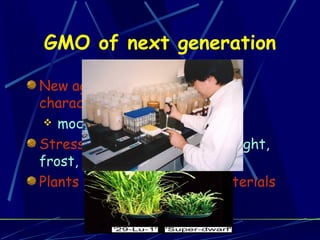
GMO of next generation New agricultural interesting charachteristisc modifficated growth Stress toleranced plants   (draught, frost, salinity, shadow) Plants producst as new biomaterials
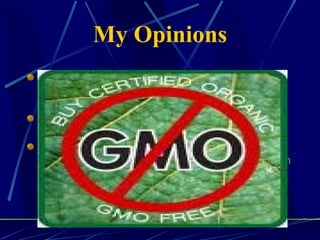
My Opinions There are many potential problems with GMO's, but also many benefits. Some of the potential problems are:  crossing of the GMO's with other species causing unwanted genetic changes.  To prevent this, we then make non seed producing species, so farmers are foced to buy their seeds from big companies like Monsanto, which drives small farmers costs up too high.  The benefits, however, are that we can feed the planet, which currently couldn't be done without GMO's.
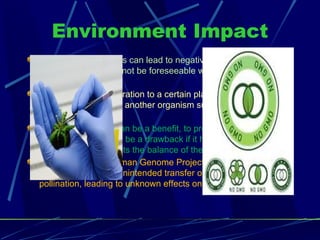
Environment Impact The creation of GMOs can lead to negative environmental impacts which might not be foreseeable when the GMO is created. For instance, an alteration to a certain plant might make it inedible or harmful to another organism such as an insect that relies on it for food.  In some cases this can be a benefit, to protect the plant against pests, but it may also be a drawback if it harms organisms that are desirable or upsets the balance of the food chain. According to the Human Genome Project Information website, GMOs can result in unintended transfer of genes through cross-pollination, leading to unknown effects on other organisms.
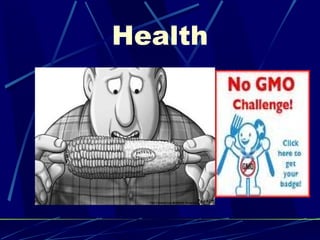
Health Another danger of GMOs is their potential to harm human  health . Altering the genetic makeup of an organism could potentially introduce new allergenic properties to it.  Some plants, such as peanuts, have powerful allergens that can kill humans. If a gene of a peanut were used to enhance a more common food crop, such as corn, it might introduce a similar allergen which could have a severe health impact
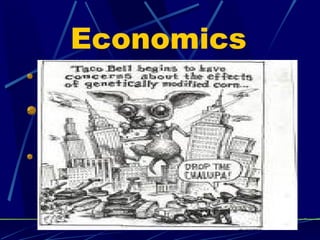
Economics Since GMOs have the potential to replace standard crops, the companies that produce them and the farmers who are able to use them stand to profit greatly. This could reduce the amount of competition between farmers and give the companies that create GMOs great power in the agricultural industry. Companies may even try to patent the genetic code of GMOs that they produce.  This could create situations where a corporation essentially owns exclusive rights to produce and sell a certain organism. Technologically advanced countries would likely benefit the most economically from increasing GMO production. The Human Genome Project Information website states that GMOs may lead to increasing dependence on industrialized nations by developing countries.
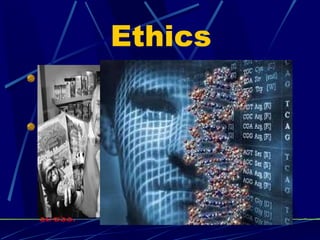
Ethics Critics of GMOs sometimes make arguments against genetic engineering on ethical grounds. For instance, some people feel it is unnatural or wrong to introduce the genes of  animals  into plants or from one plant to another, which may be likened to "playing God." In addition, animals used in genetic engineering procedures may be subjected to pain and stress.
The End  Thank you

Gmo

  • 1.
    What are genetically changed organisms and why leave the origin species of each country? Mr. Shane J. Velasco BSED I-C
  • 2.
    Traditional biotechnology andgenetic engeneering What are the GMO? (history,developement of gene engeneering) Purpose of gentic engeneering on plants Gentic engeneering methodes EU legislation Uses of GMO-advantages Uses of GMO-disadvantages and risks Care for the authochthonic/ original vegetation GMO of next generation Contents:
  • 3.
    Traditional biotechnology andgenetic engeneering Traditional biotechnology (traditional selection and breeding techniques-production of organisms with more desirable charachteristics –via mutations and recombinations of existing genes between genotypes; neer relationships industrial use of living organisms to produce foods,drugs or other products small assortiment of genes Genetic engeneering – technic enable the identification of many genes which confer desirable charachteristics and transfer them to organisms which did not posess them before; single-celled organisms with modified DNA are used to produce different products genes can be transfered, multiplied,retained or expressed in new combination that not exist in a nature; genes can be transfered also between different species
  • 4.
    Biotechnology in serviceof mankind Traditional selection and breeding techniques as fermentation processes, used live organisms such as yeast and bacteria for production of bread, cheese, yoghourt, beer, vine etc. More extensive use of GMO at present leeds to intensive production of useful substances such as insuline (1979), growth hormone or the blood clotting factor. Human genes encoding for these products have been successfully transfered into the DNA of microorganisms. This allows large scale production of these substances for medical use in so called “bioreactors” .
  • 5.
    What are theGMO? Are organisms in which genetic material has been altered in a way that does not occur naturally by mating and / or natural recombination In principle, genes from any species could be inserted into any other species
  • 6.
    GMO - history1983 – first plant transforma tion ( insertion of bacterial gene in toba cco plant ) 1986 – first field experiment with transgenes plant (toba cco plant ) 1992 – first economic pr oduct i on of transgene plant ( virus resistant tobacco plant , China ) 1994 – first economic (market) pr oduct i on of transgene plant for food ( tomato with slow decrease of softening USA)
  • 7.
    Purpose of genticengeneering on plants Resistance to diseases and pathogenes (bacteria, fungi, viruses, insects…) Resistance to novel herbicides Protection against abiotic stress – salinity, drought, frost… Functional food (cancer protecting tomato, …) Improved nutritional value in different food products Increased amount of vitamins in products (golden rice – provitamin A) Improved aroma, taste and structure of agricultural products Improved fiber quality (cotton)
  • 8.
    Gentic engeneering methodesElementary methodes for bacteria genes developed in early 60’s Other methodes for different organisms in 80’s Transformation = insert of naked DNA in form of plasmides using “gene gun” or with help of vectors – bacterial plasmides
  • 9.
    TECHNOLOGY OF RECOMBINATIONIsolation of DNA molecule from donor organism, cut with enzymes ( restriction endonucleases ) and join with other DNA from s.c. clone carrier ( vector ) – new recombinant DNA New DNA is inserted in to a host cell (plant or bacterial) = TRANSFORMATION ; the foreign DNA becomes a permanent feature of the host, being replicated and passed on to daughter cells along with the rest of its DNA 3. Host cells which already have inserted DNA are separated from other cells which are not yet transformed
  • 10.
    The most frequenttransformation places Apical- meristematic cells Reproduction cells (gametes) Embrios
  • 11.
    Range of transformationLaboratories ( 100 different plant species) Field experiments (more then 50 plant species) Market production (21 different plant species with 85 different genetic elements (2002)
  • 12.
    Field releases ofGMO in the world Year Mio. ha 1996 2,8 1997 12,8 1998 27,8 1999 39,9 2000 44,5 2001 52,6 2002 58,7 2003 67,7
  • 13.
    The most desirableagricultural GMO species (2003) GMO field species Area of field used for GMO (%) soybean 55 rape 16 cotton 21 corn 11
  • 14.
    Field releases ofGMO’s in 2003 by country Country % of all USA 64 Argentina 21 Canada 6 China 4 Other 5
  • 15.
    Field releases ofGMO’ s in 1995 by country- EUROPE France 93 % Belgium 56 % UK 47 % Netherlands 42 % Italy 19 % Germany 11 % Spain 10 % Demnark 10 % Portugal 4 %
  • 16.
    EU legislation Forprotection of health of citizens and the environment As well as ensuring a single unified market for biotechnology
  • 17.
    Documents Purpose Dir.2001-18-ECReleasing of GMO to the environment ( base for food, feeding stuffs, seeds Reg. 258/97/EEC “ New food” Reg. 1139/98/EEC Declarations (protection of consumers) Reg. 49/2000/EEC 1% values of GMO in food
  • 18.
    Disadvantages, risks Geneexpression –Mendel’ s law of independent assortiment - every gene determinate one charachteristics – more genes determines one characteristics or more genes determine more characteristics =>changing one gene may influence in change of more features Gene dynamics – during the lifetime of the cell expression of genes may change –one period are active some genes and second period another genes – how to determine exactely expression of a new inserted gene?
  • 19.
    Risks (2.) Coincidenceof genes of different organisms exl: plants, animals, people eating plants-plants are developed defense against herbivores- toxines In thousands of years genetically supported nevtralisations for undesirable vegetable products developed (in our saliva) Evolution – selection are always linked with food – too sensitive persons (food) dissapeared from population New food (exotic or GMO) – increase of alergy Digestion of proteins in intestinum – procese can stop in the level of undigested particles -> biotic effects???
  • 20.
    Pollination transfere ofpollen and genes by insects even in the area of more km from field with GMO usually inside the species rare between relative species very rare or periodical transfer between different species (weed) Risks (3.)
  • 21.
    Risks (4.) Transferof genes from GMO to weed plant - develope of high tolerante weeds GM plant become weed – high herbicide tolerance –difficulties with control of growth The migration of inserted genes from cultivated plants to wild species Artificially created selection pressure could lead to a dominance of GMO
  • 22.
    Risks (5.) Transfer of genes to microorganisms Appereance of high tolerant injurer (insects, viruses, bacteria) Toxical properties for nontarget organisms (corn butterfly-> monarch butterfly; bees, birds… )
  • 23.
    Polithic strathegy inEU countries EU - possibilities for all types of agriculture (classic, ecological, GMO…) Consumer must have possibility to choose between GMO and others; declarations on food articles are obligated Each EU country can choose freelly her own strathegy for use of GMO;by consideration of EU Directives
  • 24.
    Care for theauthochthonic/ original vegetation International convention of biotic diversity FAO contract on plant and genetic food and agriculture resources EU common programme for plant gene resources net EU project – protecting the biotic diversity on ecological farming
  • 25.
    GMO of nextgeneration Improving of nourishing values of food macronutrients (peptides, carbohydrates, lipids) micronutrients (vitamins, minerals) New applications target proteins transformation of plastids (chloroplasts) oral vaccine matter and medicines elimination of selection genes
  • 26.
    GMO of nextgeneration New agricultural interesting charachteristisc modifficated growth Stress toleranced plants (draught, frost, salinity, shadow) Plants producst as new biomaterials
  • 27.
    My Opinions Thereare many potential problems with GMO's, but also many benefits. Some of the potential problems are: crossing of the GMO's with other species causing unwanted genetic changes. To prevent this, we then make non seed producing species, so farmers are foced to buy their seeds from big companies like Monsanto, which drives small farmers costs up too high. The benefits, however, are that we can feed the planet, which currently couldn't be done without GMO's.
  • 28.
    Environment Impact Thecreation of GMOs can lead to negative environmental impacts which might not be foreseeable when the GMO is created. For instance, an alteration to a certain plant might make it inedible or harmful to another organism such as an insect that relies on it for food. In some cases this can be a benefit, to protect the plant against pests, but it may also be a drawback if it harms organisms that are desirable or upsets the balance of the food chain. According to the Human Genome Project Information website, GMOs can result in unintended transfer of genes through cross-pollination, leading to unknown effects on other organisms.
  • 29.
    Health Another dangerof GMOs is their potential to harm human health . Altering the genetic makeup of an organism could potentially introduce new allergenic properties to it. Some plants, such as peanuts, have powerful allergens that can kill humans. If a gene of a peanut were used to enhance a more common food crop, such as corn, it might introduce a similar allergen which could have a severe health impact
  • 30.
    Economics Since GMOshave the potential to replace standard crops, the companies that produce them and the farmers who are able to use them stand to profit greatly. This could reduce the amount of competition between farmers and give the companies that create GMOs great power in the agricultural industry. Companies may even try to patent the genetic code of GMOs that they produce. This could create situations where a corporation essentially owns exclusive rights to produce and sell a certain organism. Technologically advanced countries would likely benefit the most economically from increasing GMO production. The Human Genome Project Information website states that GMOs may lead to increasing dependence on industrialized nations by developing countries.
  • 31.
    Ethics Critics ofGMOs sometimes make arguments against genetic engineering on ethical grounds. For instance, some people feel it is unnatural or wrong to introduce the genes of animals into plants or from one plant to another, which may be likened to "playing God." In addition, animals used in genetic engineering procedures may be subjected to pain and stress.
  • 32.
    The End Thank you