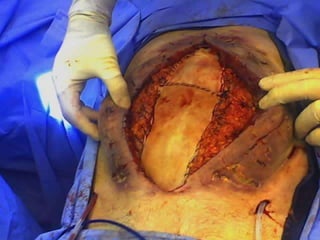
Damage Control Surgery
Dr IBRAHIM BALOCH MBBS,RMP,FCPS
PGR SURGICAL UNIT3 BMCH
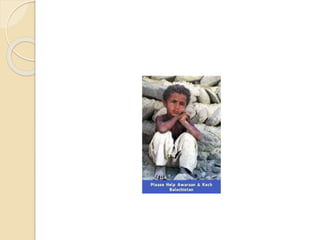
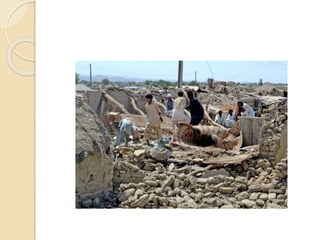
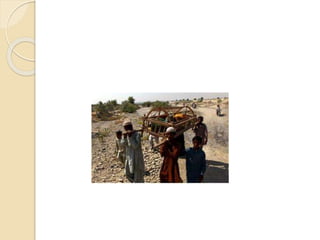
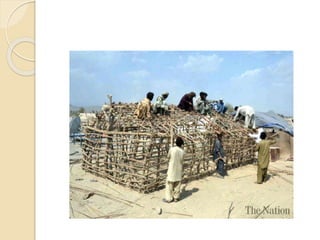
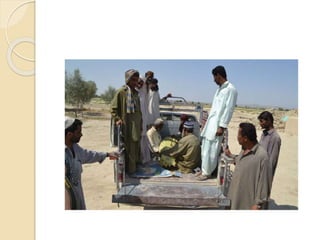
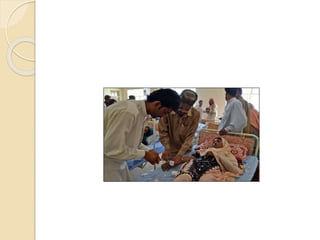
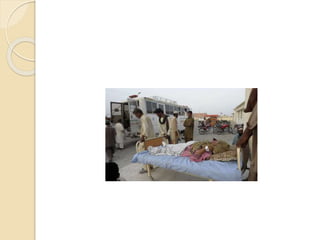
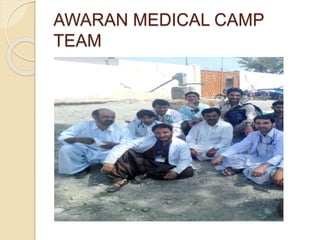
AWARAN MEDICAL CAMP
TEAM
INTRODUCTION
"The modern operation is safe for the patient. The modern surgeon
must make the patient safe for the modern operation"
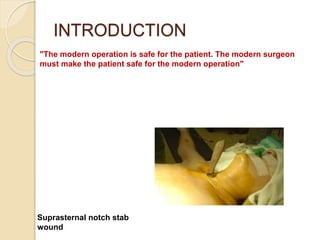
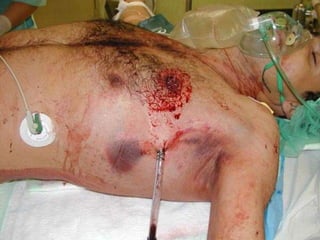
Suprasternal notch stab
wound
• Overview
 Damage control surgery is one of the major
advances in surgical technique ,
they contravene most standard surgical teaching practices - that the best operation
for a patient is one, definitive procedure.
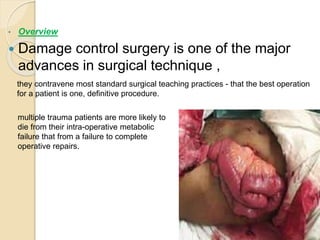
multiple trauma patients are more likely to
die from their intra-operative metabolic
failure that from a failure to complete
operative repairs.
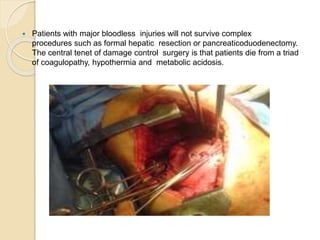
 Patients with major bloodless injuries will not survive complex
procedures such as formal hepatic resection or pancreaticoduodenectomy.
The central tenet of damage control surgery is that patients die from a triad
of coagulopathy, hypothermia and metabolic acidosis.
Once this metabolic failure has become established it is
extremely difficult to control haemorrhage and correct the
derangements. they can be transferred to a critical care
facility where they can be corrected. Once this is achieved
the definitive surgical procedure can be carried out as
necessary - the 'staged procedure'.
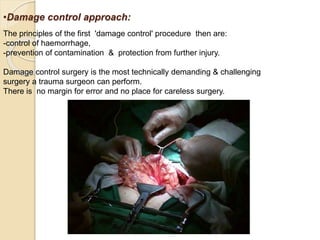
•Damage control approach:
The principles of the first 'damage control' procedure then are:
-control of haemorrhage,
-prevention of contamination & protection from further injury.
Damage control surgery is the most technically demanding & challenging
surgery a trauma surgeon can perform.
There is no margin for error and no place for careless surgery.
•PHYSIOLOGIC EXHAUSTION
Hypothermia,Acidosis&coagulopathy.
These three derangements become
established quickly in the
exsanguinating trauma patient and,
once established, form a vicious circle
which may be impossible to overcome
.
•Hypothermia:
The majority of major trauma patients
are hypothermic on arrival in the
emergency department due to:
- -Environmental conditions at the
scene.
- -Inadequate protection,
- -Intravenous fluid administration
- -And ongoing blood loss will
worsen the hypothermic state.
Hypothermia has dramatic systemic
effects on the bodies functions but most
importantly in this context exacerbates
coagulopathy.
•Acidosis
Uncorrected haemorrhagic shock will
lead into inadequate cellular perfusion
, anaerobic metabolism and the
production of lactic acid.
This leads to profound metabolic
acidosis which also interferes with
blood clotting mechanisms and
promotes coagulopathy and blood
loss.
•Coagulopathy:
Hyopthermia,acidosis&the consequences
of massive blood transfusion all lead to the
development of a coagulopathy.
Even if control of mechanical bleeding is
achievable, patients may continue to bleed
from all cut surfaces. This leads to a
worsening of haemorrhagic shock and so a
worsening of hypothermia and acidosis,
prolonging the vicious cycle.
Coagulopathy
Some studies have attempted to place
threshold levels on these parameters .
Some state that conversion to a damage
control procedure should take place if the
PH is below 7.2, core temperature is below
32C or the patient has received more than
one blood volume transfusion. However ,
once these levels are reached,
physiological exhaustion is already
established.
The trauma surgeon must make the decision to convert to a limited procedure within 5
minutes of starting the operative procedure. This decision is made on the initial
physiological state of the patient and the rapid initial assessment of internal injuries. Do
not wait for physiologic exhaustion to set in.
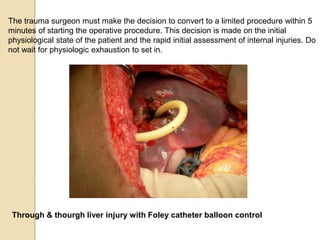
Through & thourgh liver injury with Foley catheter balloon control
Damage control surgery
 The principles of damage control
surgery are abbreviated surgery
limited to:
1-Control of haemorrhage
2-Prevention further
contamination
3-Avoid further injury
•Preparation
Prehospital and emergency department
times should be minimized in these
patients. All unnecessary and superfluous
investigations that will not immediately
affect patient management should be
deferred. Cyclic fluid resuscitation prior to
surgery is futile and will worsen
hypothermia and coagulopathy. Colloid
solutions will also interfere with clot quality.
These patients should be transferred
rapidly to the operating room without
repeated attempts to restore circulating
volume. They require operative control of
haemorrhage and simultaneous vigorous
resuscitation with blood and clotting
factors.
Anaesthesia should be induced on the operating table
once the patient is prepped and draped and the surgeons
ready. The shocked patient usually requires minimal
anaesthesia and a careful, haemodynamically-neutral
induction method should be used.
An arterial line is valuable for patient
monitoring preoperatively but small-calibre
central venous access is of limited use. Blood,
fresh frozen plasma, cryoprecipitate and
platelet transfusions should be available but
clotting factor therapy should be administered
rapidly only once control of major vascular
haemorrhage has been achieved.
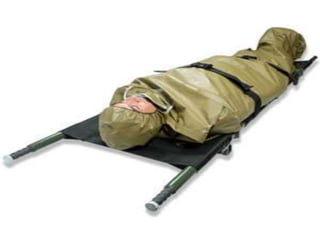
All fluids should be
warmed and as much of
the patient covered and
actively warmed as
possible.
Laparotomy: General Conduct and
Philosophy
The patient should be rapidly prepped
from neck to knees with large
abdominal packs soaked in antiseptic
skin preparation solution. The incision
should be made from the xiphisternum
to the pubis. This incision may require
extension into the right chest or as a
median sternotomy depending on the
injury pattern.
Relief of intraperitoneal
pressure with muscle paralysis
and opening of the abdominal
wall may result in dramatic
haemorrhage and hypotension.
Immediate control is necessary
and this is initially achieved with
four quadrant packing with
multiple large abdominal packs.
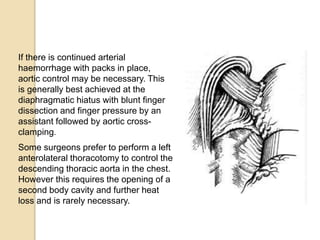
If there is continued arterial
haemorrhage with packs in place,
aortic control may be necessary. This
is generally best achieved at the
diaphragmatic hiatus with blunt finger
dissection and finger pressure by an
assistant followed by aortic cross-
clamping.
Some surgeons prefer to perform a left
anterolateral thoracotomy to control the
descending thoracic aorta in the chest.
However this requires the opening of a
second body cavity and further heat
loss and is rarely necessary.
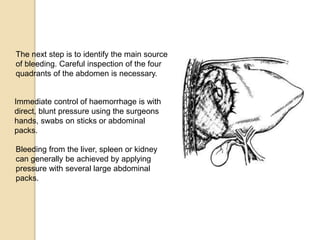
The next step is to identify the main source
of bleeding. Careful inspection of the four
quadrants of the abdomen is necessary.
Immediate control of haemorrhage is with
direct, blunt pressure using the surgeons
hands, swabs on sticks or abdominal
packs.
Bleeding from the liver, spleen or kidney
can generally be achieved by applying
pressure with several large abdominal
packs.
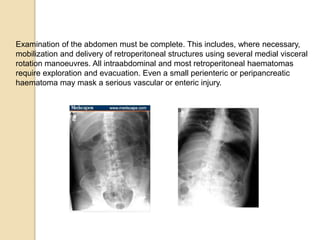
Examination of the abdomen must be complete. This includes, where necessary,
mobilization and delivery of retroperitoneal structures using several medial visceral
rotation manoeuvres. All intraabdominal and most retroperitoneal haematomas
require exploration and evacuation. Even a small perienteric or peripancreatic
haematoma may mask a serious vascular or enteric injury.
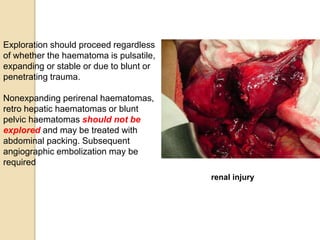
Exploration should proceed regardless
of whether the haematoma is pulsatile,
expanding or stable or due to blunt or
penetrating trauma.
Nonexpanding perirenal haematomas,
retro hepatic haematomas or blunt
pelvic haematomas should not be
explored and may be treated with
abdominal packing. Subsequent
angiographic embolization may be
required
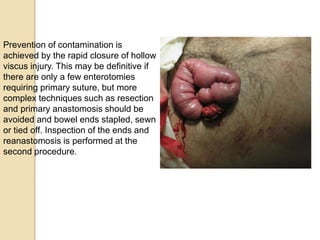
renal injury
Prevention of contamination is
achieved by the rapid closure of hollow
viscus injury. This may be definitive if
there are only a few enterotomies
requiring primary suture, but more
complex techniques such as resection
and primary anastomosis should be
avoided and bowel ends stapled, sewn
or tied off. Inspection of the ends and
reanastomosis is performed at the
second procedure.
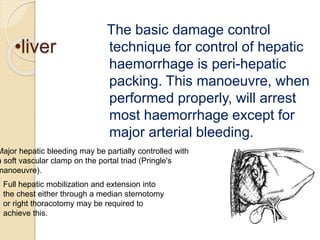
•liver
The basic damage control
technique for control of hepatic
haemorrhage is peri-hepatic
packing. This manoeuvre, when
performed properly, will arrest
most haemorrhage except for
major arterial bleeding.
Major hepatic bleeding may be partially controlled with
a soft vascular clamp on the portal triad (Pringle's
manoeuvre).
Full hepatic mobilization and extension into
the chest either through a median sternotomy
or right thoracotomy may be required to
achieve this.
Liver injury
 The liver parenchyma can be compressed
manually initially, followed by ordered packing.
To adequately pack the liver requires
compression in the antero-posterior plane. This
can only be achieved by mobilization of the
right hepatic ligament and systematic
placement of packs posterior and anterior to
this, as well as one or two in the hepato-renal
space. Even retro hepatic venous and inferior
vena cava injuries may be controlled in this
manner.
 Only major arterial bleeds from the liver parenchyma will
require further attention. In this case the liver injury can be
extended using a finger-fracture technique and the bleeding
vessels identified and tied or clipped. In some cases, where
the injury is not deep and easily accessible, rapid resection
debridement may be possible by placing large clamps along
the wound edges, performing a rapid debridement and the
under running the clamp with suture to include all the raw
surface.
 The patient who undergoes hepatic packing should be
considered for transfer to the angiography suite immediately
after the operation to identify any ongoing arterial
haemorrhage which may be controlled with selective
angiographic embolization.
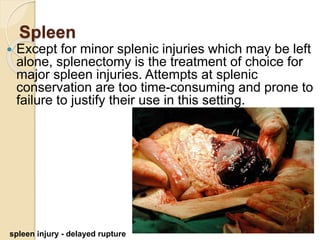
Spleen
 Except for minor splenic injuries which may be left
alone, splenectomy is the treatment of choice for
major spleen injuries. Attempts at splenic
conservation are too time-consuming and prone to
failure to justify their use in this setting.
spleen injury - delayed rupture
Abdominal Vasculature
 A central retroperitoneal haematoma likely
represents injury to a major vascular
structure. Access to the inferior vena cava or
abdominal aorta in this setting is best
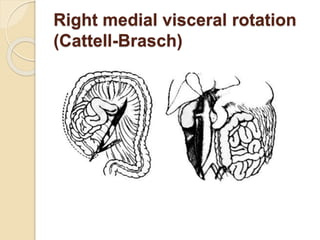
achieved by complete medial visceral rotation
of the right or left side of the abdomen. On
the right, the colon is mobilised and an
extended Kocher manoeuvre performed to
mobilise the duodenum. The root of the small
bowel mesentery is mobilised up to the
superior mesenteric artery and inferior border
of the pancreas.
Right medial visceral rotation
(Cattell-Brasch)
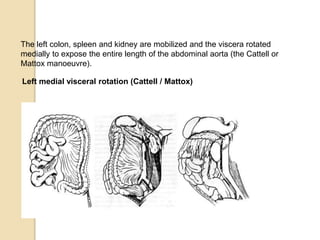
The left colon, spleen and kidney are mobilized and the viscera rotated
medially to expose the entire length of the abdominal aorta (the Cattell or
Mattox manoeuvre).
Left medial visceral rotation (Cattell / Mattox)
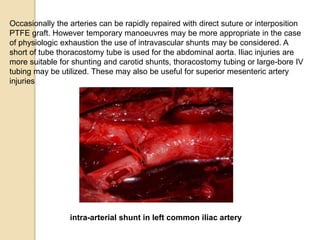
Occasionally the arteries can be rapidly repaired with direct suture or interposition
PTFE graft. However temporary manoeuvres may be more appropriate in the case
of physiologic exhaustion the use of intravascular shunts may be considered. A
short of tube thoracostomy tube is used for the abdominal aorta. Iliac injuries are
more suitable for shunting and carotid shunts, thoracostomy tubing or large-bore IV
tubing may be utilized. These may also be useful for superior mesenteric artery
injuries
intra-arterial shunt in left common iliac artery
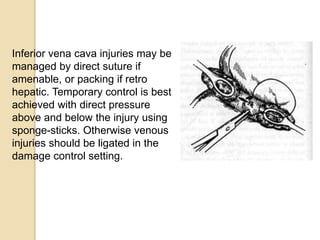
Inferior vena cava injuries may be
managed by direct suture if
amenable, or packing if retro
hepatic. Temporary control is best
achieved with direct pressure
above and below the injury using
sponge-sticks. Otherwise venous
injuries should be ligated in the
damage control setting.
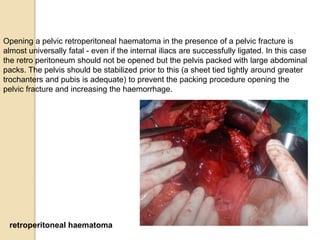
Opening a pelvic retroperitoneal haematoma in the presence of a pelvic fracture is
almost universally fatal - even if the internal iliacs are successfully ligated. In this case
the retro peritoneum should not be opened but the pelvis packed with large abdominal
packs. The pelvis should be stabilized prior to this (a sheet tied tightly around greater
trochanters and pubis is adequate) to prevent the packing procedure opening the
pelvic fracture and increasing the haemorrhage.
retroperitoneal haematoma
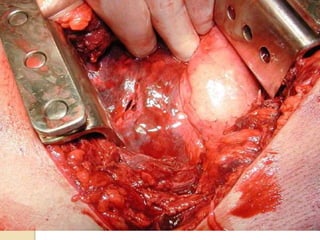
Gastrointestinal Tract
 Once control of haemorrhage has
been achieved, attention is turned to
prevention of further contamination by
controlling spillage of gut contents.
Small gastrotomies or enterotomies
can be rapidly closed primarily with a
single layer continuous suture or skin
stapler.
With extensive damage to the bowel
requiring resection, primary
anastomosis is required. This may be
time consuming and the integrity of the
anastomosis is jeopardized in the
milieu of generalized hypo perfusion.
This may also make decisions about
resection margins more difficult to
judge.
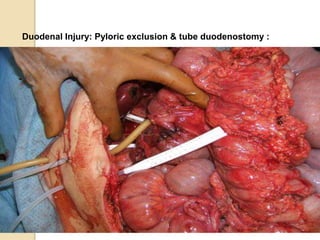
Duodenal Injury: Pyloric exclusion & tube duodenostomy :
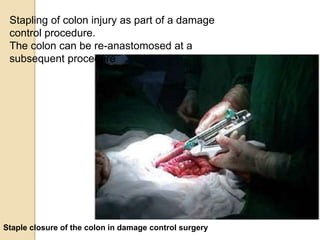
Staple closure of the colon in damage control surgery
Stapling of colon injury as part of a damage
control procedure.
The colon can be re-anastomosed at a
subsequent procedure
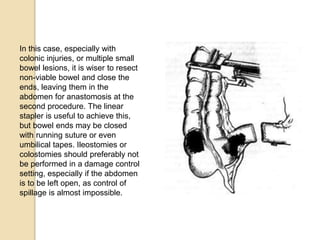
In this case, especially with
colonic injuries, or multiple small
bowel lesions, it is wiser to resect
non-viable bowel and close the
ends, leaving them in the
abdomen for anastomosis at the
second procedure. The linear
stapler is useful to achieve this,
but bowel ends may be closed
with running suture or even
umbilical tapes. Ileostomies or
colostomies should preferably not
be performed in a damage control
setting, especially if the abdomen
is to be left open, as control of
spillage is almost impossible.
Pancreas
 Pancreatic injury rarely requires or
allows definitive surgery in the damage
control setting. Minor injuries not
involving the duct require no treatment.
If possible a closed suction drain may be
placed down to the injury, but this should
not be done if the abdomen is packed
and left open. If the injury is distal (to the
superior mesenteric vein ) and there is
extensive tissue destruction including the
pancreatic duct, it may be possible to
perform a rapid distal pancreatectomy.
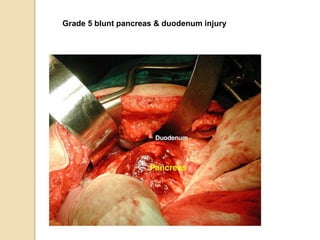
Grade 5 blunt pancreas & duodenum injury
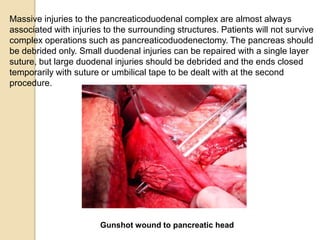
Massive injuries to the pancreaticoduodenal complex are almost always
associated with injuries to the surrounding structures. Patients will not survive
complex operations such as pancreaticoduodenectomy. The pancreas should
be debrided only. Small duodenal injuries can be repaired with a single layer
suture, but large duodenal injuries should be debrided and the ends closed
temporarily with suture or umbilical tape to be dealt with at the second
procedure.
Gunshot wound to pancreatic head
Lung
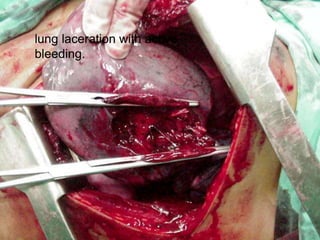
 Pulmonary resection may be
necessary to control haemorrhage or
massive air leaks and to remove
devitalised tissue. Formal pulmonary
lobar or segmental resection is difficult
and unnecessary in the multiply
injured patient. The simplest method
available should be used. This is
usually the linear stapling device
which will control most vascular and
bronchial injuries.
lung laceration with active
bleeding.
This non-anatomical approach also preserves
the maximum amount of functional lung
tissue. If necessary the staple line may be
overrun with a continuous suture. Take care
when controlling superficial injuries with
simple suture. Often this controls only
superficial haemorrhage and bleeding into
deeper tissues continues.
Hilar injuries are best controlled initially with finger
pressure. Most patients injuries will then be found to be
more distal to the hilum and can be treated accordingly.
If hilar control must be achieved this can be done with a
vascular clamp (Satinsky) or umbilical tape in the acute
setting. Up to 50% of patients will die of acute right heart
failure following clamping of hilar structures, so this
decision must be based on absolute necessity.
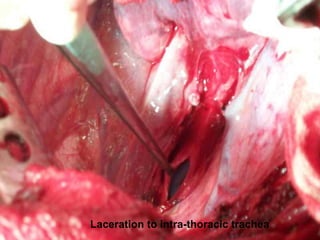
Laceration to intra-thoracic trachea
Closure
 Abdominal closure is rapid and temporary.
Abdominal compartment syndrome is
common in these patients and normally
the abdomen should be left open as a
laparostomy with a silo-bag or vacuum-
pack technique
Critical Care
 The priority of the critical care phase
of treatment is rapid and complete
reversal of metabolic failure. The
damage control procedure has
controlled life-threatening injury, but
the patient requires further surgery to
remove packs and/or definitively
complete the repairs.
Critical Care
 The next 24 to 48 hours are crucial if
the patient is to be fit for a second
procedure. After this time multiple
organ dysfunction, especially acute
respiratory distress syndrome (ARDS),
and cardiovascular failure may render
re-operation inadequate.
 The intensive care unit must act
aggressive to reverse the metabolic
failure. The patient must be actively
warmed, with blankets, air-warming
devices or even continuous
arteriovenous warming techniques.
This is vital to allow correction of
coagulopathy and acidosis.
 Coagulopathy is treated by the
administration of fresh frozen plasma,
cryoprecipitate and platelets as
necessary, and correcting the
hypothermia and acidosis. If correction
of metabolic failure is to succeed, all
three derangements must be treated
simultaneously and aggressively.
Take care not to miss the patient who
has started to actively bleed again.
Large losses from thoracostomy
tubes, abdominal distention or loss of
control of an open abdomen, or
repeated episodes of hypotension all
suggest that mechanical bleeding is
occurring that will require surgical
control.
Reoperation
 The principles of reoperation are
removal of clots and abdominal packs,
complete inspection of the abdomen
to detect missed injuries, haemostasis
and restoration of intestinal integrity
and abdominal wound closure.
 Timing of reoperation is critical. There
is usually a window of opportunity
between correction of metabolic failure
and the onset of the systemic
inflammatory response syndrome and
multiple organ failure. This window
usually occurs at 24-48 hours after the
first procedure.
If packs are left in the abdomen it is
generally recommended that these are
removed at 48-72 hours, although
there is little evidence to suggest that
leaving them longer is detrimental.
 Abdominal packs, especially around the
liver or spleen should be removed
cautiously as they may be stuck to the
parenchyma and removal may lead to
further bleeding. Soaking the swabs may
aid this process. The bleeding is rarely
dramatic however and may be controlled
with argon-beam diathermy or fibrin glue.
Occasionally repacking will be necessary.
 Any intestinal repairs carried out at the
first procedure should be inspected to
determine their continued integrity.
Bowel ends that were stapled or tied
off should be inspected, necrotic
tissue debrided and primary repair
with end-to-end anastomosis
undertaken. With a haemodynamically
stable, warm patient, colostomy is
rarely necessary.
 Copious washout should be performed
and the abdomen closed with
standard mass closure to the sheath
and routine skin closure. If the sheath
cannot be re-approximated temporary
silo closure can be reinstated or an
absorbable PDS or vicryl mesh
applied which can be skin grafted at a
later stage. The resulting incisional
hernia can be closed at a later
procedure
Thank you

Presentation on dcs

  • 1.
    Damage Control Surgery DrIBRAHIM BALOCH MBBS,RMP,FCPS PGR SURGICAL UNIT3 BMCH
  • 13.
  • 14.
    INTRODUCTION "The modern operationis safe for the patient. The modern surgeon must make the patient safe for the modern operation" Suprasternal notch stab wound
  • 15.
    • Overview  Damagecontrol surgery is one of the major advances in surgical technique , they contravene most standard surgical teaching practices - that the best operation for a patient is one, definitive procedure. multiple trauma patients are more likely to die from their intra-operative metabolic failure that from a failure to complete operative repairs.
  • 16.
     Patients withmajor bloodless injuries will not survive complex procedures such as formal hepatic resection or pancreaticoduodenectomy. The central tenet of damage control surgery is that patients die from a triad of coagulopathy, hypothermia and metabolic acidosis.
  • 17.
    Once this metabolicfailure has become established it is extremely difficult to control haemorrhage and correct the derangements. they can be transferred to a critical care facility where they can be corrected. Once this is achieved the definitive surgical procedure can be carried out as necessary - the 'staged procedure'.
  • 18.
    •Damage control approach: Theprinciples of the first 'damage control' procedure then are: -control of haemorrhage, -prevention of contamination & protection from further injury. Damage control surgery is the most technically demanding & challenging surgery a trauma surgeon can perform. There is no margin for error and no place for careless surgery.
  • 19.
    •PHYSIOLOGIC EXHAUSTION Hypothermia,Acidosis&coagulopathy. These threederangements become established quickly in the exsanguinating trauma patient and, once established, form a vicious circle which may be impossible to overcome .
  • 20.
    •Hypothermia: The majority ofmajor trauma patients are hypothermic on arrival in the emergency department due to: - -Environmental conditions at the scene. - -Inadequate protection, - -Intravenous fluid administration - -And ongoing blood loss will worsen the hypothermic state. Hypothermia has dramatic systemic effects on the bodies functions but most importantly in this context exacerbates coagulopathy.
  • 22.
    •Acidosis Uncorrected haemorrhagic shockwill lead into inadequate cellular perfusion , anaerobic metabolism and the production of lactic acid. This leads to profound metabolic acidosis which also interferes with blood clotting mechanisms and promotes coagulopathy and blood loss.
  • 23.
    •Coagulopathy: Hyopthermia,acidosis&the consequences of massiveblood transfusion all lead to the development of a coagulopathy. Even if control of mechanical bleeding is achievable, patients may continue to bleed from all cut surfaces. This leads to a worsening of haemorrhagic shock and so a worsening of hypothermia and acidosis, prolonging the vicious cycle.
  • 24.
    Coagulopathy Some studies haveattempted to place threshold levels on these parameters . Some state that conversion to a damage control procedure should take place if the PH is below 7.2, core temperature is below 32C or the patient has received more than one blood volume transfusion. However , once these levels are reached, physiological exhaustion is already established.
  • 25.
    The trauma surgeonmust make the decision to convert to a limited procedure within 5 minutes of starting the operative procedure. This decision is made on the initial physiological state of the patient and the rapid initial assessment of internal injuries. Do not wait for physiologic exhaustion to set in. Through & thourgh liver injury with Foley catheter balloon control
  • 26.
    Damage control surgery The principles of damage control surgery are abbreviated surgery limited to: 1-Control of haemorrhage 2-Prevention further contamination 3-Avoid further injury
  • 27.
    •Preparation Prehospital and emergencydepartment times should be minimized in these patients. All unnecessary and superfluous investigations that will not immediately affect patient management should be deferred. Cyclic fluid resuscitation prior to surgery is futile and will worsen hypothermia and coagulopathy. Colloid solutions will also interfere with clot quality. These patients should be transferred rapidly to the operating room without repeated attempts to restore circulating volume. They require operative control of haemorrhage and simultaneous vigorous resuscitation with blood and clotting factors.
  • 28.
    Anaesthesia should beinduced on the operating table once the patient is prepped and draped and the surgeons ready. The shocked patient usually requires minimal anaesthesia and a careful, haemodynamically-neutral induction method should be used.
  • 29.
    An arterial lineis valuable for patient monitoring preoperatively but small-calibre central venous access is of limited use. Blood, fresh frozen plasma, cryoprecipitate and platelet transfusions should be available but clotting factor therapy should be administered rapidly only once control of major vascular haemorrhage has been achieved.
  • 30.
    All fluids shouldbe warmed and as much of the patient covered and actively warmed as possible.
  • 31.
    Laparotomy: General Conductand Philosophy The patient should be rapidly prepped from neck to knees with large abdominal packs soaked in antiseptic skin preparation solution. The incision should be made from the xiphisternum to the pubis. This incision may require extension into the right chest or as a median sternotomy depending on the injury pattern.
  • 32.
    Relief of intraperitoneal pressurewith muscle paralysis and opening of the abdominal wall may result in dramatic haemorrhage and hypotension. Immediate control is necessary and this is initially achieved with four quadrant packing with multiple large abdominal packs.
  • 33.
    If there iscontinued arterial haemorrhage with packs in place, aortic control may be necessary. This is generally best achieved at the diaphragmatic hiatus with blunt finger dissection and finger pressure by an assistant followed by aortic cross- clamping. Some surgeons prefer to perform a left anterolateral thoracotomy to control the descending thoracic aorta in the chest. However this requires the opening of a second body cavity and further heat loss and is rarely necessary.
  • 34.
    The next stepis to identify the main source of bleeding. Careful inspection of the four quadrants of the abdomen is necessary. Immediate control of haemorrhage is with direct, blunt pressure using the surgeons hands, swabs on sticks or abdominal packs. Bleeding from the liver, spleen or kidney can generally be achieved by applying pressure with several large abdominal packs.
  • 35.
    Examination of theabdomen must be complete. This includes, where necessary, mobilization and delivery of retroperitoneal structures using several medial visceral rotation manoeuvres. All intraabdominal and most retroperitoneal haematomas require exploration and evacuation. Even a small perienteric or peripancreatic haematoma may mask a serious vascular or enteric injury.
  • 36.
    Exploration should proceedregardless of whether the haematoma is pulsatile, expanding or stable or due to blunt or penetrating trauma. Nonexpanding perirenal haematomas, retro hepatic haematomas or blunt pelvic haematomas should not be explored and may be treated with abdominal packing. Subsequent angiographic embolization may be required renal injury
  • 37.
    Prevention of contaminationis achieved by the rapid closure of hollow viscus injury. This may be definitive if there are only a few enterotomies requiring primary suture, but more complex techniques such as resection and primary anastomosis should be avoided and bowel ends stapled, sewn or tied off. Inspection of the ends and reanastomosis is performed at the second procedure.
  • 39.
    •liver The basic damagecontrol technique for control of hepatic haemorrhage is peri-hepatic packing. This manoeuvre, when performed properly, will arrest most haemorrhage except for major arterial bleeding. Major hepatic bleeding may be partially controlled with a soft vascular clamp on the portal triad (Pringle's manoeuvre). Full hepatic mobilization and extension into the chest either through a median sternotomy or right thoracotomy may be required to achieve this.
  • 40.
    Liver injury  Theliver parenchyma can be compressed manually initially, followed by ordered packing. To adequately pack the liver requires compression in the antero-posterior plane. This can only be achieved by mobilization of the right hepatic ligament and systematic placement of packs posterior and anterior to this, as well as one or two in the hepato-renal space. Even retro hepatic venous and inferior vena cava injuries may be controlled in this manner.
  • 41.
     Only majorarterial bleeds from the liver parenchyma will require further attention. In this case the liver injury can be extended using a finger-fracture technique and the bleeding vessels identified and tied or clipped. In some cases, where the injury is not deep and easily accessible, rapid resection debridement may be possible by placing large clamps along the wound edges, performing a rapid debridement and the under running the clamp with suture to include all the raw surface.  The patient who undergoes hepatic packing should be considered for transfer to the angiography suite immediately after the operation to identify any ongoing arterial haemorrhage which may be controlled with selective angiographic embolization.
  • 42.
    Spleen  Except forminor splenic injuries which may be left alone, splenectomy is the treatment of choice for major spleen injuries. Attempts at splenic conservation are too time-consuming and prone to failure to justify their use in this setting. spleen injury - delayed rupture
  • 43.
    Abdominal Vasculature  Acentral retroperitoneal haematoma likely represents injury to a major vascular structure. Access to the inferior vena cava or abdominal aorta in this setting is best achieved by complete medial visceral rotation of the right or left side of the abdomen. On the right, the colon is mobilised and an extended Kocher manoeuvre performed to mobilise the duodenum. The root of the small bowel mesentery is mobilised up to the superior mesenteric artery and inferior border of the pancreas.
  • 44.
    Right medial visceralrotation (Cattell-Brasch)
  • 45.
    The left colon,spleen and kidney are mobilized and the viscera rotated medially to expose the entire length of the abdominal aorta (the Cattell or Mattox manoeuvre). Left medial visceral rotation (Cattell / Mattox)
  • 46.
    Occasionally the arteriescan be rapidly repaired with direct suture or interposition PTFE graft. However temporary manoeuvres may be more appropriate in the case of physiologic exhaustion the use of intravascular shunts may be considered. A short of tube thoracostomy tube is used for the abdominal aorta. Iliac injuries are more suitable for shunting and carotid shunts, thoracostomy tubing or large-bore IV tubing may be utilized. These may also be useful for superior mesenteric artery injuries intra-arterial shunt in left common iliac artery
  • 47.
    Inferior vena cavainjuries may be managed by direct suture if amenable, or packing if retro hepatic. Temporary control is best achieved with direct pressure above and below the injury using sponge-sticks. Otherwise venous injuries should be ligated in the damage control setting.
  • 48.
    Opening a pelvicretroperitoneal haematoma in the presence of a pelvic fracture is almost universally fatal - even if the internal iliacs are successfully ligated. In this case the retro peritoneum should not be opened but the pelvis packed with large abdominal packs. The pelvis should be stabilized prior to this (a sheet tied tightly around greater trochanters and pubis is adequate) to prevent the packing procedure opening the pelvic fracture and increasing the haemorrhage. retroperitoneal haematoma
  • 49.
    Gastrointestinal Tract  Oncecontrol of haemorrhage has been achieved, attention is turned to prevention of further contamination by controlling spillage of gut contents. Small gastrotomies or enterotomies can be rapidly closed primarily with a single layer continuous suture or skin stapler.
  • 51.
    With extensive damageto the bowel requiring resection, primary anastomosis is required. This may be time consuming and the integrity of the anastomosis is jeopardized in the milieu of generalized hypo perfusion. This may also make decisions about resection margins more difficult to judge.
  • 52.
    Duodenal Injury: Pyloricexclusion & tube duodenostomy :
  • 53.
    Staple closure ofthe colon in damage control surgery Stapling of colon injury as part of a damage control procedure. The colon can be re-anastomosed at a subsequent procedure
  • 54.
    In this case,especially with colonic injuries, or multiple small bowel lesions, it is wiser to resect non-viable bowel and close the ends, leaving them in the abdomen for anastomosis at the second procedure. The linear stapler is useful to achieve this, but bowel ends may be closed with running suture or even umbilical tapes. Ileostomies or colostomies should preferably not be performed in a damage control setting, especially if the abdomen is to be left open, as control of spillage is almost impossible.
  • 55.
    Pancreas  Pancreatic injuryrarely requires or allows definitive surgery in the damage control setting. Minor injuries not involving the duct require no treatment. If possible a closed suction drain may be placed down to the injury, but this should not be done if the abdomen is packed and left open. If the injury is distal (to the superior mesenteric vein ) and there is extensive tissue destruction including the pancreatic duct, it may be possible to perform a rapid distal pancreatectomy.
  • 56.
    Grade 5 bluntpancreas & duodenum injury
  • 57.
    Massive injuries tothe pancreaticoduodenal complex are almost always associated with injuries to the surrounding structures. Patients will not survive complex operations such as pancreaticoduodenectomy. The pancreas should be debrided only. Small duodenal injuries can be repaired with a single layer suture, but large duodenal injuries should be debrided and the ends closed temporarily with suture or umbilical tape to be dealt with at the second procedure. Gunshot wound to pancreatic head
  • 58.
    Lung  Pulmonary resectionmay be necessary to control haemorrhage or massive air leaks and to remove devitalised tissue. Formal pulmonary lobar or segmental resection is difficult and unnecessary in the multiply injured patient. The simplest method available should be used. This is usually the linear stapling device which will control most vascular and bronchial injuries.
  • 60.
    lung laceration withactive bleeding.
  • 61.
    This non-anatomical approachalso preserves the maximum amount of functional lung tissue. If necessary the staple line may be overrun with a continuous suture. Take care when controlling superficial injuries with simple suture. Often this controls only superficial haemorrhage and bleeding into deeper tissues continues.
  • 62.
    Hilar injuries arebest controlled initially with finger pressure. Most patients injuries will then be found to be more distal to the hilum and can be treated accordingly. If hilar control must be achieved this can be done with a vascular clamp (Satinsky) or umbilical tape in the acute setting. Up to 50% of patients will die of acute right heart failure following clamping of hilar structures, so this decision must be based on absolute necessity.
  • 63.
  • 64.
    Closure  Abdominal closureis rapid and temporary. Abdominal compartment syndrome is common in these patients and normally the abdomen should be left open as a laparostomy with a silo-bag or vacuum- pack technique
  • 65.
    Critical Care  Thepriority of the critical care phase of treatment is rapid and complete reversal of metabolic failure. The damage control procedure has controlled life-threatening injury, but the patient requires further surgery to remove packs and/or definitively complete the repairs.
  • 66.
    Critical Care  Thenext 24 to 48 hours are crucial if the patient is to be fit for a second procedure. After this time multiple organ dysfunction, especially acute respiratory distress syndrome (ARDS), and cardiovascular failure may render re-operation inadequate.
  • 67.
     The intensivecare unit must act aggressive to reverse the metabolic failure. The patient must be actively warmed, with blankets, air-warming devices or even continuous arteriovenous warming techniques. This is vital to allow correction of coagulopathy and acidosis.
  • 68.
     Coagulopathy istreated by the administration of fresh frozen plasma, cryoprecipitate and platelets as necessary, and correcting the hypothermia and acidosis. If correction of metabolic failure is to succeed, all three derangements must be treated simultaneously and aggressively.
  • 69.
    Take care notto miss the patient who has started to actively bleed again. Large losses from thoracostomy tubes, abdominal distention or loss of control of an open abdomen, or repeated episodes of hypotension all suggest that mechanical bleeding is occurring that will require surgical control.
  • 70.
    Reoperation  The principlesof reoperation are removal of clots and abdominal packs, complete inspection of the abdomen to detect missed injuries, haemostasis and restoration of intestinal integrity and abdominal wound closure.
  • 71.
     Timing ofreoperation is critical. There is usually a window of opportunity between correction of metabolic failure and the onset of the systemic inflammatory response syndrome and multiple organ failure. This window usually occurs at 24-48 hours after the first procedure.
  • 72.
    If packs areleft in the abdomen it is generally recommended that these are removed at 48-72 hours, although there is little evidence to suggest that leaving them longer is detrimental.
  • 73.
     Abdominal packs,especially around the liver or spleen should be removed cautiously as they may be stuck to the parenchyma and removal may lead to further bleeding. Soaking the swabs may aid this process. The bleeding is rarely dramatic however and may be controlled with argon-beam diathermy or fibrin glue. Occasionally repacking will be necessary.
  • 74.
     Any intestinalrepairs carried out at the first procedure should be inspected to determine their continued integrity. Bowel ends that were stapled or tied off should be inspected, necrotic tissue debrided and primary repair with end-to-end anastomosis undertaken. With a haemodynamically stable, warm patient, colostomy is rarely necessary.
  • 75.
     Copious washoutshould be performed and the abdomen closed with standard mass closure to the sheath and routine skin closure. If the sheath cannot be re-approximated temporary silo closure can be reinstated or an absorbable PDS or vicryl mesh applied which can be skin grafted at a later stage. The resulting incisional hernia can be closed at a later procedure
  • 78.