Operating Systems
Structure of
Operating Systems
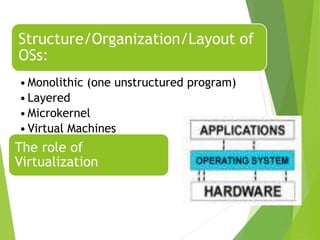
Structure/Organization/Layout of
OSs:
•Monolithic (one unstructured program)
•Layered
•Microkernel
•Virtual Machines
The role of
Virtualization
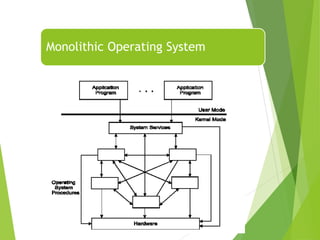
Monolithic Operating System
UNIX System Structure
UNIX – limited by hardware functionality, the original UNIX OS had
limited structuring.
The UNIX OS consists of two separable parts:
• Systems Programs:
• The Kernel:
• Consists of everything below the system-call interface and
above the physical hardware.
• Provides the file system, CPU scheduling, memory
management, and other operating-system functions; a large
number of functions for one level.
Traditional UNIX System Structure
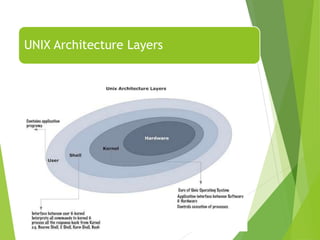
UNIX Architecture Layers
UNIX System Structure
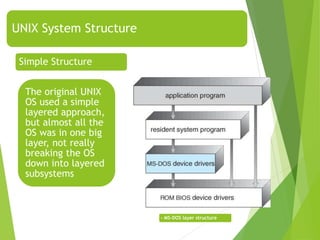
The original UNIX
OS used a simple
layered approach,
but almost all the
OS was in one big
layer, not really
breaking the OS
down into layered
subsystems
Simple Structure
- MS-DOS layer structure
UNIX System Structure
Layered Approach
This approach allows each layer to be developed and
debugged independently, with the assumption that all lower
layers have already been debugged and are trusted to
deliver proper services.
Another approach is to break the OS into a number of smaller
layers, each of which rests on the layer below it, and relies
solely on the services provided by the next lower layer
UNIX System Structure
A layered operating system
UNIX System Structure
Hybrid Systems
Mac OS X
iOS
Android
Most OSes today
do not strictly
adhere to one
architecture, but
are hybrids of
several.
UNIX System Structure
Mac OS X
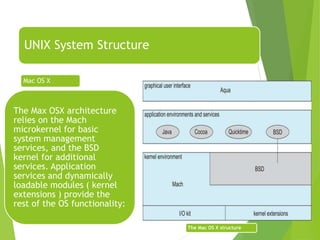
The Max OSX architecture
relies on the Mach
microkernel for basic
system management
services, and the BSD
kernel for additional
services. Application
services and dynamically
loadable modules ( kernel
extensions ) provide the
rest of the OS functionality:
The Mac OS X structure
UNIX System Structure
iOS
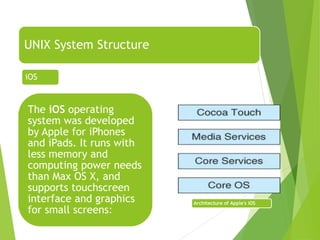
The iOS operating
system was developed
by Apple for iPhones
and iPads. It runs with
less memory and
computing power needs
than Max OS X, and
supports touchscreen
interface and graphics
for small screens:
Architecture of Apple's iOS
UNIX System Structure
Android
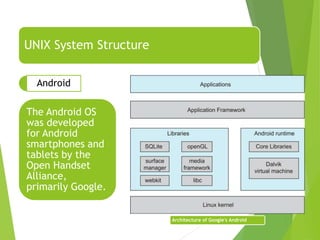
The Android OS
was developed
for Android
smartphones and
tablets by the
Open Handset
Alliance,
primarily Google.
Architecture of Google's Android

Presentation of UNIX

  • 1.
  • 2.
    Structure/Organization/Layout of OSs: •Monolithic (oneunstructured program) •Layered •Microkernel •Virtual Machines The role of Virtualization
  • 3.
  • 4.
    UNIX System Structure UNIX– limited by hardware functionality, the original UNIX OS had limited structuring. The UNIX OS consists of two separable parts: • Systems Programs: • The Kernel: • Consists of everything below the system-call interface and above the physical hardware. • Provides the file system, CPU scheduling, memory management, and other operating-system functions; a large number of functions for one level.
  • 5.
  • 6.
  • 7.
    UNIX System Structure Theoriginal UNIX OS used a simple layered approach, but almost all the OS was in one big layer, not really breaking the OS down into layered subsystems Simple Structure - MS-DOS layer structure
  • 8.
    UNIX System Structure LayeredApproach This approach allows each layer to be developed and debugged independently, with the assumption that all lower layers have already been debugged and are trusted to deliver proper services. Another approach is to break the OS into a number of smaller layers, each of which rests on the layer below it, and relies solely on the services provided by the next lower layer
  • 9.
    UNIX System Structure Alayered operating system A layered operating system
  • 10.
    UNIX System Structure HybridSystems Mac OS X iOS Android Most OSes today do not strictly adhere to one architecture, but are hybrids of several.
  • 11.
    UNIX System Structure MacOS X The Max OSX architecture relies on the Mach microkernel for basic system management services, and the BSD kernel for additional services. Application services and dynamically loadable modules ( kernel extensions ) provide the rest of the OS functionality: The Mac OS X structure
  • 12.
    UNIX System Structure iOS TheiOS operating system was developed by Apple for iPhones and iPads. It runs with less memory and computing power needs than Max OS X, and supports touchscreen interface and graphics for small screens: Architecture of Apple's iOS
  • 13.
    UNIX System Structure Android TheAndroid OS was developed for Android smartphones and tablets by the Open Handset Alliance, primarily Google. Architecture of Google's Android