Operating System Structure
Dr. Gowthami V
Operating System Structure
Monolithic Kernel
• all operating system services and functions are bundled together in a
single large executable.
Microkernel:
• It follows a minimalist approach, where only essential functions like
process management, memory management, and inter-process
communication (IPC) reside in the kernel.
• Layered Architecture:
• The operating system is divided into layers, where each layer provides
specific functionality.
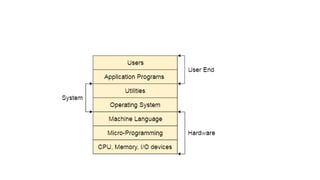
A Computer System consists of:
• Users (people who are using the computer)
• Application Programs (Compilers, Databases, Games, Video player,
Browsers, etc.)
• System Programs (Shells, Editors, Compilers, etc.)
• Operating System ( A special program which acts as an interface
between user and hardware )
• Hardware ( CPU, Disks, Memory, etc)
Virtual Machine (VM):
• To create and manage multiple virtual machines on a single physical
machine.
• Each virtual machine runs its own operating system instance, enabling
better isolation and resource utilization for different tasks .
• Client-Server Model:
• It is a collection of services that can be accessed remotely.
• Clients request services from servers, which provide the necessary
functionality.
• Exokernel:
• It provides a minimalistic interface to applications and delegates
resource management tasks, such as memory and hardware control,
to user-level programs.
• Hybrid Models:
• It use hybrid structures that combine elements from different models.
• Object-Oriented Design:
• components are modeled as objects with associated data and
methods.
• This design promotes reusability, extensibility, and encapsulation.
• Clustered System:
• Multiple machines are interconnected to work together as a single
system.
• Distributed System:
• Multiple interconnected computers collaborate to provide a unified
computing environment.

Operating System Structure.pptx

  • 1.
  • 2.
    Operating System Structure MonolithicKernel • all operating system services and functions are bundled together in a single large executable. Microkernel: • It follows a minimalist approach, where only essential functions like process management, memory management, and inter-process communication (IPC) reside in the kernel.
  • 3.
    • Layered Architecture: •The operating system is divided into layers, where each layer provides specific functionality.
  • 5.
    A Computer Systemconsists of: • Users (people who are using the computer) • Application Programs (Compilers, Databases, Games, Video player, Browsers, etc.) • System Programs (Shells, Editors, Compilers, etc.) • Operating System ( A special program which acts as an interface between user and hardware ) • Hardware ( CPU, Disks, Memory, etc)
  • 6.
    Virtual Machine (VM): •To create and manage multiple virtual machines on a single physical machine. • Each virtual machine runs its own operating system instance, enabling better isolation and resource utilization for different tasks .
  • 7.
    • Client-Server Model: •It is a collection of services that can be accessed remotely. • Clients request services from servers, which provide the necessary functionality. • Exokernel: • It provides a minimalistic interface to applications and delegates resource management tasks, such as memory and hardware control, to user-level programs.
  • 8.
    • Hybrid Models: •It use hybrid structures that combine elements from different models. • Object-Oriented Design: • components are modeled as objects with associated data and methods. • This design promotes reusability, extensibility, and encapsulation.
  • 9.
    • Clustered System: •Multiple machines are interconnected to work together as a single system. • Distributed System: • Multiple interconnected computers collaborate to provide a unified computing environment.