spotONfriday webinar:
Managing Integrated Customer-Centric
Global Campaigns
Presenter:
Shelby Torrence
Director, campaign management services
@globalmktgpro
shelby@spotonvision.com
Host:
Charles van der Wal
Marketing Operations Consultant
@charlesvdwal
charles@spotonvision.com
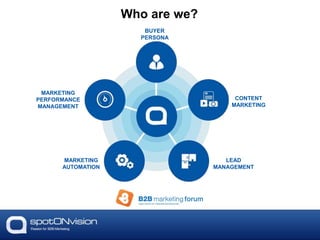
MARKETING
PERFORMANCE
MANAGEMENT
BUYER
PERSONA
CONTENT
MARKETING
LEAD
MANAGEMENT
MARKETING
AUTOMATION
Who are we?
spotONfriday webinars:
10 April: Kunnen B2B-marketeers ROI aantonen?
8 May: Klantbeleving in B2B: een onderzoek naar customer centricity in B2B
12 June: Ken je koper: wat & hoe buyer persona’s
spotONvision masterclass:
23 April: Contentmarketing voor gevorderden
Upcoming events
Upcoming events
17 March 2015: B2B Marketing Forum 2015
Questions?
GoToWebinar:
“Chat” or “Ask a question”
OF
Twitter met #b2bnl tag
Twitter: @spotonvision
@charlesvdwal
#b2bnl
• Defining integrated customer-centric global campaigns
• 7 step plan
• Example
• Take-aways & key learnings
• Q&A
Today’s webinar:
Defining integrated customer-centric global
campaigns
Poll:
What kind of campaigns do you
typically run?
Defining integrated customer-centric global
campaigns
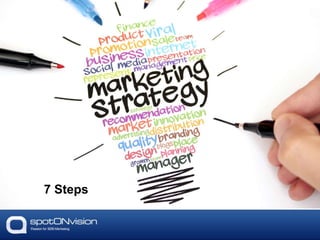
7 Steps
Step 1:
Define campaign scope
• Set objectives. Be specific.
• Create the budget overview.
• Get buy-in from stakeholders.
• Identify required resources.
Step 1:
Define campaign scope
Step 1: Define campaign scope
Step 2:
Select target audience
• Define target audience based on the customer pain.
• Buyer Personas
• Segmentation
• Review digital profiles
• Quantify reach
Step 2: Select target audience
Step 3 + 4:
Content coordination & action plan
Content Coordination:
• Key content
• Whitepapers, Powerpoint, eBooks,
calculators, assessments
• Translating/localizing content
• Don’t miss the details
Action Plan Defines
• Touch points
• Promotional channels
• Execution timing
• KPI’s & tools for measuring
• Sales follow-up plan
Step 3 + 4: Content coordination & action plan
Poll:
How supportive is your sales team?
Step 5:
Enablement
• Critical part of ensuring success.
• Like any relevant content, the message needs to be targeted.
• Be open to input. Be willing to test. But don’t get side-
tracked.
• Set expectations. Create excitement,.
Step 5: Enablement
Step 6:
Campaign execution
• Measurement tools
• Pilot
• Global vs. Regional
• Inbound Channels first
Step 6: Campaign execution
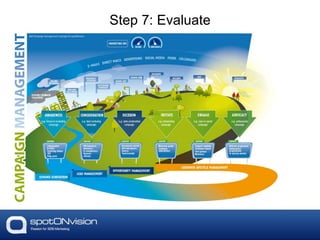
Step 7: Evaluate
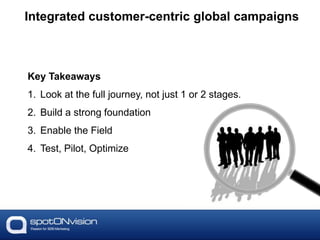
Key Takeaways
1. Look at the full journey, not just 1 or 2 stages.
2. Build a strong foundation
3. Enable the Field
4. Test, Pilot, Optimize
Integrated customer-centric global campaigns
Examples
• Competitive campaigns
• Customer pain points
• Events
Examples
spotONfriday webinars:
10 April: Kunnen B2B-marketeers ROI aantonen?
8 May: Klantbeleving in B2B: een onderzoek naar customer centricity in B2B
12 June: Ken je koper: wat & hoe buyer persona’s
spotONvision masterclass:
23 April: Contentmarketing voor gevorderden
Q&A
Want to know more? Or need help with the setup and
execution of global campaigns?
www.spotonvision.com
@spotONvision
@b2bmktforum
@charlesvdwal
@globalmktgpro
LinkedIn groups:
B2B Marketing Forum, en
Passion for B2B Marketing
http://www.youtube.com/user/spotONvision
spotONfriday webinar: Managing Integrated Customer-Centric Global Campaigns

spotONfriday webinar: Managing Integrated Customer-Centric Global Campaigns

Editor's Notes

  • #2 Polling question – What kind of campaigns do you typically run? Global EMEA-wide Western Europe Benelux Other
  • #8 It’s a lot to say Integrated global campaigns is not so hard to understand What is a customer-centric campaign? How is it different from other campaigns?
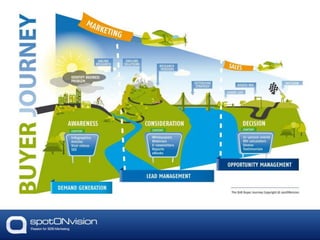
  • #9 If you know spotONvision, this is not new to you This is how we’ve illustrated the buyer’s journey It’s been very helpful. It’s helped us/our clients create engaging content It’s helped us understand the needs and requirements of our buyers – their buying process The challenge is that from a campaign perspective this is not the full story.
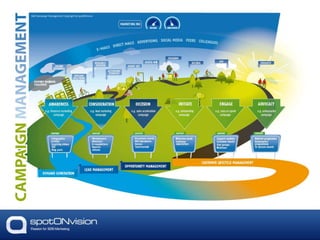
  • #10 This is how we illustrate campaign management – from beginning to end. Now as marketers we’ve tended to look at this in stages. We tend to think of campaigns as either lead gen or upsell-cross-sell. But the customer experience is not divided that we. It’s continuous. Sometimes customers start and stop along the way. It’s definitely not an easy or quick journey. Customer-centric doesn’t just mean campaigns for your existing customer base. The complete customer journey – from unknown suspect to loyal advocate. So I hope that make sense. And hopefully the meaning will become even clearer as we go through this presentation. Before continuing, let’s get some feedback from all of you. We have a polling question.
  • #12 These are our building blocks I’m not going to talk about these here But think of it as a recipe and this is our list of ingredients
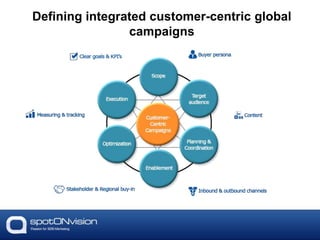
  • #13 We’re going to take the ingredients and go through a 7 Step plan for managing integrated customer-centric global campaigns
  • #14 I like to breakdown target goals by region. It’s a way of keeping myself honest and making sure it’s really a global campaign. Be selective with your stakeholders Management, budget approval Key insights Champions – positive attitude excited Resources External advocates – customers, partners SMEs Asset development – content, event organization, PR, Social,
  • #15 Be selective with your stakeholders
  • #16 If you have your buyer persona ready to go, this step is a lot easier. Without the buyer persona, it’s much more challenging But if you have existing customers you can analyse their profiles and speak with them in order to understand your audience better. Understand the information needs, preferred channels, preferred content formats, and language Be sure to create segments. The audience is not homogenous. Better chance of success with diversity.
  • #17 So we’ve said that a customer-centric campaign should address a customer pain point. Now we need to understand who within your target audience is feeling the pain the most? If you have your buyer persona ready to go, this step is a lot easier. Without the buyer persona, it’s much more challenging but if you have existing customers who are With customer campaigns, this should be easier because you should be able to talk with your customers directly and get their input. Segments may differ. The audience is not homogenous. Better chance of success with diversity. Understand the information needs, preferred channels, preferred content formats, and language
  • #18 You’ve got your budget, you’ve got your objectives, and you’ve defined your target audience. Now it gets a little complicated because the next 2 steps really need to be done in parallel. You need to make sure you have the right content and chances are you will need to develop some content, which takes time so you need to do it early in the process But to develop the right content you need your action plan. That’s why these steps intertwine. You’re Action Plan is where you define touch points, promotional channels, timing, the KPIs based on the objectives you set in the scope, the tools you’ll use to measure the campaigns and very importantly the Sales follow-up plan. That’s a key component that is sometimes forgotten. You’re Action Plan should be written down. It shouldn’t just be in your head. I always share it with my stakeholders and get their input. When you’re developing your Content and your Action Plan for global campaigns, the issue of translation and localization needs to be comprehensively addressed. And not just for your campaign assets like whitepapers. Don’t forget the little things – like Titles, Email subject lines, Images, Symbols like using $ vs. Yen, etc. When these elements are not planned, our execution is weaker.
  • #19 So you’ve tackled what I consider is the most complicated part of the campaign, next is the most challenging part.
  • #21 Polling question – How supportive/involved is your sales team? Enablement can be tricky, especially for global campaigns. But in B2B it’s really impossible to be successful without support from Sales. Good campaigns can easily be derailed with-out proper filed roll-out Use your champions here! Approach enablement like you approach the campaign – create the right message and the right tools for each segment Be flexible – be willing to test ideas. But don’t get side-tracked
  • #23 So now you’re ready to execute. Because you laid out your Action Plan and received feedback Execution should be a breeze. Okay, not a breeze, but you’re prepared for the challenges that will come your way. And there will be challenges. It’s never going to go as smoothly as you’d like. There will always be some unexpected issues. I recommend piloting. Try testing in 2-3 countries or regions or within a specific segment. I always start with Inbound channels first. It’s easier to quickly evaluate and make changes on Inbound channels Make sure that in the excite to launch, that important details are not missed. Make sure that you take care of details like launching in correct time zones matter,
  • #25 Step 7 but it starts during Step 6 while executing Expect to tweak and optimize. Plan on periodic analysis – I would aim for bi-weekly, but sometimes when a campaign first launches, I look at it weekly. Talk to Sales; get feedback; share it globally – Sales team tend to work regionally Measure through to revenue based on buying cycle Debrief so you can duplicate success and really understand where improvements are needed
  • #29 Examples