
WHAT IS VOCABULARY?
WHAT IS LEXIS ?

It refers mainly to single words,
e.g. market and sometimes to
very tightly linked 2 or 3 words
combinations , e.g. stock
market.
VOCABULARY

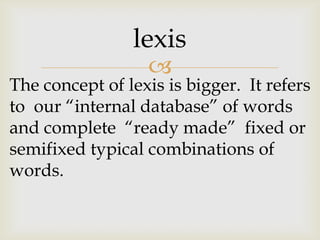
The concept of lexis is bigger. It refers
to our “internal database” of words
and complete “ready made” fixed or
semifixed typical combinations of
words.
lexis

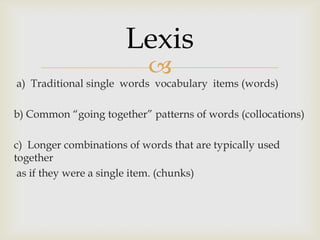
a) Traditional single words vocabulary items (words)
b) Common “going together” patterns of words (collocations)
c) Longer combinations of words that are typically used
together
as if they were a single item. (chunks)
Lexis

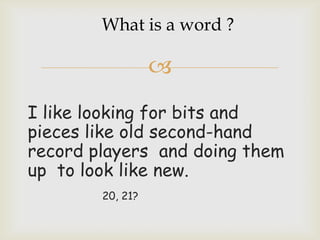
I like looking for bits and
pieces like old second-hand
record players and doing them
up to look like new.
20, 21?
What is a word ?

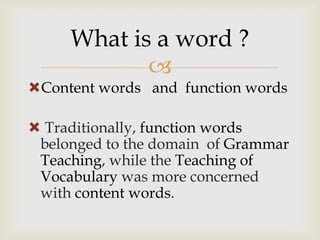
Content words and function words
 Traditionally, function words
belonged to the domain of Grammar
Teaching, while the Teaching of
Vocabulary was more concerned
with content words.
What is a word ?

A lexical approach to language teaching
foregrounds vocabulary learning, both in
the form of individual, high frequency
words, and in the form of word
combinations (chunks)
How words go together and in context.
Lexical approach
 a syllabus should be organised around meanings
 the most frequent words encode the most frequent
meanings and
 words typically co-occur with other words
 these co-ocurences are an aid to fluency
Lexical approach:
principles

 The coining of new words never stops. Nor does the
acquisition of words.
 We are constantly learning new words and learning
new meanings for old words.
What is a word ?

 “A deep red in colour. Lush and soft aroma with
plums and blackberries. The mouthfeel is plush
and comfortable like an old pair of slippers. The
generous finish ends with a grippy earthy
aftertaste”
 www.ewine.ex.aus
What is a word ?

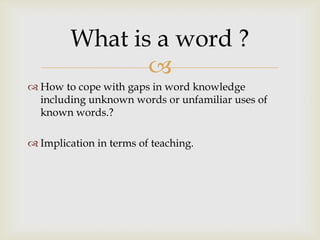
 How to cope with gaps in word knowledge
including unknown words or unfamiliar uses of
known words.?
 Implication in terms of teaching.
What is a word ?
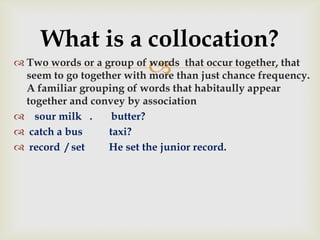
 Two words or a group of words that occur together, that
seem to go together with more than just chance frequency.
A familiar grouping of words that habitaully appear
together and convey by association
 sour milk . butter?
 catch a bus taxi?
 record / set He set the junior record.
What is a collocation?

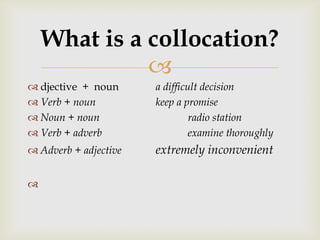
 djective + noun a difficult decision
 Verb + noun keep a promise
 Noun + noun radio station
 Verb + adverb examine thoroughly
 Adverb + adjective extremely inconvenient

What is a collocation?

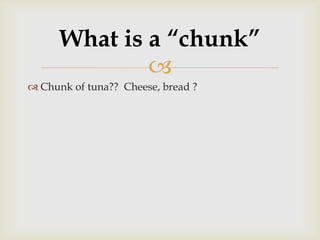
 Chunk of tuna?? Cheese, bread ?
What is a “chunk”

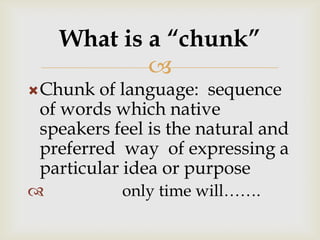
Chunk of language: sequence
of words which native
speakers feel is the natural and
preferred way of expressing a
particular idea or purpose
 only time will…….
What is a “chunk”

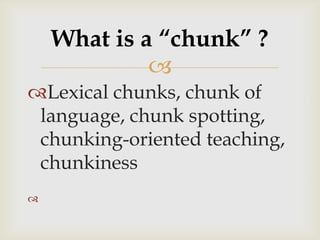
Lexical chunks, chunk of
language, chunk spotting,
chunking-oriented teaching,
chunkiness

What is a “chunk” ?

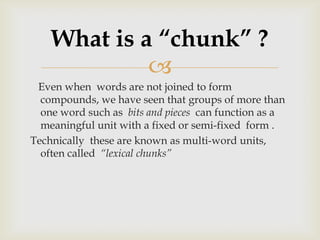
Even when words are not joined to form
compounds, we have seen that groups of more than
one word such as bits and pieces can function as a
meaningful unit with a fixed or semi-fixed form .
Technically these are known as multi-word units,
often called “lexical chunks”
What is a “chunk” ?

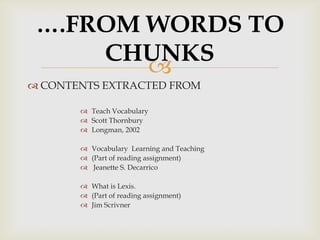
 CONTENTS EXTRACTED FROM
 Teach Vocabulary
 Scott Thornbury
 Longman, 2002
 Vocabulary Learning and Teaching
 (Part of reading assignment)
 Jeanette S. Decarrico
 What is Lexis.
 (Part of reading assignment)
 Jim Scrivner
….FROM WORDS TO
CHUNKS

Presentation from_words_to_chunks

  • 2.
  • 3.
     It refers mainlyto single words, e.g. market and sometimes to very tightly linked 2 or 3 words combinations , e.g. stock market. VOCABULARY
  • 4.
     The concept oflexis is bigger. It refers to our “internal database” of words and complete “ready made” fixed or semifixed typical combinations of words. lexis
  • 5.
     a) Traditional singlewords vocabulary items (words) b) Common “going together” patterns of words (collocations) c) Longer combinations of words that are typically used together as if they were a single item. (chunks) Lexis
  • 6.
     I like lookingfor bits and pieces like old second-hand record players and doing them up to look like new. 20, 21? What is a word ?
  • 7.
     Content words andfunction words  Traditionally, function words belonged to the domain of Grammar Teaching, while the Teaching of Vocabulary was more concerned with content words. What is a word ?
  • 8.
     A lexical approachto language teaching foregrounds vocabulary learning, both in the form of individual, high frequency words, and in the form of word combinations (chunks) How words go together and in context. Lexical approach
  • 9.
     a syllabusshould be organised around meanings  the most frequent words encode the most frequent meanings and  words typically co-occur with other words  these co-ocurences are an aid to fluency Lexical approach: principles
  • 10.
      The coiningof new words never stops. Nor does the acquisition of words.  We are constantly learning new words and learning new meanings for old words. What is a word ?
  • 11.
      “A deepred in colour. Lush and soft aroma with plums and blackberries. The mouthfeel is plush and comfortable like an old pair of slippers. The generous finish ends with a grippy earthy aftertaste”  www.ewine.ex.aus What is a word ?
  • 12.
      How tocope with gaps in word knowledge including unknown words or unfamiliar uses of known words.?  Implication in terms of teaching. What is a word ?
  • 13.
     Two wordsor a group of words that occur together, that seem to go together with more than just chance frequency. A familiar grouping of words that habitaully appear together and convey by association  sour milk . butter?  catch a bus taxi?  record / set He set the junior record. What is a collocation?
  • 14.
      djective +noun a difficult decision  Verb + noun keep a promise  Noun + noun radio station  Verb + adverb examine thoroughly  Adverb + adjective extremely inconvenient  What is a collocation?
  • 15.
      Chunk oftuna?? Cheese, bread ? What is a “chunk”
  • 16.
     Chunk of language:sequence of words which native speakers feel is the natural and preferred way of expressing a particular idea or purpose  only time will……. What is a “chunk”
  • 17.
     Lexical chunks, chunkof language, chunk spotting, chunking-oriented teaching, chunkiness  What is a “chunk” ?
  • 18.
     Even when wordsare not joined to form compounds, we have seen that groups of more than one word such as bits and pieces can function as a meaningful unit with a fixed or semi-fixed form . Technically these are known as multi-word units, often called “lexical chunks” What is a “chunk” ?
  • 19.
      CONTENTS EXTRACTEDFROM  Teach Vocabulary  Scott Thornbury  Longman, 2002  Vocabulary Learning and Teaching  (Part of reading assignment)  Jeanette S. Decarrico  What is Lexis.  (Part of reading assignment)  Jim Scrivner ….FROM WORDS TO CHUNKS