Road Extraction fromRemote Sensing Images using SVM combined with FCM and MRFJiawei Xu MULTIMEDIA PROCESSING LABORATORYDepartment of Electronic Engineering, Hallym UniversityE-mail: abyssecho@hallym.ac.kr
ContentsIntroductionA brief review of previous methodsMulti-times SVMProposed algorithmExperimental resultsPerformance evaluationConclusion
A brief review of previous methodsMathematical morphologyHough transformP-value segmentationGenetic algorithmMarkov random field
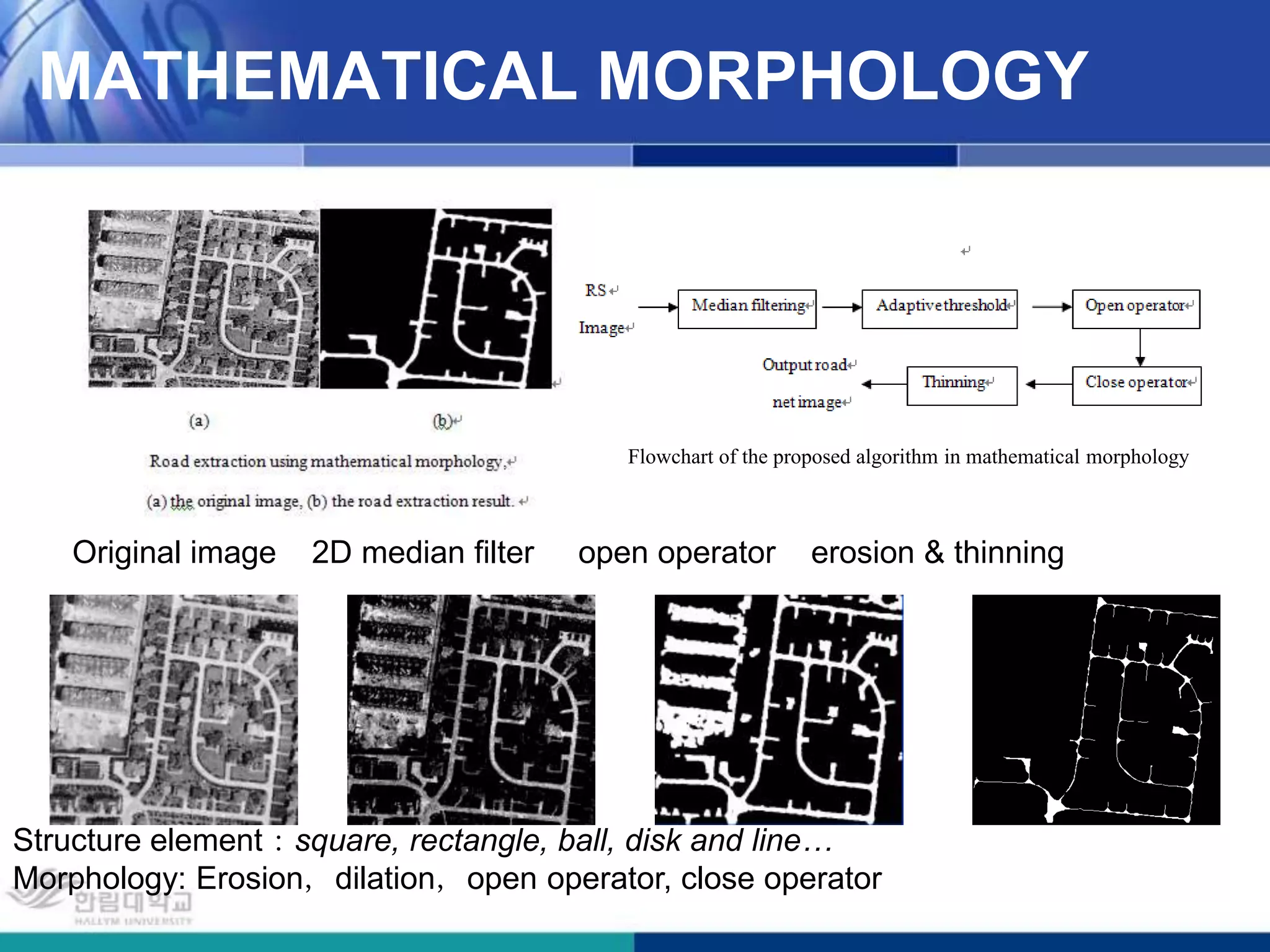
MATHEMATICAL MORPHOLOGYFlowchart of the proposed algorithm in mathematical morphologyOriginal image    2D median filter     open operator    erosion & thinningStructure element:square, rectangle, ball, disk and line…Morphology: Erosion,dilation,openoperator, close operator
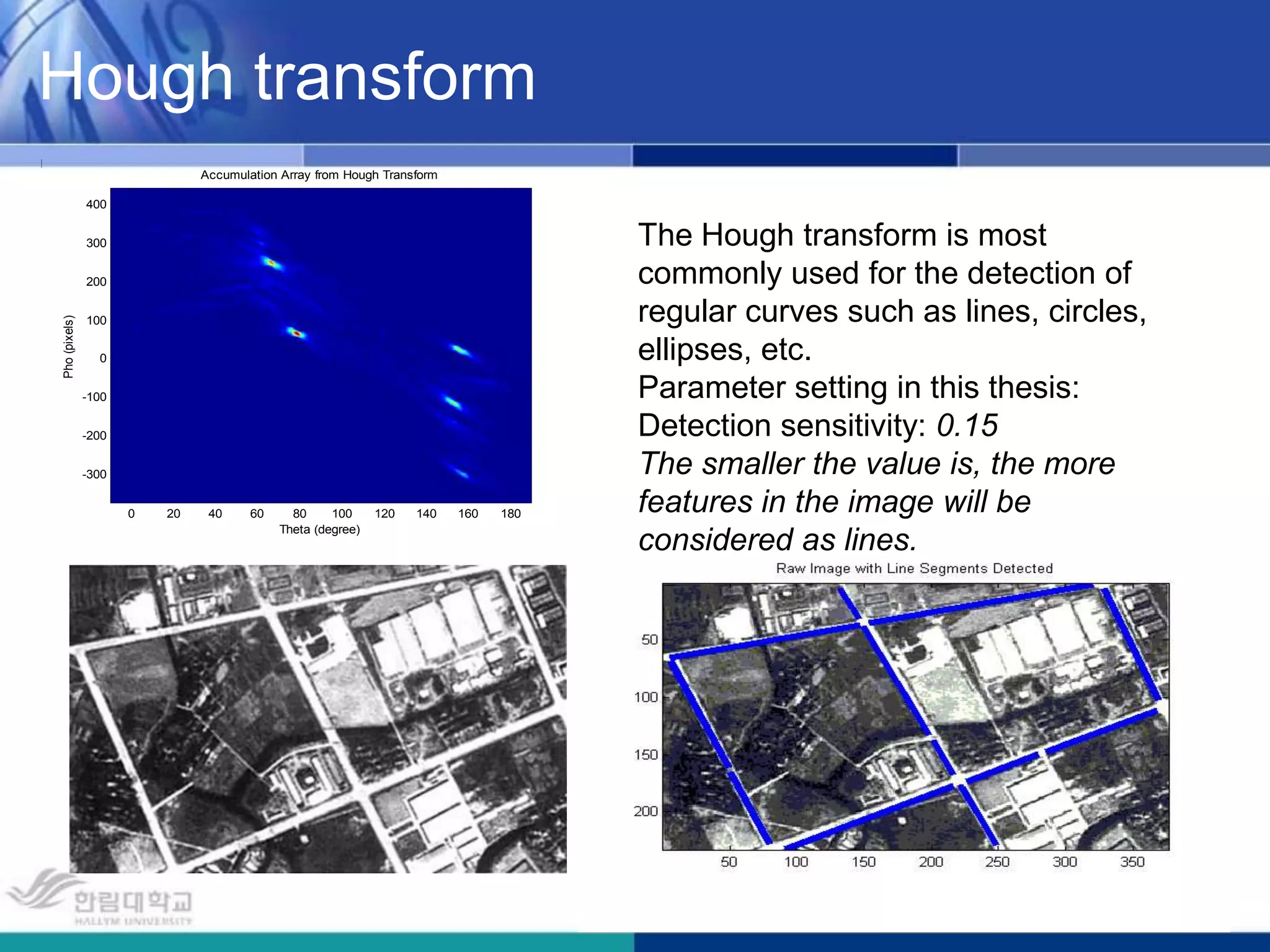
Hough transformThe Hough transform is most commonly used for the detection of regular curves such as lines, circles, ellipses, etc.Parameter setting in this thesis:Detection sensitivity: 0.15The smaller the value is, the more features in the image will be considered as lines.
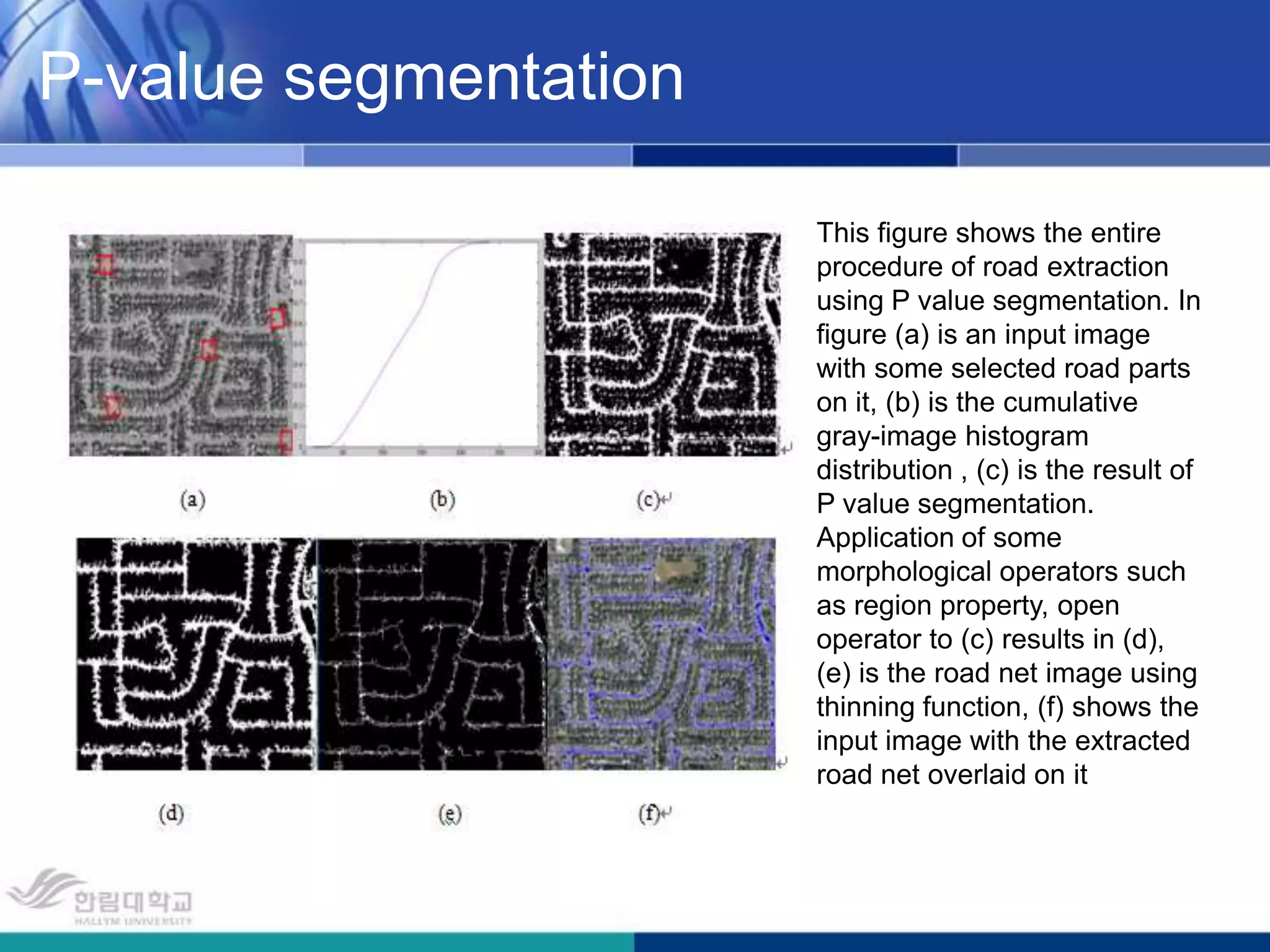
P-value segmentationThis figure shows the entire procedure of road extraction using P value segmentation. In figure (a) is an input image with some selected road parts on it, (b) is the cumulative gray-image histogram distribution , (c) is the result of P value segmentation. Application of some morphological operators such as region property, open operator to (c) results in (d), (e) is the road net image using thinning function, (f) shows the input image with the extracted road net overlaid on it
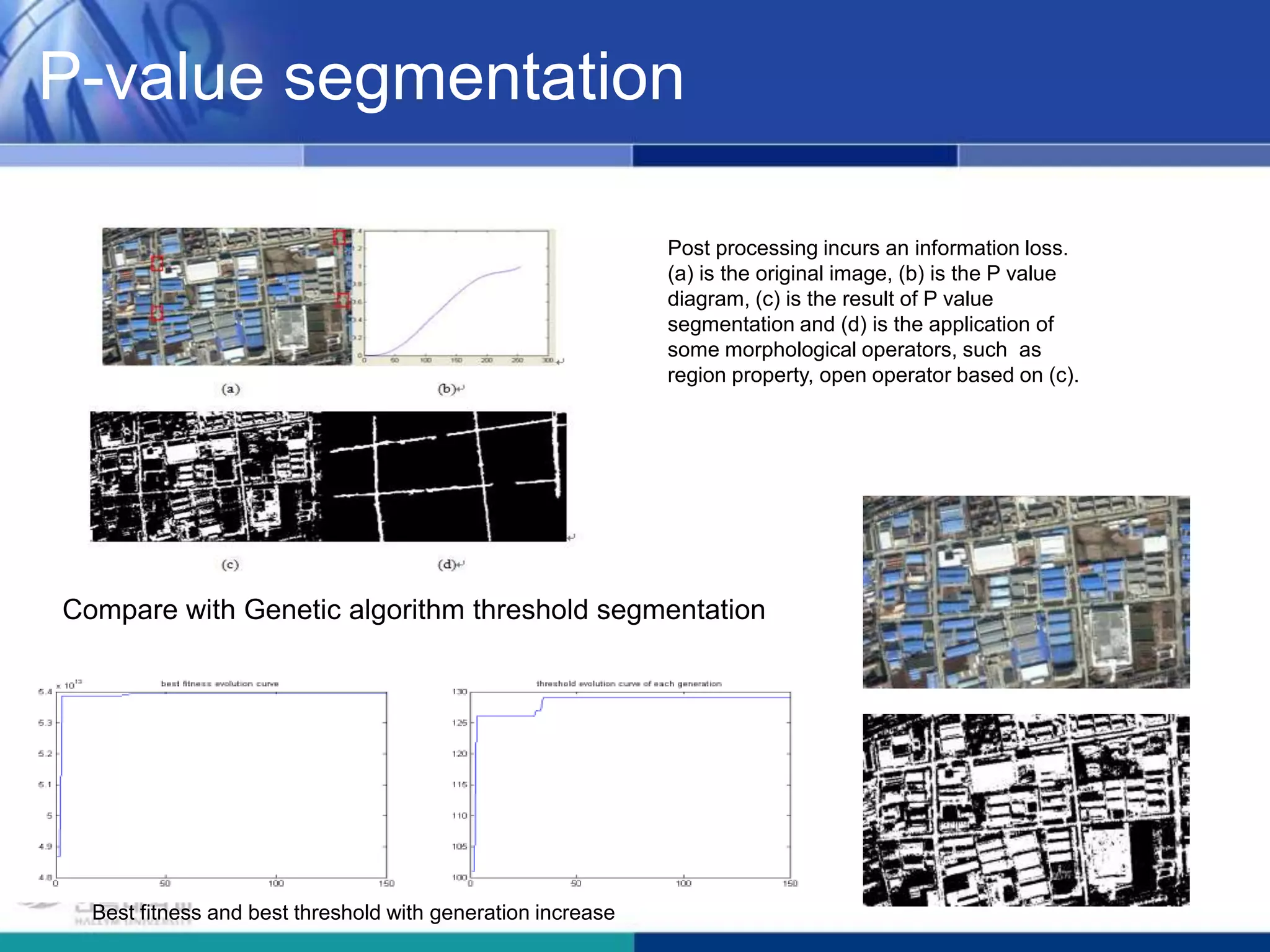
P-value segmentationPost processing incurs an information loss. (a) is the original image, (b) is the P value diagram, (c) is the result of P value segmentation and (d) is the application of some morphological operators, such  as region property, open operator based on (c).Compare with Genetic algorithm threshold segmentationBest fitness and best threshold with generation increase
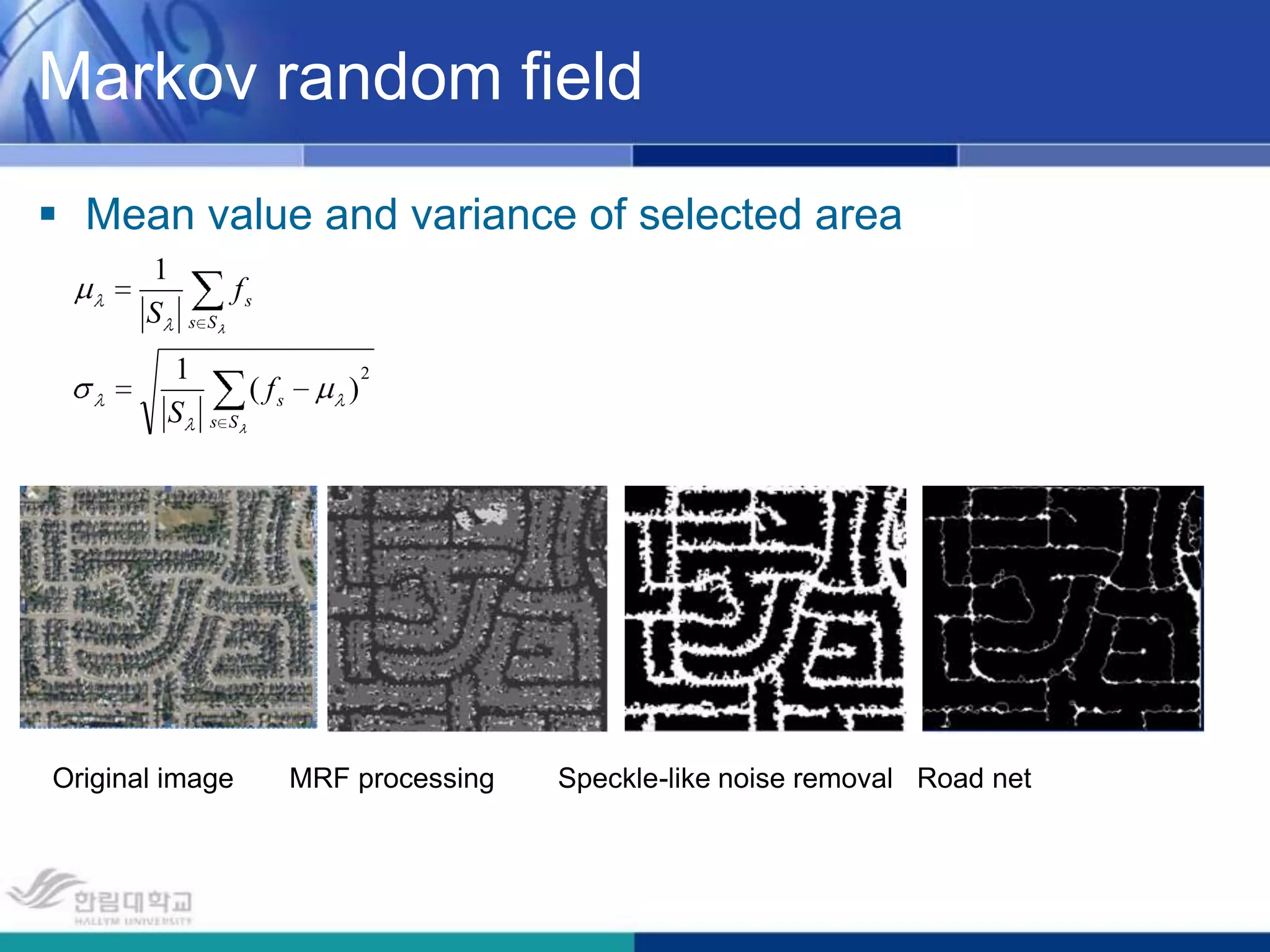
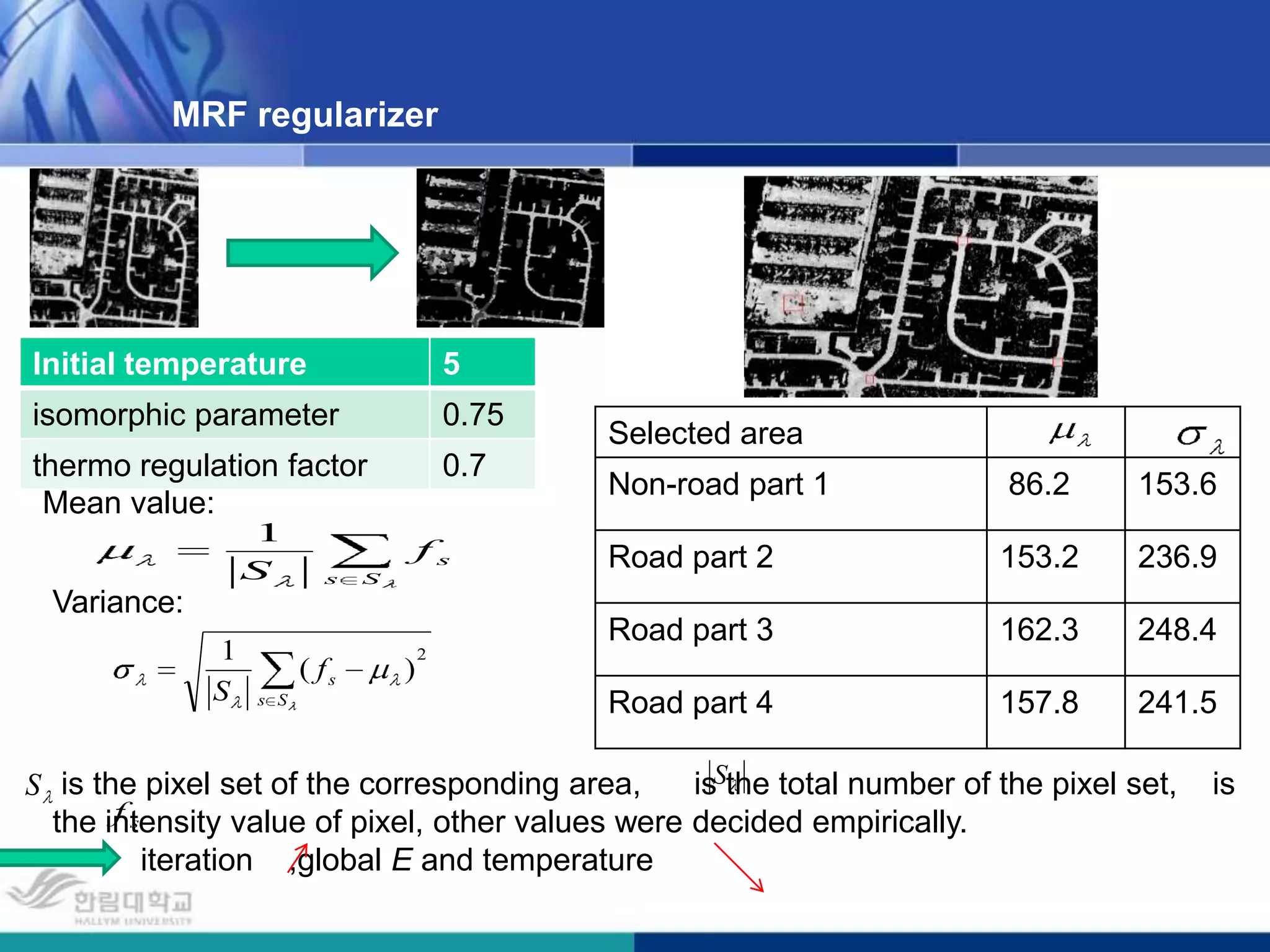
Markov random fieldMean value and variance of selected areaOriginal image       MRF processing        Speckle-like noise removal   Road net
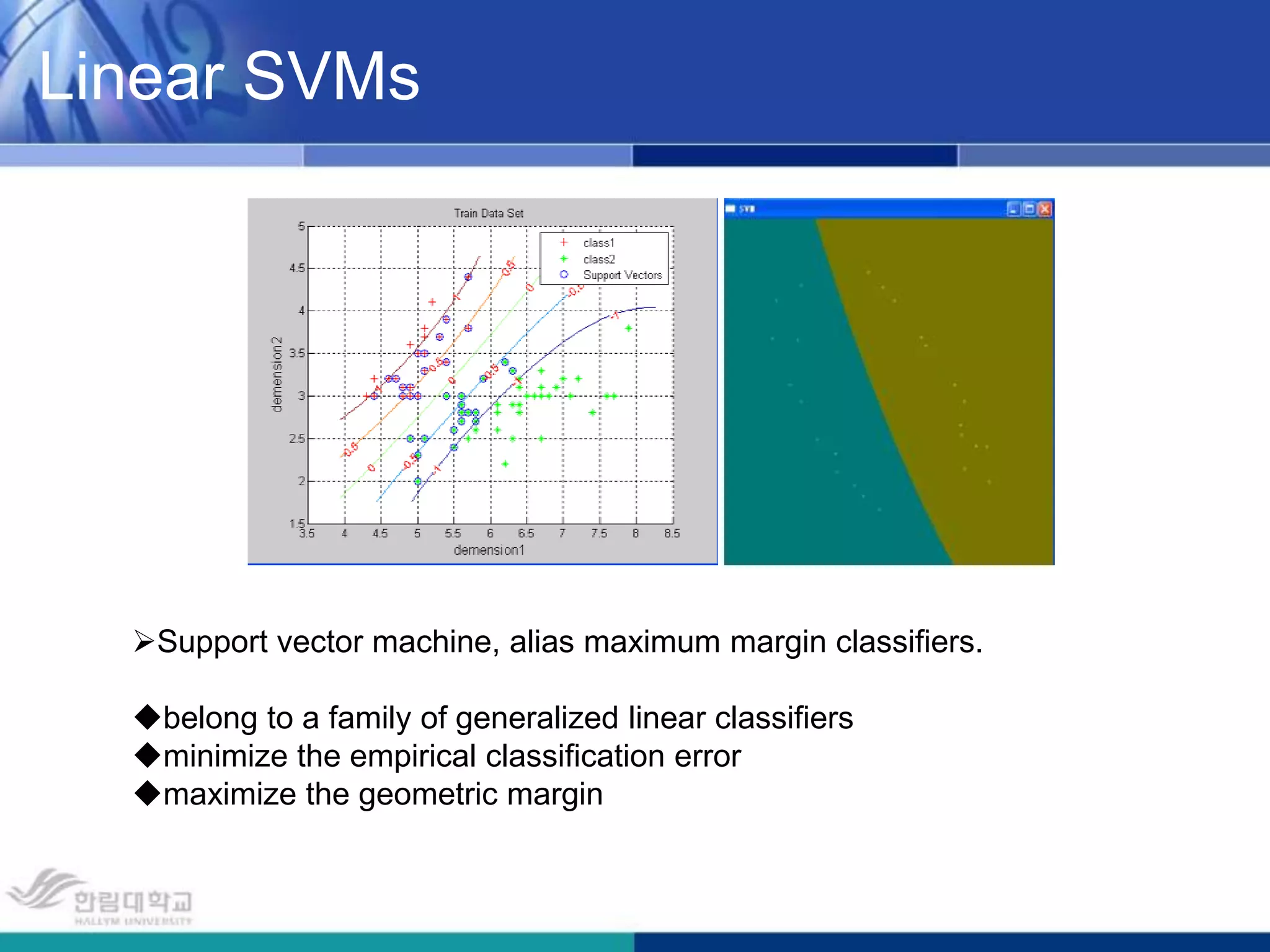
Linear SVMsSupport vector machine, alias maximum margin classifiers.
belong to a family of generalized linear classifiers
minimize the empirical classification error
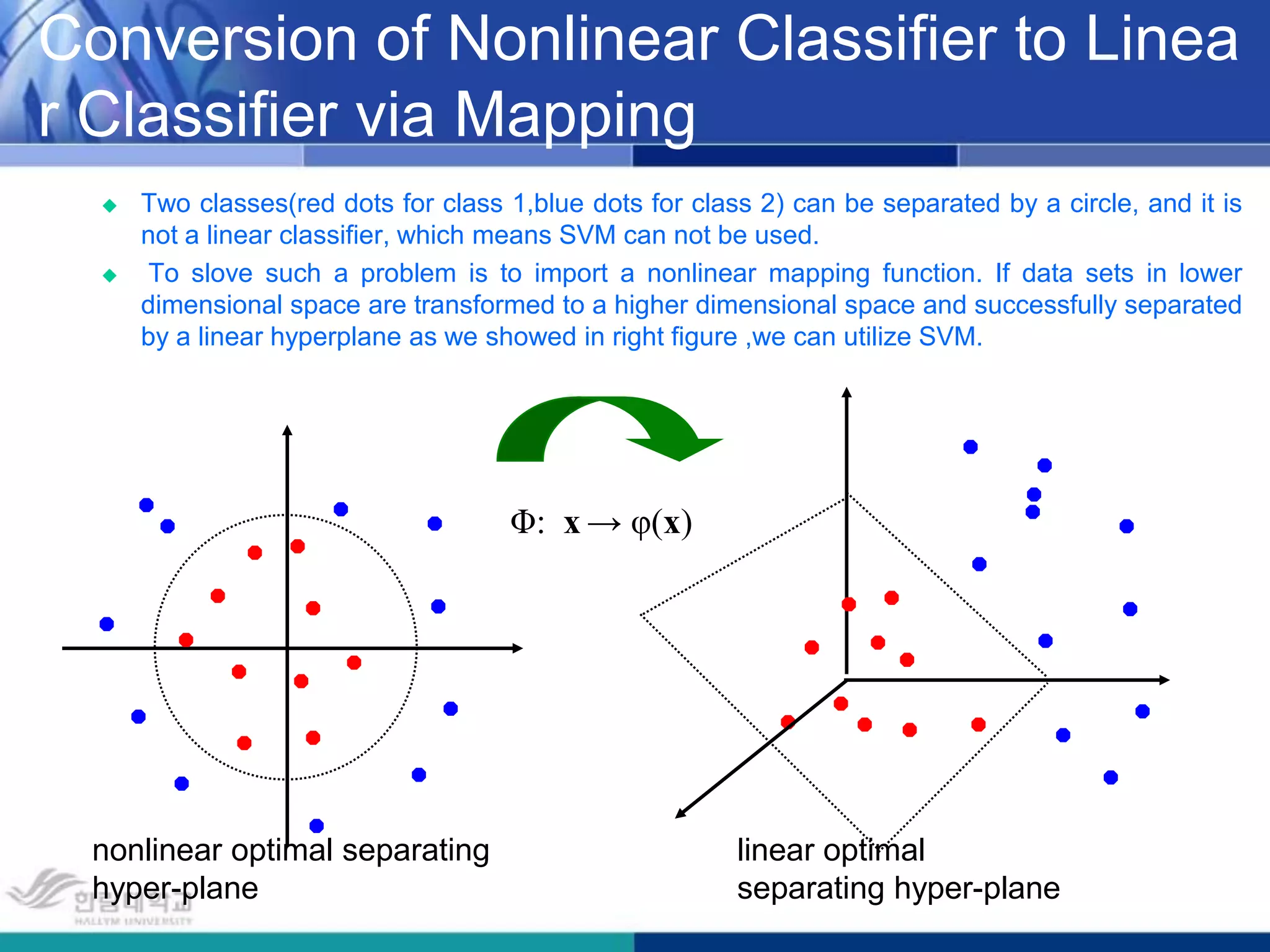
maximize the geometric marginΦ:  x->φ(x)Conversion of Nonlinear Classifier to Linear Classifier via MappingTwo classes(red dots for class 1,blue dots for class 2) can be separated by a circle, and it is not a linear classifier, which means SVM can not be used.
 To slove such a problem is to import a nonlinear mapping function. If data sets in lower dimensional space are transformed to a higher dimensional space and successfully separated by a linear hyperplane as we showed in right figure ,we can utilize SVM.linear optimal separating hyper-planenonlinear optimal separating hyper-plane
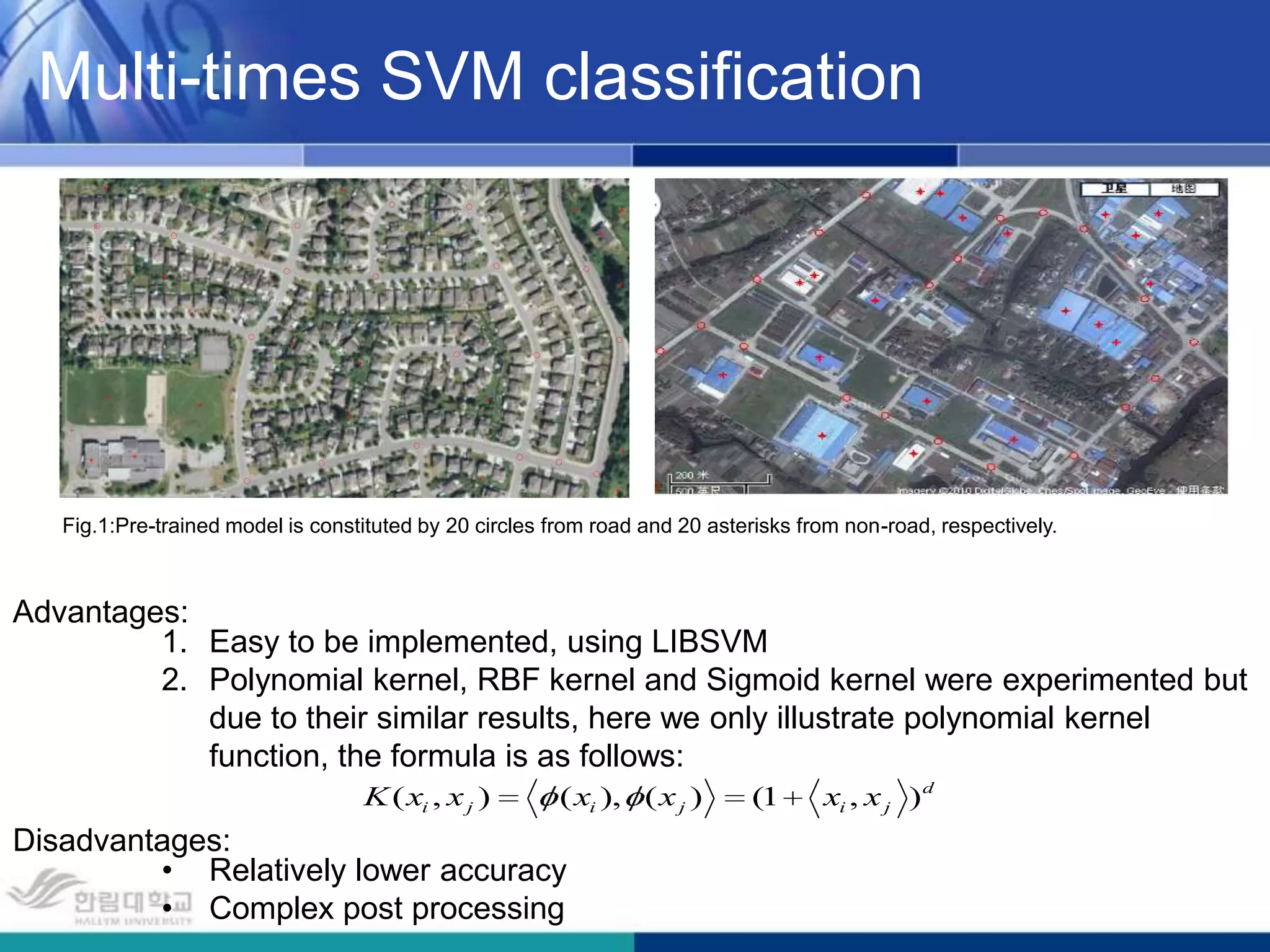
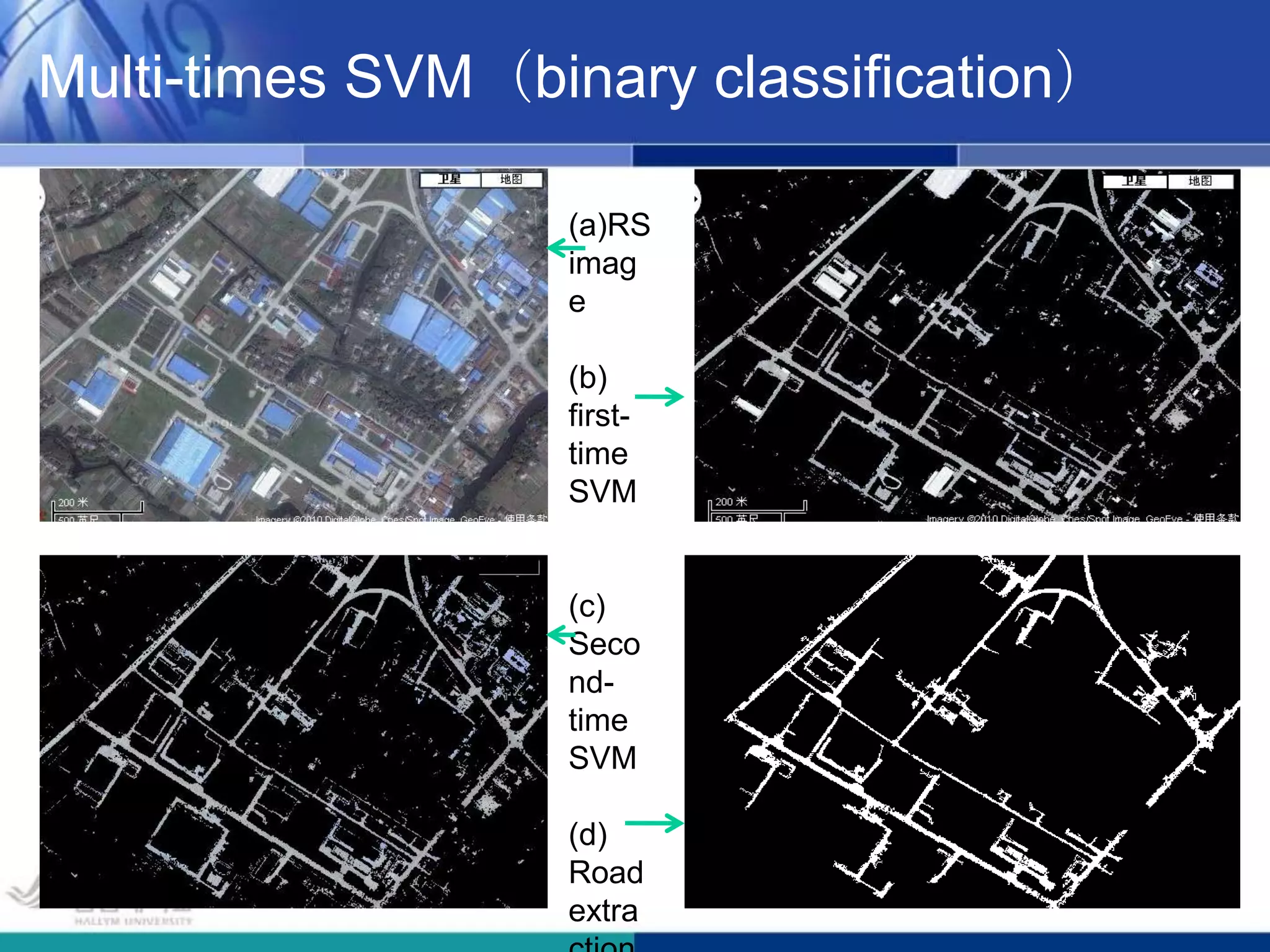
Multi-times SVM classificationFig.1:Pre-trained model is constituted by 20 circles from road and 20 asterisks from non-road, respectively. Advantages:Disadvantages:Easy to be implemented, using LIBSVMPolynomial kernel, RBF kernel and Sigmoid kernel were experimented but due to their similar results, here we only illustrate polynomial kernel function, the formula is as follows:Relatively lower accuracy
Complex post processing Multi-times SVM(binary classification)(a)RS image(b) first-timeSVM(c)Second-timeSVM(d)Road extraction
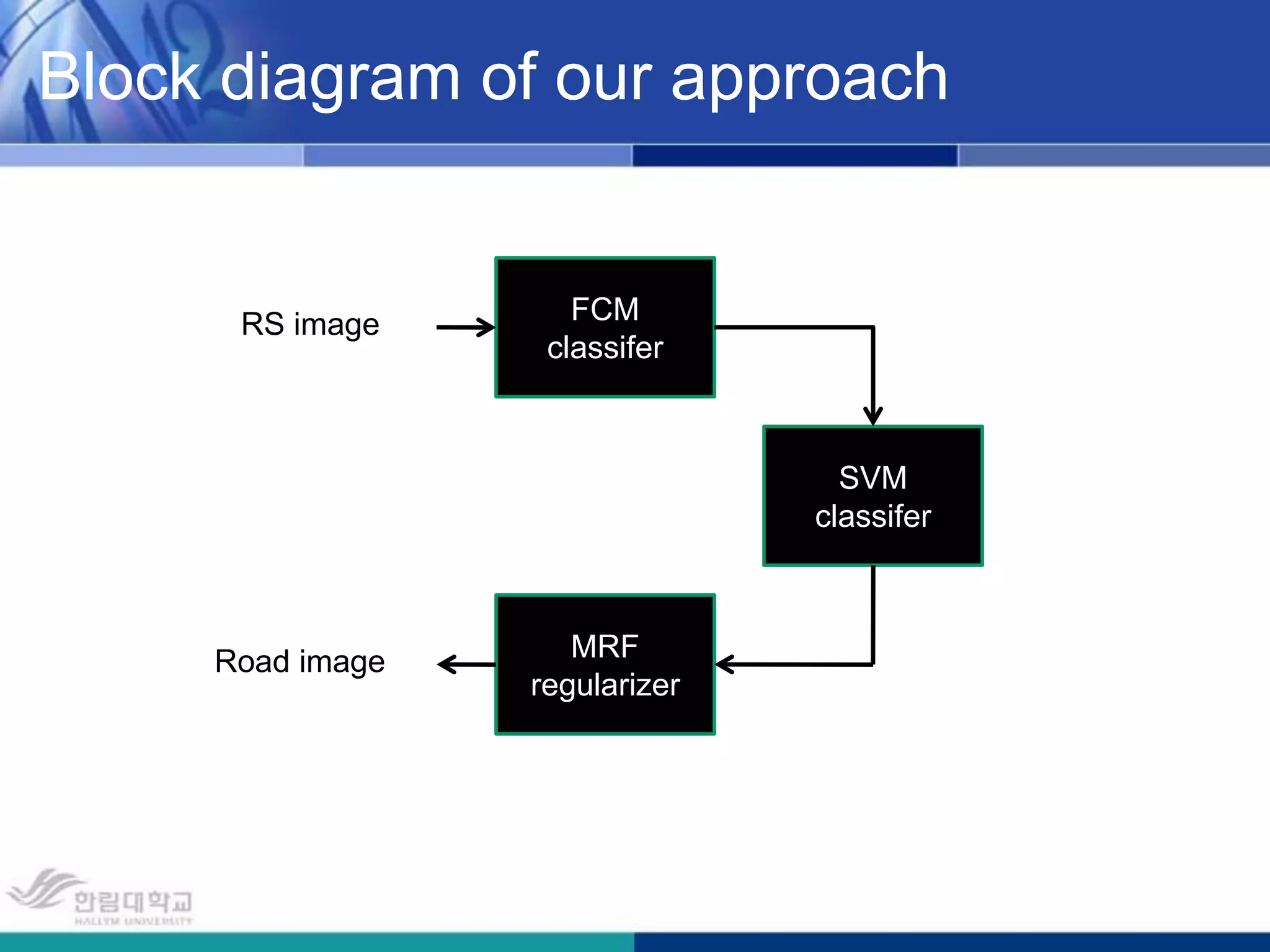
Block diagram of our approachFCM classiferRS imageSVM classiferMRF regularizer      Road image
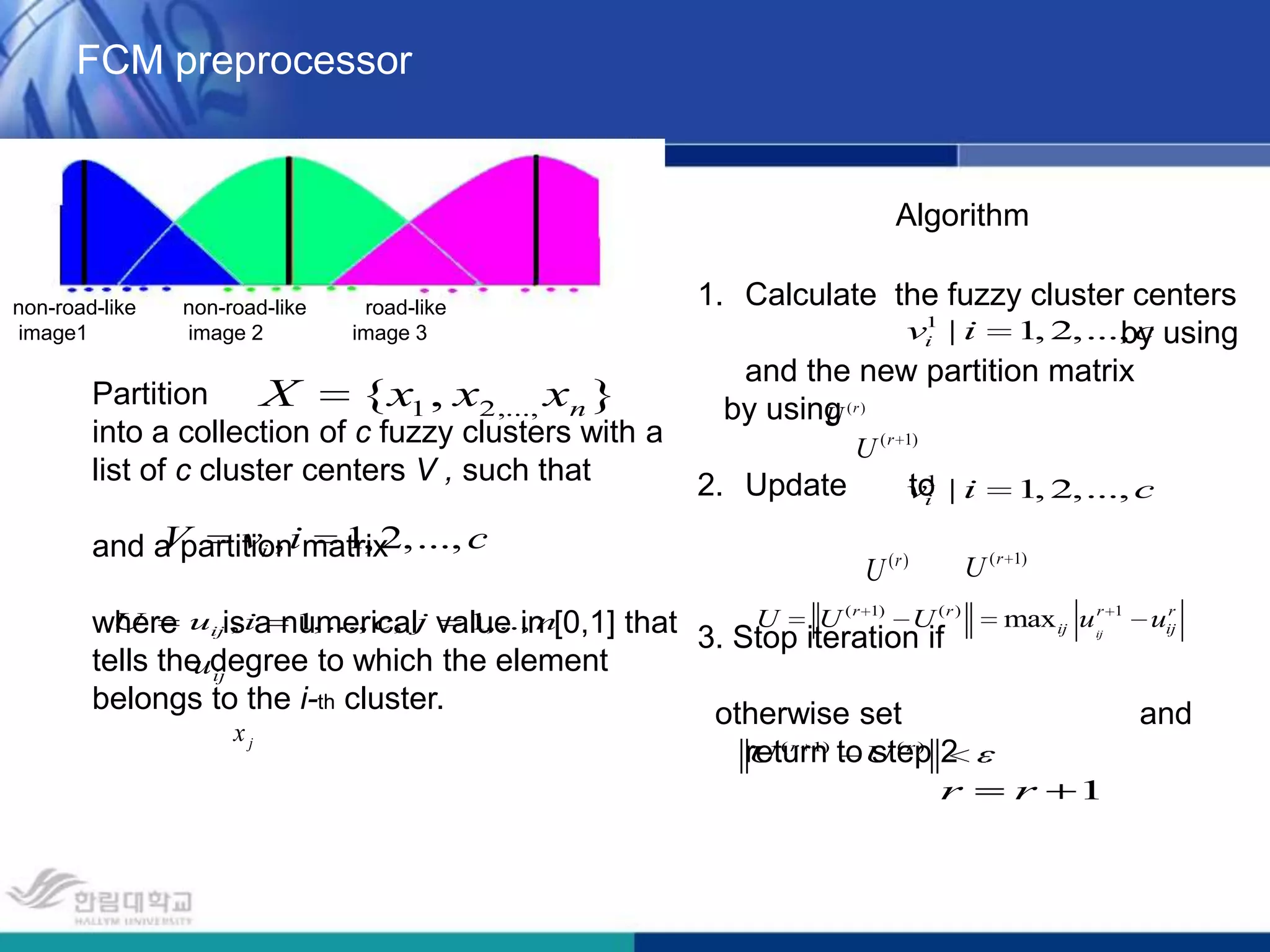
FCM preprocessorAlgorithmCalculate  the fuzzy cluster centers                                                 by using     and the new partition matrix    by usingUpdate       to 3. Stop iteration if   otherwise set                           and return to step 2non-road-like        non-road-like          road-like image1                 image 2               image 3Partitioninto a collection of c fuzzy clusters with a list of c cluster centers V , such that                              and a partition matrixwhere     is a numerical  value in [0,1] that tells the degree to which the element    belongs to the i-th cluster.
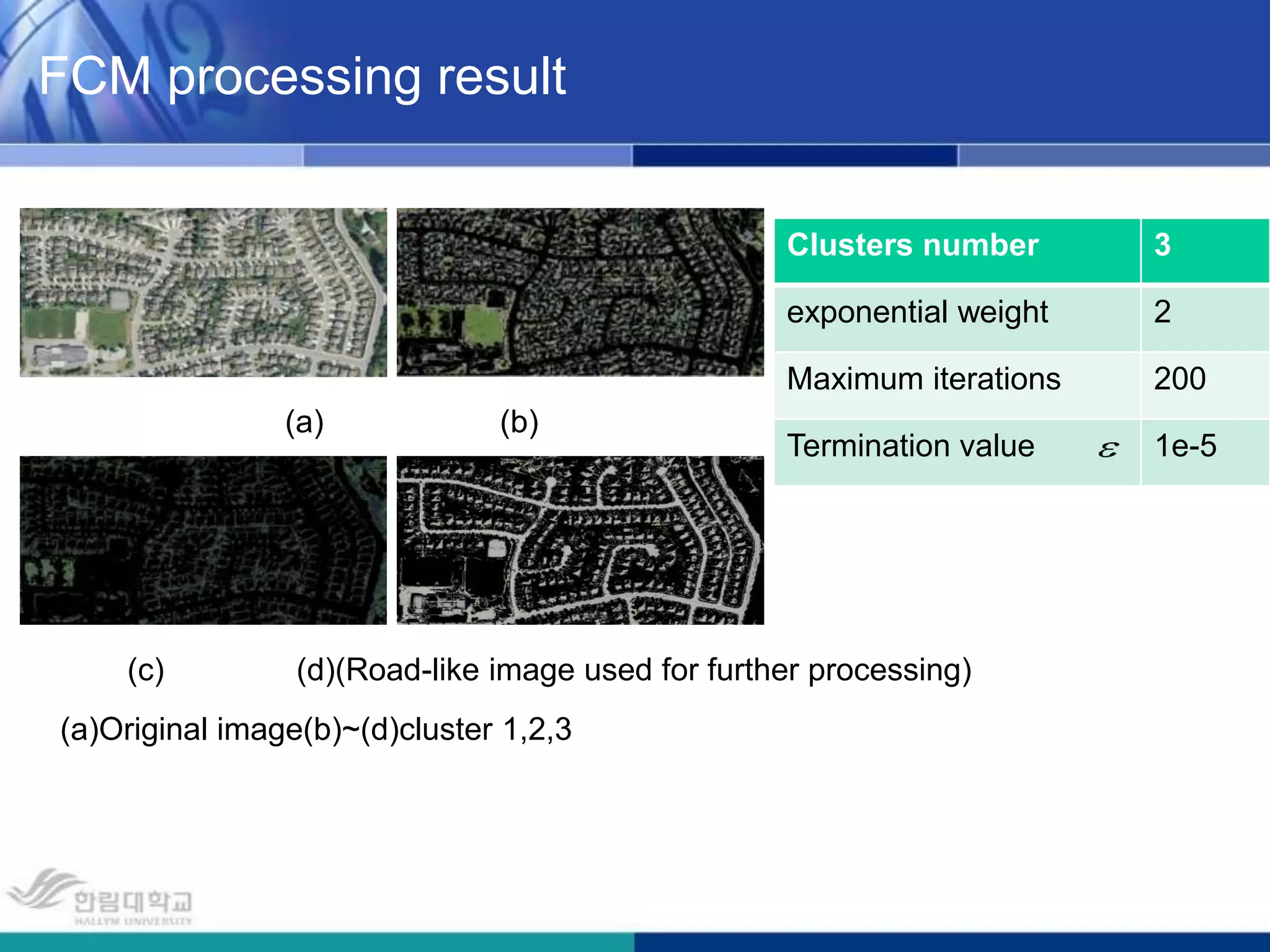
FCM processing result (a)                    (b)             (c)               (d)(Road-like image used for further processing)  (a)Original image(b)~(d)cluster 1,2,3
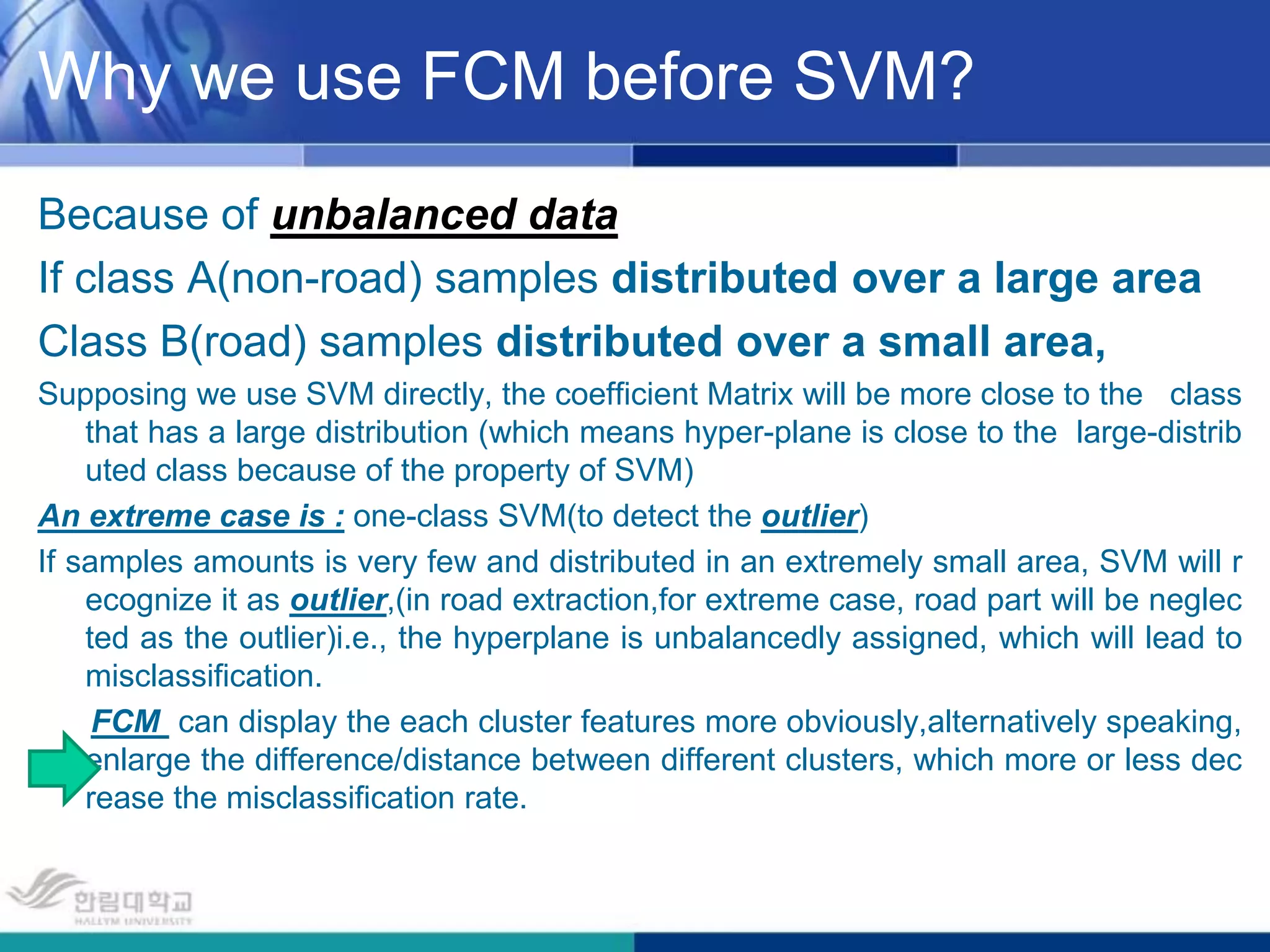
Why we use FCM before SVM?Because of unbalanced dataIf class A(non-road) samples distributed over a large areaClass B(road) samples distributed over a small area,Supposing we use SVM directly, the coefficient Matrix will be more close to the   class that has a large distribution (which means hyper-plane is close to the  large-distributed class because of the property of SVM)An extreme case is : one-class SVM(to detect the outlier)If samples amounts is very few and distributed in an extremely small area, SVM will recognize it as outlier,(in road extraction,for extreme case, road part will be neglected as the outlier)i.e., the hyperplane is unbalancedly assigned, which will lead to misclassification.FCM  can display the each cluster features more obviously,alternatively speaking, enlarge the difference/distance between different clusters, which more or less decrease the misclassification rate.
Test Images & Reference Models to evaluate our performance
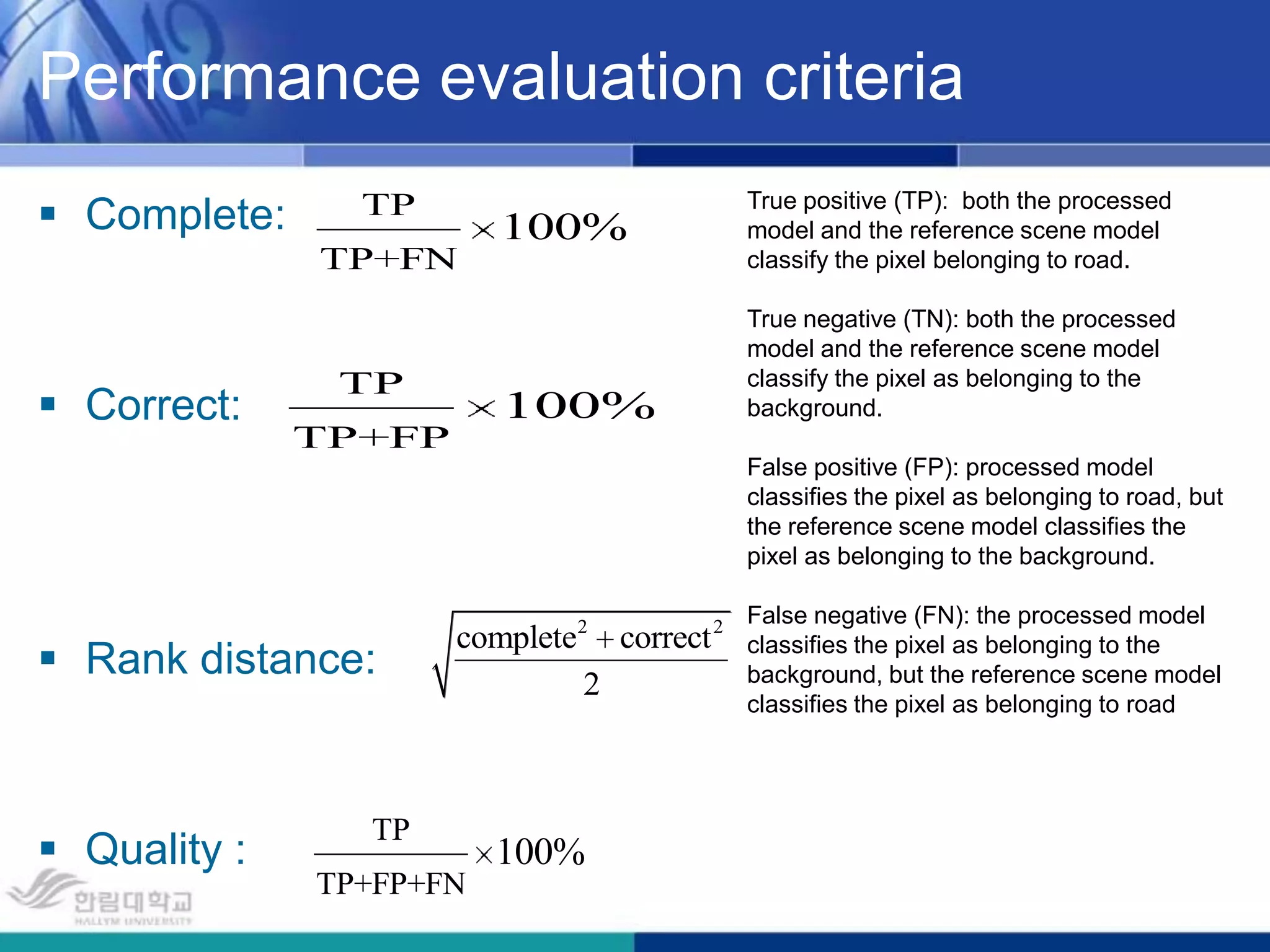
Performance evaluation criteriaComplete: Correct: Rank distance: Quality : True positive (TP):  both the processed model and the reference scene model classify the pixel belonging to road.True negative (TN): both the processed model and the reference scene model classify the pixel as belonging to the background.False positive (FP): processed model classifies the pixel as belonging to road, but the reference scene model classifies the pixel as belonging to the background.False negative (FN): the processed model classifies the pixel as belonging to the background, but the reference scene model classifies the pixel as belonging to road
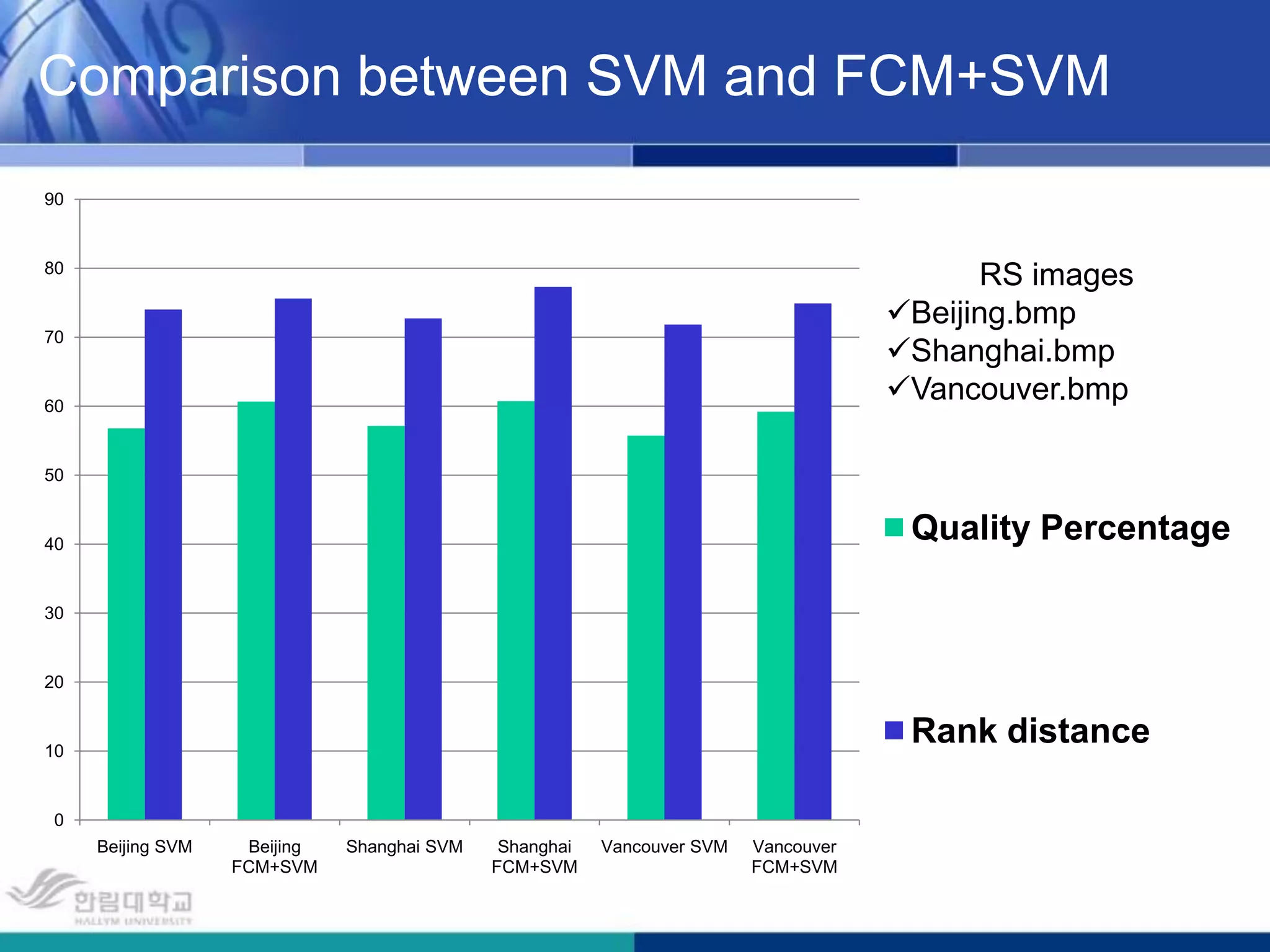
Comparison between SVM and FCM+SVMRS imagesBeijing.bmp
Shanghai.bmp
Vancouver.bmpMRF regularizerMean value:Variance: is the pixel set of the corresponding area,      is the total number of the pixel set,    is the intensity value of pixel, other values were decided empirically.          iteration    ,global E and temperature
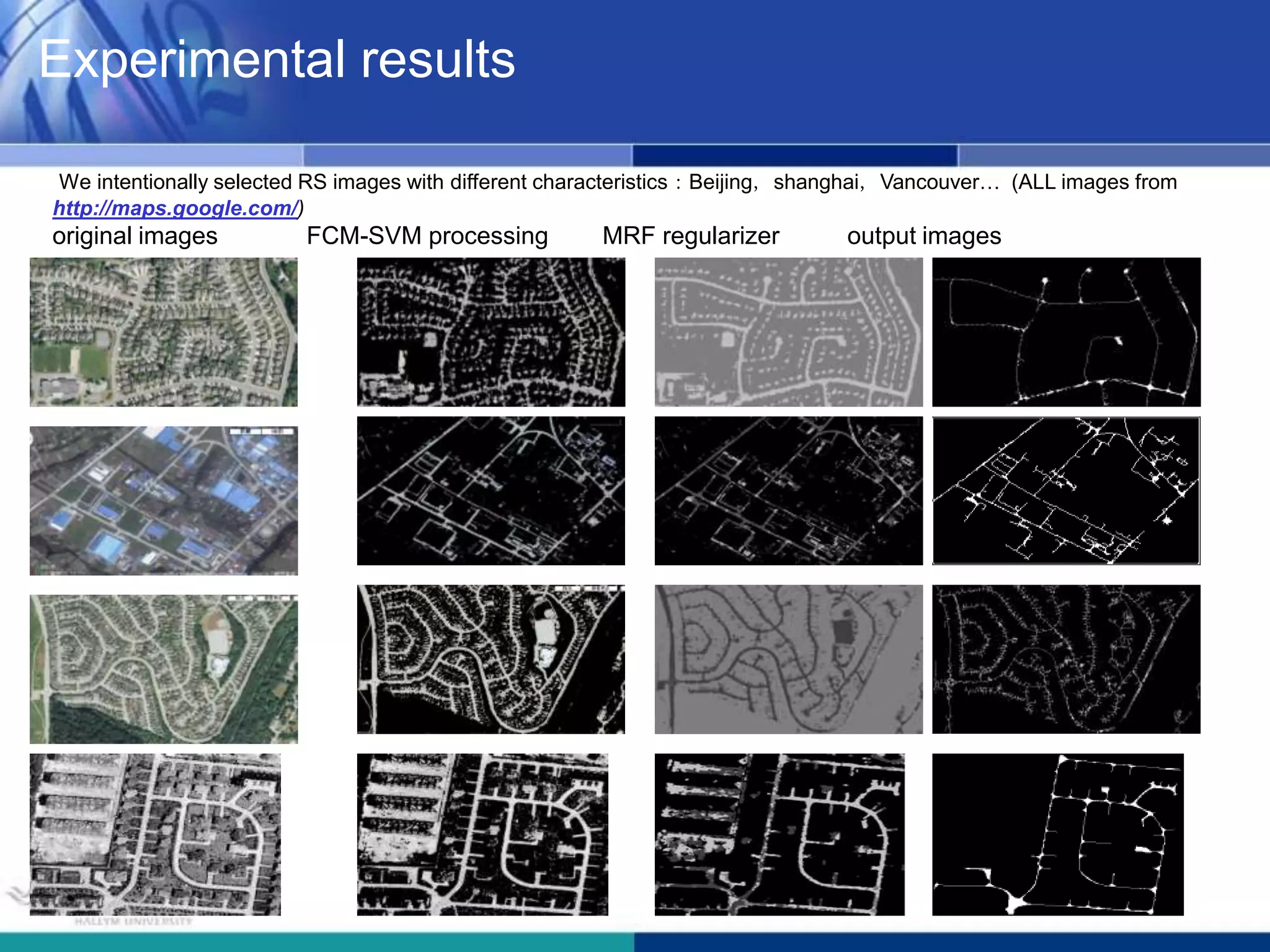
Experimental resultsWe intentionally selected RS images with different characteristics:Beijing,shanghai,Vancouver…  (ALL images from http://maps.google.com/)original images             FCM-SVM processing        MRF regularizer          output images
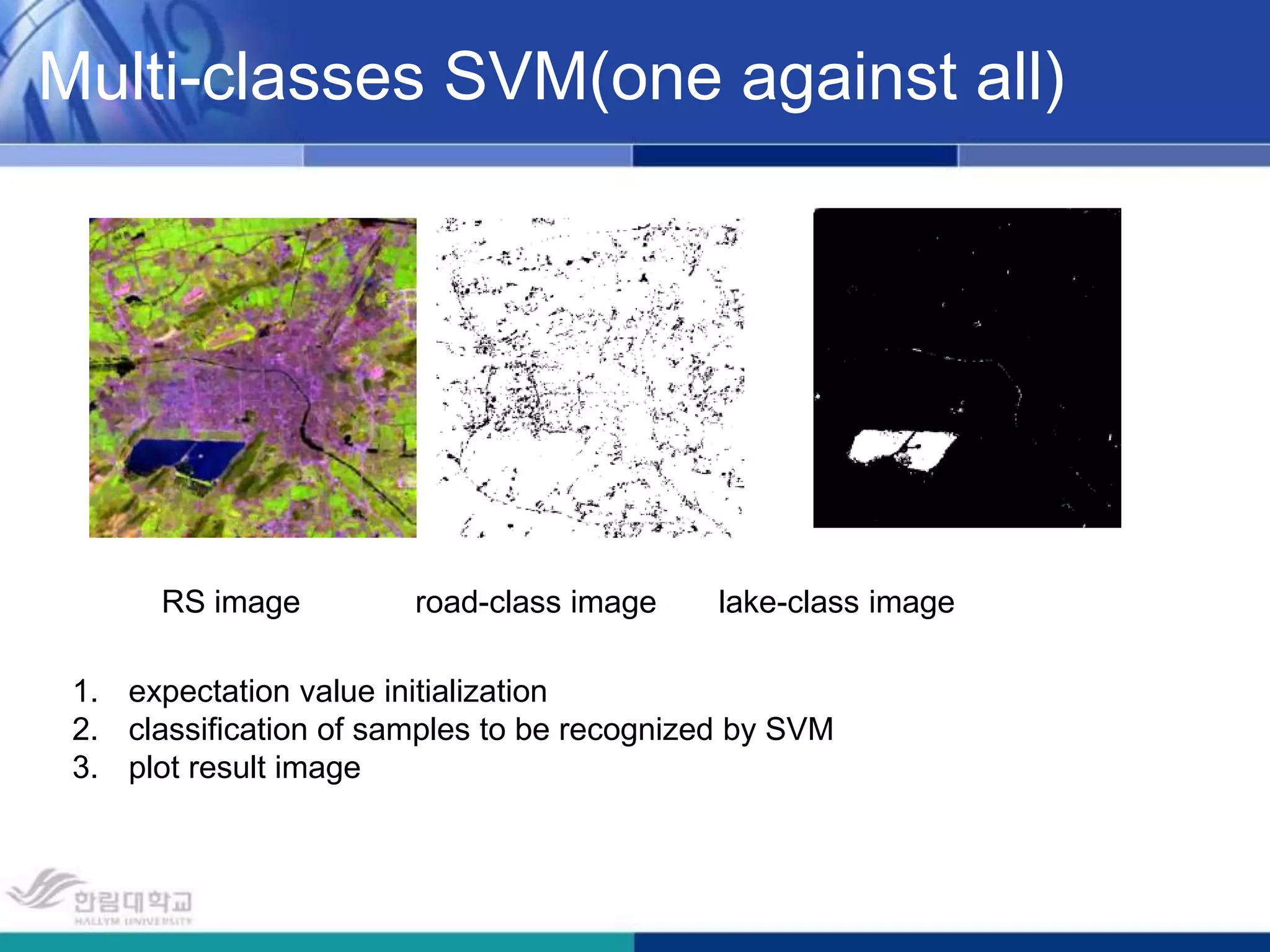
Multi-classes SVM(one against all)RS image             road-class image       lake-class imageexpectation value initialization classification of samples to be recognized by SVM plot result image
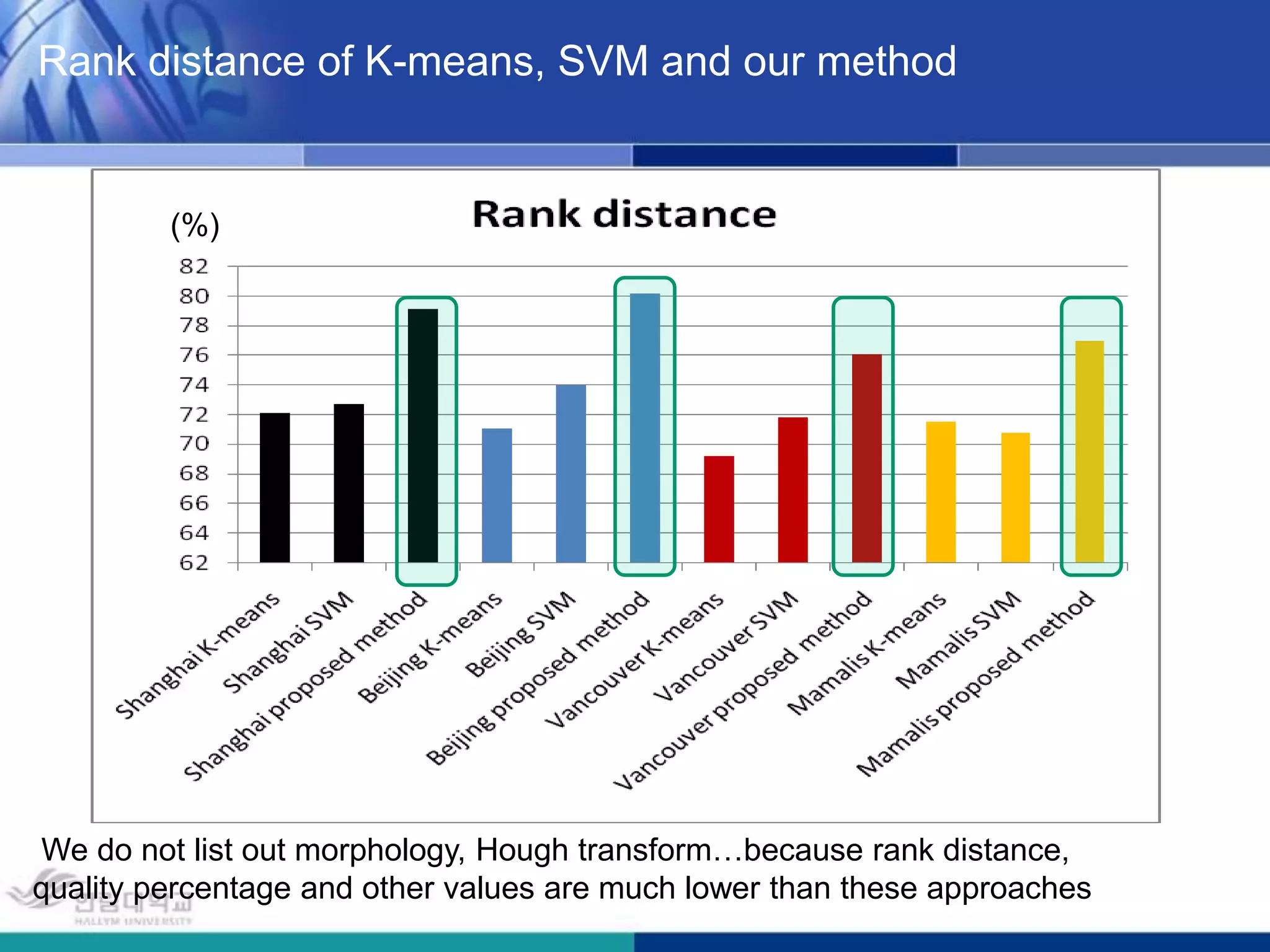
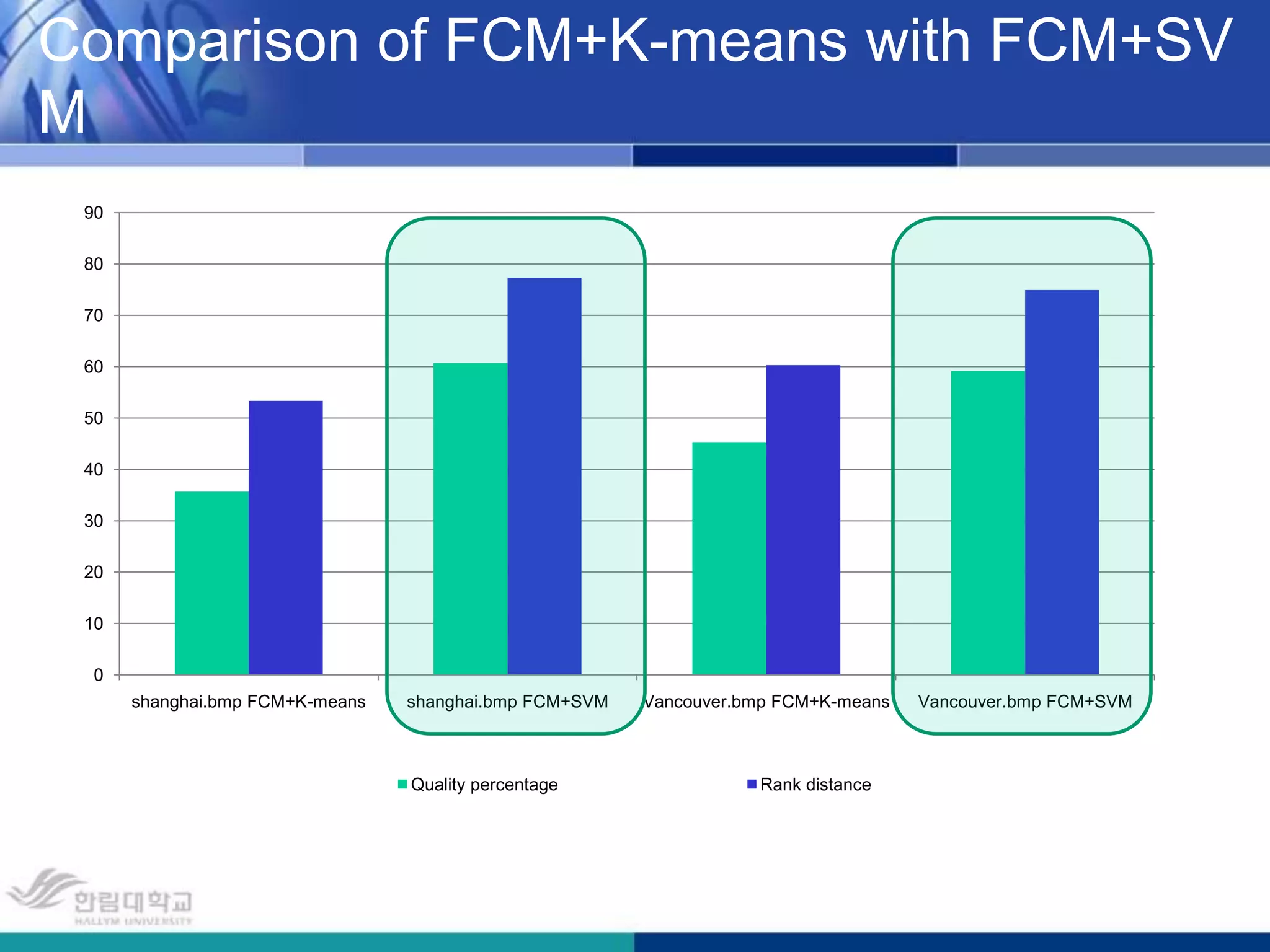
Rank distance of K-means, SVM and our method  (%) We do not list out morphology, Hough transform…because rank distance, quality percentage and other values are much lower than these approaches
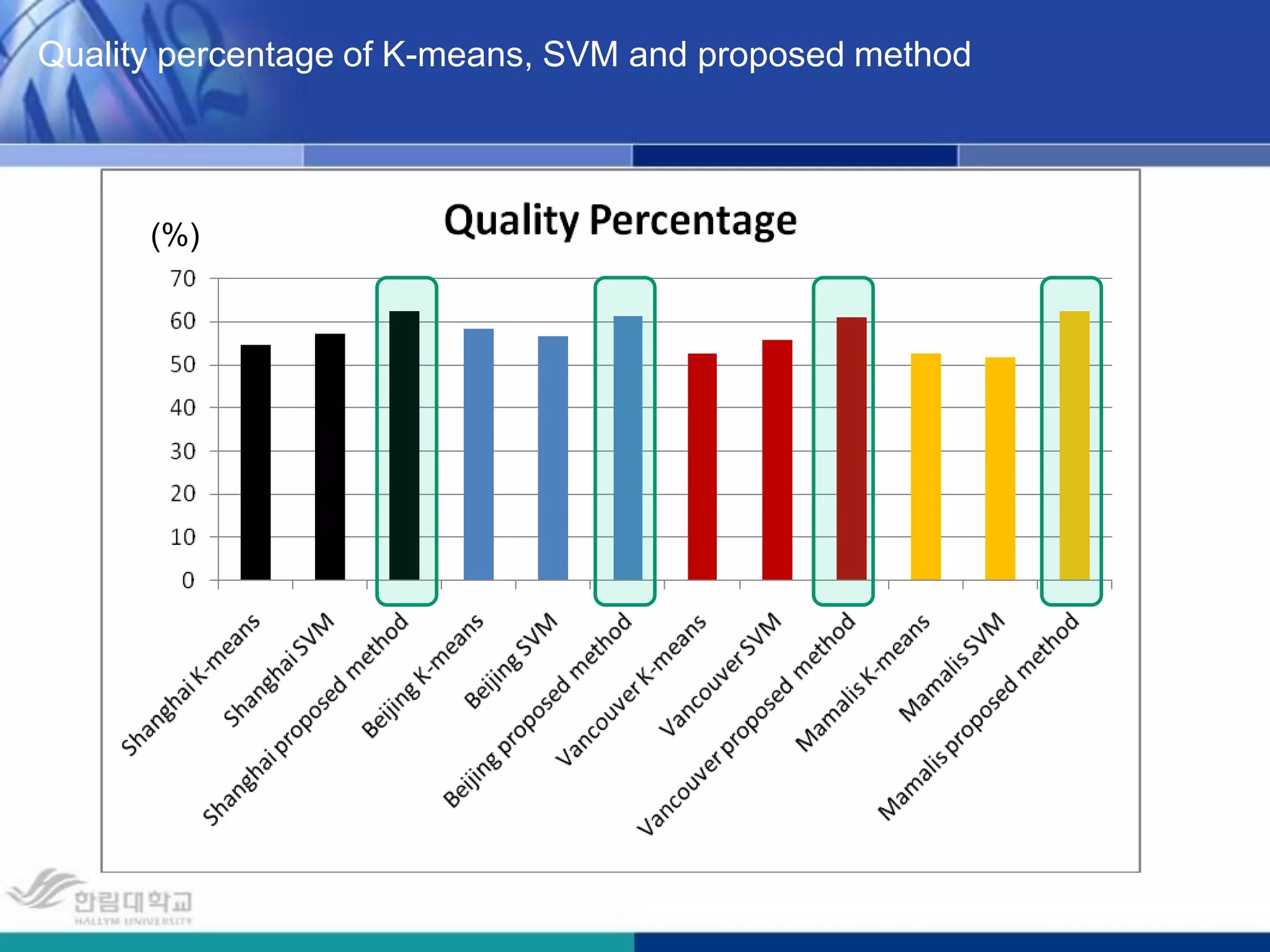
Quality percentage of K-means, SVM and proposed method (%)
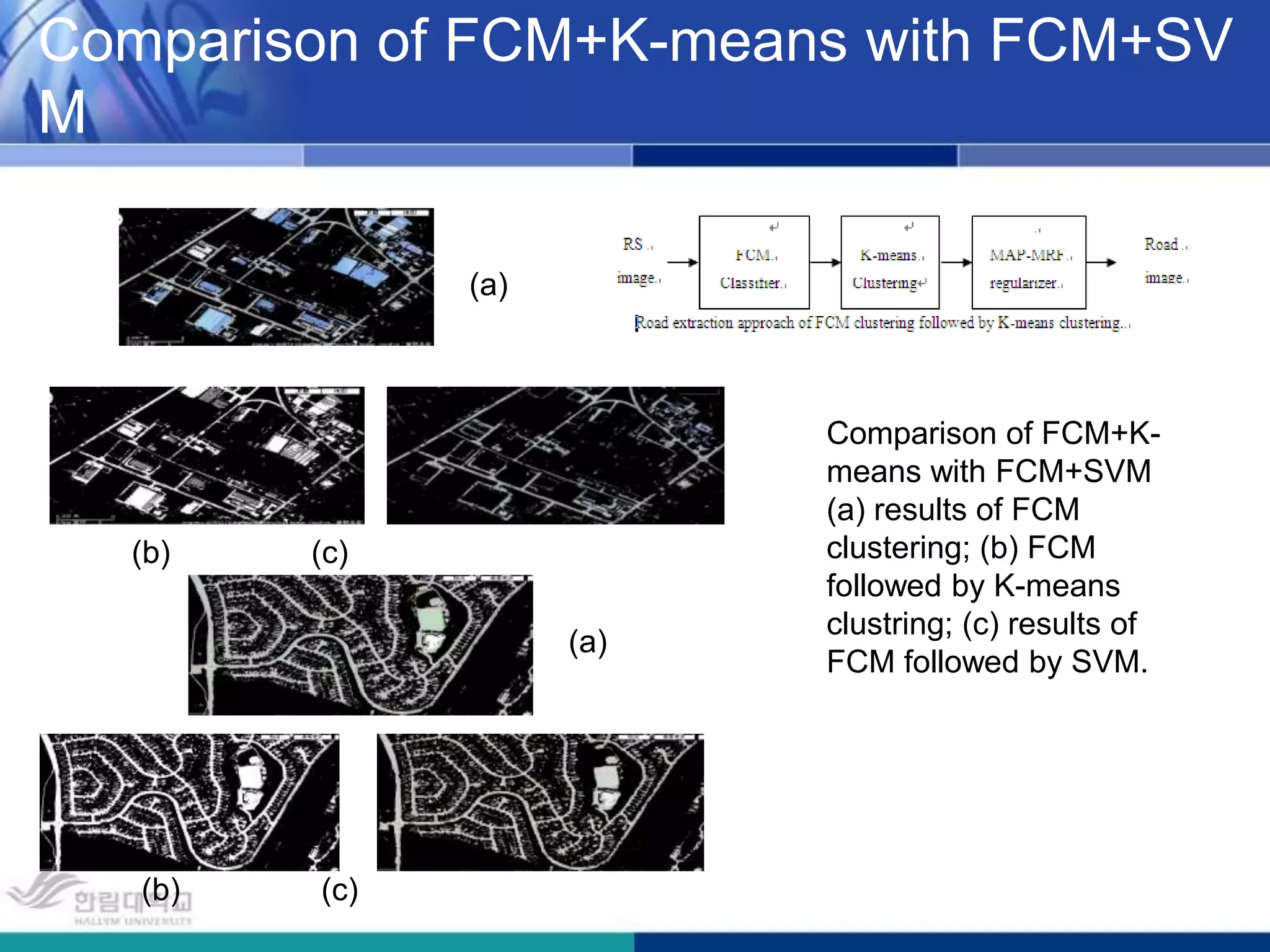
Comparison of FCM+K-means with FCM+SVM(a)Comparison of FCM+K-means with FCM+SVM (a) results of FCM clustering; (b) FCM followed by K-means clustring; (c) results of FCM followed by SVM.         (b)                (c)(a)         (b)                (c)
Comparison of FCM+K-means with FCM+SVM
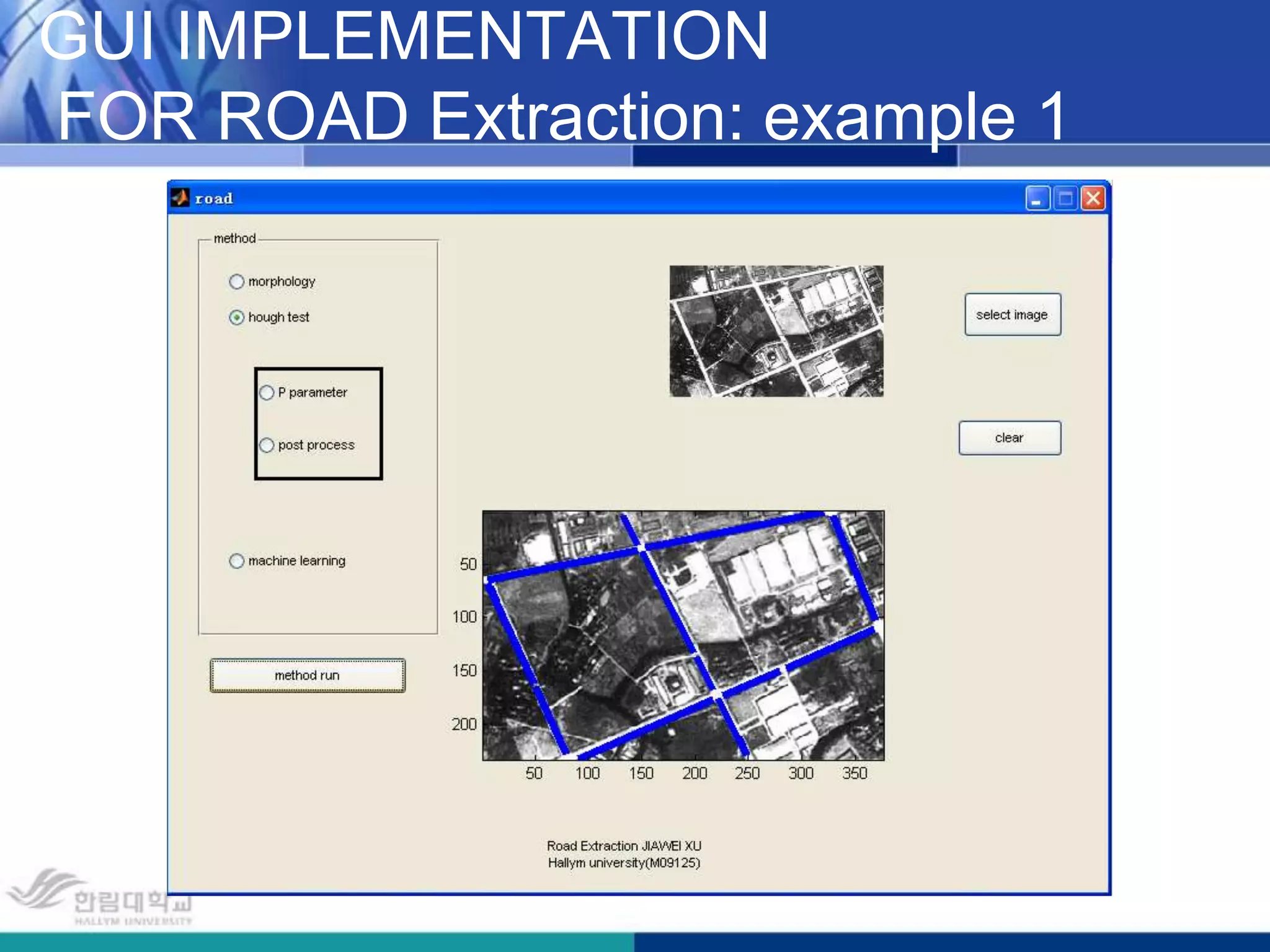
GUI IMPLEMENTATION FOR ROAD Extraction: example 1
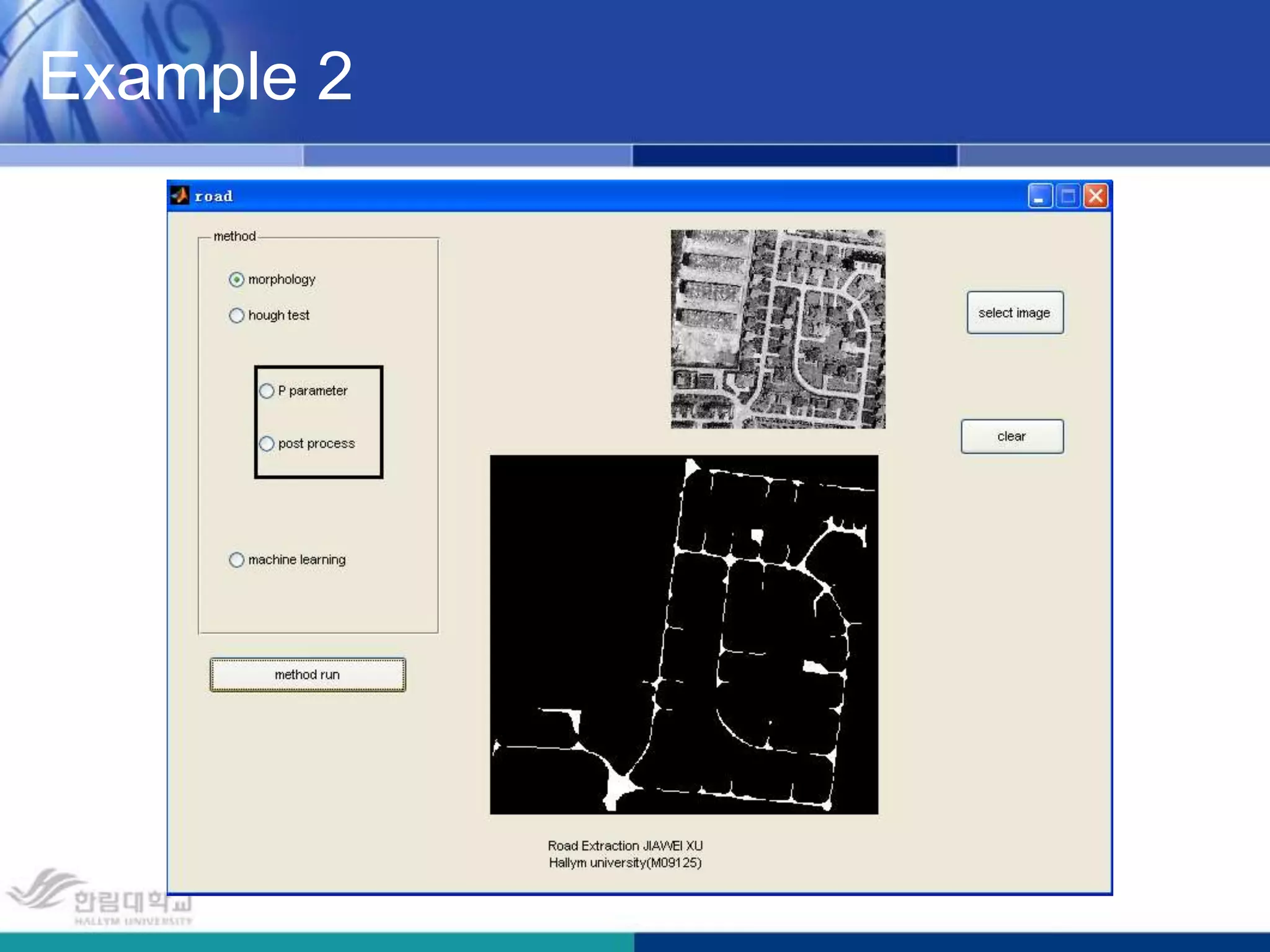
Example 2
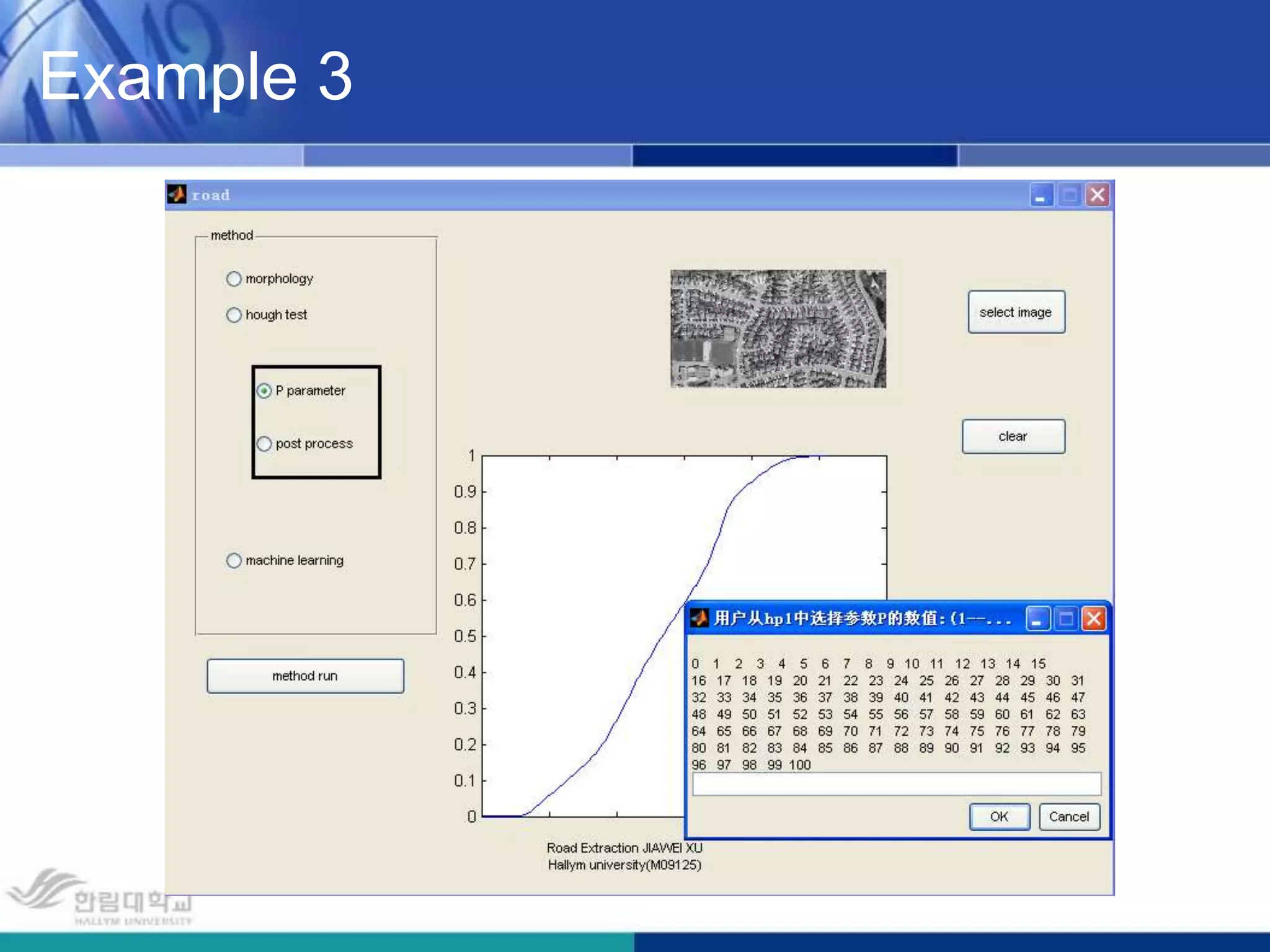
Example 3
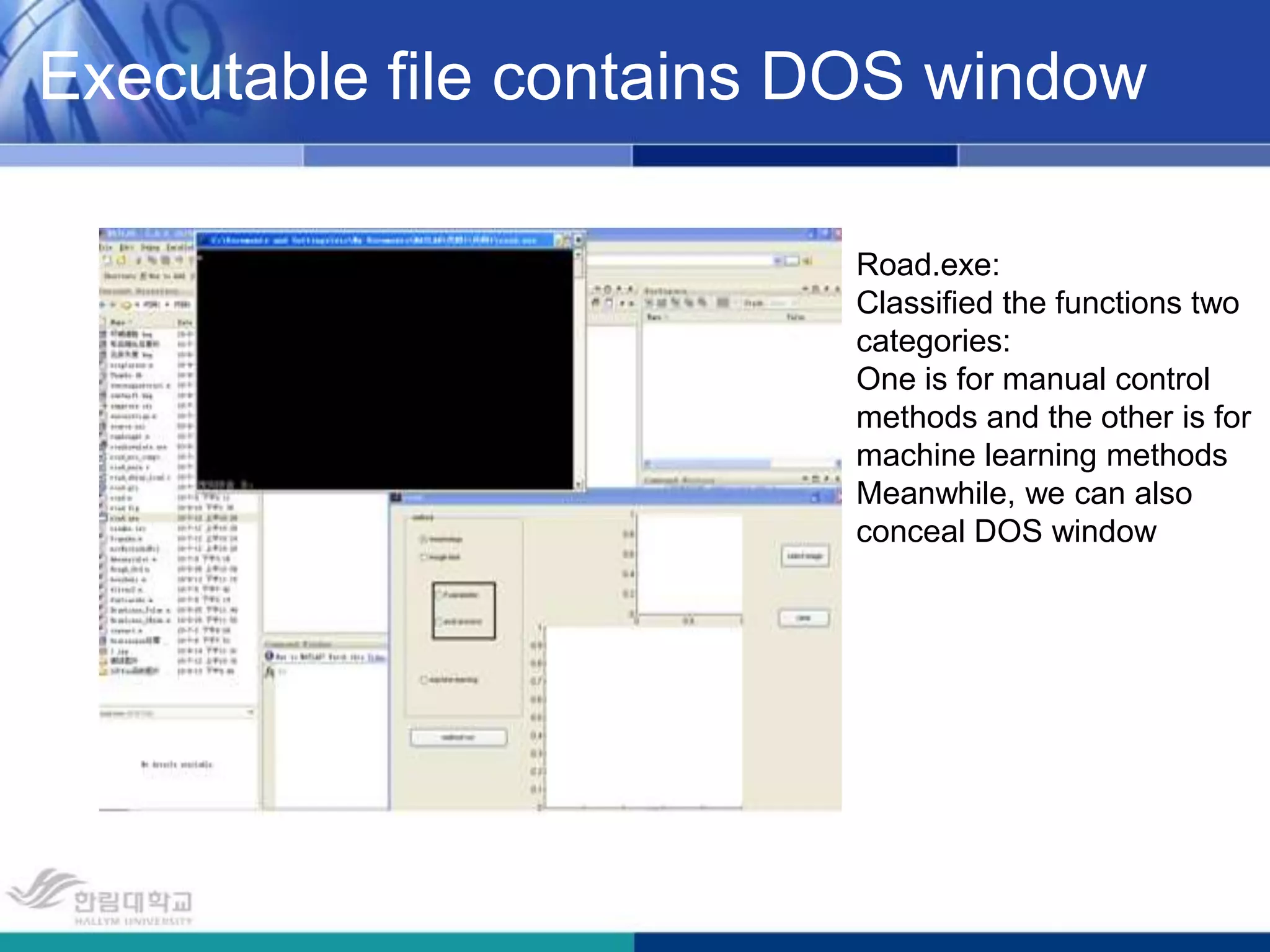
Executable file contains DOS window Road.exe:Classified the functions two categories:One is for manual control methods and the other is for machine learning methodsMeanwhile, we can also conceal DOS window
ConclusionThis thesis has proposed a new road extraction method based on SVM classification combined with FCM clustering and MRF regularization. In terms of rank distance, and quality percentage, the proposed method is superior to SVM, morphological approaches, Hough transforms and K-means.
Using FCM clustering to separate road-like cluster and the other clusters increases the SVM classification accuracy.
We used MRF regularization to remove speckle-like noise then we could extract the fine road net.
Experimental results with several images with various features show that the proposed method gives us a higher accuracy and strong robustness regardless of input characteristics.Future researchBatch processing of remote sensing imageFuzzy SVM application in RS imagesOne against all SVM computational duration reductionANN algorithm optimization
References[1] 	 Stefan Hinz, “Automatic extraction of urban road networks from multi-view aerial imagery”, Technische University 2003[2]   VladmirVapnik, ”Statistical Learning Theory”, JOHN WILELY & SONS, Inc.1998[3]	Curt H.Davis, “An integrated system for automatic road mapping from high-resolution multi-spectral satellite imagery by information fusion”, Elsevier Inc. 2004 [4]	Yairmoshe, “GUI with Matlab” Department of Electronic Engineering, Columbia University , May 2004.[5]	http://maps.google.com/[6]	Yang Li, “A new validity function for fuzzy clustering”, School of mathematical sciences, Beijing normal university, 2005[6]	Xu Yong and Shaoguang Zhou, “Markov random field for road extraction applications in remote sensing images”, Department of Surveying and Mapping Engineering, Hohai University, 2008[7]	David M.McKeown ,“Performance evaluation for automatic feature extraction ”, Computer Science Department, Carnegie Mellon University 2000[8]	Patrick Perez, “Markov random fields and images”, Campus Beauileu, 1999[9]	Drs. Trani and Rahka, “MATLAB Graphic user interfaces(GUI) computer applications in civil engineering ”, Spring, 2000

Presentation for korea multimedia(in english)

  • 1.
    Road Extraction fromRemoteSensing Images using SVM combined with FCM and MRFJiawei Xu MULTIMEDIA PROCESSING LABORATORYDepartment of Electronic Engineering, Hallym UniversityE-mail: abyssecho@hallym.ac.kr
  • 2.
    ContentsIntroductionA brief reviewof previous methodsMulti-times SVMProposed algorithmExperimental resultsPerformance evaluationConclusion
  • 3.
    A brief reviewof previous methodsMathematical morphologyHough transformP-value segmentationGenetic algorithmMarkov random field
  • 4.
    MATHEMATICAL MORPHOLOGYFlowchart ofthe proposed algorithm in mathematical morphologyOriginal image 2D median filter open operator erosion & thinningStructure element:square, rectangle, ball, disk and line…Morphology: Erosion,dilation,openoperator, close operator
  • 5.
    Hough transformThe Houghtransform is most commonly used for the detection of regular curves such as lines, circles, ellipses, etc.Parameter setting in this thesis:Detection sensitivity: 0.15The smaller the value is, the more features in the image will be considered as lines.
  • 6.
    P-value segmentationThis figureshows the entire procedure of road extraction using P value segmentation. In figure (a) is an input image with some selected road parts on it, (b) is the cumulative gray-image histogram distribution , (c) is the result of P value segmentation. Application of some morphological operators such as region property, open operator to (c) results in (d), (e) is the road net image using thinning function, (f) shows the input image with the extracted road net overlaid on it
  • 7.
    P-value segmentationPost processingincurs an information loss. (a) is the original image, (b) is the P value diagram, (c) is the result of P value segmentation and (d) is the application of some morphological operators, such as region property, open operator based on (c).Compare with Genetic algorithm threshold segmentationBest fitness and best threshold with generation increase
  • 8.
    Markov random fieldMeanvalue and variance of selected areaOriginal image MRF processing Speckle-like noise removal Road net
  • 9.
    Linear SVMsSupport vectormachine, alias maximum margin classifiers.
  • 10.
    belong to afamily of generalized linear classifiers
  • 11.
    minimize the empiricalclassification error
  • 12.
    maximize the geometricmarginΦ: x->φ(x)Conversion of Nonlinear Classifier to Linear Classifier via MappingTwo classes(red dots for class 1,blue dots for class 2) can be separated by a circle, and it is not a linear classifier, which means SVM can not be used.
  • 13.
    To slovesuch a problem is to import a nonlinear mapping function. If data sets in lower dimensional space are transformed to a higher dimensional space and successfully separated by a linear hyperplane as we showed in right figure ,we can utilize SVM.linear optimal separating hyper-planenonlinear optimal separating hyper-plane
  • 14.
    Multi-times SVM classificationFig.1:Pre-trainedmodel is constituted by 20 circles from road and 20 asterisks from non-road, respectively. Advantages:Disadvantages:Easy to be implemented, using LIBSVMPolynomial kernel, RBF kernel and Sigmoid kernel were experimented but due to their similar results, here we only illustrate polynomial kernel function, the formula is as follows:Relatively lower accuracy
  • 15.
    Complex post processingMulti-times SVM(binary classification)(a)RS image(b) first-timeSVM(c)Second-timeSVM(d)Road extraction
  • 16.
    Block diagram ofour approachFCM classiferRS imageSVM classiferMRF regularizer Road image
  • 17.
    FCM preprocessorAlgorithmCalculate the fuzzy cluster centers by using and the new partition matrix by usingUpdate to 3. Stop iteration if otherwise set and return to step 2non-road-like non-road-like road-like image1 image 2 image 3Partitioninto a collection of c fuzzy clusters with a list of c cluster centers V , such that and a partition matrixwhere is a numerical value in [0,1] that tells the degree to which the element belongs to the i-th cluster.
  • 18.
    FCM processing result(a) (b) (c) (d)(Road-like image used for further processing) (a)Original image(b)~(d)cluster 1,2,3
  • 19.
    Why we useFCM before SVM?Because of unbalanced dataIf class A(non-road) samples distributed over a large areaClass B(road) samples distributed over a small area,Supposing we use SVM directly, the coefficient Matrix will be more close to the class that has a large distribution (which means hyper-plane is close to the large-distributed class because of the property of SVM)An extreme case is : one-class SVM(to detect the outlier)If samples amounts is very few and distributed in an extremely small area, SVM will recognize it as outlier,(in road extraction,for extreme case, road part will be neglected as the outlier)i.e., the hyperplane is unbalancedly assigned, which will lead to misclassification.FCM can display the each cluster features more obviously,alternatively speaking, enlarge the difference/distance between different clusters, which more or less decrease the misclassification rate.
  • 20.
    Test Images &Reference Models to evaluate our performance
  • 21.
    Performance evaluation criteriaComplete:Correct: Rank distance: Quality : True positive (TP): both the processed model and the reference scene model classify the pixel belonging to road.True negative (TN): both the processed model and the reference scene model classify the pixel as belonging to the background.False positive (FP): processed model classifies the pixel as belonging to road, but the reference scene model classifies the pixel as belonging to the background.False negative (FN): the processed model classifies the pixel as belonging to the background, but the reference scene model classifies the pixel as belonging to road
  • 22.
    Comparison between SVMand FCM+SVMRS imagesBeijing.bmp
  • 23.
  • 24.
    Vancouver.bmpMRF regularizerMean value:Variance:is the pixel set of the corresponding area, is the total number of the pixel set, is the intensity value of pixel, other values were decided empirically. iteration ,global E and temperature
  • 25.
    Experimental resultsWe intentionallyselected RS images with different characteristics:Beijing,shanghai,Vancouver… (ALL images from http://maps.google.com/)original images FCM-SVM processing MRF regularizer output images
  • 26.
    Multi-classes SVM(one againstall)RS image road-class image lake-class imageexpectation value initialization classification of samples to be recognized by SVM plot result image
  • 27.
    Rank distance ofK-means, SVM and our method (%) We do not list out morphology, Hough transform…because rank distance, quality percentage and other values are much lower than these approaches
  • 28.
    Quality percentage ofK-means, SVM and proposed method (%)
  • 29.
    Comparison of FCM+K-meanswith FCM+SVM(a)Comparison of FCM+K-means with FCM+SVM (a) results of FCM clustering; (b) FCM followed by K-means clustring; (c) results of FCM followed by SVM. (b) (c)(a) (b) (c)
  • 30.
  • 31.
    GUI IMPLEMENTATION FORROAD Extraction: example 1
  • 32.
  • 33.
  • 34.
    Executable file containsDOS window Road.exe:Classified the functions two categories:One is for manual control methods and the other is for machine learning methodsMeanwhile, we can also conceal DOS window
  • 35.
    ConclusionThis thesis hasproposed a new road extraction method based on SVM classification combined with FCM clustering and MRF regularization. In terms of rank distance, and quality percentage, the proposed method is superior to SVM, morphological approaches, Hough transforms and K-means.
  • 36.
    Using FCM clusteringto separate road-like cluster and the other clusters increases the SVM classification accuracy.
  • 37.
    We used MRFregularization to remove speckle-like noise then we could extract the fine road net.
  • 38.
    Experimental results withseveral images with various features show that the proposed method gives us a higher accuracy and strong robustness regardless of input characteristics.Future researchBatch processing of remote sensing imageFuzzy SVM application in RS imagesOne against all SVM computational duration reductionANN algorithm optimization
  • 39.
    References[1] StefanHinz, “Automatic extraction of urban road networks from multi-view aerial imagery”, Technische University 2003[2] VladmirVapnik, ”Statistical Learning Theory”, JOHN WILELY & SONS, Inc.1998[3] Curt H.Davis, “An integrated system for automatic road mapping from high-resolution multi-spectral satellite imagery by information fusion”, Elsevier Inc. 2004 [4] Yairmoshe, “GUI with Matlab” Department of Electronic Engineering, Columbia University , May 2004.[5] http://maps.google.com/[6] Yang Li, “A new validity function for fuzzy clustering”, School of mathematical sciences, Beijing normal university, 2005[6] Xu Yong and Shaoguang Zhou, “Markov random field for road extraction applications in remote sensing images”, Department of Surveying and Mapping Engineering, Hohai University, 2008[7] David M.McKeown ,“Performance evaluation for automatic feature extraction ”, Computer Science Department, Carnegie Mellon University 2000[8] Patrick Perez, “Markov random fields and images”, Campus Beauileu, 1999[9] Drs. Trani and Rahka, “MATLAB Graphic user interfaces(GUI) computer applications in civil engineering ”, Spring, 2000
  • 40.
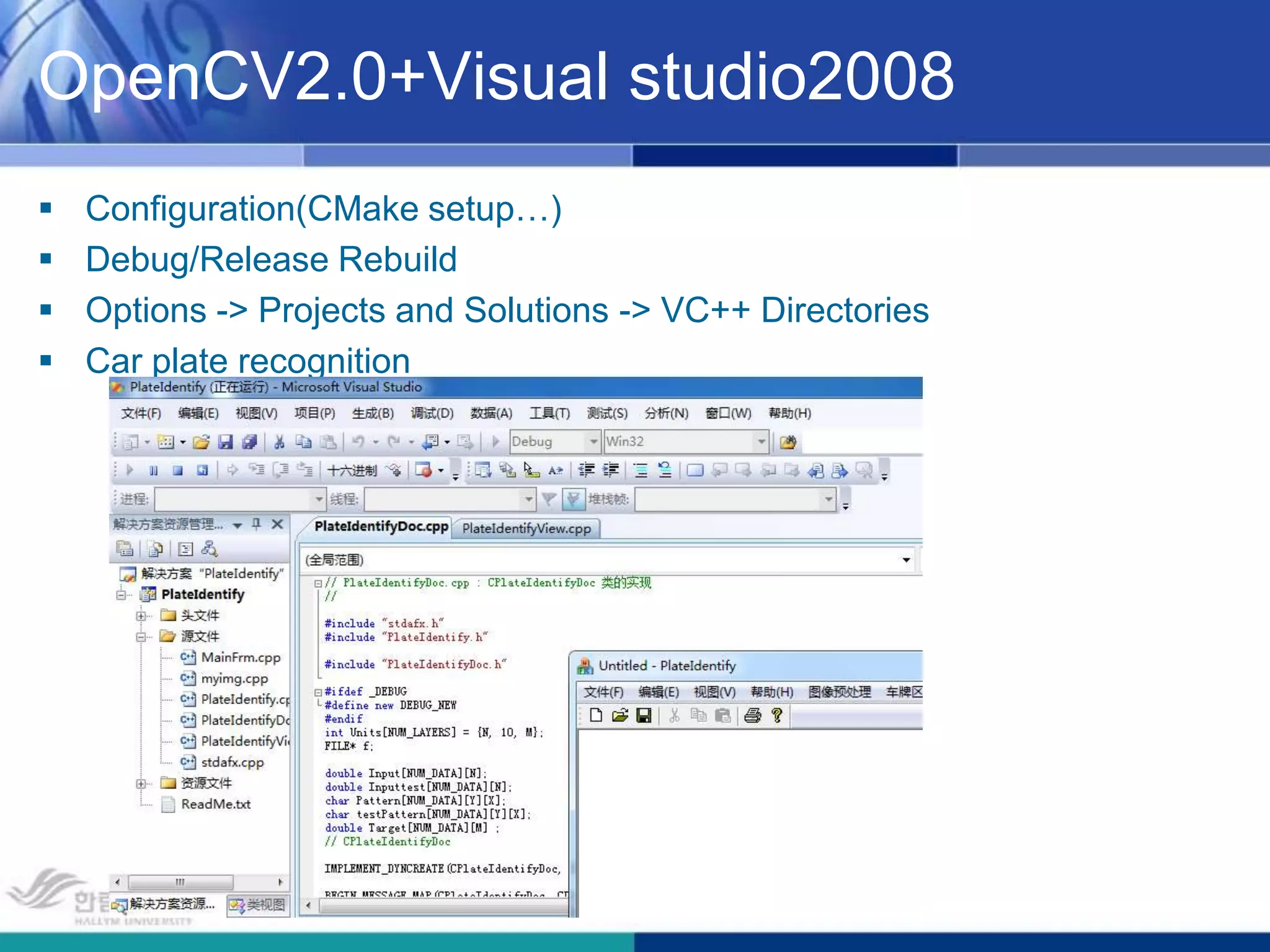
    Other fieldsFrom 2009.01to 2009.12OpenCV1.0+VC6.0OpenGL+VC6.0OpenCV2.0+VS2008Java3d on Myeclipse 7.5
  • 41.
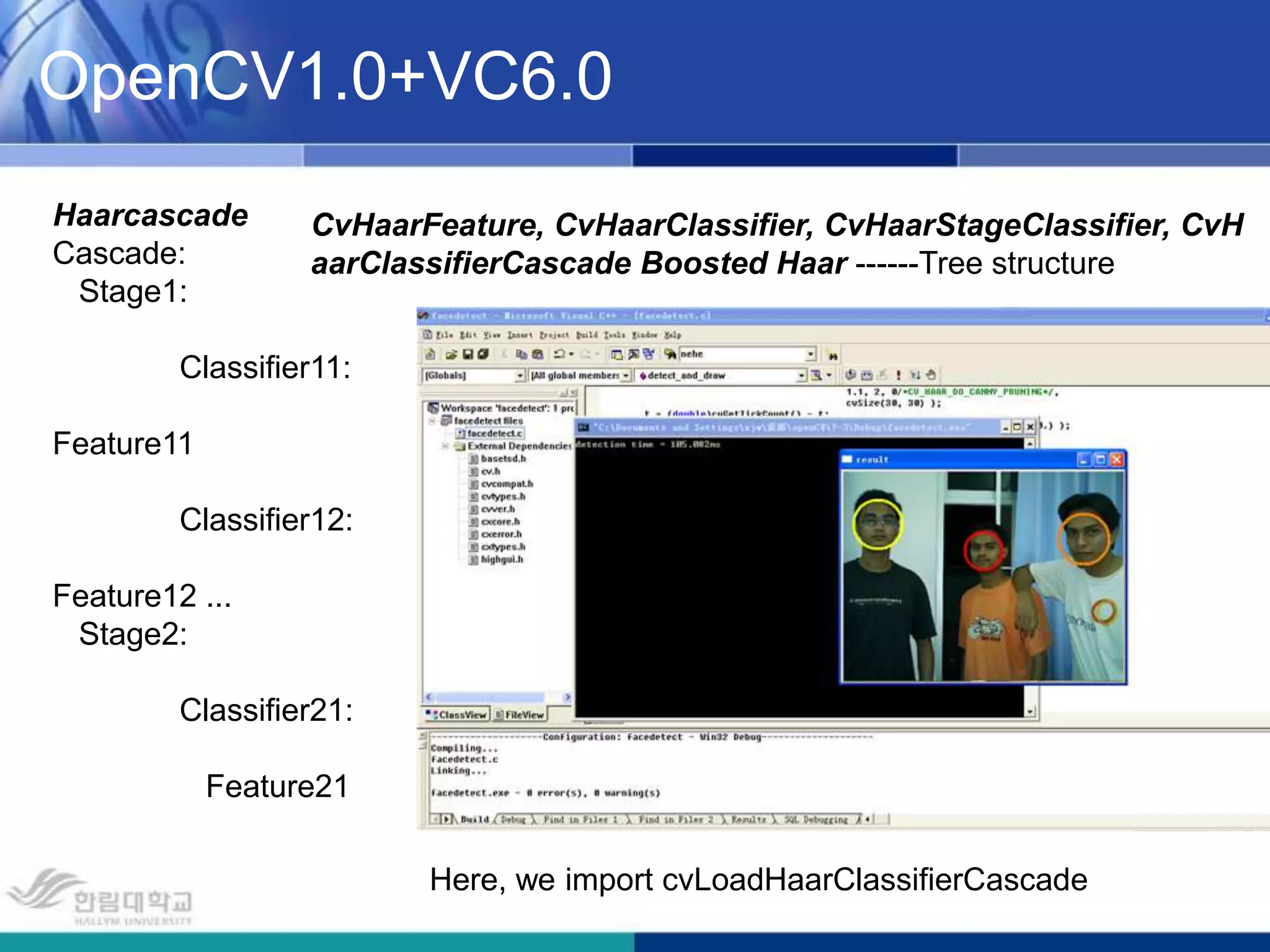
    OpenCV1.0+VC6.0HaarcascadeCascade: Stage1: Classifier11: Feature11 Classifier12: Feature12 ... Stage2: Classifier21: Feature21CvHaarFeature, CvHaarClassifier, CvHaarStageClassifier, CvHaarClassifierCascade Boosted Haar------Tree structureHere, we import cvLoadHaarClassifierCascade
  • 42.
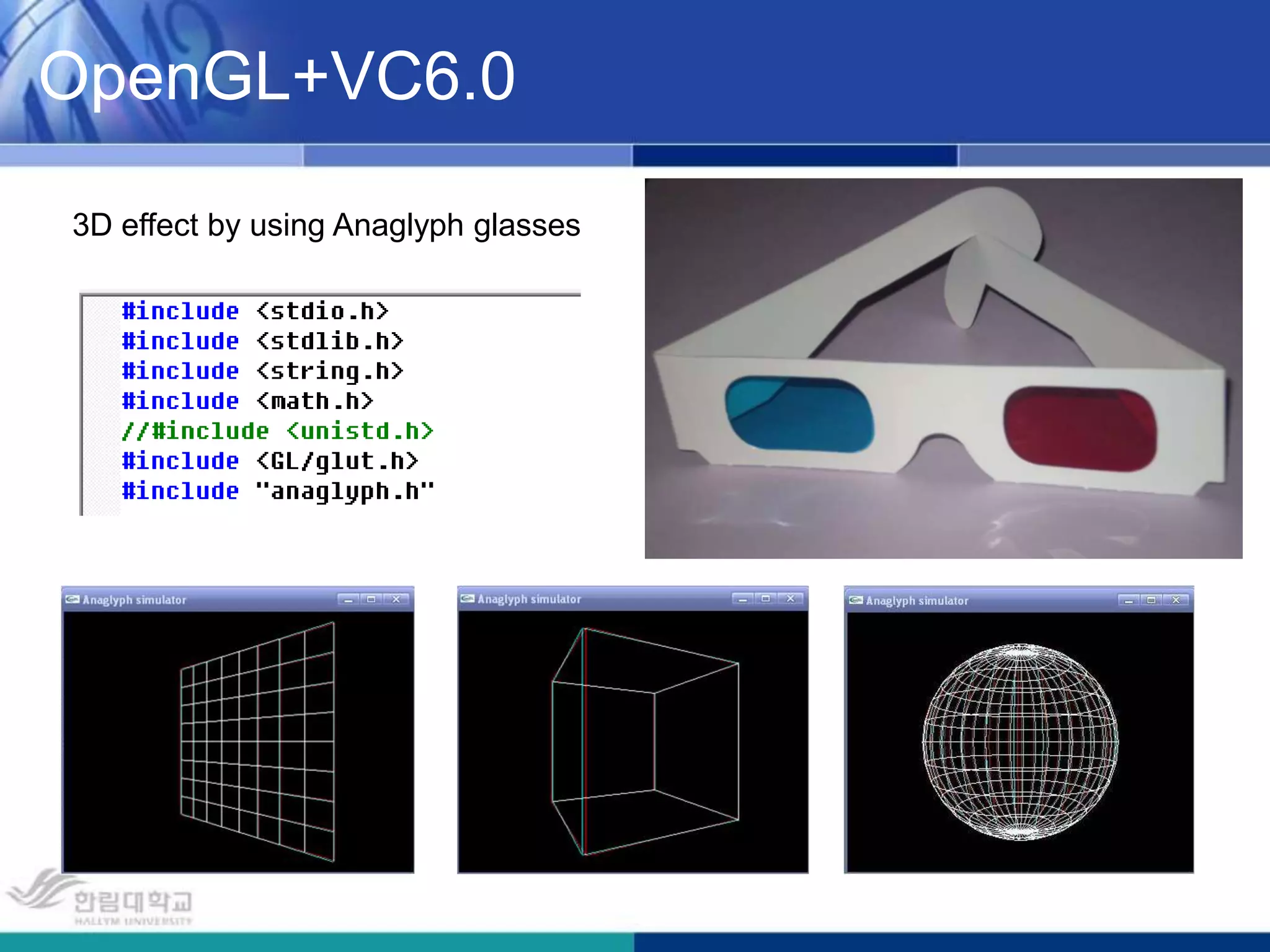
    OpenGL+VC6.03D effect byusing Anaglyph glasses
  • 43.
    OpenCV2.0+Visual studio2008Configuration(CMake setup…)Debug/ReleaseRebuildOptions -> Projects and Solutions -> VC++ Directories Car plate recognition
  • 44.
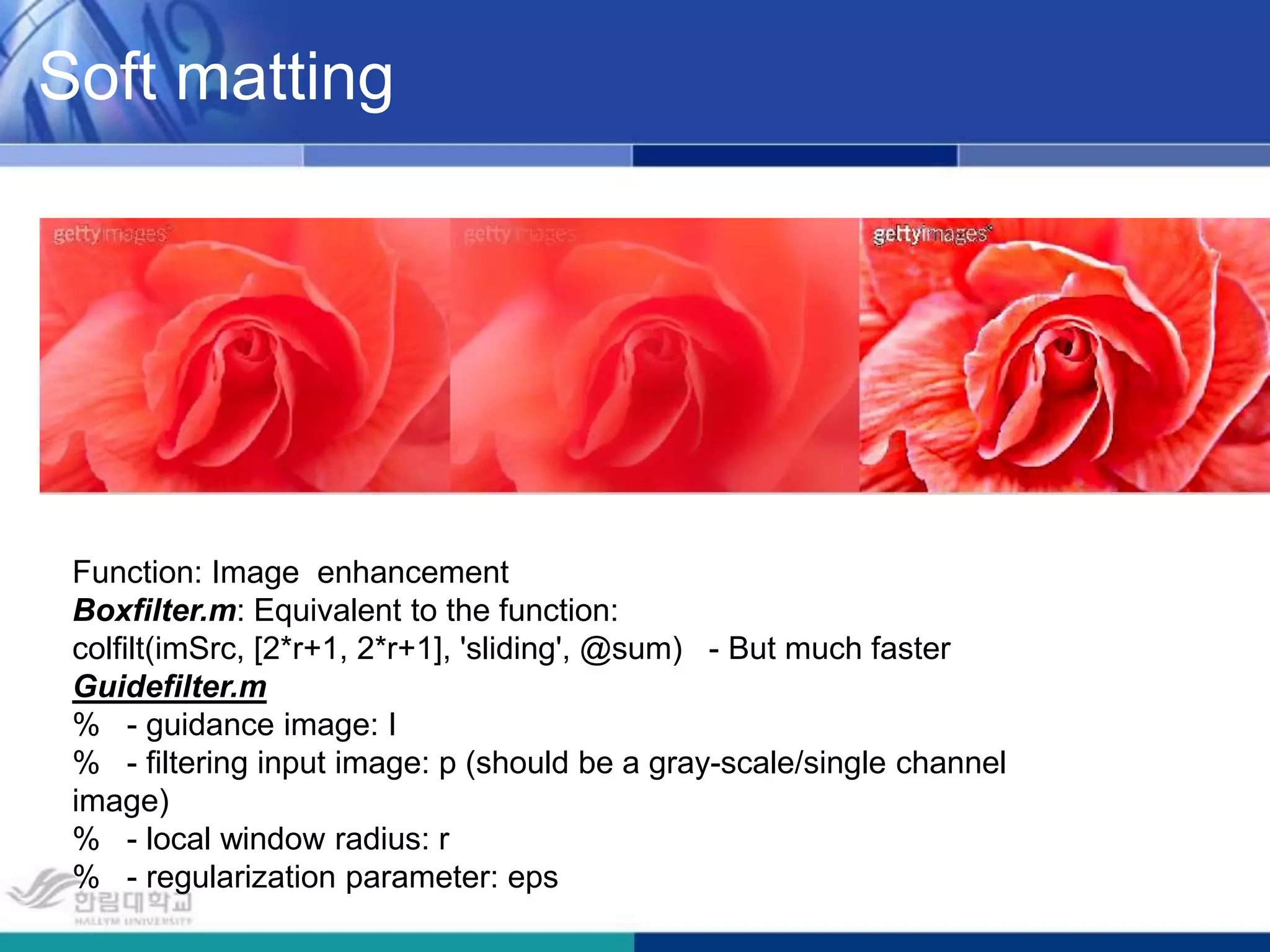
    Soft mattingFunction: Image enhancementBoxfilter.m: Equivalent to the function: colfilt(imSrc, [2*r+1, 2*r+1], 'sliding', @sum) - But much fasterGuidefilter.m% - guidance image: I% - filtering input image: p (should be a gray-scale/single channel image)% - local window radius: r% - regularization parameter: eps
  • 45.