International Research Journal of Engineering and Technology (IRJET) e-ISSN: 2395-0056
Volume: 05 Issue: 03 | Mar-2018 www.irjet.net p-ISSN: 2395-0072
© 2018, IRJET | Impact Factor value: 6.171 | ISO 9001:2008 Certified Journal | Page 3677
ROAD RECOGNITION FROM REMOTE SENSING IMAGERY USING
MACHINE LEARNING
P. Deepan1, S. Abinaya2, G. Haritha3, V. Iswarya4.
1 Assistant Professor Dept. of Computer Science and Engineering, Arasu Engineering College, Tamil nadu, India.
2,3,4 Students Dept. of Science and Engineering, Arasu Engineering College, Tamil nadu, India.
---------------------------------------------------------------------***---------------------------------------------------------------------
Abstract - The advance of remote sensing technology has
been capable of providing abundant spatial and contextual
information for object or area detection in satellite or aerial
imagery, which facilitates subsequent automatic analysisand
interpretation of the optical remotes sensing images (RSIs).
Most existing object or area detection approaches suffer from
two limitations. First, the feature representation used is
insufficiently powerful to capture the spatial and structural
patterns of objects and the background regions. Second, a
large number of training data with manual annotation of
object bounding boxes is required in the supervised learning
techniques adopted while the annotation process is generally
too expensive and sometimes even unreliable. We propose an
end-to-end framework for the dense, pixel-wise classification
of satellite imagery with convolution neural networks(CNNs).
In our framework, CNNs are directly trained to produce
classification maps out of the input mages. We first devise a
fully convolution architecture and demonstrate its relevance
to the dense classification problem. We then address the issue
of imperfect training data through a two-step training
approach: CNNs are first initialized by usingalargeamountof
possibly inaccurate reference data, and thenrefinedonasmall
amount of accurately labeled data. To complete our
framework, we design this module with the two different
stages that alleviates the common trade-off between
recognition and precise localization. A seriesofexperimentsin
MATLAB show that our works consider a large amount of
Meta context to provide fine-grained classification maps.
Keywords: Gaussian filtering, Histogram oriented
gradient (HOG) feature extraction, DCNN
1 INTRODUCTION
In Remote sensing systems one of the most
important features needed are roads, which require feature
extraction to identify them from high-resolution satellite
imagery. Nowadays, roads are changing rapidlythanever.In
order to keep up with the development trend and adapt to
the dynamic road data, updating the road data in real time
will contribute to the partition of functional areas around
the roads and the assessment of traffic capacity. Road
recognition from remote sensing imagery can be divided
into two phases: road detection and road classification. The
roads are recognized according to the road classification
results after detecting and extracting the road networks.
Recognition of roads is critical since they form an
important GIS layer in significant civilian and military
applications including navigation or location aware systems
and emergency planning systems for evacuation and fire
response. A number of methodsto extract roadsfrom multi-
spectral and panchromatic images have been proposed [4].
Roads can be classified using different classification
methods. Zhang and Coulorigner proposed a fuzzy logic
based classifier to road identification for high resolution
multi-spectral imagery [8]
In remote sensing imagery, roads are obviously
different from the surrounding backgrounds in color,
intensity, and shape. So, we have to extract the features of
roads based on the background information of road. [1]
Defines extracted road network based on image
segmentation, in which the images were segmented by
clustering algorithm. They use technique called k-means
clustering. It defines “The road extraction involves the two
main steps: the detection of road that might have the other
non-road parts like buildings and parking lots followed by
morphological operations to remove the non-road parts
based on their features”. Li and Cao [7] used saliencyfeature
extraction model to obtain seed points, and then extracted
road network with the active contour model.
The existing machine learning algorithms for road
recognition include support vector machine (SVM), neural
networksand decision tree, etc. Usually, classificationmodel
is obtained by training image samples with learning
algorithms, and then to classify
samples, which is called “onetime” learning [2]. For
examples, AdaBoost classifier wasusedtoconstructtheroad
classification model [12], and Das et al. [3] firstly divided
remote sensing image into sub blocks, and then selected
road and non-road sub blocksastraining samples, road was
finally recognized by using SVM to train and test samples.
Recently, saliency model has been applied into remote
sensing images processing. Existing works show that image
recognition based on saliency feature can quickly locate
saliency regions from complex background, providinginitial
region and position reference for target detection,whichhas
lower computing complexity as well as higher recognition
rate.
However, traditional saliency model is to compute
colour, intensity, and orientation saliency features,whichdo
not include the salient information of roads, such as edges.
Obviously, traditional saliency model is not appropriate for
urban satellite imageswith complex background. Hence,we
International Research Journal of Engineering and Technology (IRJET) e-ISSN: 2395-0056
Volume: 05 Issue: 03 | Mar-2018 www.irjet.net p-ISSN: 2395-0072
© 2018, IRJET | Impact Factor value: 6.171 | ISO 9001:2008 Certified Journal | Page 3678
extend the definition of saliency feature to most significant
characteristics of roads compared with surrounding
background.
With growing number of remote sensing imagery and
the constantly changing of the road structure, road
recognition from remote sensing imagery is proposed using
Machine learning algorithm. Road network is detected from
the remote sensing imagery by extracting road features.
Machine learning algorithm is employed to recognize the
road types. Finally, the recognition rate and computing time
are analyzed and compared as the performance indexes of
our method.
1.1 LITERATURE SURVEY
R. Maurya, Dr. P.R Gupta, Ajay Shankar Shukla et al. [1] has
proposed the road extraction that involves the two main
steps: the detection of road that might have the other non-
road parts like buildings and parking lots followed by
morphological operations to remove the non- road parts
based on their features. They used the K-Means clusteringto
detect the road area and may be some non-road area.
Morphological operations are used to remove the non-road
area based on the assumptions that road regions are an
elongated area that has largest connected component.
Clustering is method to group similar objects into one
cluster. K-means clustering [11] finds clusters such that
objects within each cluster are as close to each other as
possible, and as far from objects in other clustersaspossible.
K-means clustering requires you to specify the number of
clusters to be partitioned and a distance metric to specify
how close two objects are to each other.
Yoonsung Bae, Won-Hee Lee and Yunjun Choi et al. [2]
proposed a novel automatic algorithm for road extraction
from remote sensing images. The algorithm includes low-
and high-level processing. In the low-level processing, we
determine a normalized second derivative map of road
profiles of a generalized bar shape, which is width invariant
and contrast proportional, and accordingly obtain initial
road center pixels. In the high-level processing, using the
map and initial center pixels, we initially determine road
segments. The segments are then locally refined using their
orientation randomness and length-to-width ratio and
further refined via global graph-cut optimization. A final
road network is thereby extracted in a robust manner.
Experimental results demonstrate that the proposed
algorithm provides noticeably more robust and higher road
extraction performance in various images compared with
the existing algorithms.
Jing Zhang, Lu Chen, Li Zhuo, Qi Tian et al. [3] proposed a
road recognition method for remote sensing imagery using
incremental learning. In principle, our method includes the
following steps: 1) the non-road remote sensing imagery is
first filtered by using support vector machine; 2) the road
network is obtained from the road remote sensing imagery
by computing multiple saliency features; 3) the road
features are extracted from road network and background
environment; and 4) the roads are recognized as three road
types according to the classification results of incremental
learning algorithm.
Uwe BACHER and Helmut Mayer et al. [4] proposed a road
model for areas with different road appearance in IRS
satellite image data with a panchromatic resolution of 5 m
and 20 m multispectral resolution. We model areas where
water makes agriculture possible on one hand, and areas
dominated by the desert and dry mountainous areas on the
other hand. In agricultural areas, on which they focusin this
paper, roadsoften do not appear asdistinct lines. Bordersof
the fields represented by edges in the image and the
knowledge that these borders can be collinearly grouped,
possibly together with lines, into longer linearstructuresare
used to construct road sections. To close gaps, pairs of lines
or edges are connected by zip lock snakes. To verify these
road sections, the paths of the snakes are evaluated using
the line strength and the gradient image. The verified road
sections are finally globally grouped using the knowledge
that roads construct a network between important points.
Gaps which have a high impact on the network topology are
closed if evidence supporting this is found in the image.
D. Chaudhuri, N. K. Kushwaha, and A. Samal et al. [5]
proposed semi-automatic approach for road detection that
achieves high accuracy and efficiency. This method exploits
the properties of road segments to develop customized
operators to accurately derive the road segments. The
customized operators include directional morphological
enhancement, directional segmentation and thinning. They
have systematically evaluated the algorithm on a variety of
images from IKONOS, Quick Bird, CARTOSAT-2A satellites
and carefully compared it with the techniques presented in
literature. The results demonstrate that the algorithm
proposed is both accurate and efficient.
Yuan Tian and Yanqing Wang et al. [6] proposed a new
approach based on machine learning. First, many features
reflecting road characteristicsare extracted,whichconsistof
the ratio of bright regions, the direction consistencyofedges
and local binary patterns. Then these features are input into
a learning container, and AdaBoost is adopted to train
classifiers and select most effective features. Finally, roads
are detected with a sliding window by using the learning
results and validated by combining the road connectivity.
Experimental results on real Quick bird imagesdemonstrate
the effectiveness and robustness of the proposed method.
Sukhendu Das, T. T. Mirnalinee, and KoshyVargheseetal.[7]
propose Dominant Singular Measure. Itusedtodetectlocally
linear edge segments aspotential trajectories forroads.This
complimentary information is integrated using an
optimization framework to obtain potential targets for
roads. This provides decent results in situations only when
the roads have few obstacles (trees, large vehicles, and tall
buildings). Linking of disjoint segments uses the local
gradient functions at the adjacent pair of road endings.
International Research Journal of Engineering and Technology (IRJET) e-ISSN: 2395-0056
Volume: 05 Issue: 03 | Mar-2018 www.irjet.net p-ISSN: 2395-0072
© 2018, IRJET | Impact Factor value: 6.171 | ISO 9001:2008 Certified Journal | Page 3679
Region part segmentation uses curvature information to
remove stray non-road structures. Medial-Axis-Transform-
based hypothesis verificationeliminatesconnectednon-road
structures to improve the accuracy in road detection.
Another approach is Celal Ozturk [7] proposed the
Energy Constrained Sensor Networks. Whiledevelopingand
evaluating our privacy-aware routing protocols; we jointly
consider issues of location-privacy as well as the amount of
energy consumed by the sensor network. Motivated by the
observations, we propose a flexible routing strategy, known
as phantom routing, which protects the source’s location.
Source. Our investigations haveshownthatphantomrouting
is a powerful technique for protecting the location of the
source during sensor transmissions
2. PROPOSED WORK
In order to adapt to continuously updated road
samples and overcome the influence of complexbackground
in remote sensing imagery, our road recognition method
includes three parts: 1) Preliminary processing: Initially,we
perform blocking of images, then the image isconvertedinto
gray scale image and then we perform Denoising ; 2) Road
feature extraction: the road features are extractedfromroad
network and back-ground environment using Histogram of
Oriented Gradient (HOG) feature extraction technique; 3)
Machine learning: roads are recognized by using Machine
learning algorithm called Deep Convolutional Neural
Network (DCNN). The framework of our work is shown in
Fig.1.
In machine learning, an artificial neuralnetworkisa
system of interconnected neurons that pass messages to
each other. Neural networks are used to model complex
functions and, in particular, asframeworksforclassification.
Deep Convolutional neural networks(DCNNs)are,therefore,
gaining attention, due to their capability to automatically
discover relevant contextual features in image
categorization problems. DCNNsconsist of a stackoflearned
convolution filters that extract hierarchicalcontextualimage
features, and are a popular form of deep learning networks.
Our goal is to devise an end-to-end framework to classify
satellite imagery with DCNNs. The context of large-scale
satellite image classification introduces certain challenges
that we must address in order to turn DCNNsinto a relevant
classification tool.
Fig. 1. The framework of our method
Advantages:
 It does not need any separate clustering technique
 Less time consumption
 Accuracy is high
 Used to detect roads from any high resolution
images
 Higher road extraction performance
Fig. 2 System Architecture
Fig . 2. Shows the architecture of our model. Initially the
image is taken from satellite and then we perform
preprocessing steps to the image. The image is scaled into
500 x 500 pixels. Then we have to remove the noise using
Gaussian filter. In screening phase, We tracktheroadsandin
Discrimination phase the roads are recognized.
2.1 PROBLEM FORMULATION
To formulate our problem, first we have convert RGB image
into Gray scale image. The remote sensing image is
converted to gray scale image, which is calculated by
weighted average method of RGB three components
I (a, b) = 0.299R (a, b) + 0.587G (a, b) + 0.114B (a,
b) --> (1)
Then (1) gamma compression is used to reduce the local
changes of shadow and illumination:
Y (a, b) = I (a, b) gamma --> (2)
Here, I (a, b) represents the gray value of the
original pixel (a, b), and Y (a, b) represents the gray value of
the original pixel (a, b) after gamma compression (gamma =
0.5).
Then, using (2) the window is divided into several
cells. Then, a local 1-D histogram of gradient directions is
used to describe gradient information for each cell. For
example, the 360° gradient direction of cell is divided into 9
bins, if the gradient direction of pixel lies in 20°−40° , the
International Research Journal of Engineering and Technology (IRJET) e-ISSN: 2395-0056
Volume: 05 Issue: 03 | Mar-2018 www.irjet.net p-ISSN: 2395-0072
© 2018, IRJET | Impact Factor value: 6.171 | ISO 9001:2008 Certified Journal | Page 3680
count of the second bin will add 1. Finally, the gradient
directions histogram of cell can be achieved by counting
gradient direction of pixels in this cell.
In order to generate more accurate road networks,
Total Variation Regularization-based image fusion hasbeen
adopted to fuse the input images with noise.
Let u1 (a, b) be the true road network, which is
integrated by candidate region feature u2(a, b) and edge
feature u3(a, b), the relationship of trueimageandcandidate
images.
uj (a,b) = βj (a, b) u1 (a, b) + ηj (a, b) , j = 1, 2 --> (3)
where βj (x, y) and ηj (x, y) are the gain and noise
respectively. The essence of image fusion is to estimate the
true image u0 from the candidate images uj .
Algorithm:
Step 1: Convolution
The first layers that receive an input signal are
called convolution filters. Convolution isaprocesswherethe
network tries to label the input signal by referring to what it
haslearned in the past. If the input signal lookslikeprevious
cat images it has seen before, the “cat” reference signal will
be mixed into, or convolved with, the input signal. The
resulting output signal is then passed on to the next layer.
Step 2: Sub-sampling or Screening
Inputs from the convolution layer can be
“smoothened” to reduce the sensitivity of the filtersto noise
and variations. This smoothing process is
called subsampling, and can be achievedbytakingaverages
or taking the maximum over a sample of the signal.
Examples of subsampling methods (for image signals)
include reducing the size of the image, or reducing the color
contrast across red, green, blue (RGB) channels.
Step 3: Activation or Discrimination
The activation layer controls how the signal flows
from one layer to the next, emulating how neurons are fired
in our brain. Output signals which are strongly associated
with past references would activate more neurons, enabling
signals to be propagated more efficiently for identification.
CNN is compatible with a wide variety of complex activation
functions to model signal propagation, the most common
function being the Rectified Linear Unit (ReLU), which is
favored for its faster training speed.
Step 4: Fully Connected
The last layers in the network are fully connected,
meaning that neurons of preceding layers are connected to
every neuron in subsequent layers. This mimics high level
reasoning where all possible pathways from the input to
output are considered.
(During Training) Step 5: Loss
When training the neural network, there is
additional layer called the loss layer. This layer provides
feedback to the neural network on whether it identified
inputs correctly, and if not, how far off its guesses was. This
helps to guide the neural network to reinforce the right
concepts as it trains. This is always the last layer during
training
2.2 METHODOLOGY
A.PREPROCESSING
1. Blocking
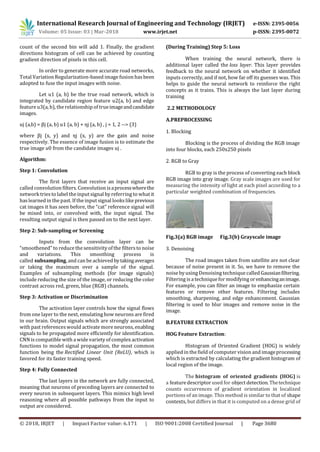
Blocking is the process of dividing the RGB image
into four blocks, each 250x250 pixels
2. RGB to Gray
RGB to gray is the process of converting each block
RGB image into gray image. Gray scale images are used for
measuring the intensity of light at each pixel according to a
particular weighted combination of frequencies.
Fig.3(a) RGB image Fig.3(b) Grayscale image
3. Denoising
The road images taken from satellite are not clear
because of noise present in it. So, we have to remove the
noise by using Denoising technique called Gaussianfiltering.
Filtering is a technique for modifying orenhancinganimage.
For example, you can filter an image to emphasize certain
features or remove other features. Filtering includes
smoothing, sharpening, and edge enhancement. Gaussian
filtering is used to blur images and remove noise in the
image.
B.FEATURE EXTRACTION
HOG Feature Extraction:
Histogram of Oriented Gradient (HOG) is widely
applied in the field of computer vision and imageprocessing
which is extracted by calculating the gradient histogram of
local region of the image.
The histogram of oriented gradients (HOG) is
a feature descriptor used for object detection.Thetechnique
counts occurrences of gradient orientation in localized
portions of an image. This method is similar to that of shape
contexts, but differs in that it is computed on a dense grid of
International Research Journal of Engineering and Technology (IRJET) e-ISSN: 2395-0056
Volume: 05 Issue: 03 | Mar-2018 www.irjet.net p-ISSN: 2395-0072
© 2018, IRJET | Impact Factor value: 6.171 | ISO 9001:2008 Certified Journal | Page 3681
uniformly spaced cells and uses overlapping local contrast
normalization for improved accuracy.
The image is divided into small connected regions
called cells, and for the pixelswithin each cell, ahistogramof
gradient directions is compiled. For improved accuracy, the
local histograms can be contrast-normalizedbycalculatinga
measure of the intensity across a larger region of the image,
called a block, and then using this value to normalizeallcells
within the block.
Since HOG is a kind of local feature, if extracting
HOG feature for a whole image, different images may
produce similar features, which is difficult to achieve a
satisfied result. Remote sensing imagery is relatively large
and usually contains a huge number of complex background
information.
The HOG feature is obtained by combing the
features of all blocks. In the process of extracting the HOG
feature, a whole image is divided into sub blocks of 32 × 32
pixels and the 360° gradient direction of cell is separated
into 9 bins, which is different from the standard HOG
extracting.
Therefore, block processing is necessary before
extracting HOG feature. However, if the size of sub-block is
too large, the dimension of HOG feature will increase;
otherwise, it will lead to incomplete information of the road
in the sub-block. Therefore, we cut thewholeremotesensing
imagery into sub blocks, and then to extract HOG feature
from every sub-block.
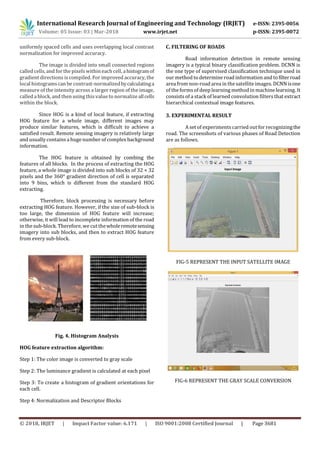
Fig. 4. Histogram Analysis
HOG feature extraction algorithm:
Step 1: The color image is converted to gray scale
Step 2: The luminance gradient is calculated at each pixel
Step 3: To create a histogram of gradient orientations for
each cell.
Step 4: Normalization and Descriptor Blocks
C. FILTERING OF ROADS
Road information detection in remote sensing
imagery is a typical binary classification problem. DCNN is
the one type of supervised classification technique used in
our method to determine road information and to filterroad
area from non-road area in the satellite images. DCNN isone
of the formsof deep learning method in machinelearning. It
consists of a stack of learned convolution filters that extract
hierarchical contextual image features.
3. EXPERIMENTAL RESULT
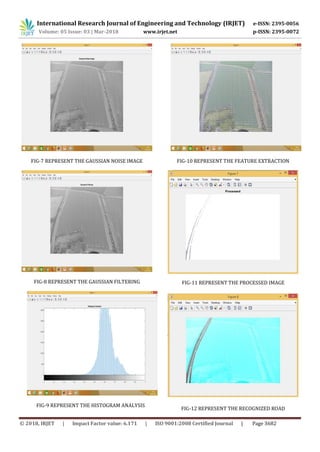
A set of experimentscarried out for recognizingthe
road. The screenshots of various phases of Road Detection
are as follows.
FIG-5 REPRESENT THE INPUT SATELLITE IMAGE
FIG-6 REPRESENT THE GRAY SCALE CONVERSION
International Research Journal of Engineering and Technology (IRJET) e-ISSN: 2395-0056
Volume: 05 Issue: 03 | Mar-2018 www.irjet.net p-ISSN: 2395-0072
© 2018, IRJET | Impact Factor value: 6.171 | ISO 9001:2008 Certified Journal | Page 3682
FIG-7 REPRESENT THE GAUSSIAN NOISE IMAGE
FIG-8 REPRESENT THE GAUSSIAN FILTERING
FIG-9 REPRESENT THE HISTOGRAM ANALYSIS
FIG-10 REPRESENT THE FEATURE EXTRACTION
FIG-11 REPRESENT THE PROCESSED IMAGE
FIG-12 REPRESENT THE RECOGNIZED ROAD
International Research Journal of Engineering and Technology (IRJET) e-ISSN: 2395-0056
Volume: 05 Issue: 03 | Mar-2018 www.irjet.net p-ISSN: 2395-0072
© 2018, IRJET | Impact Factor value: 6.171 | ISO 9001:2008 Certified Journal | Page 3683
4. CONCLUSION
A method of road recognition from remote sensing
imagery is proposed by using Machine learninginthispaper.
First, the preliminary processing is utilized to perform
Scaling the image and convert RGB to Gray andthenperform
Denoising. Second, extract the road features using HOG
feature extraction. Finally, Machinelearningalgorithmcalled
DCNN is used to filter roads from non-road areas. The
experimental results show that our method hashigher road
recognition rate as well as less recognition time than the
other popular algorithms
5. FUTURE ENHANCEMENT
In the future work, we will exploitsomeverysimilar
objects, such as rivers and buildings and also some moving
objects like vehicles, human beings etc. Then we will add
topological features and texture features to the road
network detection
REFERENCES
[1] R. Maurya, P. R. Gupta, and A. S. Shukla, “Road extraction
using K-means clustering and morphological operations,”in
Proc. Int. Conf. Image Inf. Process. (ICIIP), Shimla,India,Nov.
2011, pp. 1–6.
[2] Y. Bae, W. H. Lee, Y. W. Jeon, J. B. Ra, and Y. J. Choi,
“Automatic road extraction from remote sensing images
based on a normalized second derivative map,” IEEE Geosci.
Remote Sens. Lett., vol. 12, no. 9, pp. 1858–1862, Sep. 2015.
[3] Jing Zhang, Member, IEEE, Lu Chen, Chao Wang, Li Zhuo,
Qi Tian, Fellow, IEEE, “Road recognition from remote
sensing imagery using incremental learning,” IEEE Remote
Sens. Dec. 2016.
[4] U. Bacher and H. Mayer, “Automatic road extractionfrom
IRS satellite images in agricultural and desert areas,” Int.
Arch. Photogramm., Remote Sens. Spatial Inf. Sci., vol.35,pp.
1055–1060, Jul. 2004.
[5] D. Chaudhuri, N. K. Kushwaha, and A. Samal, “Semi-
automated road detection from high resolution satellite
images by directional morphological enhancement and
segmentation techniques,” IEEE J. Sel. Topics Appl. Earth
Observ. Remote Sens., vol. 5, no. 5, pp. 1538–1544,Oct.2012.
[6] Y. Q. Wang, Y. Tian, and X. Q. Tai, “Extraction of main
urban roads from high resolution satellite images by
machine learning,” in Computer Vision (Lecture Notes in
Computer Science). Berlin, Germany: Springer,Jan.2006,pp.
236–245.
[7] S. Das, T. T. Mirnalinee, and K. Varghese, “Use of salient
features for the design of a multistage framework to extract
roads from high resolution multispectral satellite images,”
IEEE Trans. Geosci. Remote Sens., vol. 49, no. 10, pp. 3906–
3931, Oct. 2011.
BIOGRAPHIES
Deepan.P received B.E degree in
Computer Science and Engineering from
Pallavan college of Engineering and M.E
degree from Annamalai University. He is
currently working as Assistant Professor
in Department of Computer science and
Engineering, Arasu Engineering College,
Kumbakonam. He is a Part time Ph.D.
Candidate in the Department of Computer science and
Engineering, Annamalai University.
Abinaya.S pursuing B.E Degree in the
stream of computer science and
engineering at Arasu engineering college
Kumbakonam.
Haritha.G pursuing B.E Degree in the
stream of computer science and
engineering at Arasu engineering college
Kumbakonam.
Iswarya.V pursuing B.E Degree in the
stream of computer science and
engineering at Arasu engineering college
Kumbakonam.

IRJET- Road Recognition from Remote Sensing Imagery using Machine Learning

  • 1.
    International Research Journalof Engineering and Technology (IRJET) e-ISSN: 2395-0056 Volume: 05 Issue: 03 | Mar-2018 www.irjet.net p-ISSN: 2395-0072 © 2018, IRJET | Impact Factor value: 6.171 | ISO 9001:2008 Certified Journal | Page 3677 ROAD RECOGNITION FROM REMOTE SENSING IMAGERY USING MACHINE LEARNING P. Deepan1, S. Abinaya2, G. Haritha3, V. Iswarya4. 1 Assistant Professor Dept. of Computer Science and Engineering, Arasu Engineering College, Tamil nadu, India. 2,3,4 Students Dept. of Science and Engineering, Arasu Engineering College, Tamil nadu, India. ---------------------------------------------------------------------***--------------------------------------------------------------------- Abstract - The advance of remote sensing technology has been capable of providing abundant spatial and contextual information for object or area detection in satellite or aerial imagery, which facilitates subsequent automatic analysisand interpretation of the optical remotes sensing images (RSIs). Most existing object or area detection approaches suffer from two limitations. First, the feature representation used is insufficiently powerful to capture the spatial and structural patterns of objects and the background regions. Second, a large number of training data with manual annotation of object bounding boxes is required in the supervised learning techniques adopted while the annotation process is generally too expensive and sometimes even unreliable. We propose an end-to-end framework for the dense, pixel-wise classification of satellite imagery with convolution neural networks(CNNs). In our framework, CNNs are directly trained to produce classification maps out of the input mages. We first devise a fully convolution architecture and demonstrate its relevance to the dense classification problem. We then address the issue of imperfect training data through a two-step training approach: CNNs are first initialized by usingalargeamountof possibly inaccurate reference data, and thenrefinedonasmall amount of accurately labeled data. To complete our framework, we design this module with the two different stages that alleviates the common trade-off between recognition and precise localization. A seriesofexperimentsin MATLAB show that our works consider a large amount of Meta context to provide fine-grained classification maps. Keywords: Gaussian filtering, Histogram oriented gradient (HOG) feature extraction, DCNN 1 INTRODUCTION In Remote sensing systems one of the most important features needed are roads, which require feature extraction to identify them from high-resolution satellite imagery. Nowadays, roads are changing rapidlythanever.In order to keep up with the development trend and adapt to the dynamic road data, updating the road data in real time will contribute to the partition of functional areas around the roads and the assessment of traffic capacity. Road recognition from remote sensing imagery can be divided into two phases: road detection and road classification. The roads are recognized according to the road classification results after detecting and extracting the road networks. Recognition of roads is critical since they form an important GIS layer in significant civilian and military applications including navigation or location aware systems and emergency planning systems for evacuation and fire response. A number of methodsto extract roadsfrom multi- spectral and panchromatic images have been proposed [4]. Roads can be classified using different classification methods. Zhang and Coulorigner proposed a fuzzy logic based classifier to road identification for high resolution multi-spectral imagery [8] In remote sensing imagery, roads are obviously different from the surrounding backgrounds in color, intensity, and shape. So, we have to extract the features of roads based on the background information of road. [1] Defines extracted road network based on image segmentation, in which the images were segmented by clustering algorithm. They use technique called k-means clustering. It defines “The road extraction involves the two main steps: the detection of road that might have the other non-road parts like buildings and parking lots followed by morphological operations to remove the non-road parts based on their features”. Li and Cao [7] used saliencyfeature extraction model to obtain seed points, and then extracted road network with the active contour model. The existing machine learning algorithms for road recognition include support vector machine (SVM), neural networksand decision tree, etc. Usually, classificationmodel is obtained by training image samples with learning algorithms, and then to classify samples, which is called “onetime” learning [2]. For examples, AdaBoost classifier wasusedtoconstructtheroad classification model [12], and Das et al. [3] firstly divided remote sensing image into sub blocks, and then selected road and non-road sub blocksastraining samples, road was finally recognized by using SVM to train and test samples. Recently, saliency model has been applied into remote sensing images processing. Existing works show that image recognition based on saliency feature can quickly locate saliency regions from complex background, providinginitial region and position reference for target detection,whichhas lower computing complexity as well as higher recognition rate. However, traditional saliency model is to compute colour, intensity, and orientation saliency features,whichdo not include the salient information of roads, such as edges. Obviously, traditional saliency model is not appropriate for urban satellite imageswith complex background. Hence,we
  • 2.
    International Research Journalof Engineering and Technology (IRJET) e-ISSN: 2395-0056 Volume: 05 Issue: 03 | Mar-2018 www.irjet.net p-ISSN: 2395-0072 © 2018, IRJET | Impact Factor value: 6.171 | ISO 9001:2008 Certified Journal | Page 3678 extend the definition of saliency feature to most significant characteristics of roads compared with surrounding background. With growing number of remote sensing imagery and the constantly changing of the road structure, road recognition from remote sensing imagery is proposed using Machine learning algorithm. Road network is detected from the remote sensing imagery by extracting road features. Machine learning algorithm is employed to recognize the road types. Finally, the recognition rate and computing time are analyzed and compared as the performance indexes of our method. 1.1 LITERATURE SURVEY R. Maurya, Dr. P.R Gupta, Ajay Shankar Shukla et al. [1] has proposed the road extraction that involves the two main steps: the detection of road that might have the other non- road parts like buildings and parking lots followed by morphological operations to remove the non- road parts based on their features. They used the K-Means clusteringto detect the road area and may be some non-road area. Morphological operations are used to remove the non-road area based on the assumptions that road regions are an elongated area that has largest connected component. Clustering is method to group similar objects into one cluster. K-means clustering [11] finds clusters such that objects within each cluster are as close to each other as possible, and as far from objects in other clustersaspossible. K-means clustering requires you to specify the number of clusters to be partitioned and a distance metric to specify how close two objects are to each other. Yoonsung Bae, Won-Hee Lee and Yunjun Choi et al. [2] proposed a novel automatic algorithm for road extraction from remote sensing images. The algorithm includes low- and high-level processing. In the low-level processing, we determine a normalized second derivative map of road profiles of a generalized bar shape, which is width invariant and contrast proportional, and accordingly obtain initial road center pixels. In the high-level processing, using the map and initial center pixels, we initially determine road segments. The segments are then locally refined using their orientation randomness and length-to-width ratio and further refined via global graph-cut optimization. A final road network is thereby extracted in a robust manner. Experimental results demonstrate that the proposed algorithm provides noticeably more robust and higher road extraction performance in various images compared with the existing algorithms. Jing Zhang, Lu Chen, Li Zhuo, Qi Tian et al. [3] proposed a road recognition method for remote sensing imagery using incremental learning. In principle, our method includes the following steps: 1) the non-road remote sensing imagery is first filtered by using support vector machine; 2) the road network is obtained from the road remote sensing imagery by computing multiple saliency features; 3) the road features are extracted from road network and background environment; and 4) the roads are recognized as three road types according to the classification results of incremental learning algorithm. Uwe BACHER and Helmut Mayer et al. [4] proposed a road model for areas with different road appearance in IRS satellite image data with a panchromatic resolution of 5 m and 20 m multispectral resolution. We model areas where water makes agriculture possible on one hand, and areas dominated by the desert and dry mountainous areas on the other hand. In agricultural areas, on which they focusin this paper, roadsoften do not appear asdistinct lines. Bordersof the fields represented by edges in the image and the knowledge that these borders can be collinearly grouped, possibly together with lines, into longer linearstructuresare used to construct road sections. To close gaps, pairs of lines or edges are connected by zip lock snakes. To verify these road sections, the paths of the snakes are evaluated using the line strength and the gradient image. The verified road sections are finally globally grouped using the knowledge that roads construct a network between important points. Gaps which have a high impact on the network topology are closed if evidence supporting this is found in the image. D. Chaudhuri, N. K. Kushwaha, and A. Samal et al. [5] proposed semi-automatic approach for road detection that achieves high accuracy and efficiency. This method exploits the properties of road segments to develop customized operators to accurately derive the road segments. The customized operators include directional morphological enhancement, directional segmentation and thinning. They have systematically evaluated the algorithm on a variety of images from IKONOS, Quick Bird, CARTOSAT-2A satellites and carefully compared it with the techniques presented in literature. The results demonstrate that the algorithm proposed is both accurate and efficient. Yuan Tian and Yanqing Wang et al. [6] proposed a new approach based on machine learning. First, many features reflecting road characteristicsare extracted,whichconsistof the ratio of bright regions, the direction consistencyofedges and local binary patterns. Then these features are input into a learning container, and AdaBoost is adopted to train classifiers and select most effective features. Finally, roads are detected with a sliding window by using the learning results and validated by combining the road connectivity. Experimental results on real Quick bird imagesdemonstrate the effectiveness and robustness of the proposed method. Sukhendu Das, T. T. Mirnalinee, and KoshyVargheseetal.[7] propose Dominant Singular Measure. Itusedtodetectlocally linear edge segments aspotential trajectories forroads.This complimentary information is integrated using an optimization framework to obtain potential targets for roads. This provides decent results in situations only when the roads have few obstacles (trees, large vehicles, and tall buildings). Linking of disjoint segments uses the local gradient functions at the adjacent pair of road endings.
  • 3.
    International Research Journalof Engineering and Technology (IRJET) e-ISSN: 2395-0056 Volume: 05 Issue: 03 | Mar-2018 www.irjet.net p-ISSN: 2395-0072 © 2018, IRJET | Impact Factor value: 6.171 | ISO 9001:2008 Certified Journal | Page 3679 Region part segmentation uses curvature information to remove stray non-road structures. Medial-Axis-Transform- based hypothesis verificationeliminatesconnectednon-road structures to improve the accuracy in road detection. Another approach is Celal Ozturk [7] proposed the Energy Constrained Sensor Networks. Whiledevelopingand evaluating our privacy-aware routing protocols; we jointly consider issues of location-privacy as well as the amount of energy consumed by the sensor network. Motivated by the observations, we propose a flexible routing strategy, known as phantom routing, which protects the source’s location. Source. Our investigations haveshownthatphantomrouting is a powerful technique for protecting the location of the source during sensor transmissions 2. PROPOSED WORK In order to adapt to continuously updated road samples and overcome the influence of complexbackground in remote sensing imagery, our road recognition method includes three parts: 1) Preliminary processing: Initially,we perform blocking of images, then the image isconvertedinto gray scale image and then we perform Denoising ; 2) Road feature extraction: the road features are extractedfromroad network and back-ground environment using Histogram of Oriented Gradient (HOG) feature extraction technique; 3) Machine learning: roads are recognized by using Machine learning algorithm called Deep Convolutional Neural Network (DCNN). The framework of our work is shown in Fig.1. In machine learning, an artificial neuralnetworkisa system of interconnected neurons that pass messages to each other. Neural networks are used to model complex functions and, in particular, asframeworksforclassification. Deep Convolutional neural networks(DCNNs)are,therefore, gaining attention, due to their capability to automatically discover relevant contextual features in image categorization problems. DCNNsconsist of a stackoflearned convolution filters that extract hierarchicalcontextualimage features, and are a popular form of deep learning networks. Our goal is to devise an end-to-end framework to classify satellite imagery with DCNNs. The context of large-scale satellite image classification introduces certain challenges that we must address in order to turn DCNNsinto a relevant classification tool. Fig. 1. The framework of our method Advantages:  It does not need any separate clustering technique  Less time consumption  Accuracy is high  Used to detect roads from any high resolution images  Higher road extraction performance Fig. 2 System Architecture Fig . 2. Shows the architecture of our model. Initially the image is taken from satellite and then we perform preprocessing steps to the image. The image is scaled into 500 x 500 pixels. Then we have to remove the noise using Gaussian filter. In screening phase, We tracktheroadsandin Discrimination phase the roads are recognized. 2.1 PROBLEM FORMULATION To formulate our problem, first we have convert RGB image into Gray scale image. The remote sensing image is converted to gray scale image, which is calculated by weighted average method of RGB three components I (a, b) = 0.299R (a, b) + 0.587G (a, b) + 0.114B (a, b) --> (1) Then (1) gamma compression is used to reduce the local changes of shadow and illumination: Y (a, b) = I (a, b) gamma --> (2) Here, I (a, b) represents the gray value of the original pixel (a, b), and Y (a, b) represents the gray value of the original pixel (a, b) after gamma compression (gamma = 0.5). Then, using (2) the window is divided into several cells. Then, a local 1-D histogram of gradient directions is used to describe gradient information for each cell. For example, the 360° gradient direction of cell is divided into 9 bins, if the gradient direction of pixel lies in 20°−40° , the
  • 4.
    International Research Journalof Engineering and Technology (IRJET) e-ISSN: 2395-0056 Volume: 05 Issue: 03 | Mar-2018 www.irjet.net p-ISSN: 2395-0072 © 2018, IRJET | Impact Factor value: 6.171 | ISO 9001:2008 Certified Journal | Page 3680 count of the second bin will add 1. Finally, the gradient directions histogram of cell can be achieved by counting gradient direction of pixels in this cell. In order to generate more accurate road networks, Total Variation Regularization-based image fusion hasbeen adopted to fuse the input images with noise. Let u1 (a, b) be the true road network, which is integrated by candidate region feature u2(a, b) and edge feature u3(a, b), the relationship of trueimageandcandidate images. uj (a,b) = βj (a, b) u1 (a, b) + ηj (a, b) , j = 1, 2 --> (3) where βj (x, y) and ηj (x, y) are the gain and noise respectively. The essence of image fusion is to estimate the true image u0 from the candidate images uj . Algorithm: Step 1: Convolution The first layers that receive an input signal are called convolution filters. Convolution isaprocesswherethe network tries to label the input signal by referring to what it haslearned in the past. If the input signal lookslikeprevious cat images it has seen before, the “cat” reference signal will be mixed into, or convolved with, the input signal. The resulting output signal is then passed on to the next layer. Step 2: Sub-sampling or Screening Inputs from the convolution layer can be “smoothened” to reduce the sensitivity of the filtersto noise and variations. This smoothing process is called subsampling, and can be achievedbytakingaverages or taking the maximum over a sample of the signal. Examples of subsampling methods (for image signals) include reducing the size of the image, or reducing the color contrast across red, green, blue (RGB) channels. Step 3: Activation or Discrimination The activation layer controls how the signal flows from one layer to the next, emulating how neurons are fired in our brain. Output signals which are strongly associated with past references would activate more neurons, enabling signals to be propagated more efficiently for identification. CNN is compatible with a wide variety of complex activation functions to model signal propagation, the most common function being the Rectified Linear Unit (ReLU), which is favored for its faster training speed. Step 4: Fully Connected The last layers in the network are fully connected, meaning that neurons of preceding layers are connected to every neuron in subsequent layers. This mimics high level reasoning where all possible pathways from the input to output are considered. (During Training) Step 5: Loss When training the neural network, there is additional layer called the loss layer. This layer provides feedback to the neural network on whether it identified inputs correctly, and if not, how far off its guesses was. This helps to guide the neural network to reinforce the right concepts as it trains. This is always the last layer during training 2.2 METHODOLOGY A.PREPROCESSING 1. Blocking Blocking is the process of dividing the RGB image into four blocks, each 250x250 pixels 2. RGB to Gray RGB to gray is the process of converting each block RGB image into gray image. Gray scale images are used for measuring the intensity of light at each pixel according to a particular weighted combination of frequencies. Fig.3(a) RGB image Fig.3(b) Grayscale image 3. Denoising The road images taken from satellite are not clear because of noise present in it. So, we have to remove the noise by using Denoising technique called Gaussianfiltering. Filtering is a technique for modifying orenhancinganimage. For example, you can filter an image to emphasize certain features or remove other features. Filtering includes smoothing, sharpening, and edge enhancement. Gaussian filtering is used to blur images and remove noise in the image. B.FEATURE EXTRACTION HOG Feature Extraction: Histogram of Oriented Gradient (HOG) is widely applied in the field of computer vision and imageprocessing which is extracted by calculating the gradient histogram of local region of the image. The histogram of oriented gradients (HOG) is a feature descriptor used for object detection.Thetechnique counts occurrences of gradient orientation in localized portions of an image. This method is similar to that of shape contexts, but differs in that it is computed on a dense grid of
  • 5.
    International Research Journalof Engineering and Technology (IRJET) e-ISSN: 2395-0056 Volume: 05 Issue: 03 | Mar-2018 www.irjet.net p-ISSN: 2395-0072 © 2018, IRJET | Impact Factor value: 6.171 | ISO 9001:2008 Certified Journal | Page 3681 uniformly spaced cells and uses overlapping local contrast normalization for improved accuracy. The image is divided into small connected regions called cells, and for the pixelswithin each cell, ahistogramof gradient directions is compiled. For improved accuracy, the local histograms can be contrast-normalizedbycalculatinga measure of the intensity across a larger region of the image, called a block, and then using this value to normalizeallcells within the block. Since HOG is a kind of local feature, if extracting HOG feature for a whole image, different images may produce similar features, which is difficult to achieve a satisfied result. Remote sensing imagery is relatively large and usually contains a huge number of complex background information. The HOG feature is obtained by combing the features of all blocks. In the process of extracting the HOG feature, a whole image is divided into sub blocks of 32 × 32 pixels and the 360° gradient direction of cell is separated into 9 bins, which is different from the standard HOG extracting. Therefore, block processing is necessary before extracting HOG feature. However, if the size of sub-block is too large, the dimension of HOG feature will increase; otherwise, it will lead to incomplete information of the road in the sub-block. Therefore, we cut thewholeremotesensing imagery into sub blocks, and then to extract HOG feature from every sub-block. Fig. 4. Histogram Analysis HOG feature extraction algorithm: Step 1: The color image is converted to gray scale Step 2: The luminance gradient is calculated at each pixel Step 3: To create a histogram of gradient orientations for each cell. Step 4: Normalization and Descriptor Blocks C. FILTERING OF ROADS Road information detection in remote sensing imagery is a typical binary classification problem. DCNN is the one type of supervised classification technique used in our method to determine road information and to filterroad area from non-road area in the satellite images. DCNN isone of the formsof deep learning method in machinelearning. It consists of a stack of learned convolution filters that extract hierarchical contextual image features. 3. EXPERIMENTAL RESULT A set of experimentscarried out for recognizingthe road. The screenshots of various phases of Road Detection are as follows. FIG-5 REPRESENT THE INPUT SATELLITE IMAGE FIG-6 REPRESENT THE GRAY SCALE CONVERSION
  • 6.
    International Research Journalof Engineering and Technology (IRJET) e-ISSN: 2395-0056 Volume: 05 Issue: 03 | Mar-2018 www.irjet.net p-ISSN: 2395-0072 © 2018, IRJET | Impact Factor value: 6.171 | ISO 9001:2008 Certified Journal | Page 3682 FIG-7 REPRESENT THE GAUSSIAN NOISE IMAGE FIG-8 REPRESENT THE GAUSSIAN FILTERING FIG-9 REPRESENT THE HISTOGRAM ANALYSIS FIG-10 REPRESENT THE FEATURE EXTRACTION FIG-11 REPRESENT THE PROCESSED IMAGE FIG-12 REPRESENT THE RECOGNIZED ROAD
  • 7.
    International Research Journalof Engineering and Technology (IRJET) e-ISSN: 2395-0056 Volume: 05 Issue: 03 | Mar-2018 www.irjet.net p-ISSN: 2395-0072 © 2018, IRJET | Impact Factor value: 6.171 | ISO 9001:2008 Certified Journal | Page 3683 4. CONCLUSION A method of road recognition from remote sensing imagery is proposed by using Machine learninginthispaper. First, the preliminary processing is utilized to perform Scaling the image and convert RGB to Gray andthenperform Denoising. Second, extract the road features using HOG feature extraction. Finally, Machinelearningalgorithmcalled DCNN is used to filter roads from non-road areas. The experimental results show that our method hashigher road recognition rate as well as less recognition time than the other popular algorithms 5. FUTURE ENHANCEMENT In the future work, we will exploitsomeverysimilar objects, such as rivers and buildings and also some moving objects like vehicles, human beings etc. Then we will add topological features and texture features to the road network detection REFERENCES [1] R. Maurya, P. R. Gupta, and A. S. Shukla, “Road extraction using K-means clustering and morphological operations,”in Proc. Int. Conf. Image Inf. Process. (ICIIP), Shimla,India,Nov. 2011, pp. 1–6. [2] Y. Bae, W. H. Lee, Y. W. Jeon, J. B. Ra, and Y. J. Choi, “Automatic road extraction from remote sensing images based on a normalized second derivative map,” IEEE Geosci. Remote Sens. Lett., vol. 12, no. 9, pp. 1858–1862, Sep. 2015. [3] Jing Zhang, Member, IEEE, Lu Chen, Chao Wang, Li Zhuo, Qi Tian, Fellow, IEEE, “Road recognition from remote sensing imagery using incremental learning,” IEEE Remote Sens. Dec. 2016. [4] U. Bacher and H. Mayer, “Automatic road extractionfrom IRS satellite images in agricultural and desert areas,” Int. Arch. Photogramm., Remote Sens. Spatial Inf. Sci., vol.35,pp. 1055–1060, Jul. 2004. [5] D. Chaudhuri, N. K. Kushwaha, and A. Samal, “Semi- automated road detection from high resolution satellite images by directional morphological enhancement and segmentation techniques,” IEEE J. Sel. Topics Appl. Earth Observ. Remote Sens., vol. 5, no. 5, pp. 1538–1544,Oct.2012. [6] Y. Q. Wang, Y. Tian, and X. Q. Tai, “Extraction of main urban roads from high resolution satellite images by machine learning,” in Computer Vision (Lecture Notes in Computer Science). Berlin, Germany: Springer,Jan.2006,pp. 236–245. [7] S. Das, T. T. Mirnalinee, and K. Varghese, “Use of salient features for the design of a multistage framework to extract roads from high resolution multispectral satellite images,” IEEE Trans. Geosci. Remote Sens., vol. 49, no. 10, pp. 3906– 3931, Oct. 2011. BIOGRAPHIES Deepan.P received B.E degree in Computer Science and Engineering from Pallavan college of Engineering and M.E degree from Annamalai University. He is currently working as Assistant Professor in Department of Computer science and Engineering, Arasu Engineering College, Kumbakonam. He is a Part time Ph.D. Candidate in the Department of Computer science and Engineering, Annamalai University. Abinaya.S pursuing B.E Degree in the stream of computer science and engineering at Arasu engineering college Kumbakonam. Haritha.G pursuing B.E Degree in the stream of computer science and engineering at Arasu engineering college Kumbakonam. Iswarya.V pursuing B.E Degree in the stream of computer science and engineering at Arasu engineering college Kumbakonam.