COMMON PITFALLS IN RESEARCH
PROPOSAL WRITING AND HOW
TO AVOID THEM
TUTOR : Matthew
Group 11
INTRODUCTION
• Conducting research from planning to publication can be a very
rewarding process.
• However, multiple preventable setbacks can occur within each
stage of research.
• While these inefficiencies are an inevitable part of the research
process, understanding common pitfalls can limit those
hindrances.
• This presentation provides a detailed, step-by –step guide to
identify these pitfalls and offers strategies for avoiding them.
Overview of Research Proposal Writing
. Importance of a Strong Proposal
• A well-crafted proposal is essential for communicating the significance,
feasibility, and methodology of the proposed research.
• It serves as the foundation for obtaining funding, support, and resources
necessary for successful project execution.
Understanding the Funding Landscape
• Familiarize yourself with various funding sources and their specific
requirements to tailor your proposal accordingly.
• A successful proposal aligns the research goals with the priorities of the
funding agency
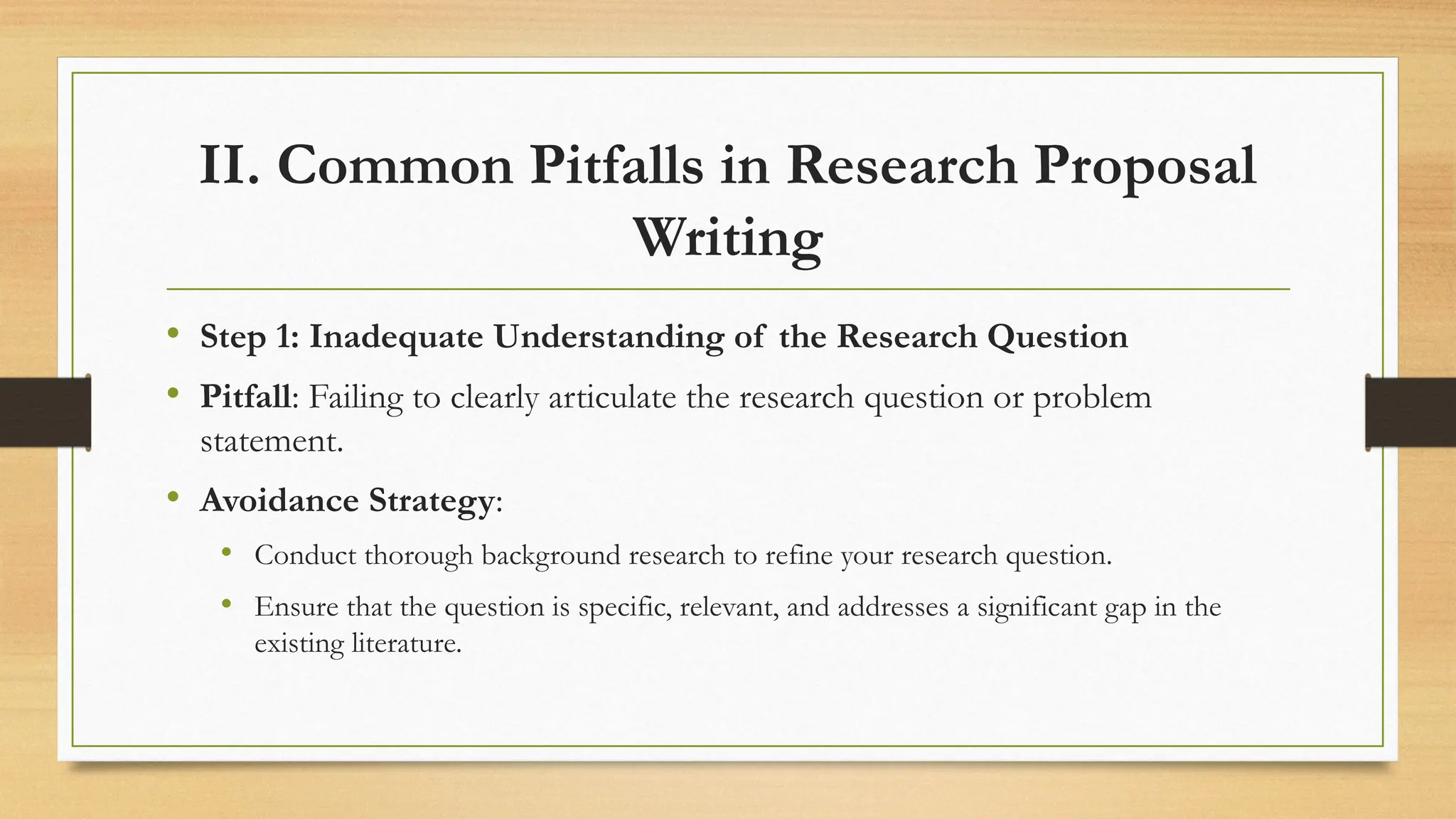
II. Common Pitfalls in Research Proposal
Writing
• Step 1: Inadequate Understanding of the Research Question
• Pitfall: Failing to clearly articulate the research question or problem
statement.
• Avoidance Strategy:
• Conduct thorough background research to refine your research question.
• Ensure that the question is specific, relevant, and addresses a significant gap in the
existing literature.
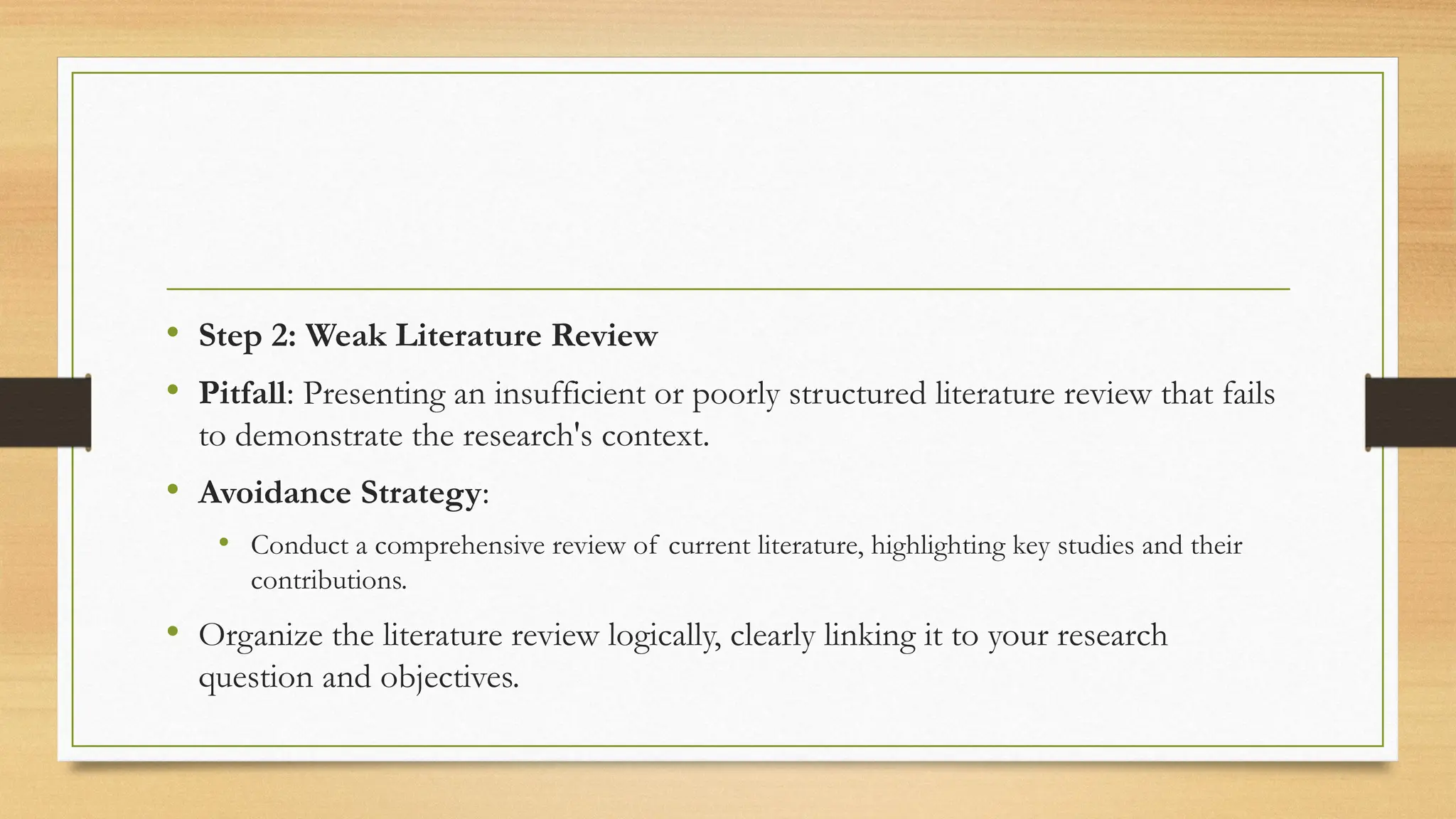
• Step 2: Weak Literature Review
• Pitfall: Presenting an insufficient or poorly structured literature review that fails
to demonstrate the research's context.
• Avoidance Strategy:
• Conduct a comprehensive review of current literature, highlighting key studies and their
contributions.
• Organize the literature review logically, clearly linking it to your research
question and objectives.
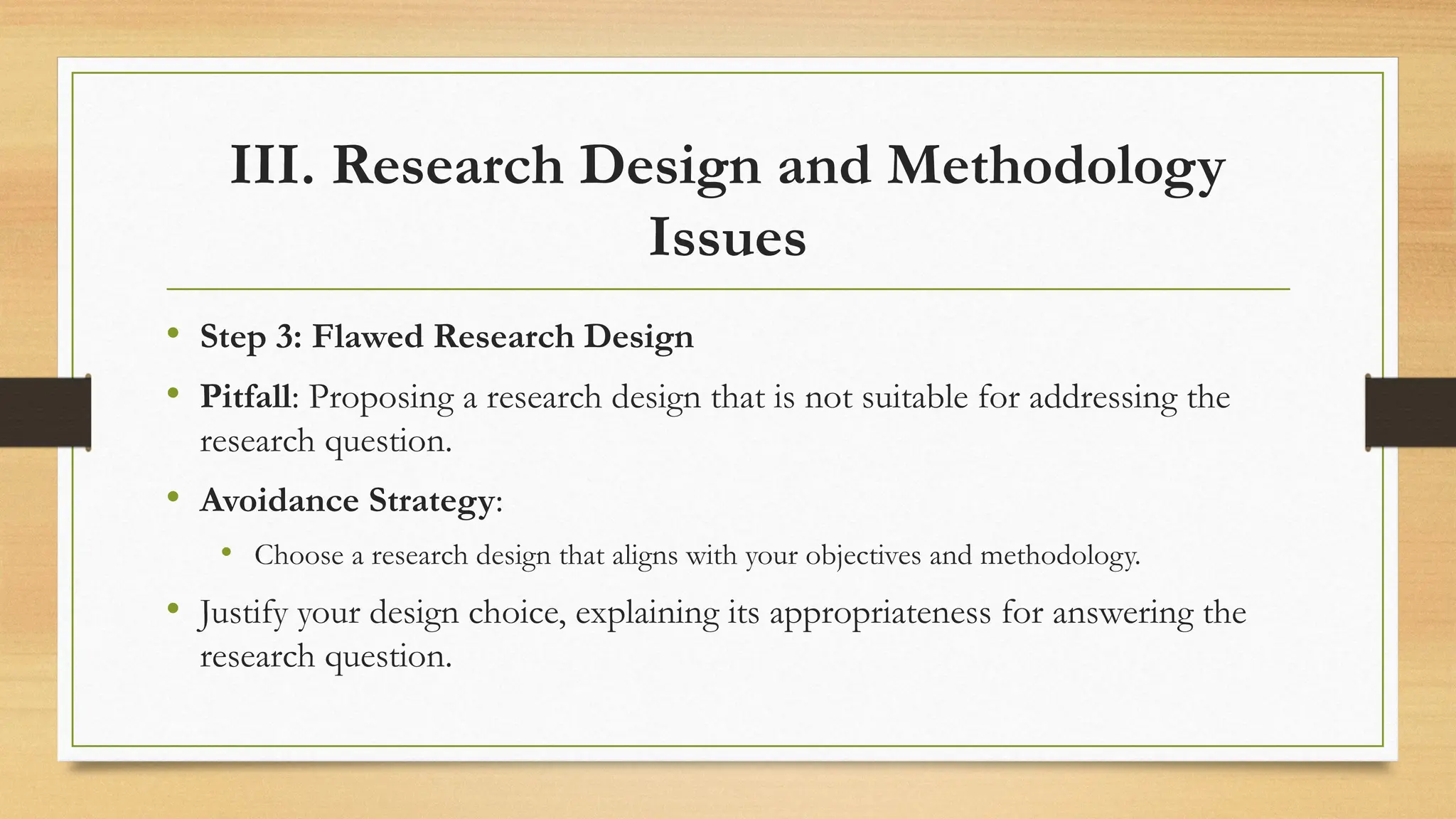
III. Research Design and Methodology
Issues
• Step 3: Flawed Research Design
• Pitfall: Proposing a research design that is not suitable for addressing the
research question.
• Avoidance Strategy:
• Choose a research design that aligns with your objectives and methodology.
• Justify your design choice, explaining its appropriateness for answering the
research question.
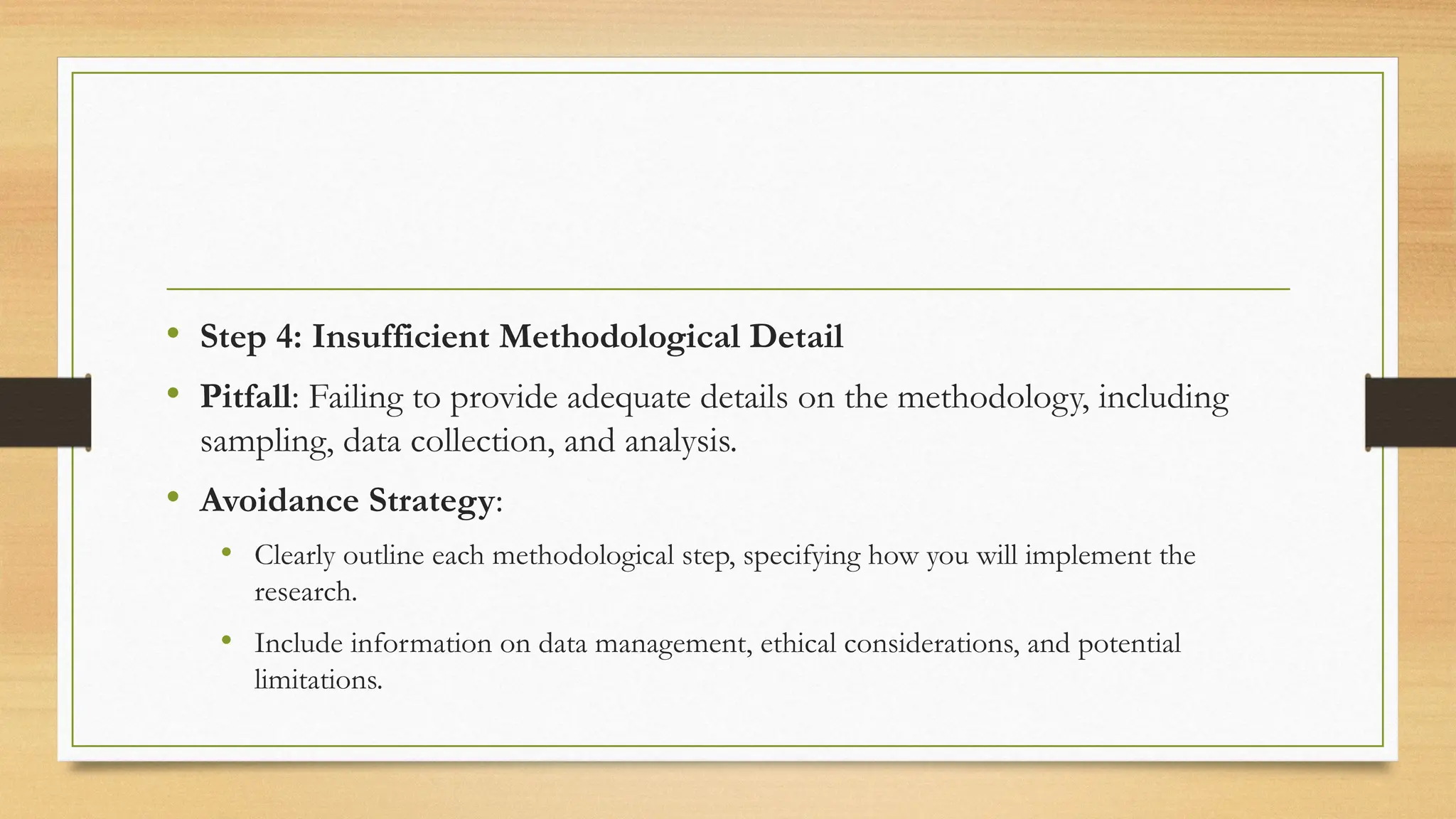
• Step 4: Insufficient Methodological Detail
• Pitfall: Failing to provide adequate details on the methodology, including
sampling, data collection, and analysis.
• Avoidance Strategy:
• Clearly outline each methodological step, specifying how you will implement the
research.
• Include information on data management, ethical considerations, and potential
limitations.
IV. Budgeting and Resource Allocation
Challenges
• Step 5: Unrealistic Budget Proposals
• Pitfall: Submitting a budget that is either too vague or unrealistic, which can
raise red flags for reviewers.
• Avoidance Strategy:
• Create a detailed budget that accurately reflects the costs associated with the project.
• Justify each expense and consider potential contingencies.
• Step 6: Lack of Resource Assessment
• Pitfall: Not adequately assessing available resources or institutional support.
• Avoidance Strategy:
• Clearly state the resources and support your institution provides, including personnel,
facilities, and equipment.
• Highlight any collaborations or partnerships that will enhance the project's success.
V. Proposal Structure and Clarity Issues
• Step 7: Poor Organization and Structure
• Pitfall: Submitting a proposal that lacks a logical flow or coherent structure,
making it difficult for reviewers to follow.
• Avoidance Strategy:
• Use clear headings and subheadings to organize content logically.
• Ensure that each section flows smoothly into the next, maintaining a clear narrative
throughout the proposal.
• Step 8: Excessive Jargon and Complexity
• Pitfall: Using technical language or jargon that may alienate reviewers
unfamiliar with the specific field.
• Avoidance Strategy:
• Write clearly and concisely, avoiding unnecessary jargon.
• Aim for a balance between technical detail and accessibility, ensuring that your proposal
can be understood by a broader audience.
VI. Review and Submission Process
• Step 9: Neglecting the Review Process
• Pitfall: Skipping the peer review process, which can lead to overlooked
errors or weaknesses.
• Avoidance Strategy:
• Share your proposal with colleagues or mentors for feedback.
• Incorporate their suggestions to improve clarity, coherence, and overall quality
• Step 10: Failing to Adhere to Submission Guidelines
• Pitfall: Ignoring specific submission requirements set by the funding agency,
leading to disqualification or rejection.
• Avoidance Strategy:
• Carefully review and adhere to all submission guidelines, including formatting, length,
and required documentation.
• Double-check that all components of the proposal are included before submission.
• Issues of Concern
There are five phases of research:
• Planning phase,
• Data collection/analysis phase,
• Writing phase,
• Journal submission phase,
• Rejections/revisions/acceptance phase.
Phase I Pitfalls: Planning a Study
• The highest yield preempting of pitfalls in the research process occurs in the
planning phase. This is when a researcher can set the stage for an optimal
research process. Below are pitfalls that can occur during the planning phase.
• Pitfall: Underestimating what committing to a research project
requires
• Pitfall: Choosing the wrong research pursuit/topic lacks precision
• Pitfall: Not considering research bias
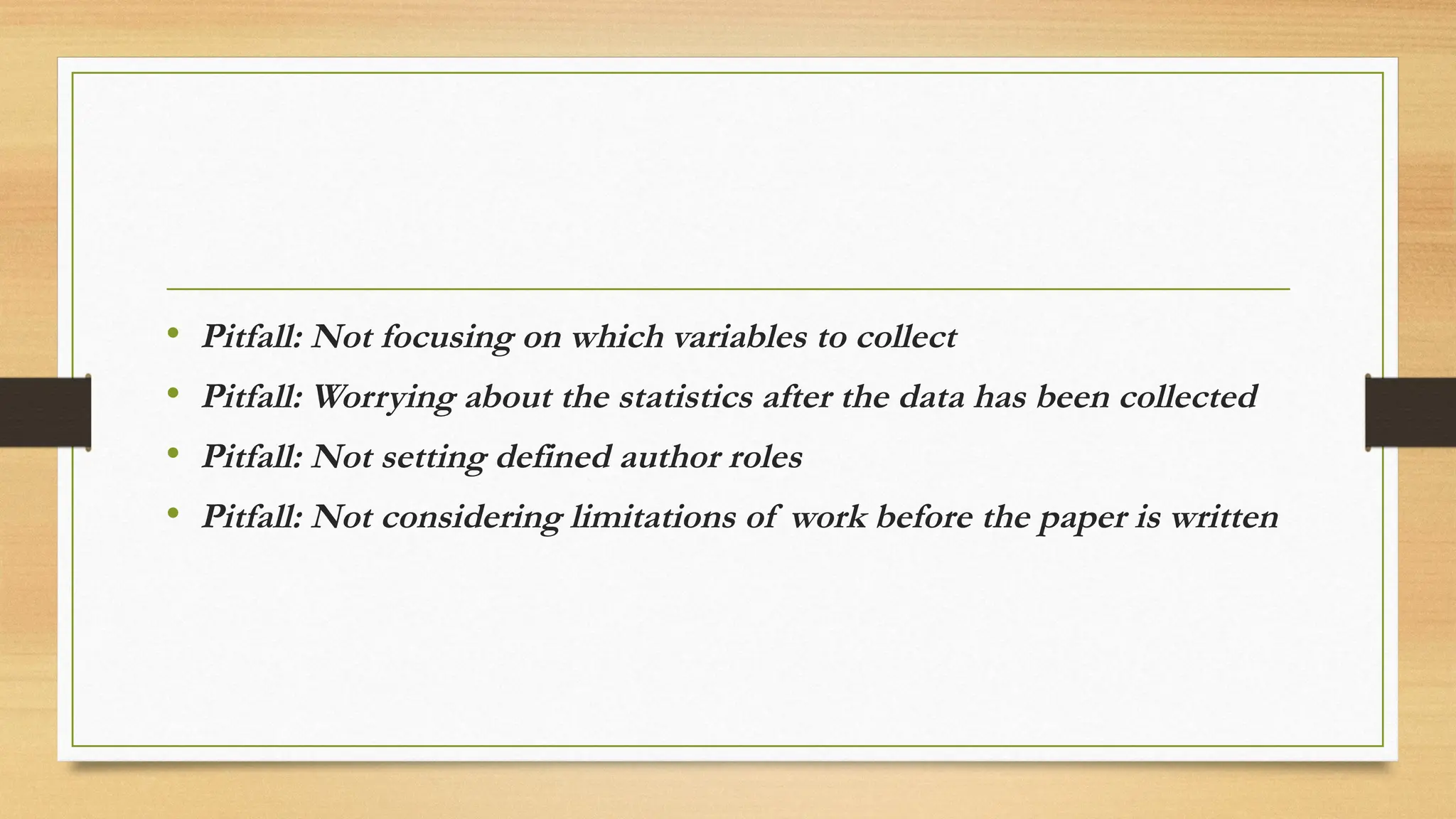
• Pitfall: Not focusing on which variables to collect
• Pitfall: Worrying about the statistics after the data has been collected
• Pitfall: Not setting defined author roles
• Pitfall: Not considering limitations of work before the paper is written
Phase II Pitfalls: Data Collection and
Analysis
• Pitfall: Not being involved in the data collection phase
• Pitfall: Not being involved with the statistical analysis phase
Phase III Pitfalls: The Writing Phase
• Pitfall: Poor or outdated references
• Pitfall: No clearly defined purpose of the paper
• Pitfall: Unclear methods making research hard to reproduce
• Pitfall: The tables and narratives are the same
• Pitfall: Not reporting all data/outcomes
• Pitfall: Repeating results in discussion
• Pitfall: Making conclusions that do not align with your work
• Pitfall: Thinking the title is not a big deal
• Pitfall: Completing the abstract last minute
Phase IV Pitfalls: Submitting to a Journal
• Pitfall: Choosing the wrong journal
• Pitfall: Poor cover letter on journal submission
• Pitfall: Assuming that after the paper has been submitted to a journal,
the work is done
Phase V Pitfalls: The Rejections, Revisions,
and Acceptance Phase
• Pitfall: Mourning rejections too long/ “sitting on” a rejected paper
• Pitfall: Not laying to rest rejected papers when it is indeed their time
to go
• Pitfall: Not addressing all of reviewer feedback
• Pitfall: Thinking you know what the reviewers are going to say
• Pitfall: Not rewarding yourself for a published paper
Conclusion
• Avoiding common pitfalls in research proposal writing is essential for
developing a compelling and successful proposal. By following this step-by-
step guide, researchers can strengthen their proposals by addressing key
issues related to research questions, literature reviews, design methodologies,
budgeting, and clarity. A well-prepared proposal not only increases the
chances of obtaining funding but also lays the groundwork for successful
research execution and contributes to advancing knowledge in the field.

PRESENTATION COMMON PITFALLS of group 11

  • 1.
    COMMON PITFALLS INRESEARCH PROPOSAL WRITING AND HOW TO AVOID THEM TUTOR : Matthew Group 11
  • 2.
    INTRODUCTION • Conducting researchfrom planning to publication can be a very rewarding process. • However, multiple preventable setbacks can occur within each stage of research. • While these inefficiencies are an inevitable part of the research process, understanding common pitfalls can limit those hindrances. • This presentation provides a detailed, step-by –step guide to identify these pitfalls and offers strategies for avoiding them.
  • 3.
    Overview of ResearchProposal Writing . Importance of a Strong Proposal • A well-crafted proposal is essential for communicating the significance, feasibility, and methodology of the proposed research. • It serves as the foundation for obtaining funding, support, and resources necessary for successful project execution.
  • 4.
    Understanding the FundingLandscape • Familiarize yourself with various funding sources and their specific requirements to tailor your proposal accordingly. • A successful proposal aligns the research goals with the priorities of the funding agency
  • 5.
    II. Common Pitfallsin Research Proposal Writing • Step 1: Inadequate Understanding of the Research Question • Pitfall: Failing to clearly articulate the research question or problem statement. • Avoidance Strategy: • Conduct thorough background research to refine your research question. • Ensure that the question is specific, relevant, and addresses a significant gap in the existing literature.
  • 6.
    • Step 2:Weak Literature Review • Pitfall: Presenting an insufficient or poorly structured literature review that fails to demonstrate the research's context. • Avoidance Strategy: • Conduct a comprehensive review of current literature, highlighting key studies and their contributions. • Organize the literature review logically, clearly linking it to your research question and objectives.
  • 7.
    III. Research Designand Methodology Issues • Step 3: Flawed Research Design • Pitfall: Proposing a research design that is not suitable for addressing the research question. • Avoidance Strategy: • Choose a research design that aligns with your objectives and methodology. • Justify your design choice, explaining its appropriateness for answering the research question.
  • 8.
    • Step 4:Insufficient Methodological Detail • Pitfall: Failing to provide adequate details on the methodology, including sampling, data collection, and analysis. • Avoidance Strategy: • Clearly outline each methodological step, specifying how you will implement the research. • Include information on data management, ethical considerations, and potential limitations.
  • 9.
    IV. Budgeting andResource Allocation Challenges • Step 5: Unrealistic Budget Proposals • Pitfall: Submitting a budget that is either too vague or unrealistic, which can raise red flags for reviewers. • Avoidance Strategy: • Create a detailed budget that accurately reflects the costs associated with the project. • Justify each expense and consider potential contingencies.
  • 10.
    • Step 6:Lack of Resource Assessment • Pitfall: Not adequately assessing available resources or institutional support. • Avoidance Strategy: • Clearly state the resources and support your institution provides, including personnel, facilities, and equipment. • Highlight any collaborations or partnerships that will enhance the project's success.
  • 11.
    V. Proposal Structureand Clarity Issues • Step 7: Poor Organization and Structure • Pitfall: Submitting a proposal that lacks a logical flow or coherent structure, making it difficult for reviewers to follow. • Avoidance Strategy: • Use clear headings and subheadings to organize content logically. • Ensure that each section flows smoothly into the next, maintaining a clear narrative throughout the proposal.
  • 12.
    • Step 8:Excessive Jargon and Complexity • Pitfall: Using technical language or jargon that may alienate reviewers unfamiliar with the specific field. • Avoidance Strategy: • Write clearly and concisely, avoiding unnecessary jargon. • Aim for a balance between technical detail and accessibility, ensuring that your proposal can be understood by a broader audience.
  • 13.
    VI. Review andSubmission Process • Step 9: Neglecting the Review Process • Pitfall: Skipping the peer review process, which can lead to overlooked errors or weaknesses. • Avoidance Strategy: • Share your proposal with colleagues or mentors for feedback. • Incorporate their suggestions to improve clarity, coherence, and overall quality
  • 14.
    • Step 10:Failing to Adhere to Submission Guidelines • Pitfall: Ignoring specific submission requirements set by the funding agency, leading to disqualification or rejection. • Avoidance Strategy: • Carefully review and adhere to all submission guidelines, including formatting, length, and required documentation. • Double-check that all components of the proposal are included before submission.
  • 15.
    • Issues ofConcern There are five phases of research: • Planning phase, • Data collection/analysis phase, • Writing phase, • Journal submission phase, • Rejections/revisions/acceptance phase.
  • 16.
    Phase I Pitfalls:Planning a Study • The highest yield preempting of pitfalls in the research process occurs in the planning phase. This is when a researcher can set the stage for an optimal research process. Below are pitfalls that can occur during the planning phase. • Pitfall: Underestimating what committing to a research project requires • Pitfall: Choosing the wrong research pursuit/topic lacks precision • Pitfall: Not considering research bias
  • 17.
    • Pitfall: Notfocusing on which variables to collect • Pitfall: Worrying about the statistics after the data has been collected • Pitfall: Not setting defined author roles • Pitfall: Not considering limitations of work before the paper is written
  • 18.
    Phase II Pitfalls:Data Collection and Analysis • Pitfall: Not being involved in the data collection phase • Pitfall: Not being involved with the statistical analysis phase
  • 19.
    Phase III Pitfalls:The Writing Phase • Pitfall: Poor or outdated references • Pitfall: No clearly defined purpose of the paper • Pitfall: Unclear methods making research hard to reproduce • Pitfall: The tables and narratives are the same • Pitfall: Not reporting all data/outcomes • Pitfall: Repeating results in discussion
  • 20.
    • Pitfall: Makingconclusions that do not align with your work • Pitfall: Thinking the title is not a big deal • Pitfall: Completing the abstract last minute
  • 21.
    Phase IV Pitfalls:Submitting to a Journal • Pitfall: Choosing the wrong journal • Pitfall: Poor cover letter on journal submission • Pitfall: Assuming that after the paper has been submitted to a journal, the work is done
  • 22.
    Phase V Pitfalls:The Rejections, Revisions, and Acceptance Phase • Pitfall: Mourning rejections too long/ “sitting on” a rejected paper • Pitfall: Not laying to rest rejected papers when it is indeed their time to go • Pitfall: Not addressing all of reviewer feedback • Pitfall: Thinking you know what the reviewers are going to say • Pitfall: Not rewarding yourself for a published paper
  • 23.
    Conclusion • Avoiding commonpitfalls in research proposal writing is essential for developing a compelling and successful proposal. By following this step-by- step guide, researchers can strengthen their proposals by addressing key issues related to research questions, literature reviews, design methodologies, budgeting, and clarity. A well-prepared proposal not only increases the chances of obtaining funding but also lays the groundwork for successful research execution and contributes to advancing knowledge in the field.