Business Model: Retrofitting
Hotel Hot Water Heaters
with Solar Thermal Systems
Joseph Liao
ISAT Energy and Business
The Business Idea
Green Showers provides an opportunity to heat
water with renewable energy by retrofitting existing
boilers with tailored solar thermal systems.
Background
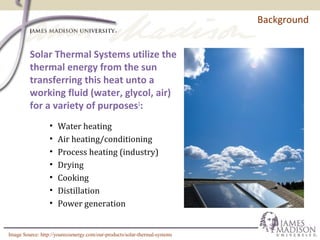
Solar Thermal Systems utilize the
thermal energy from the sun
transferring this heat unto a
working fluid (water, glycol, air)
for a variety of purposes1
:
• Water heating
• Air heating/conditioning
• Process heating (industry)
• Drying
• Cooking
• Distillation
• Power generation
Image Source: http://yourecoenergy.com/our-products/solar-thermal-systems
Background1
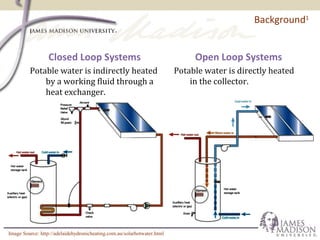
Open Loop Systems
Potable water is directly heated
in the collector.
Closed Loop Systems
Potable water is indirectly heated
by a working fluid through a
heat exchanger.
Image Source: http://adelaidehydronicheating.com.au/solarhotwater.html
Background1
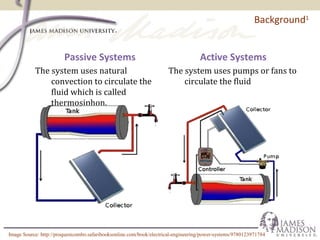
Active Systems
The system uses pumps or fans to
circulate the fluid
Passive Systems
The system uses natural
convection to circulate the
fluid which is called
thermosiphon.
Image Source: http://proquestcombo.safaribooksonline.com/book/electrical-engineering/power-systems/9780123971784
Background2
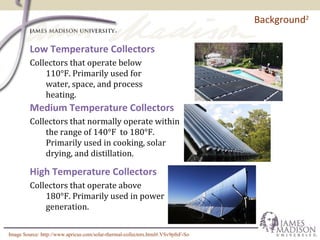
Low Temperature Collectors
Collectors that operate below
110°F. Primarily used for
water, space, and process
heating.
High Temperature Collectors
Collectors that operate above
180°F. Primarily used in power
generation.
Medium Temperature Collectors
Collectors that normally operate within
the range of 140°F to 180°F.
Primarily used in cooking, solar
drying, and distillation.
Image Source: http://www.apricus.com/solar-thermal-collectors.html#.VSv9pfnF-So
Background
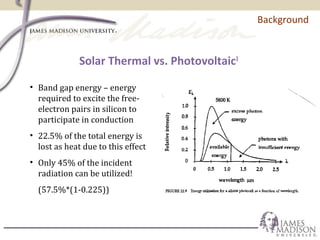
Solar Thermal vs. Photovoltaic3
• Band gap energy – energy
required to excite the free-
electron pairs in silicon to
participate in conduction
• 22.5% of the total energy is
lost as heat due to this effect
• Only 45% of the incident
radiation can be utilized!
(57.5%*(1-0.225))
Background
Image Source: http://www.lazard.com/PDF/Levelized%20Cost%20of%20Energy%20-%20Version%208.0.pdf
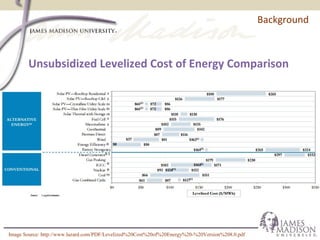
Unsubsidized Levelized Cost of Energy Comparison
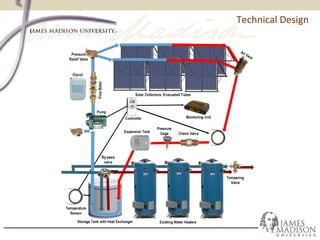
Technical Design
The Problem4
High Upfront Cost
Such a large system can cost anywhere from
$80,000 to $150,000
Lack of Knowledge
Many individuals are unaware of the
technology and the know-how to implement
such a system
Lack of Time
Many don’t have the time to determine the
cost-effectiveness of a solar thermal system
Value Proposition
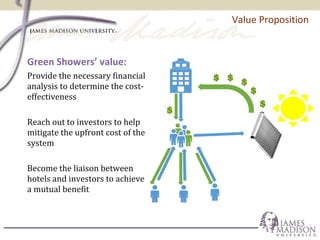
Green Showers’ value:
Provide the necessary financial
analysis to determine the cost-
effectiveness
Reach out to investors to help
mitigate the upfront cost of the
system
Become the liaison between
hotels and investors to achieve
a mutual benefit
Industry Analysis5
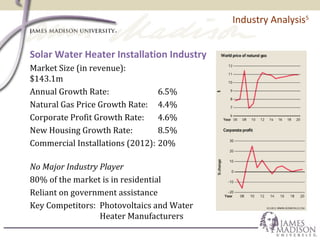
Solar Water Heater Installation Industry
Market Size (in revenue):
$143.1m
Annual Growth Rate: 6.5%
Natural Gas Price Growth Rate: 4.4%
Corporate Profit Growth Rate: 4.6%
New Housing Growth Rate: 8.5%
Commercial Installations (2012): 20%
No Major Industry Player
80% of the market is in residential
Reliant on government assistance
Key Competitors: Photovoltaics and Water
Heater Manufacturers
Market Analysis
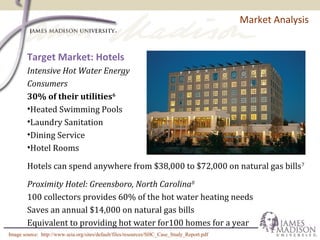
Target Market: Hotels
Intensive Hot Water Energy
Consumers
30% of their utilities6
•Heated Swimming Pools
•Laundry Sanitation
•Dining Service
•Hotel Rooms
Hotels can spend anywhere from $38,000 to $72,000 on natural gas bills7
Proximity Hotel: Greensboro, North Carolina8
100 collectors provides 60% of the hot water heating needs
Saves an annual $14,000 on natural gas bills
Equivalent to providing hot water for100 homes for a year
Image source: http://www.seia.org/sites/default/files/resources/SHC_Case_Study_Report.pdf
Market Analysis
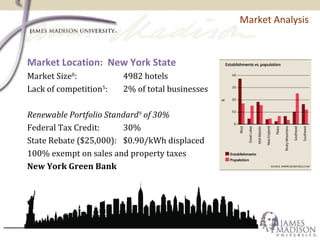
Market Location: New York State
Market Size8
: 4982 hotels
Lack of competition5
: 2% of total businesses
Renewable Portfolio Standard9
of 30%
Federal Tax Credit: 30%
State Rebate ($25,000): $0.90/kWh displaced
100% exempt on sales and property taxes
New York Green Bank
Service Development
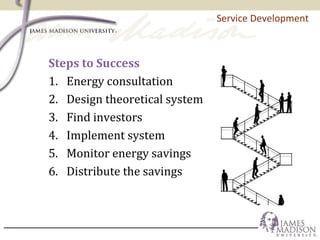
Steps to Success
1. Energy consultation
2. Design theoretical system
3. Find investors
4. Implement system
5. Monitor energy savings
6. Distribute the savings
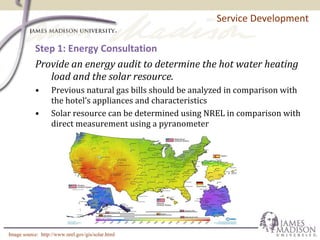
Step 1: Energy Consultation
Provide an energy audit to determine the hot water heating
load and the solar resource.
• Previous natural gas bills should be analyzed in comparison with
the hotel’s appliances and characteristics
• Solar resource can be determined using NREL in comparison with
direct measurement using a pyranometer
Service Development
Image source: http://www.nrel.gov/gis/solar.html
Step 2: Design Theoretical System
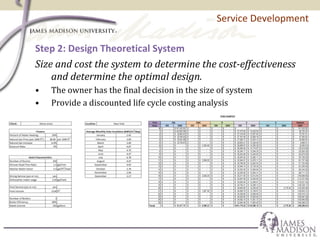
Size and cost the system to determine the cost-effectiveness
and determine the optimal design.
• The owner has the final decision in the size of system
• Provide a discounted life cycle costing analysis
Service Development
Service Development
Step 3: Find Investors
Market the economic analysis and the internal rate of return.
Why would investors want to invest?
• Diversify their portfolio
• Investment would provide an IRR: 13-14%
• Wants to contribute to environmental conservation
Example:
$147,431 system that provides $15,000 in energy savings
Investment of $10,000 is 6.78% of the system
Over 20 Years – IRR of 13.56%
NPV of $7,648.65
(includes incentives distribute and maintenance cost)
Service Development
Step 4: Implement System
Contract the parts and labor for implementation as well as the
maintenance
• Installation should be straightforward and take only 1-2 weeks
• Maintenance is performed every 4 years to ensure optimal
performance
Service Development
Step 5: Monitor Energy Savings
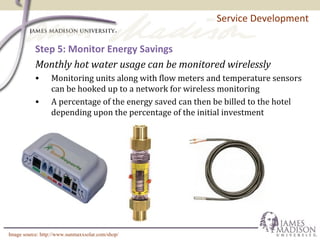
Monthly hot water usage can be monitored wirelessly
• Monitoring units along with flow meters and temperature sensors
can be hooked up to a network for wireless monitoring
• A percentage of the energy saved can then be billed to the hotel
depending upon the percentage of the initial investment
Image source: http://www.sunmaxxsolar.com/shop/
Service Development
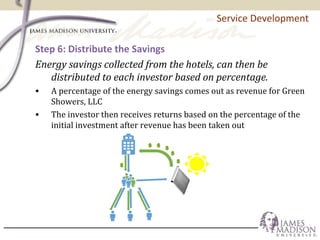
Step 6: Distribute the Savings
Energy savings collected from the hotels, can then be
distributed to each investor based on percentage.
• A percentage of the energy savings comes out as revenue for Green
Showers, LLC
• The investor then receives returns based on the percentage of the
initial investment after revenue has been taken out
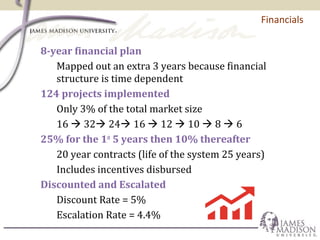
8-year financial plan
Mapped out an extra 3 years because financial
structure is time dependent
124 projects implemented
Only 3% of the total market size
16  32 24 16  12  10  8  6
25% for the 1st
5 years then 10% thereafter
20 year contracts (life of the system 25 years)
Includes incentives disbursed
Discounted and Escalated
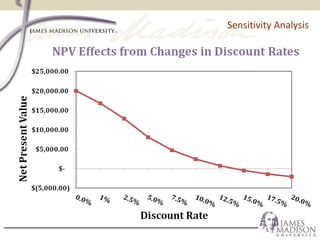
Discount Rate = 5%
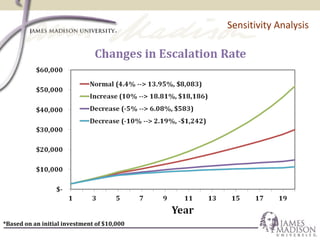
Escalation Rate = 4.4%
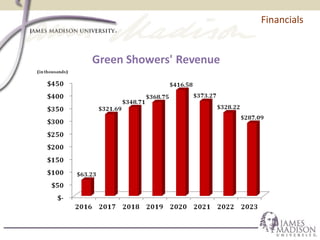
Financials
Financials
Financials
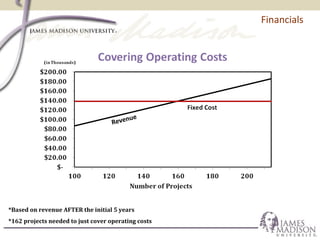
*Based on revenue AFTER the initial 5 years
*162 projects needed to just cover operating costs
Revenue
Assumptions
Assumptions
• Rebate and federal tax credit remain
The federal tax credit (30%) from the Energy Policy Act of 2005 has
been extended by the Emergency Economic Stabilization Act of
2008 to the end of 2016.
• Number of systems
The number of systems implemented is vital to the survival of
this business because only a fraction of the energy savings is being
collected as revenue.
• Bad weather
New York receives a large amount of snow fall which can be
potentially hazardous to collectors on the roof.
• Funding the Business
We need a large amount of funding in the first year but we
don’t have the assets for collateral
Assumptions
Assumptions
• Solar thermal remains cost effective
For the next 4 or 5 years, we assume that the price of
photovoltaics and water heaters remain so that solar thermal still
has the advantage.
• Natural gas prices are increasing
The internal rate of return as well as the revenue is dependent on
the price of natural gas increasing at 4.4%
• Scaling and Legionella
Scaling is impurities from water developing within the pipes.
Assumed that the water in the storage tank will remain so
that Legionella, a bacteria, will not grow in the water supply
• Hotels remain in business
The revenue is dependent upon the hotel using the predicted
amount of hot water each year
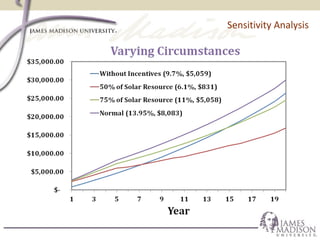
Sensitivity Analysis
*Based on an initial investment of $10,000
Sensitivity Analysis
Growth plan
Other Alternative Energy Projects
• This financial model can be applied to any other
alternative energy projects that could potentially
produce higher returns
Moving from State to State
• Moving to another state with better solar resources
and government incentives would be possible since
after implementation, transactions are wireless
New Technology
• Being updated with the newest technology can help
increase performance efficiencies and thus increase
our bottom line
References
1. Kalogirou, S. A. (2014). Photovoltaic Systems. In Solar Energy Engineering, 2nd
ed (ch.9). Retrieved from
http://proquestcombo.safaribooksonline.com/book/engineering/9780123972705
2. Solar Thermal Collector Shipments by Type, Price, and Trade. (2012). U.S. Energy Information Administration.
Retrieved from http://www.eia.gov/totalenergy/data/annual/showtext.cfm?t=ptb1006
3. Miles, Johnathan. (2015). Homework 7 Solutions.
4. Porter, Wayne E. (2011). Renewable Energy in Rural Southeastern Arizona. Retrieved from
http://repository.asu.edu/attachments/56749/content/Porter_asu_0010N_10728.pdf
5. Market Research Reports | Procurement Research Reports | IBISWorld US. (n.d.). Retrieved from
http://clients1.ibisworld.com/reports/us/industry/productsandmarkets.aspx?entid=4873
6. Energy End-Use Patterns in Full Service Hotels: A Case Study. American Council for an Energy-Efficient
Economy. (n.d.) Retrieved from https://www.aceee.org/files/proceedings/2010/data/papers/1984.pdf
7. Solar Water Heating Ideal For Hotels and Hospitality. (2014). Center for Sustainable Energy. Retrieved from
https://energycenter.org/article/solar-water-heating-ideal-hotels-hospitality
8. Hasek, Glenn. (2007). Greensboro’s Proximity Hotel Developer Aiming for LEED Gold Rating. Retrieved from
http://www.proximityhotel.com/greenlodgingnews.htm
9. ReferenceUSA - Log On. (n.d.). Retrieved from
http://www.referenceusa.com/UsBusiness/Search/Custom/54d3d6c1b9bc451ea045184d883b6203
10. New York Solar Sales Tax Exemption. (n.d.). Retrieved from
http://www.dsireusa.org/solar/incentives/incentive.cfm?Incentive_Code=NY24F&re=1&ee=1
Questions?

Presentation

  • 1.
    Business Model: Retrofitting HotelHot Water Heaters with Solar Thermal Systems Joseph Liao ISAT Energy and Business
  • 2.
    The Business Idea GreenShowers provides an opportunity to heat water with renewable energy by retrofitting existing boilers with tailored solar thermal systems.
  • 3.
    Background Solar Thermal Systemsutilize the thermal energy from the sun transferring this heat unto a working fluid (water, glycol, air) for a variety of purposes1 : • Water heating • Air heating/conditioning • Process heating (industry) • Drying • Cooking • Distillation • Power generation Image Source: http://yourecoenergy.com/our-products/solar-thermal-systems
  • 4.
    Background1 Open Loop Systems Potablewater is directly heated in the collector. Closed Loop Systems Potable water is indirectly heated by a working fluid through a heat exchanger. Image Source: http://adelaidehydronicheating.com.au/solarhotwater.html
  • 5.
    Background1 Active Systems The systemuses pumps or fans to circulate the fluid Passive Systems The system uses natural convection to circulate the fluid which is called thermosiphon. Image Source: http://proquestcombo.safaribooksonline.com/book/electrical-engineering/power-systems/9780123971784
  • 6.
    Background2 Low Temperature Collectors Collectorsthat operate below 110°F. Primarily used for water, space, and process heating. High Temperature Collectors Collectors that operate above 180°F. Primarily used in power generation. Medium Temperature Collectors Collectors that normally operate within the range of 140°F to 180°F. Primarily used in cooking, solar drying, and distillation. Image Source: http://www.apricus.com/solar-thermal-collectors.html#.VSv9pfnF-So
  • 7.
    Background Solar Thermal vs.Photovoltaic3 • Band gap energy – energy required to excite the free- electron pairs in silicon to participate in conduction • 22.5% of the total energy is lost as heat due to this effect • Only 45% of the incident radiation can be utilized! (57.5%*(1-0.225))
  • 8.
  • 9.
  • 10.
    The Problem4 High UpfrontCost Such a large system can cost anywhere from $80,000 to $150,000 Lack of Knowledge Many individuals are unaware of the technology and the know-how to implement such a system Lack of Time Many don’t have the time to determine the cost-effectiveness of a solar thermal system
  • 11.
    Value Proposition Green Showers’value: Provide the necessary financial analysis to determine the cost- effectiveness Reach out to investors to help mitigate the upfront cost of the system Become the liaison between hotels and investors to achieve a mutual benefit
  • 12.
    Industry Analysis5 Solar WaterHeater Installation Industry Market Size (in revenue): $143.1m Annual Growth Rate: 6.5% Natural Gas Price Growth Rate: 4.4% Corporate Profit Growth Rate: 4.6% New Housing Growth Rate: 8.5% Commercial Installations (2012): 20% No Major Industry Player 80% of the market is in residential Reliant on government assistance Key Competitors: Photovoltaics and Water Heater Manufacturers
  • 13.
    Market Analysis Target Market:Hotels Intensive Hot Water Energy Consumers 30% of their utilities6 •Heated Swimming Pools •Laundry Sanitation •Dining Service •Hotel Rooms Hotels can spend anywhere from $38,000 to $72,000 on natural gas bills7 Proximity Hotel: Greensboro, North Carolina8 100 collectors provides 60% of the hot water heating needs Saves an annual $14,000 on natural gas bills Equivalent to providing hot water for100 homes for a year Image source: http://www.seia.org/sites/default/files/resources/SHC_Case_Study_Report.pdf
  • 14.
    Market Analysis Market Location:New York State Market Size8 : 4982 hotels Lack of competition5 : 2% of total businesses Renewable Portfolio Standard9 of 30% Federal Tax Credit: 30% State Rebate ($25,000): $0.90/kWh displaced 100% exempt on sales and property taxes New York Green Bank
  • 15.
    Service Development Steps toSuccess 1. Energy consultation 2. Design theoretical system 3. Find investors 4. Implement system 5. Monitor energy savings 6. Distribute the savings
  • 16.
    Step 1: EnergyConsultation Provide an energy audit to determine the hot water heating load and the solar resource. • Previous natural gas bills should be analyzed in comparison with the hotel’s appliances and characteristics • Solar resource can be determined using NREL in comparison with direct measurement using a pyranometer Service Development Image source: http://www.nrel.gov/gis/solar.html
  • 17.
    Step 2: DesignTheoretical System Size and cost the system to determine the cost-effectiveness and determine the optimal design. • The owner has the final decision in the size of system • Provide a discounted life cycle costing analysis Service Development
  • 18.
    Service Development Step 3:Find Investors Market the economic analysis and the internal rate of return. Why would investors want to invest? • Diversify their portfolio • Investment would provide an IRR: 13-14% • Wants to contribute to environmental conservation Example: $147,431 system that provides $15,000 in energy savings Investment of $10,000 is 6.78% of the system Over 20 Years – IRR of 13.56% NPV of $7,648.65 (includes incentives distribute and maintenance cost)
  • 19.
    Service Development Step 4:Implement System Contract the parts and labor for implementation as well as the maintenance • Installation should be straightforward and take only 1-2 weeks • Maintenance is performed every 4 years to ensure optimal performance
  • 20.
    Service Development Step 5:Monitor Energy Savings Monthly hot water usage can be monitored wirelessly • Monitoring units along with flow meters and temperature sensors can be hooked up to a network for wireless monitoring • A percentage of the energy saved can then be billed to the hotel depending upon the percentage of the initial investment Image source: http://www.sunmaxxsolar.com/shop/
  • 21.
    Service Development Step 6:Distribute the Savings Energy savings collected from the hotels, can then be distributed to each investor based on percentage. • A percentage of the energy savings comes out as revenue for Green Showers, LLC • The investor then receives returns based on the percentage of the initial investment after revenue has been taken out
  • 22.
    8-year financial plan Mappedout an extra 3 years because financial structure is time dependent 124 projects implemented Only 3% of the total market size 16  32 24 16  12  10  8  6 25% for the 1st 5 years then 10% thereafter 20 year contracts (life of the system 25 years) Includes incentives disbursed Discounted and Escalated Discount Rate = 5% Escalation Rate = 4.4% Financials
  • 23.
  • 24.
    Financials *Based on revenueAFTER the initial 5 years *162 projects needed to just cover operating costs Revenue
  • 25.
    Assumptions Assumptions • Rebate andfederal tax credit remain The federal tax credit (30%) from the Energy Policy Act of 2005 has been extended by the Emergency Economic Stabilization Act of 2008 to the end of 2016. • Number of systems The number of systems implemented is vital to the survival of this business because only a fraction of the energy savings is being collected as revenue. • Bad weather New York receives a large amount of snow fall which can be potentially hazardous to collectors on the roof. • Funding the Business We need a large amount of funding in the first year but we don’t have the assets for collateral
  • 26.
    Assumptions Assumptions • Solar thermalremains cost effective For the next 4 or 5 years, we assume that the price of photovoltaics and water heaters remain so that solar thermal still has the advantage. • Natural gas prices are increasing The internal rate of return as well as the revenue is dependent on the price of natural gas increasing at 4.4% • Scaling and Legionella Scaling is impurities from water developing within the pipes. Assumed that the water in the storage tank will remain so that Legionella, a bacteria, will not grow in the water supply • Hotels remain in business The revenue is dependent upon the hotel using the predicted amount of hot water each year
  • 27.
    Sensitivity Analysis *Based onan initial investment of $10,000
  • 28.
  • 29.
  • 30.
    Growth plan Other AlternativeEnergy Projects • This financial model can be applied to any other alternative energy projects that could potentially produce higher returns Moving from State to State • Moving to another state with better solar resources and government incentives would be possible since after implementation, transactions are wireless New Technology • Being updated with the newest technology can help increase performance efficiencies and thus increase our bottom line
  • 31.
    References 1. Kalogirou, S.A. (2014). Photovoltaic Systems. In Solar Energy Engineering, 2nd ed (ch.9). Retrieved from http://proquestcombo.safaribooksonline.com/book/engineering/9780123972705 2. Solar Thermal Collector Shipments by Type, Price, and Trade. (2012). U.S. Energy Information Administration. Retrieved from http://www.eia.gov/totalenergy/data/annual/showtext.cfm?t=ptb1006 3. Miles, Johnathan. (2015). Homework 7 Solutions. 4. Porter, Wayne E. (2011). Renewable Energy in Rural Southeastern Arizona. Retrieved from http://repository.asu.edu/attachments/56749/content/Porter_asu_0010N_10728.pdf 5. Market Research Reports | Procurement Research Reports | IBISWorld US. (n.d.). Retrieved from http://clients1.ibisworld.com/reports/us/industry/productsandmarkets.aspx?entid=4873 6. Energy End-Use Patterns in Full Service Hotels: A Case Study. American Council for an Energy-Efficient Economy. (n.d.) Retrieved from https://www.aceee.org/files/proceedings/2010/data/papers/1984.pdf 7. Solar Water Heating Ideal For Hotels and Hospitality. (2014). Center for Sustainable Energy. Retrieved from https://energycenter.org/article/solar-water-heating-ideal-hotels-hospitality 8. Hasek, Glenn. (2007). Greensboro’s Proximity Hotel Developer Aiming for LEED Gold Rating. Retrieved from http://www.proximityhotel.com/greenlodgingnews.htm 9. ReferenceUSA - Log On. (n.d.). Retrieved from http://www.referenceusa.com/UsBusiness/Search/Custom/54d3d6c1b9bc451ea045184d883b6203 10. New York Solar Sales Tax Exemption. (n.d.). Retrieved from http://www.dsireusa.org/solar/incentives/incentive.cfm?Incentive_Code=NY24F&re=1&ee=1
  • 32.